Mindblog
The mind, the Indian way: philosophy, psychology and the research on attention, habits and calm.
The blog of Manthan (Mindspace). Manthan means churning. Written by Sapta.
75 posts9 kinds125 interactive charts and calculators84 forum questions answered
Start with these
Find a post
75 posts. Search, or pick a kind of post to see more.
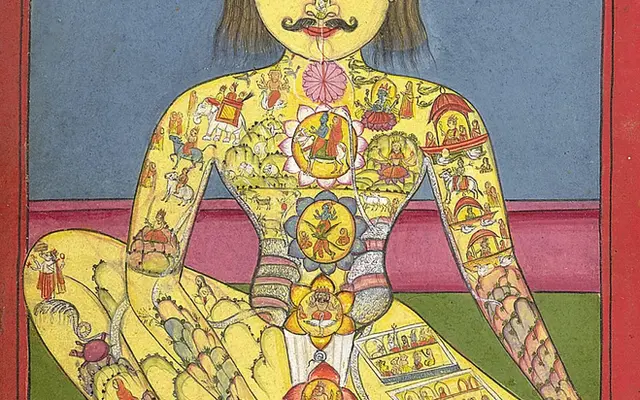
The seven chakras explained: what the old texts actually sayRoot to crown, as the 16th-century tantric text describes them: petals, letters, elements and seed sounds. Then which parts were added in the 20th century, and what research does and does not show.Technical14 min read

Your attention and a pressure cooker release the same wayA cooker holds 121°C because a small weight lets steam out in regular bursts. The research on focus says your attention works best on the same schedule: short, frequent releases instead of one big one.What ifs13 min read

Why worry and rust are the same process, solvedRust eats steel by a slow reaction that only runs while the surface is wet. Worry wears a body down by a slow activation that only runs while the mind keeps it open. The maths of exposure time is the same.What ifs15 min read

What would the Gita say to an AI? Duty, detachment, the off switchKrishna's advice to Arjuna was written for a warrior with a stake in the outcome. Hand it to a machine that has goals but no stake, and three verses turn into a real piece of AI safety maths.What ifs14 min read

What if you took only one breath a minute?The maths says a big-lunged adult at rest could just about survive on one huge breath a minute. Smaller lungs, any movement or one sloppy breath, and carbon dioxide wins.What ifs15 min read

What if you spent a year completely alone? Time, sleep and moodCave experiments, polar winters, solo sailors and a 520-day Mars simulation all point to the same thing: a year alone is survivable, but your clock, your sleep and your sense of time drift first, and whether you chose it decides most of the rest.What ifs12 min read

What if you sat perfectly still for a year?Your skin would start to die under your sitting bones within hours, your blood would pool and clot in days, and by the end of the year your heels would have lost about a quarter of their bone.What ifs14 min read

What if you flipped a coin for every decision?For close calls a coin costs you almost nothing and may even make you happier. For everything else, the probability compounds against you fast.What ifs13 min read

What if you could upload your mind? The zettabyte problemThe biggest complete brain map ever made is of a fruit fly. Scale the best human tissue scan to a whole head and you get about 1.7 zettabytes of images, and a philosophical problem no amount of storage fixes.What ifs12 min read

What if you could never forget anything? The maths of total recallAbout 50 people on Earth have been confirmed to remember nearly every day of their lives. They are not geniuses, they still form false memories, and the arithmetic says a brain that kept everything would run out of room.What ifs13 min read

What if humans didn't need sleep? Short-sleeper genes and limitsA few families carry gene variants that let them thrive on about six hours. Nobody, human or animal, has been found who needs none. Here is what a sleepless body would have to do instead, with the numbers.What ifs12 min read

Kabaddi is a lesson in breath control: the maths of a raidThe raider's chant is not ritual. It is a lie detector for breathing, and the 30-second raid limit sits almost exactly at the longest a healthy man can keep a voice going on one breath.What ifs13 min read

Chanakya would have understood your clutchDump the clutch and the bike stalls; ride it and the plates cook. The Arthashastra's rule on punishment, too harsh is hated and too soft is despised, turns out to be friction-zone engineering.What ifs14 min read

A traffic signal is a meditation timerA red light hands you 30 to 180 seconds of forced stillness, enough for a handful of slow breaths. The catch: it is also the dirtiest air on your commute.What ifs12 min read

A to-do list is a pile of unpaid loans: the Zeigarnik mathsOpen tasks do charge interest, paid in intrusive thoughts and lost focus. The famous memory effect behind the idea barely replicates, but the interest is real, it can spiral, and a written plan refinances it to almost zero.What ifs13 min read

Working memory: why you can hold only about four thingsMiller's famous seven was never the real limit. Strip away rehearsal and grouping and the mind holds three to five chunks, which is why chunking, not willpower, decides how much you can juggle.Technical14 min read

Why can I scroll for hours but can't study for 20 minutes?It is not that your focus is broken. A feed pays out instantly, unpredictably and for free, while study pays out in weeks, with effort and doubt. Piers Steel's procrastination equation shows exactly which terms to change.Questions answered13 min read

What if your brain ran on a phone battery?Your brain draws about 17 watts. A flagship phone battery holds about 18.5 watt-hours. Do the division and you get roughly an hour of being you, and a daily bill of under ₹3.What ifs11 min read

What if you stayed awake for 72 hours?Seventy-two hours awake is where the research stops being about yawning and starts being about hallucinations. Here is the hour-by-hour collapse, with the numbers from the studies that measured it.What ifs14 min read

What if you meditated 10 hours a day for 10 days?That is not a thought experiment: it is the standard Vipassana course, and thousands of Indians sit it every year. Here is what the studies say it does to stress, attention and the brain, and who should not go.What ifs13 min read

What if you didn't touch your phone for 30 days?The controlled trials of phone and social-media breaks agree on the direction and disagree on the size. Here is what 30 days off would likely do to your attention, mood, sleep and your UPI-run life in India.What ifs15 min read

What if you could stop time for everyone but yourself?The film version ignores the air and the light. Work it through and the superpower turns into a dark, silent, airless room where every step hits like a bomb.What ifs14 min read

What if a thought had weight? The physics of a bit's massLandauer's principle and E = mc² let you put a number on it. Everything you know weighs about 2 × 10⁻²³ kg; the glucose your brain burns while thinking weighs about 3.7 grams an hour.What ifs14 min read

Vivekananda Chicago speech, 1893: what really happenedFour thousand people, a monk in red with a yellow turban, and an applause that lasted minutes. The official record of 11 September 1893, and how it led to the book that exported yoga.Stories12 min read

Tihar Vipassana: the 1993–94 prison courses and the evidenceIn November 1993, 96 prisoners and 23 guards sat in silence for ten days inside one of India's most crowded jails. Five months later, more than a thousand did. What happened, and what research can and cannot say about it.Stories11 min read

The six darshanas: a history of Indian philosophy's schoolsSamkhya, Yoga, Nyaya, Vaisheshika, Mimamsa and Vedanta, with their rivals the Buddhists, Jains and Charvakas: when each took shape, what each said about knowledge and mind, and how the famous list of six was itself a late invention.History12 min read

The replication crisis: which psychology findings survivedEgo depletion, power posing and the pen-in-mouth smile fill self-help books. Large, preregistered replications tested them. Here is the scorecard, with the effect sizes.Advanced14 min read

The default mode network: where your wandering mind livesThe brain has a network that switches on the moment you stop doing a task. It builds your inner narrative, pulls you into the past and future, and is quieter in experienced meditators.Technical14 min read

The case for silence: why thinking needs empty timeIn one famous experiment, two-thirds of men chose an electric shock over 15 quiet minutes with their thoughts. Why empty time feels so hard, and why the mind seems to need it anyway.Good reads13 min read

The Yoga Sutras' history: lost, revived and reinventedPatanjali's 195 short sentences on stilling the mind were composed around 400 CE, nearly forgotten in India after the 16th century, rescued by colonial scholars, and then turned into the founding text of a fitness industry.History11 min read

Tagore Einstein conversation: what they said in 1930A poet and a physicist sat down at Caputh on 14 July 1930 and argued about whether truth needs a mind. Here is what the record says, and what the internet added later.Stories13 min read

Stoicism and the Bhagavad Gita: same advice, different worldsEpictetus and Krishna both tell you to act well and let go of the result. Why they say it, and what they think happens after you die, could hardly be further apart.Good reads14 min read

Slow breathing and the vagus nerve: how pranayama calms youSix breaths a minute is not folklore. It lines your breath up with the body's blood-pressure reflex. Here is the mechanism, the trials, and where the claims run ahead of the data.Technical16 min read

Samkhya's 25 tattvas: an ancient model of the mindAround 350 CE, the Samkhya Karika split the mind into intellect, ego-making and a coordinating manas, all of it unconscious matter. Read as a theory, it gets some things strikingly right and others plainly wrong.Advanced14 min read

Ramanujan's intuition: the goddess, the notebooks and HardyA port-trust clerk in Madras wrote to Cambridge in January 1913 with formulas a leading mathematician could not prove. Where did they come from: a goddess, dreams, or something cognitive science can name?Stories13 min read

Predictive processing and maya: is perception a guess?Neuroscience now says the brain predicts its input and perceives the best guess. Advaita says we superimpose the remembered on the real. The overlap is real, the conclusions are not the same, and science does not prove Vedanta.Advanced13 min read

Nyaya's five-step syllogism: how Indian logic proves a claimFire on the hill, because there is smoke. The Nyaya argument looks slow next to Aristotle, but its extra steps force you to show your evidence, and its list of bad reasons still catches most bad arguments.Technical13 min read

Nagarjuna's catuskoti: the four-cornered logic of emptinessIs, is not, both, neither: Nagarjuna rejects all four. Classical logic says that cannot be done coherently. Here is how modern logicians try to make sense of it, and where they disagree.Advanced15 min read

Monk brain study: Ricard, Davidson and the gamma wavesEight Tibetan Buddhist practitioners, ten students and a 128-electrode cap. What the famous 2004 gamma study found, and what it never claimed.Stories13 min read
Mindfulness hype vs evidence: what meditation can't doMindfulness helps anxiety and depression about as much as other good treatments, and no more. It does not reliably rebuild your brain in eight weeks, it failed in UK schools, and a minority of people get worse.Good reads13 min read

Mental health care in India: asylums to Tele-MANASTwo and a half centuries of Indian mental health care, from a 1745 asylum for Europeans to a national helpline that has taken 47.7 lakh calls, with the laws, the scandals and the numbers in between.History14 min read

Kuvalayananda and the first yoga labs: India's 1924 experimentIn 1924 a Sanskrit scholar from Baroda put yogis in front of an X-ray machine and a mercury gauge in Lonavala. A century later, India still produces almost half the world's yoga trials. This is how that started.History12 min read

Jain syadvada: the seven-fold logic of 'maybe', explainedThree building blocks, seven answers. How the Jain saptabhangi works as a formal system, why Shankara called it incoherent, and why logicians and data scientists keep rediscovering it.Advanced16 min read

Is there a self? Atman, anatta and what neuroscience findsThe Upanishads say the self is the one thing that never changes. The Buddha said there is no such thing. Brain scans have joined the argument, and they settle less than people claim.Good reads13 min read

Is a 10-day Vipassana course worth it? An honest answerTen days of silence, about ten and a half hours of sitting a day, no phone and no fee. What the timetable really asks of you, what the research shows, and who should wait.Questions answered13 min read
Indian states ranked by mental illness prevalence (NMHS data)India's only national psychiatric survey found current mental illness ranging from 5.8% of adults in Assam to 14.1% in Manipur. Here is the full ranking, what drives the gaps, and what the numbers cannot tell you.Top lists12 min read

Indian logic's history: from Nyaya Sutra to Navya-NyayaFourteen centuries of argument about how we know: the debate manuals, Gautama's Nyaya Sutra, the Buddhist logicians Dignaga and Dharmakirti, Gangesha's new logic in Mithila, and the Navadvipa scholars whose technical language now interests type theorists.History12 min read

If there is no self, what gets reborn in Buddhism?Buddhism denies a lasting self yet teaches rebirth. The old answer is a flame lit from a flame: a chain of causes with nothing carried across. Here is how the texts and schools make that work.Questions answered16 min read
How to start pranayama safely: a 4-week beginner planSlow, gentle breathing has the best evidence and the fewest reported problems. Here is a four-week plan built on that, with timings, a breath-rate calculator, and the medical cautions for the forceful techniques.Guides12 min read

How to start meditating: a 10-minute daily routine that lastsOne technique, one cue, one timer, eight weeks. A plan for sceptics, built on what the trials found: real but modest effects, a minimum useful dose, and a short list of times when meditation is the wrong tool.Guides12 min read

How to sleep better without pills: the CBT-I methodThe treatment sleep doctors recommend first for chronic insomnia is not a pill or a sleep-hygiene list. It is a set of rules about when you are in bed, and it starts with spending less time there.Guides13 min read

How to focus for 90 minutes: a deep work routineMicrosoft counts 275 interruptions in a knowledge worker's day. Here is a 90-minute routine built from interruption experiments, a phone study that partly failed to replicate, and one old idea from the Gita.Guides13 min read

How to find affordable therapy in India: a step-by-step guideA private session in a metro can cost ₹450 or ₹6,000. Government psychiatry OPDs charge about ₹10 a card, Tele-MANAS is free, and the law already promises more than most people know. Here is how to use all of it.Guides13 min read

How to check a WhatsApp forward with Nyaya logicA 2,000-year-old Indian method for testing an inference turns out to be a sharp fact-checking checklist. Five steps, five classic errors, and two famous Indian forwards taken apart.Guides13 min read

How to build a habit that sticks: an evidence-based planTwenty-one days is a myth. The real numbers come from a 12-week UCL study, a 2,601-person review and hourly diaries, and they point to a plan you can start tomorrow morning with your chai.Guides15 min read

How the Bhagavad Gita reached the West: 1785 to OppenheimerA Company merchant's translation, a governor-general's preface, Concord's Transcendentalists, a law student in London and a physicist in the New Mexico desert: the 160-year route by which the Gita became the West's first Indian book.History12 min read

How sleep turns the day's learning into memorySleep is not downtime for memory. In deep sleep the hippocampus replays what you learned and hands it to the cortex, which is why an all-nighter before an exam costs more than it gains.Technical13 min read

How dopamine builds habits: the reward prediction errorDopamine is not a pleasure chemical. It is a teaching signal that fires when life beats your forecast, and that one fact explains why cues, not rewards, end up running your habits.Technical16 min read

Exam pressure in India: what the student suicide data saysNCRB counted 14,488 student deaths by suicide in 2024, the highest on record. What the numbers can and cannot tell us, what research says about the pressure behind them, and where to find help.Good reads14 min read

Does meditation actually change your brain? The evidenceThe famous Harvard scans said eight weeks of mindfulness grows grey matter. The largest controlled trial since found nothing. Here is how to read both, and what still holds up.Questions answered15 min read

Does karma leave room for free will? Indian views comparedKarma is often read as fate. Most Indian schools read it the other way: past actions set your starting conditions, and present choice is what karma is made of. Here is how the Gita, Vedanta, the Buddha and neuroscience divide it.Questions answered15 min read

Does a dopamine detox work? What the science saysYou cannot flush or reset dopamine by staying off your phone for a weekend. But the man who named the trend never claimed you could, and the technique hidden inside it has decades of evidence.Questions answered12 min read

Deepika Padukone's 2015 depression talk and India's stigmaIn 2015 India's biggest film star said she had clinical depression. What she actually said, what her foundation measured afterwards, and what the national data says about the gap she was talking into.Stories16 min read
Buddhist momentariness and perception science comparedAbhidharma thinkers said experience is a stream of moments, each gone as soon as it arises. Neuroscience now argues about perceptual cycles. Here is where the two really meet, and where the parallel is only a metaphor.Advanced14 min read

Attention span in India: screen time and the goldfish mythThe eight-second attention span is a made-up number. What is real is how often we switch screens, and India now switches for about five hours a day.Good reads13 min read

Attention residue: the hidden cost of switching tasksWhen you jump from one task to another, part of your mind stays behind. The lab numbers on that leftover attention, and the one-minute habit that cuts it, matter more than any productivity slogan.Technical14 min read

Advaita vs Dvaita vs Vishishtadvaita: the real differenceShankara, Ramanuja and Madhva read the same Upanishads and reached three different answers about the self, God and the world. Here is exactly where they part ways, and whether more than one can be right.Questions answered13 min read

A history of meditation research, from TM labs to MRIFrom six papers a year in 1970 to more than 3,000 in 2025: how meditation went from a Harvard physiology lab to brain scanners and school trials, and why the biggest, best-controlled studies keep shrinking the early claims.History12 min read

8 pranayama techniques ranked by research evidenceAnulom vilom has the most randomised studies, kapalbhati has the most safety warnings, and the Stanford cyclic sigh has one strong trial. Here are eight breathing techniques ranked by what the research actually holds.Top lists14 min read

7 meditation techniques ranked by strength of evidenceMindfulness programmes have 136 randomised trials behind them; Vipassana, the one most Indians have heard of, has a handful of small studies. Here are seven techniques ranked by the trials, with effect sizes.Top lists13 min read

7 habit techniques ranked by what the experiments showMost habit advice is a list of tricks with no numbers. Here are seven, ranked by meta-analytic effect sizes first and field experiments second, including the 61,293-person gym megastudy.Top lists14 min read

10 study techniques ranked by evidence, from Dunlosky's reviewRereading and highlighting are what most students do. In the biggest review of study methods, both came last. Here is the full ranking and how to use the top two for NEET, JEE, CAT or UPSC.Top lists15 min read

10 oldest Indian texts on the mind, ranked by ageFrom a Rigveda hymn that calls desire the first seed of mind to Patanjali's definition of yoga, here are the ten earliest Indian texts that theorise the mind, ranked by scholarly dating, with the one idea each added.Top lists15 min read

10 cognitive biases ranked by how well they replicateAnchoring and the fundamental attribution error survive giant multi-lab re-tests with huge effects; sunk cost survives small; money priming and ego depletion vanish. Here is the scorecard, with Indian money examples.Top lists16 min read
10 Indian thinkers on the mind, in order of timeFrom Yajnavalkya's seer who cannot be seen to Tagore's argument with Einstein, ten Indian philosophers whose ideas about the mind still raise testable questions. Ordered by date, each with one idea and how it holds up.Top lists15 min read
Nothing matches that. Try a shorter word.