
To build a habit, pick one small action, attach it to a cue you meet every day ("after I pour my morning chai, I will do 10 squats"), and repeat it in the same place and order until it starts without thought. In Phillippa Lally's 2010 study at University College London, that took a median of 66 days, with a range of 18 to 254 days, and missing a single day did not reset progress.
- 66 days was the median time to a habit plateau in Lally's UCL study; individuals ranged from 18 to 254.
- The 21-day rule comes from a 1960 self-help book's "minimum", not from an experiment.
- An if-then plan tied to a daily cue had an effect of d = 0.65 across 94 tests (Gollwitzer and Sheeran 2006).
- One missed day barely dented automaticity; a string of misses is what weakens the cue-action link.
- Habits are common: about 43% of daily actions in Wood's diaries, and about 65% started habitually in a 2025 study.
The plan below is built from the studies that actually measured habit formation, not from productivity folklore. A habit, in the psychology literature, is a behaviour triggered automatically by a context cue because the two have been paired many times.
That definition matters, because it tells you what to train: the link between a cue and an action, not your willpower. If you want the techniques ranked by effect size, read 7 habit techniques ranked by what the experiments show. This post is the step-by-step version, and it sits with the other mind guides in Manthan.
How long does it really take to build a habit?
The famous number has an author, and he was a plastic surgeon. In the 1950s Maxwell Maltz noticed that patients who had a nose job seemed to need about three weeks to get used to the new face in the mirror, and that people who lost a limb felt a phantom limb for about the same time. He found that he needed about 21 days to settle into a new habit himself.
In 1960 he put it into Psycho-Cybernetics, which went on to sell more than 30 million copies, writing that it takes "a minimum of about 21 days" for an old self-image to dissolve. Retold by a generation of motivational speakers, the word minimum fell away, and an observation from a surgery became "it takes 21 days to form a habit". The first study to actually time habit formation arrived half a century later, at UCL.
James Clear: How long does it actually take to form a new habit?A simple daily habit takes about two months on average, but the spread between people is huge. Lally and colleagues recruited 96 volunteers at UCL, each of whom chose one eating, drinking or exercise behaviour to do once a day in the same context for 84 days, and rated its automaticity daily.
Of the 82 people with enough data, 39 had automaticity curves that fitted the expected pattern well. For them, the median time to reach 95% of their own plateau was 66 days.
- Water-drinking habits were quickest: median 59 days.
- Eating habits took 65 days.
- Exercise habits took 91 days.
The authors noted that the behaviour-type difference was not statistically reliable with this sample. The curve itself is the useful part: automaticity rises steeply in the first few weeks, then flattens. Early repetitions buy the most.
A 2024 systematic review by Ben Singh and colleagues at the University of South Australia pulled together 20 studies with 2,601 participants. Only four measured time to habit directly. Their medians ran from 59 to 66 days and their means from 106 to 154 days, with individuals anywhere from 4 to 335 days. So plan for 10 weeks, and do not be surprised if a harder behaviour takes five months.
See the data as a table
| Days (days) | |
|---|---|
| Lally 2010: drinking water (median) | 59 |
| Keller 2021: healthy eating (median) | 59 |
| Lally 2010: eating (median) | 65 |
| Lally 2010: all behaviours (median) | 66 |
| Lally 2010: exercise (median) | 91 |
| Lally 2008: eating and self-weighing (mean) | 91 |
| Fournier 2017: morning stretching (mean) | 106 |
| Fournier 2017: evening stretching (mean) | 154 |
Source: Singh et al., Healthcare 2024 (systematic review); Lally et al., EJSP 2010 · Medians and means are not directly comparable; means are pulled up by slow formers. Lally behaviour medians are among the 39 participants with good model fit.
Two caveats keep this honest. First, Lally's headline number comes from fewer than half of the participants, because the rest either did not perform the behaviour consistently or did not show a clean curve. Second, automaticity was self-reported on a questionnaire. Nobody has a brain scan showing day 66. Treat the number as a planning range, not a finish line.
Why does willpower fail where habits work?
Willpower is needed only while an action is still a decision; once it is a habit, the cue does the starting for you. Wendy Wood's 2002 diary studies at Texas A&M asked students to log what they were doing, thinking and feeling every hour. Behaviours done almost daily in the same place made up 35% of entries in the first study and 43% in the second.
During those habitual actions, people's thoughts were mostly about something else. In study 1, thoughts did not match the action 60% of the time, against 29% for non-habits. People also reported less stress during habits. That is the payoff you are building towards: an action that runs while your mind is free.
A 2025 study by Amanda Rebar, Benjamin Gardner and colleagues in Psychology & Health pushed the estimate higher. They pinged 105 adults in the UK and Australia six times a day for a week and found about 65% of behaviours were started habitually and 88% were carried out habitually. Encouragingly, 76% of those habits lined up with what people said they wanted to do. Habits are not the enemy of goals; they are the delivery mechanism.
Habits are not the enemy of goals; they are the delivery mechanism.
| Feature | Habitual action | Deliberate action | Source |
|---|---|---|---|
| What starts it | A stable cue: time, place, preceding action | A conscious intention | Wood, Quinn and Kashy 2002 |
| Thoughts during the action | Usually elsewhere (60% non-matching, study 1) | Usually on the task (70% matching, study 1) | Wood, Quinn and Kashy 2002 |
| Typical complexity | 79% low complexity | Mixed (54% high) | Wood, Quinn and Kashy 2002 |
| Stress while doing it | Lower | Higher | Wood, Quinn and Kashy 2002 |
| Share of behaviours (2025 estimate) | 65% habitually started | 35% deliberately started | Rebar et al. 2025 |
How do you build a habit, step by step?
The method that the evidence supports has six steps: choose, shrink, anchor, plan, repeat in the same context, and track. Each step below says what to do and which study backs it.
- Choose one behaviour you actually want. Self-selected habits formed faster than assigned ones in the studies Singh's review pooled. Pick one; Lally's participants each had a single behaviour, and that is the design that produced the 66-day number.
- Shrink it until it is boring. Simple actions such as drinking a glass of water reached automaticity sooner than elaborate ones such as 50 sit-ups, as Gardner, Lally and Wardle summarised in 2012. Start with "put on running shoes and step outside", not "run 5 km".
- Anchor it to a cue you meet every single day. Good anchors are fixed events: after the first cup of chai, after you sit down in the metro, after you brush your teeth, after you park the bike. A cue that happens only on weekdays will give you five repetitions a week, not seven.
- Write an if-then plan. "If I have poured my morning chai, then I will do 10 squats beside the kitchen counter." Gollwitzer and Sheeran's 2006 meta-analysis of 94 tests found such plans had an effect of d = 0.65 on reaching goals, a medium-to-large effect.
- Repeat it in the same place and order. Variation works against automaticity. Same cue, same spot, same action. Kilb and colleagues (2022, in Singh's review) linked a stable performance pattern in a consistent context to stronger habits.
- Track it for 10 weeks. A tick on a paper calendar each day, plus a once-a-week rating of "how automatic does this feel, 1 to 10", is the tool Gardner and colleagues recommended to GPs. Stop tracking when the rating stops rising.
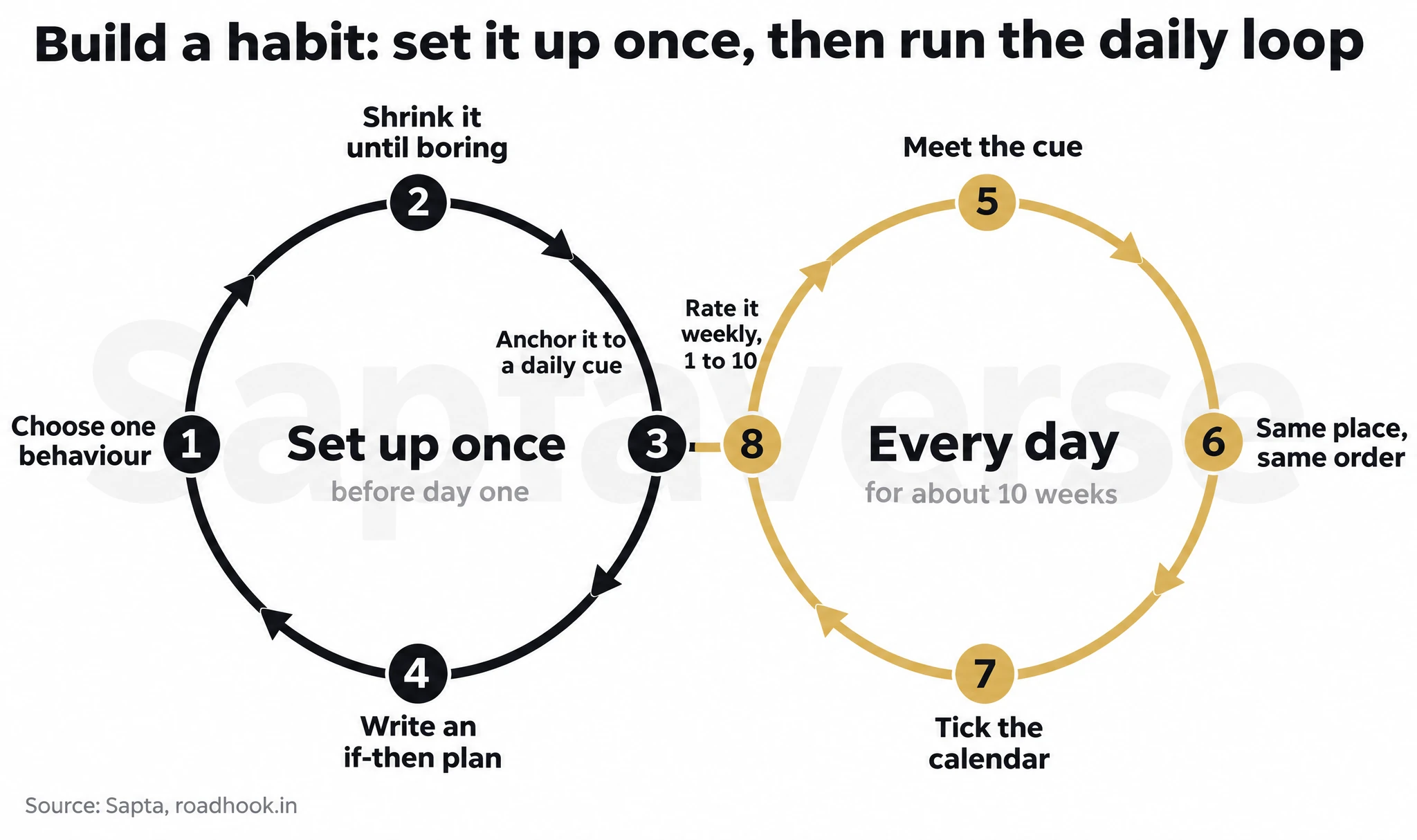
- Choose one behaviour: one you actually want; self-chosen habits formed faster
- Shrink it until boring: simple actions became automatic sooner
- Anchor it to a daily cue: after the first chai, after you park the bike
- Write an if-then plan: a medium-to-large effect, d = 0.65, across 94 tests
- Meet the cue: the fixed event you anchored to
- Same place, same order: a stable context builds automaticity
- Tick the calendar: one tick a day on paper
- Rate it weekly, 1 to 10: stop tracking when the rating stops rising

What makes a good cue for an Indian daily routine?
A good cue is something that happens every day, at a predictable point, and that you cannot miss noticing. Many Indian routines already have these built in, which makes them excellent anchors.
| Existing routine (the cue) | Tiny new habit (the action) | Why it works |
|---|---|---|
| Pouring the first chai or filter coffee | 10 squats, or take your tablet, or write one line in a journal | Happens daily, at home, at roughly the same time |
| Sitting down in the metro or bus | Open a language app or read two pages | Fixed seat time, phone already in hand |
| Parking the bike or car at the office | Write the day's single most important task | A clear transition from commute to work |
| Puja, or lighting a diya | Two minutes of slow breathing | Already a quiet, repeated moment |
| Finishing dinner and washing your plate | Put the phone on charge outside the bedroom | Sets up the sleep routine (see the sleep guide) |
The morning has a slight edge. Fournier and colleagues found that a daily stretching habit reached automaticity in a mean of 106 days when done in the morning, against 154 days in the evening. One study, with a low quality rating in Singh's review, so treat it as a tie-breaker rather than a rule. Evenings in Indian homes also tend to be less predictable: guests, late dinners, cricket on TV.

Does missing a day break a habit?
No. In Lally's data, a single missed day produced a dip in automaticity of less than half a point on the scale, and scores recovered quickly once the person resumed. Gardner, Lally and Wardle put it plainly for doctors in 2012: an occasional missed opportunity does not seriously impair habit formation.
What hurts is a string of misses, because the cue then appears without the action often enough to weaken the link. Two practical rules follow:
- Never miss twice. If you skip on Monday, Tuesday's repetition matters more than any other day of the week.
- Keep a "minimum version". On a bad day, do one squat, read one line, write one word. The repetition of cue-plus-action is what counts, not the volume.
How long until my habit feels automatic? Use the calculator
The calculator turns the published medians into a rough personal estimate. Lally's participants were asked to act daily, so the model treats automaticity as a function of repetitions; if you only manage five days a week, the calendar stretches accordingly.
Rough estimate: days until your habit plateaus
Two things the calculator cannot capture. Complex habits take longer, and the curve is personal: in the same study, one person plateaued in under three weeks while another was projected to need eight months. Use the result to set expectations for the first review, at week 10, not to judge yourself.
What should I do when motivation drops in week three?
Expect it. Motivation is high on day one and usually lower by week three, while automaticity is only part-built. This is the most fragile window, and the evidence suggests leaning on structure rather than mood.
- Reduce friction. Lay out the shoes the night before, keep the book on the metro bag, keep the journal next to the kettle. Environment changes were among the strongest tools in the meta-analyses covered in the ranked list.
- Make the reward immediate. Habits are reinforced by what happens right after the action, which is part of what dopamine signals do in learning. The reward prediction error post explains why an expected, immediate payoff teaches faster than a distant one.
- Remove the competing cue. If your phone sits beside the chai cup, the morning cue already has a habit attached: scrolling. Move the phone. The dopamine detox post explains why this "stimulus control" works and the detox label does not.

Which habits are hardest to build, and why?
Complex, effortful, variable behaviours are hardest, because each part needs its own cue-response link. Exercise had the longest median in Lally's study (91 days, against 59 for water), and in Wood's diaries 79% of habits were low-complexity actions.
The fix is to build the entry ramp as the habit and let the rest follow. "Change into gym clothes after work" is a habit; "do a 45-minute workout" is a plan that the habit then triggers. The same goes for study: "open the notes file when I sit at the desk" can become automatic, and once the file is open, the session tends to happen. If focus is the problem rather than starting, the deep work routine picks up from there, and the sleep guide applies the same cue logic to bedtime.
Breaking a bad habit runs the same logic in reverse. You cannot simply delete a cue-response link, so you either remove the cue (phone out of the bedroom) or attach a new response to the old cue (on opening Instagram in the morning, the if-then plan says "close it and open the reading app"). Both work better than trying to resist the urge each time it fires.
Reviewed 20 studies with 2,601 adults, 12 of them in a meta-analysis. Habit-strength interventions had a moderate-to-large effect (standardised mean difference 0.69). Four studies timed habit formation directly: medians of 59 to 66 days, means of 106 to 154 days, individual range 4 to 335 days. Morning practice, self-chosen habits, planning and stable contexts helped. Limits: most studies had under 100 people, heterogeneity was high (I² = 87%) and outcomes were mostly self-reported.
Read the paper (free)Two diary studies in which Texas A&M students recorded their actions, thoughts and feelings every waking hour. Behaviours done almost daily in the same setting were 35% of entries in study 1 and 43% in study 2. During habits, thoughts wandered from the action about half to 60% of the time, and people felt less stress than during non-habitual actions. Limits: a student sample over a short window, and habit was defined by frequency and context rather than measured automaticity.
Read the paper (free)A short evidence summary for doctors by two of the authors behind the 66-day study. It explains habit as a cue-triggered automatic response, reports that a single missed repetition did not derail formation, that simple actions automate faster than elaborate ones, and that a habit-based weight-loss leaflet produced 2 kg loss at 8 weeks against 0.4 kg in controls. It recommends telling patients to expect about 10 weeks, not 21 days. Limit: a narrative review, not new data.
Read the paper (free)What's new
- A 105-person study finds about 88% of daily actions are carried out habitually, and most habits match people's goals Workplace Insight, Nov 2025
- Review of 20 studies puts typical habit formation at two to five months, not 21 days News-Medical, Jan 2025
Questions people ask
Is it true that it takes 21 days to form a habit?
No. The 21-day figure has no experimental basis; Gardner and colleagues trace it to anecdotes from plastic surgery, not habit research. The best measured median is 66 days (Lally 2010), and the 2024 review found medians of 59 to 66 days with means above 100.
Can I build several habits at once?
You can, but each one needs its own cue and its own repetitions, and the studies that produced the 66-day figure tested one behaviour per person. Start one, wait until it feels automatic on your weekly rating, then add the next, ideally chained to the first.
Why can I scroll for hours but not study for 20 minutes?
Scrolling is already a habit with strong cues (boredom, a free hand, the phone in sight) and an instant, variable reward. Study has neither yet. Give study a fixed cue and a tiny starting action, and remove the phone cue from the room. The scrolling question gets its own answer on this blog.
What if my schedule changes every day?
Use an action cue instead of a clock cue. "After I brush my teeth" happens daily whatever time you wake. Keller and colleagues (2021) found no clear difference between time-based and routine-based cues, so pick whichever is more reliable in your life.
Sources
- Lally P, van Jaarsveld CHM, Potts HWW, Wardle J: How are habits formed: Modelling habit formation in the real world, European Journal of Social Psychology (2010)
- The Behavioral Scientist: How long does it take to form a habit? What Lally et al. (2010) actually found (participant and subgroup figures)
- Singh B et al.: Time to Form a Habit, a systematic review and meta-analysis, Healthcare (2024)
- Gardner B, Lally P, Wardle J: Making health habitual, British Journal of General Practice (2012)
- Wood W, Quinn JM, Kashy DA: Habits in everyday life, Journal of Personality and Social Psychology (2002)
- Gollwitzer PM, Sheeran P: Implementation intentions and goal achievement, a meta-analysis, Advances in Experimental Social Psychology (2006)
- Workplace Insight: Most daily behaviours are driven by habits (Rebar et al., Psychology & Health 2025) (2025)
- News-Medical: How long does it take to form a healthy habit? (2025)
- James Clear: How long does it actually take to form a new habit? (Maltz and the origin of the 21-day figure)
- Wikipedia: Maxwell Maltz (cosmetic surgeon; Psycho-Cybernetics, 1960)

Sapta (Saptarshi Sarkar) is a mechanical engineer turned marketer in Bengaluru and a solo touring rider. He writes the seven Saptaverse blogs. Work with him or read more of Mindblog.


