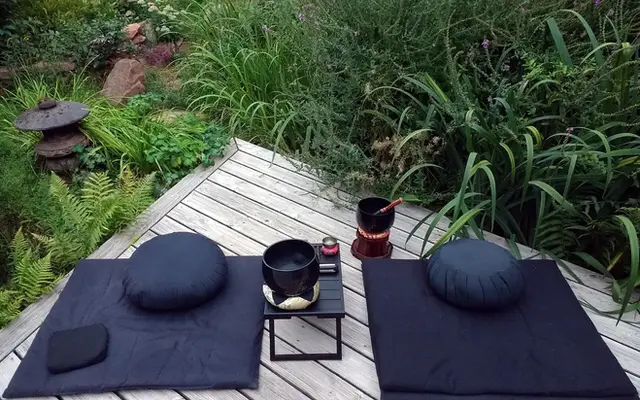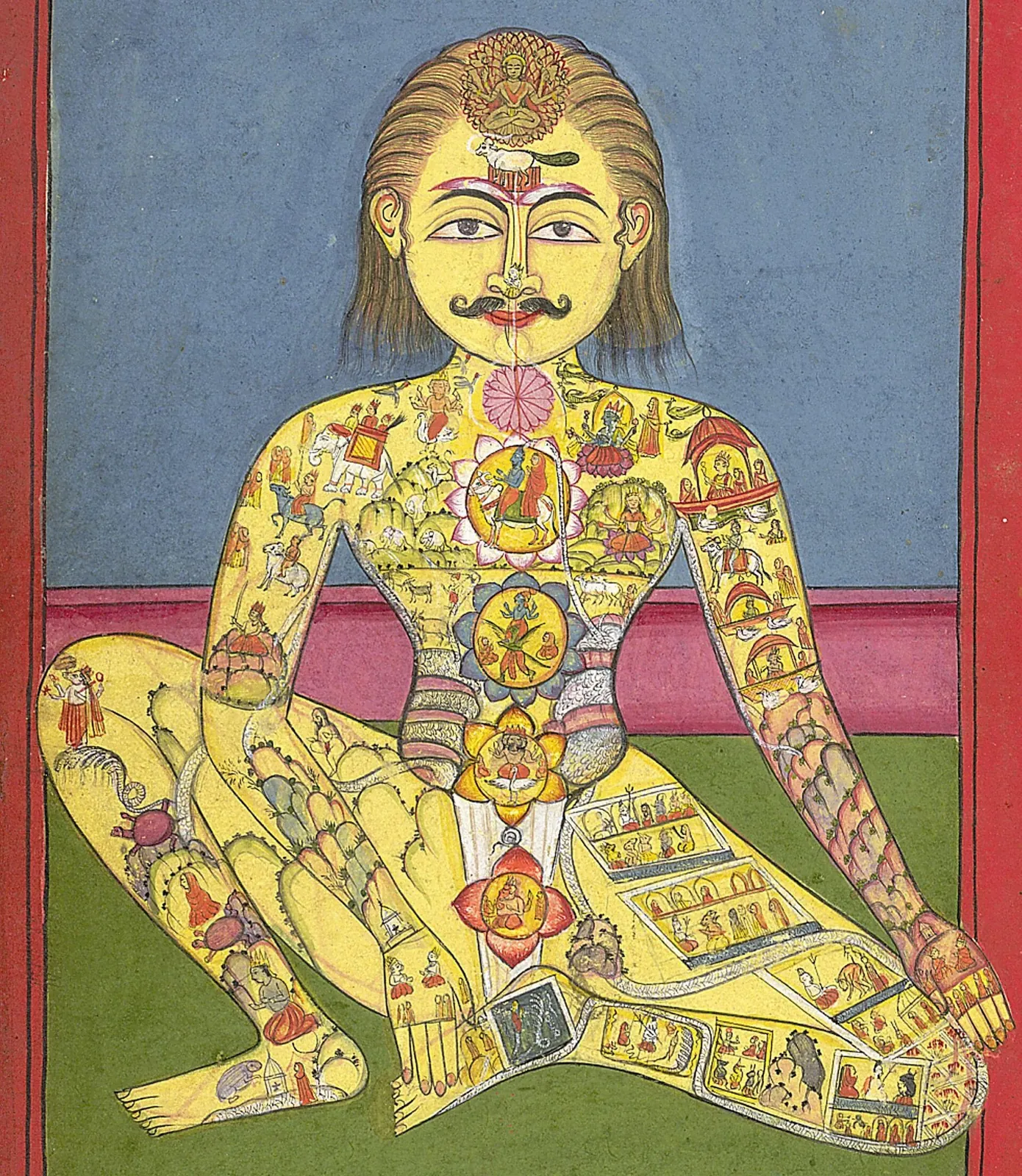
The seven chakras (Sanskrit cakra, "wheel") are centres along the spinal axis that tantric yoga uses as places to rest attention in meditation: Mūlādhāra, Svādhiṣṭhāna, Maṇipūra, Anāhata, Viśuddha, Ājñā and Sahasrāra. The version most people know comes from one text, Pūrṇānanda's Ṣaṭ-cakra-nirūpaṇa of 1577, which describes six lotuses plus a thousand-petalled lotus at the crown. Chakras are a map for practice from a religious tradition, not organs: anatomy has never found them, and the rainbow colours on modern posters are a 20th-century addition.
- The seven-chakra layout comes mainly from the Ṣaṭ-cakra-nirūpaṇa, usually dated to 1577.
- It reached English readers through Arthur Avalon's The Serpent Power (1919), the pen name of a Calcutta judge and his collaborators.
- Older texts disagree on the count: 4 in the Buddhist Hevajra Tantra, 6 in the Netra Tantra, 8 in the Kaulajñāna-nirṇaya.
- The six lower lotuses carry 50 petals, one for each letter of the Sanskrit alphabet.
- The rainbow colours and one-word psychology labels first appeared together in print in 1977.
- No study has found chakras in the body; meditation itself shows small to moderate benefits in trials.
This post does three things. It sets out what the tradition's own key text says about each centre, with the numbers it gives. It separates that from the layers added in Europe and America after 1900. And it says plainly what science can and cannot tell you, because a chakra is a description of where to put attention, not a claim anatomy can confirm.
What is a chakra, according to the tantric texts?
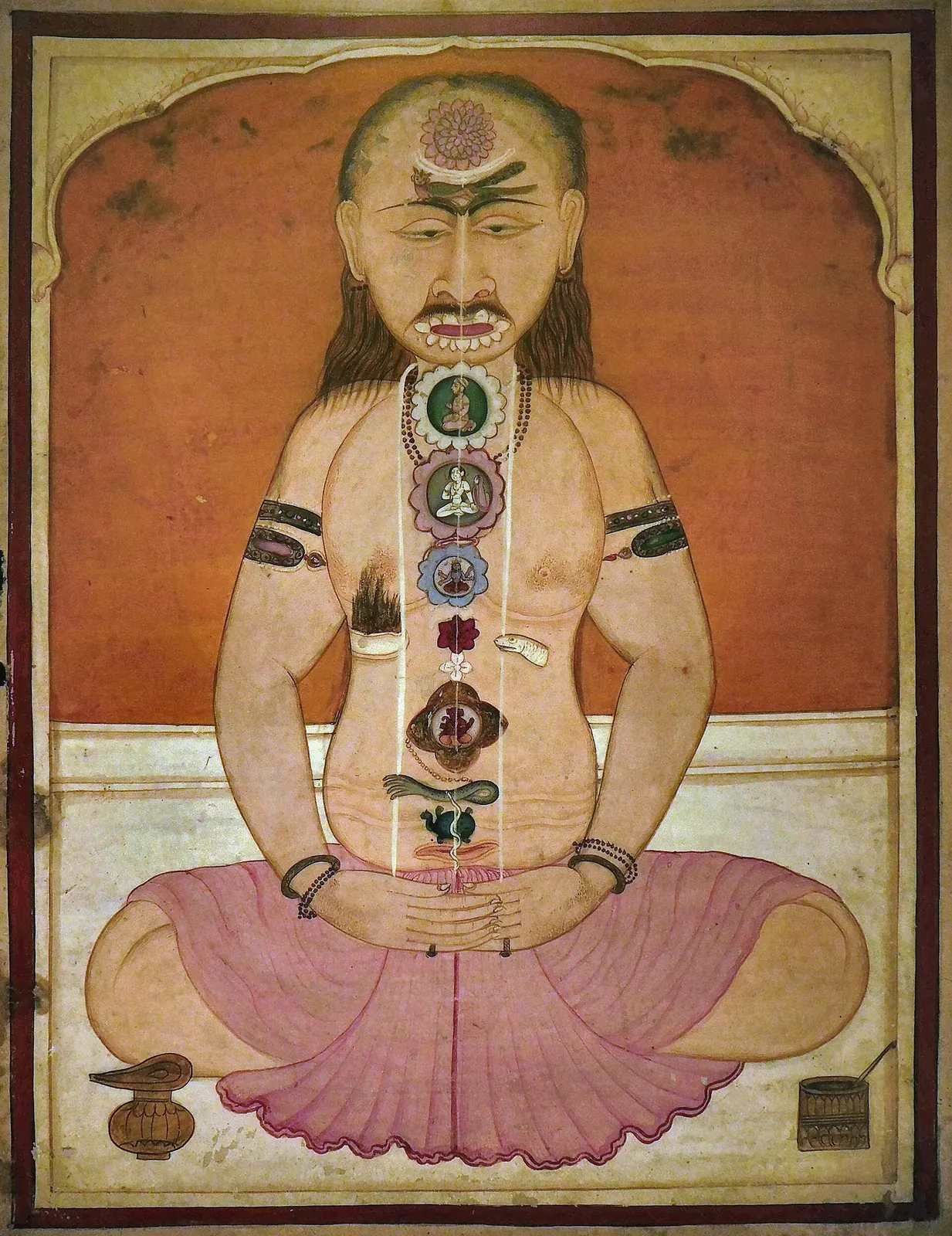
In tantra, a chakra is a lotus-shaped centre on the central channel, the suṣumṇā nāḍī, which the texts picture running up the spine. Two side channels, iḍā and piṅgalā, wind around it. These belong to the "subtle body", a body described for meditation, not dissected.
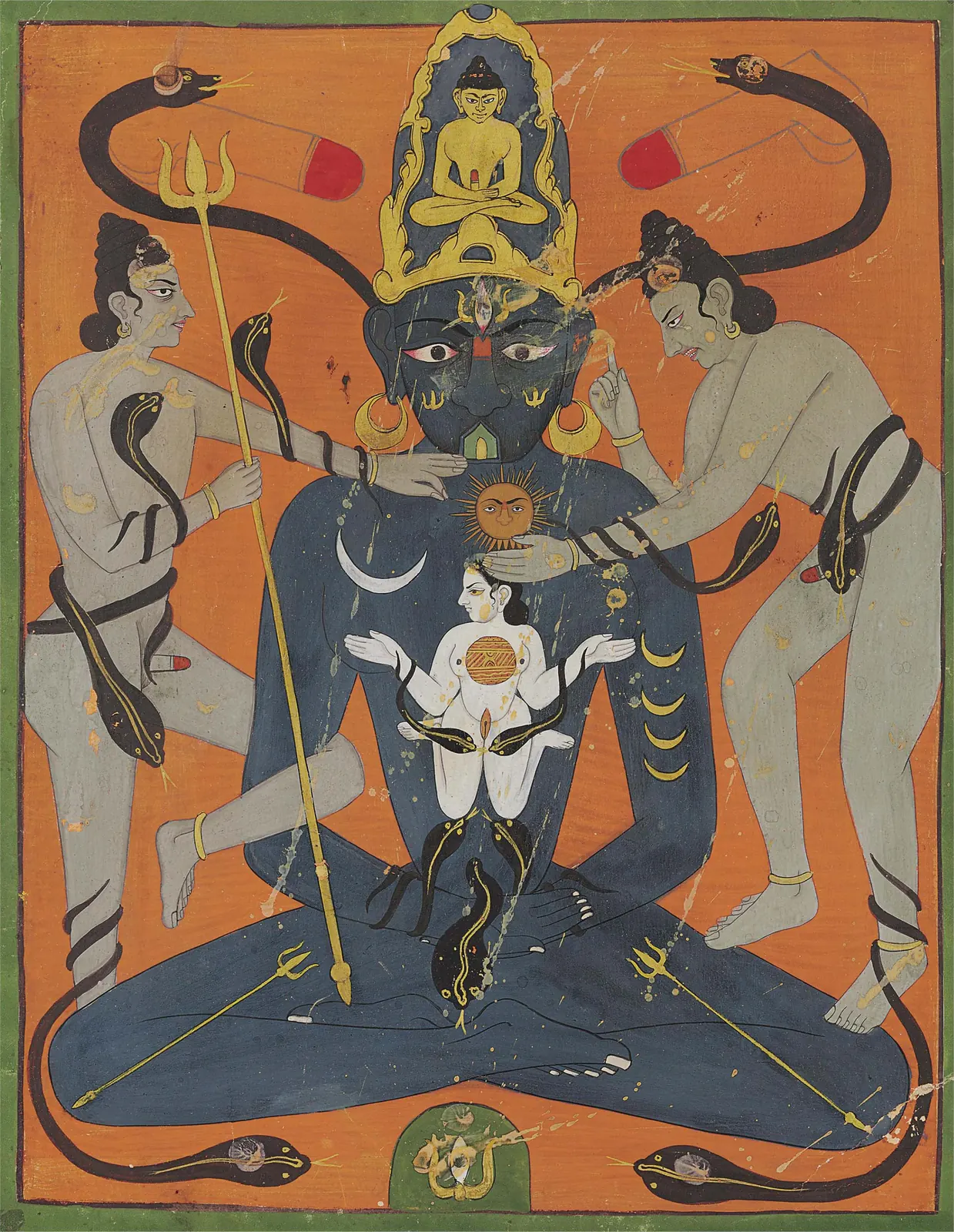
The practice the Ṣaṭ-cakra-nirūpaṇa describes is laya yoga: attention is placed on each lotus in turn, with its seed sound, while a power called kuṇḍalinī, pictured as a coiled serpent at the base, is said to rise to the crown. Every centre in the text has the same parts:
- Petals, each carrying one Sanskrit letter;
- a region (maṇḍala) with a shape standing for an element;
- a seed syllable (bīja) and an animal that carries it;
- deities who preside over the lotus.
That is the whole mechanism as the text gives it. Which emotion "lives" in which chakra is not in it.
Where does the seven-chakra system come from?
There was never one agreed chakra system; the number changes from text to text. David Gordon White dates hierarchies of inner centres to Buddhist tantras of around the 8th century CE, and those texts, such as the Hevajra Tantra, name only four.
How many chakras did the old texts count?
Shaiva texts give other numbers. Alexis Sanderson points to a six-centre system in the Netra Tantra (700 to 850 CE). Dory Heilijgers-Seelen's study of the Kubjikāmata Tantra found five centres there, each a seat for a group of goddesses, while Gavin Flood places the first six-plus-crown arrangement in that Kaula tradition. The Kaulajñāna-nirṇaya has eight.
See the data as a table
| Centres (centres) | |
|---|---|
| Hevajra Tantra (Buddhist, c. 8th century) | 4 |
| Kubjikamata Tantra (Heilijgers-Seelen reading) | 5 |
| Netra Tantra (700-850 CE) | 6 |
| Sat-cakra-nirupana (1577), six plus crown | 7 |
| Kaulajnana-nirnaya | 8 |
Source: Wikipedia: Chakra, citing D. G. White, Heilijgers-Seelen 1992, Sanderson, Samuel and Johnston 2013 · Counts are as reported by the scholars cited; dates of tantric texts are approximate.
The version that won is Pūrṇānanda's. He was a Bengali tantric, and library catalogues record him as active from 1526 and dying in 1577. The Ṣaṭ-cakra-nirūpaṇa ("Description of the Six Centres") is the sixth chapter of his larger ritual work, the Śrītattvacintāmaṇi. It describes six lotuses and then, separately, the thousand-petalled lotus above them.
In 1904 John Woodroffe, born in Calcutta in 1865, was raised to the bench of the Calcutta High Court. By day he was a British judge. Under the pen name Arthur Avalon, taken, Taylor found, from a Burne-Jones painting of Arthur asleep in Avalon, he published some 20 translations of tantric texts. In 1919 Luzac of London issued The Serpent Power: Pūrṇānanda's text in Sanskrit and English, with Kālīcaraṇa's commentary.
The historian Kathleen Taylor later showed that "Avalon" was a partnership. Woodroffe's close friend Atal Bihari Ghose supplied most of the knowledge of the Sanskrit texts. Through that one Calcutta collaboration, a 16th-century Bengali manual became the source of almost every Western book on chakras.
Kathleen Taylor: Sir John Woodroffe, Tantra and Bengal (Routledge, 2001); Wikipedia: John WoodroffeAvalon was not the first English translator. Baradā Kānta Majumdār printed passages from the same text in The Theosophist in April 1880, nearly 40 years earlier. It was Avalon's full edition that lasted.
What does each of the seven chakras stand for?
Each chakra in the 1577 text is defined by a place, a petal count, letters, an element and a seed syllable. The descriptions below follow the Avalon translation of the Ṣaṭ-cakra-nirūpaṇa; the short reading after each is how the tradition's commentators frame it, plus the plain sense of the name.
Muladhara, the root chakra
Mūlādhāra ("root support") is a four-petalled red lotus at the base of the spinal axis. Its petals carry the letters va, śa, ṣa and sa. Inside is a square, the region of earth, ringed by eight spears, with the seed syllable laṃ carried by the elephant Airāvata. This is where the text places the coiled kuṇḍalinī, so practice starts here: the foundation everything above rests on.
Svadhisthana, the sacral chakra
Svādhiṣṭhāna ("one's own seat") sits inside the central channel at the root of the genitals. The text gives it a vermilion lotus of six petals with the letters ba to la, and a white region of water marked by a half-moon. Its seed syllable vaṃ rides a makara, a sea creature. Many modern books put it "below the navel"; the 1577 text puts it lower.
Manipura, the navel chakra
Maṇipūra ("city of jewels") is the navel lotus, with ten petals the colour of a rain cloud. Its letters run from ḍa to pha. In the centre is a red triangle, the region of fire, and the seed syllable raṃ rides a ram. The posters call it yellow and "solar plexus"; the text's lotus is dark and the fire inside it is red.
Anahata, the heart chakra
Anāhata ("unstruck") is the twelve-petalled heart lotus. The commentary explains the name: here the sound of śabda-brahman is heard, a sound made without two things striking. The lotus is the red of the bandhūka flower, its letters run from ka to ṭha, and inside is a smoky six-cornered region of air, with the seed syllable yaṃ on a black antelope. Three centres sit below it and three above.
Vishuddha, the throat chakra
Viśuddha ("pure") sits at the base of the throat, a lotus of sixteen smoky purple petals. The petals carry the sixteen Sanskrit vowels. Inside is a white circular region of ether (ākāśa) holding the moon's disc, and the seed syllable haṃ rides a white elephant. Because the vowels live here, later readers tie it to speech.
Ajna, the third eye chakra
Ājñā ("command") is a white two-petalled lotus between the eyebrows. Its petals carry the last two letters, ha and kṣa, and the commentary places the praṇava, the syllable Om, in its centre. The commentary explains the name: this is where the command is received from above. Above it the text places manas, the mind, which is why it is the usual point for resting attention.
Sahasrara, the crown chakra
Sahasrāra ("thousand-spoked") is a white lotus of 1,000 petals above the top of the central channel. Its head turns downward and its filaments are red. All 50 letters of the alphabet circle its petals twenty times (50 × 20 = 1,000). It has no element and no seed syllable: it is described apart from the six centres, as the goal of the practice rather than a seventh step on the ladder.
| Chakra | Place (1577 text) | Petals | Element | Seed |
|---|---|---|---|---|
| Mūlādhāra | Base of the spinal axis | 4 | Earth (square) | laṃ |
| Svādhiṣṭhāna | Root of the genitals | 6 | Water (half-moon) | vaṃ |
| Maṇipūra | Navel | 10 | Fire (triangle) | raṃ |
| Anāhata | Heart | 12 | Air (six corners) | yaṃ |
| Viśuddha | Base of the throat | 16 | Ether (circle) | haṃ |
| Ājñā | Between the eyebrows | 2 | Mind (manas) | Om |
| Sahasrāra | Above the crown | 1,000 | None | None |
See the data as a table
| Petals (petals) | |
|---|---|
| Muladhara | 4 |
| Svadhisthana | 6 |
| Manipura | 10 |
| Anahata | 12 |
| Vishuddha | 16 |
| Ajna | 2 |
Source: Sat-cakra-nirupana, tr. Arthur Avalon, The Serpent Power (1919), via Wisdom Library · 4+6+10+12+16+2 = 50, the letters of the Sanskrit alphabet; Sahasrara repeats all 50 twenty times.
Which parts of the chakra system are modern?
The rainbow colours, the gland links and the one-word psychology are all 20th-century and Western. The historian Kurt Leland traced each layer in Rainbow Body (2016) and summed it up bluntly in Quest in 2017:
"The much-vaunted 'ancient' chakra system of the West is barely forty years old." Kurt Leland, Quest, Spring 2017
- Endocrine glands (1928): Leland credits Cajzoran Ali with first pairing each chakra with a gland.
- Psychology (1932 onward): Carl Jung gave a seminar on kundalini yoga to the Psychological Club in Zurich from 12 October 1932, reading the chakras as stages of individuation. Later authors filled in the familiar labels.
- Rainbow plus labels (1977): colour healers had used a spectrum scheme, but Leland dates its fusion with the list of qualities to Ken Dychtwald's Bodymind, published June 1977.
| Chakra | Colour in the 1577 text | Poster colour |
|---|---|---|
| Mūlādhāra | Red petals | Red |
| Svādhiṣṭhāna | Vermilion lotus | Orange |
| Maṇipūra | Rain-cloud petals, red fire triangle | Yellow |
| Anāhata | Bandhūka red, smoky air region | Green |
| Viśuddha | Smoky purple petals | Blue |
| Ājñā | White | Indigo |
| Sahasrāra | White, red filaments | Violet |
Only the root matches, and that is a coincidence of red. None of this makes the modern version useless. It just means a poster that calls its colours "ancient" is wrong about its own history.
Are chakras real? What does research show?
No study has found chakras as physical structures, and the texts never claimed anatomy. The nerve plexuses and glands that modern books map onto them were matched after the fact, from 1928 on. So the useful question is a different one: does attention practice built on this map do anything?
What research does show
- Meditation helps a little. A 2014 meta-analysis of 47 trials found small to moderate drops in anxiety, depression and pain, and no edge over drugs, exercise or other therapies.
- Kundalini yoga helps some people with anxiety. In a 2021 trial, it beat stress education for generalised anxiety disorder but was not shown to be as good as CBT.
- Bodies localise feelings. People across cultures place emotions in consistent body regions, mostly the chest and head, which may explain why a "heart" or "throat" centre feels intuitive.
- Intensive practice has risks. Interviews with practitioners who had difficulties found surges of "somatic energy" were common among them.
What research does not show
- That chakras exist as structures, emit anything, or can be "blocked" and "balanced".
- That chakra work treats any disease. Trials test whole yoga or meditation packages, so they cannot isolate the chakra map itself.
Pooled 47 randomised trials with 3,515 participants. Mindfulness programmes reduced anxiety by an effect size of 0.38 at 8 weeks (0.22 at 3 to 6 months), depression by 0.30, and pain by 0.33. Meditation did not beat active treatments such as drugs or exercise. It tests meditation programmes in general, not chakra practice.
Read the paper (free)226 adults with generalised anxiety disorder were randomised to Kundalini yoga (93), CBT (90) or stress education (43), in 12 weekly two-hour group sessions. At 12 weeks, 54.2% responded to yoga, 70.8% to CBT and 33.0% to stress education. Yoga was not shown to be non-inferior to CBT, and by 6 months only CBT still beat the control. The yoga package mixed postures, breathing and meditation.
Read the paper (free)701 participants from Finland, Sweden and Taiwan coloured body silhouettes to show where they felt emotions. Each basic emotion produced a distinct map, most with raised activity in the upper chest, and the maps held across cultures. The limit: they are self-reports of felt sensation, not measured physiology, so they show why body-centred maps feel right, not that chakras exist.
Read the paper (free)Interviews with 60 Theravāda, Zen and Tibetan practitioners who had difficulties, plus 32 teachers and clinicians, yielded 59 kinds of experience. "Somatic energy", surges like currents through the body, was reported by 63%, and 73% had moderate to severe impairment at some point. The sample was chosen for difficulties, so it cannot give a rate.
Read the paper (free)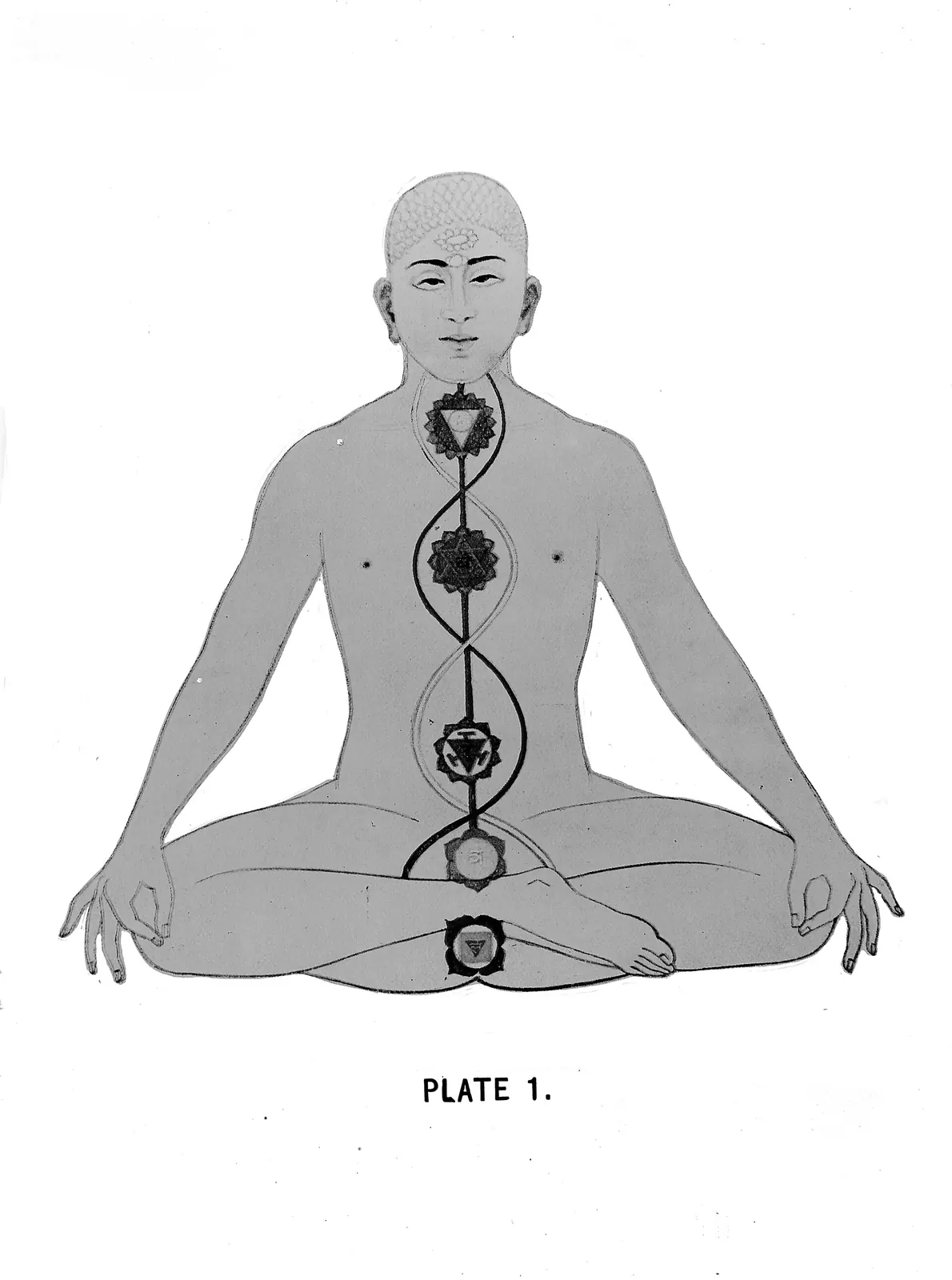
How can you use the chakra map without the myths?
Use it the way the text does: as an ordered sequence of places to rest attention. If you want to try it, here is how I would read the seven as a checklist that runs from the ground up:
- Root. Am I rested, fed and safe?
- Own seat. Am I enjoying anything, or only managing?
- Navel fire. Do I have the drive to act on what matters?
- Heart. Do I care about someone other than myself today?
- Throat. Am I saying what is true, and how much is noise?
- Brow. Am I seeing what is there before my opinion arrives?
- Crown. Can I let the whole list go?
Wherever the honest answer breaks first is what to fix first. That is a modern, reflective reading, not what Pūrṇānanda taught; his practice was the seed syllables and the rising of kuṇḍalinī. For the attention side, start with a beginner's meditation routine and check which methods hold up in meditation techniques ranked by evidence.
For the wider picture, see where mindfulness hype outruns the evidence, how the Yoga Sutras came to be and the oldest Indian texts on the mind. All of Manthan's thinking on the mind lives at Mindspace.
What's new
- A single-arm pilot of an 8-week "chakra-informed" Kundalini yoga course for 13 young people with diabetes reported lower distress, with no control group Complementary Therapies in Medicine, Mar 2026
- A systematic review of Kundalini yoga trials calls the evidence promising but asks for larger, standardised RCTs UNLV News, Oct 2025
Questions people ask
Is there any scientific evidence that chakras exist?
No. No anatomical or imaging study has found chakras, and the tantric texts describe a body for meditation rather than a physical one. Research can test the practices built on the map, and meditation shows small to moderate benefits in trials.
Why are there seven chakras and not some other number?
Because one text won. Older tantras count four, five, six or eight. The six-plus-crown scheme of Pūrṇānanda's Ṣaṭ-cakra-nirūpaṇa (1577) became standard in India and then spread worldwide through Avalon's 1919 translation.
Are the chakra colours traditional?
No. The 1577 text gives red, vermilion, rain-cloud, bandhūka red, smoky purple and white lotuses. The red-to-violet rainbow joined the psychological labels in print in 1977, in Ken Dychtwald's Bodymind.
Can you "open" or "unblock" a chakra?
That language is modern. The old texts describe piercing the centres as kuṇḍalinī rises during meditation, not unblocking them like pipes. No study has measured a blocked chakra, and anyone selling a cure for one is selling a story.
Sources
- Pūrṇānanda: Ṣaṭ-cakra-nirūpaṇa, tr. Arthur Avalon, The Serpent Power, via Wisdom Library (1919; source for petals, letters, elements, seeds and locations)
- Open Library: Pūrṇānanda (fl. 1526, d. 1577) (author's dates)
- Wikipedia: Chakra (counts in older texts, citing White, Sanderson, Flood, Heilijgers-Seelen)
- Wikipedia: John Woodroffe (career and pen name)
- Kathleen Taylor: Sir John Woodroffe, Tantra and Bengal, Routledge (2001)
- Enfolding: Chakras into the West, B. K. Majumdār and Arthur Avalon (the 1880 translation)
- Kurt Leland: The Rainbow Body, How the Western Chakra System Came to Be, Quest 105.2 (2017)
- C. G. Jung: The Psychology of Kundalini Yoga, Notes of the Seminar Given in 1932, ed. Sonu Shamdasani, Princeton University Press (1996)
- Goyal M et al.: Meditation Programs for Psychological Stress and Well-being, JAMA Internal Medicine (2014)
- Simon NM et al.: Yoga vs CBT vs Stress Education for Generalized Anxiety Disorder, JAMA Psychiatry (2021)
- NCCIH: Kundalini yoga is helpful for adults with GAD but not as effective as CBT (2020)
- Nummenmaa L et al.: Bodily maps of emotions, PNAS (2014)
- Lindahl JR et al.: The varieties of contemplative experience, PLOS ONE (2017)
- Chakra-informed kundalini yoga pilot for adolescents and young adults with diabetes, Complementary Therapies in Medicine (2026)

Sapta (Saptarshi Sarkar) is a mechanical engineer turned marketer in Bengaluru and a solo touring rider. He writes the seven Saptaverse blogs. Work with him or read more of Mindblog.