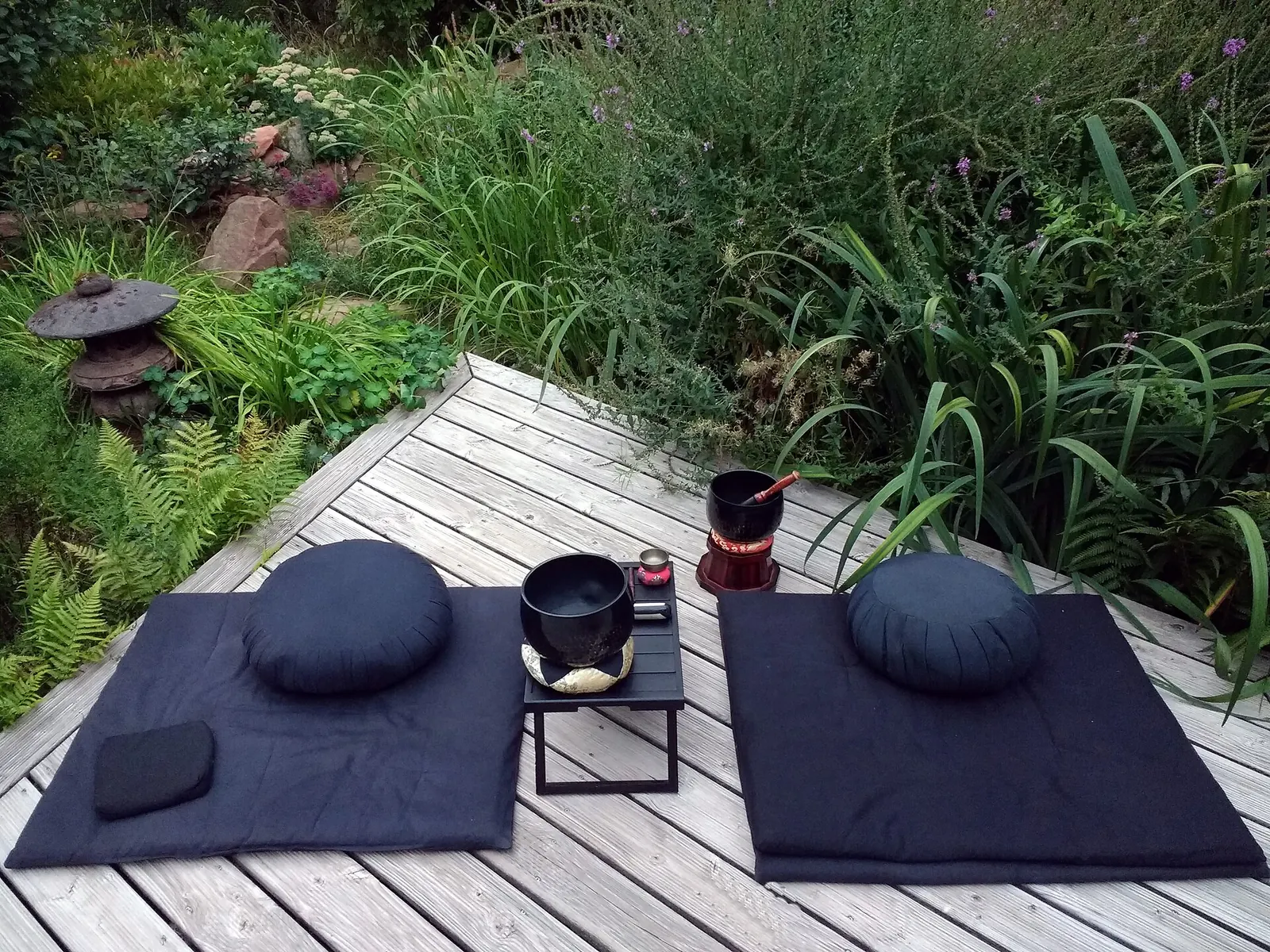
To start meditating, sit for 10 minutes a day at the same time, rest your attention on the sensation of breathing, and each time you notice your mind has wandered, return to the breath without judging yourself. Keep it up for at least eight weeks: in a randomised trial of beginners, 13 minutes a day improved mood, attention and memory after 8 weeks but not after 4, and a review of 47 trials found mindfulness programmes reduced anxiety and depression by a small-to-moderate amount at 8 weeks.
- 10 minutes a day, same cue, breath focus: that is the whole method.
- 8 weeks, not 4: beginners on 13 minutes a day improved mood, attention and memory only at week 8 (Basso 2018).
- Mindfulness programmes cut anxiety by an effect size of 0.38 at 8 weeks across 47 trials (Goyal 2014).
- About 8.3% of people in meditation studies reported an adverse effect, most often anxiety or low mood.
- Noticing and returning is the exercise; a wandering mind is not failure.
That is the whole method. The rest of this guide is about making it last and setting honest expectations.
Meditation is not a cure-all: the same 2014 JAMA Internal Medicine review found no evidence that meditation beat other active treatments such as drugs, exercise or therapy, and a 2020 review in Acta Psychiatrica Scandinavica found that about 8% of people in meditation studies reported some adverse effect, most often anxiety or low mood. Both facts belong in a beginner's plan.
What is the simplest way to start meditating?
Pick one technique, focused attention on the breath, and do only that for the first eight weeks. Switching between apps and styles is the most common way beginners turn practice into browsing; if you want to compare styles first, see meditation techniques ranked by evidence, then choose one.
- Choose a cue. Tie the session to something you already do daily: after brushing your teeth, after the first cup of chai, before opening the laptop. Write it as "If I finish my tea, then I sit for ten minutes."
- Set up once. A chair or cushion, back upright but not stiff, hands resting, eyes closed or lowered. Phone on airplane mode, timer set to 10 minutes.
- Find the breath. Notice where you feel breathing most clearly: the nostrils, the chest or the belly. Do not control it; just feel each in-breath and out-breath.
- Notice and return. The mind will wander within seconds. When you realise it has, note "thinking" silently and bring attention back to the next breath.
- Close the session. When the timer ends, take one deliberate breath and open your eyes. Mark the day on a calendar.
Why step 4 is the real exercise
Step 4 is the exercise. Wendy Hasenkamp and colleagues at Emory University scanned 14 experienced meditators doing breath-focused meditation and had them press a button whenever they noticed their mind had wandered.
They described a repeating four-part cycle:
- mind-wandering;
- awareness of wandering;
- shifting attention back;
- sustained focus.
Each phase lit up different brain networks, with the default mode network active during wandering. Every return is one repetition, like a curl in the gym.
Shortly after 7 am on a spring morning in 2004, the ABC News correspondent Dan Harris was filling in on Good Morning America, reading the news updates at the top of the hour to an audience he puts at about five million. Partway through the six stories, panic hit: his heart pounded, he gasped for air and could not get the words out. He cut the segment short and handed back to the anchors.
His doctor traced the attack to the cocaine and ecstasy he had been using on weekends after years of war reporting and depression, and told him to stop at once. Around then his mentor, Peter Jennings, put him on the faith beat. Reporting on religion, self-help and neuroscience, the lifelong sceptic became, in his own telling, a reluctant convert to meditation.
Dan Harris, ABC News: How an on-air panic attack improved my lifeThe point for a beginner: Harris did not start because he believed in meditation. He started because his own mind had shown him, on live television, how little control he had over it, and that loss of control is exactly what the notice-and-return loop trains.
How long should a beginner meditate each day?
Ten to fifteen minutes a day is enough to start, if you keep it daily for at least eight weeks. Julia Basso and Wendy Suzuki's 2018 trial at New York University randomised meditation-naive adults aged 18 to 45 to either a 13-minute daily guided meditation or a 13-minute daily podcast for eight weeks.
Meditation reduced negative mood and improved attention, working memory and recognition memory at 8 weeks, but not at 4.
Work out your own dose
Use the calculator to see your total dose. Basso's minimum works out at about 12 hours over 8 weeks. The original Stress Reduction and Relaxation Program that Jon Kabat-Zinn described in 1982, the forerunner of MBSR, ran for 10 weeks with chronic-pain patients and asked for far more practice.
Your meditation dose
What should you expect week by week?
Expect the first weeks to feel restless and the benefits to arrive slowly and modestly. The table maps a plan to what the research measured, so you know what is realistic.
| Weeks | Practice | What is typical | What the evidence says |
|---|---|---|---|
| 1-2 | 10 min, breath focus, same cue daily | Constant wandering, fidgeting, boredom | Wandering is the normal state; the loop is the training (Hasenkamp 2012) |
| 3-4 | 10-12 min; add a 1-minute body scan at the start | Noticing wandering a little sooner | No measured cognitive change yet at 4 weeks in beginners (Basso 2018) |
| 5-8 | 12-15 min | Easier to settle; fewer skipped days | Mood, attention and memory gains at 8 weeks (Basso 2018); anxiety effect 0.38, depression 0.30 (Goyal 2014) |
| 8+ | Keep the daily habit; try a group or retreat if curious | Practice becomes routine | Effects at 3-6 months smaller but present: anxiety 0.22, depression 0.23 (Goyal 2014) |
See the data as a table
| At 8 weeks (effect size) | At 3 to 6 months (effect size) | |
|---|---|---|
| Anxiety | 0.38 | 0.22 |
| Depression | 0.3 | 0.23 |
Source: Goyal et al., JAMA Internal Medicine, 2014 · Moderate evidence for both. Goyal also reports 0.33 for pain, without a follow-up split.
From 18,753 citations, 47 randomised trials with 3,515 participants and active control groups. Mindfulness programmes showed moderate evidence of improved anxiety (effect size 0.38 at 8 weeks, 0.22 at 3 to 6 months), depression (0.30 and 0.23) and pain (0.33), with low evidence for stress and quality of life. There was low or insufficient evidence for effects on positive mood, attention, sleep, substance use, eating and weight, and no evidence that meditation beat drugs, exercise or other therapies. Limit: trials were short and varied, and positive outcomes were under-studied.
Read the paper (free)Meditation-naive adults aged 18 to 45 were randomised to 13 minutes a day of guided meditation or podcast listening for 8 weeks. After 8 weeks, but not 4, the meditation group had less negative mood, better attention, working memory and recognition memory, and lower state anxiety under a laboratory stress test. Limit: a small sample from one university, and a podcast control that cannot rule out expectation effects.
Read the paper83 studies with 6,703 meditators. 55 studies (65%) reported at least one kind of adverse event. The pooled prevalence was 8.3%: 3.7% in experimental studies and 33.2% in observational ones. The most common were anxiety, depression and cognitive anomalies, and some occurred in people with no previous mental-health history. Limit: inconsistent reporting across studies, and observational studies may over-sample people who had problems.
Read the paperWhen is meditation the wrong tool?
Meditation is the wrong tool in three situations:
- Crisis: when you are in a mental-health crisis.
- Diagnosis: when you have a diagnosed condition that needs treatment.
- Worsening: when sitting with your thoughts reliably makes you feel worse.
Meditation is a training practice, not a treatment substitute: Goyal's review found no evidence it outperforms established therapies, and NCCIH advises against using it to replace conventional care or to delay seeing a health professional.
If a retreat is on your list, read is the Vipassana 10-day course worth it? first.


Does meditation change your brain?
Some imaging studies report differences in brain structure and activity, but the effects most relevant to a beginner are behavioural and modest, and the brain claims are often overstated. Hasenkamp's study shows that the act of noticing and returning engages attention and salience networks; whether eight weeks of practice reshapes them in lasting ways is a separate, contested question.
I go through the brain-change evidence, including the famous Harvard claim from the forum question above, in does meditation change the brain?, and the wider gap between marketing and data in mindfulness: hype and evidence. If you want a calmer entry point, two or three minutes of slow breathing before sitting helps many people settle; the plan is in how to start pranayama safely. More on the Indian traditions behind these practices is on the Manthan page.
How do you keep the habit going?
Treat it as a habit-formation problem, not a willpower problem. If-then plans had a pooled effect of d = 0.65 across 94 studies of goal pursuit, and tracking progress where others can see it had d = 0.40 across 138 studies; both are covered in 7 habit techniques ranked by what the experiments show.
- Same cue, same place. The cue does the remembering for you.
- Never skip twice. One missed day is normal; restart the next day without trying to "make up" minutes.
- Shrink, do not stop. On bad days, do three minutes. The point is to keep the cue-action link alive.
- Review at week 8. Compare how you feel with week 1, then decide whether to extend, change technique, or join a course.
What are the common beginner problems, and the fixes?
Wandering is not failure; noticing is the skill.The notice-and-return loop, after Hasenkamp et al. 2012
Most problems in the first month are practical, not spiritual: sleepiness, restlessness, the wrong time slot, or expecting calm on day one. The fixes below are habit and set-up changes, not claims from a trial.
| Problem | Likely cause | Fix to try |
|---|---|---|
| Falling asleep | Sitting after a meal or late at night; lying down | Sit upright, eyes slightly open, move the session earlier |
| Restless body, itching, fidgeting | Normal in the first weeks | Allow one slow adjustment, then return to the breath |
| "I can't stop thinking" | Expecting a blank mind | Count breaths 1 to 10 and restart at 1 when you lose count |
| Skipping days | No fixed cue; slot too ambitious | Attach to an existing routine and cut to 5 minutes for a week |
| Feeling worse, anxious or low | Can happen; anxiety is the most reported adverse effect | Shorten or pause, open your eyes, and talk to a professional if it persists |
What's new
- Meta-analysis of 16 trials: online mindfulness cut university students' stress about as much as in-person courses Frontiers in Psychology, Mar 2026
- Randomised trial of 310 students: four weeks of digital mindfulness lowered perceived stress and anxiety Frontiers in Psychiatry, Aug 2025
- First World Meditation Day observed at the UN after a resolution India co-sponsored; it now recurs every 21 December All India Radio News, Dec 2024
Questions people ask
Is it normal that my mind keeps wandering?
Yes. In breath-focused meditation, wandering is one of the four normal phases of the attention cycle. The skill being trained is noticing sooner and returning gently, not keeping the mind blank.
Should I use an app or meditate in silence?
Either works. Basso's beginners used guided recordings, and a 2026 meta-analysis found online mindfulness reduced student stress about as much as in-person courses. Use an app for the timer and a short guide at first, then try silent sessions.
Can meditation make anxiety worse?
It can for some people. Farias's review of 83 studies found anxiety was the most common adverse effect. Keep sessions short, keep eyes open if that helps, and stop and seek professional advice if distress builds.
Morning or night: when is the best time?
The trials do not settle this. Choose the time you can protect every day and attach it to an existing routine. Consistency drives the effect more than the hour.
How long until I notice a difference?
In Basso's trial, measured changes appeared at 8 weeks, not 4. Goyal's review reports effects at 8 weeks. Give it two months before judging.
Sources
- Goyal M. et al.: Meditation programs for psychological stress and well-being, JAMA Internal Medicine 174(3):357-368 (2014)
- Basso J.C. et al.: Brief, daily meditation enhances attention, memory, mood, and emotional regulation in non-experienced meditators, Behavioural Brain Research 356:208-220 (2018)
- Farias M. et al.: Adverse events in meditation practices and meditation-based therapies, Acta Psychiatrica Scandinavica 142(5):374-393 (2020)
- Hasenkamp W. et al.: Mind wandering and attention during focused meditation, NeuroImage 59(1):750-760 (2012)
- Kabat-Zinn J.: An outpatient program in behavioral medicine for chronic pain patients based on the practice of mindfulness meditation, General Hospital Psychiatry 4(1):33-47 (1982)
- NCCIH: Meditation and Mindfulness: Effectiveness and Safety (2022)
- Wang Y. et al.: Online and traditional mindfulness-based interventions for stress in university students, Frontiers in Psychology 17 (2026)
- Effect of digital mindfulness on perceived stress and anxious emotion among college students, Frontiers in Psychiatry 16 (2025)
- Ministry of Health and Family Welfare: Tele-MANAS
- Dan Harris, ABC News: How an on-air panic attack improved my life

Sapta (Saptarshi Sarkar) is a mechanical engineer turned marketer in Bengaluru and a solo touring rider. He writes the seven Saptaverse blogs. Work with him or read more of Mindblog.