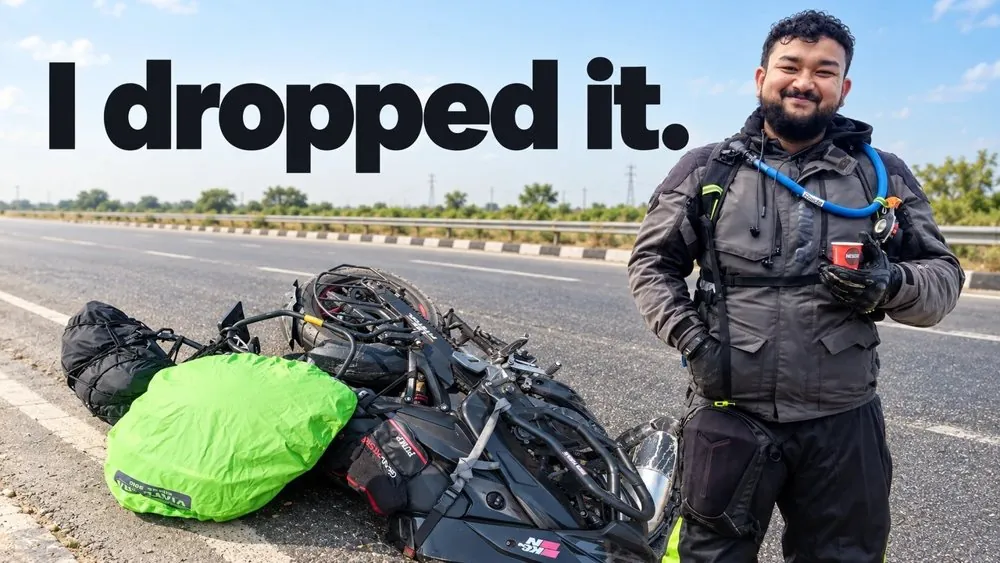
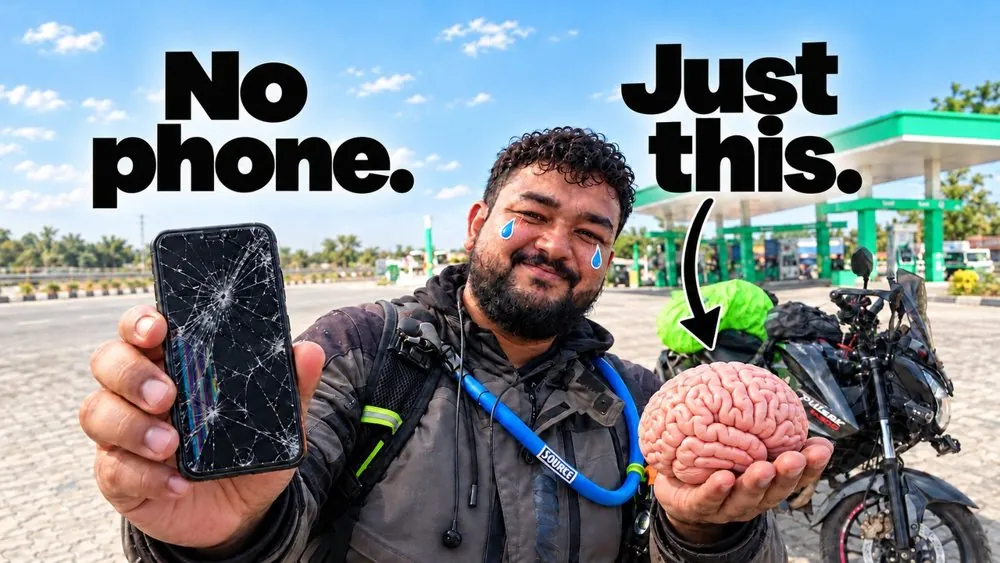
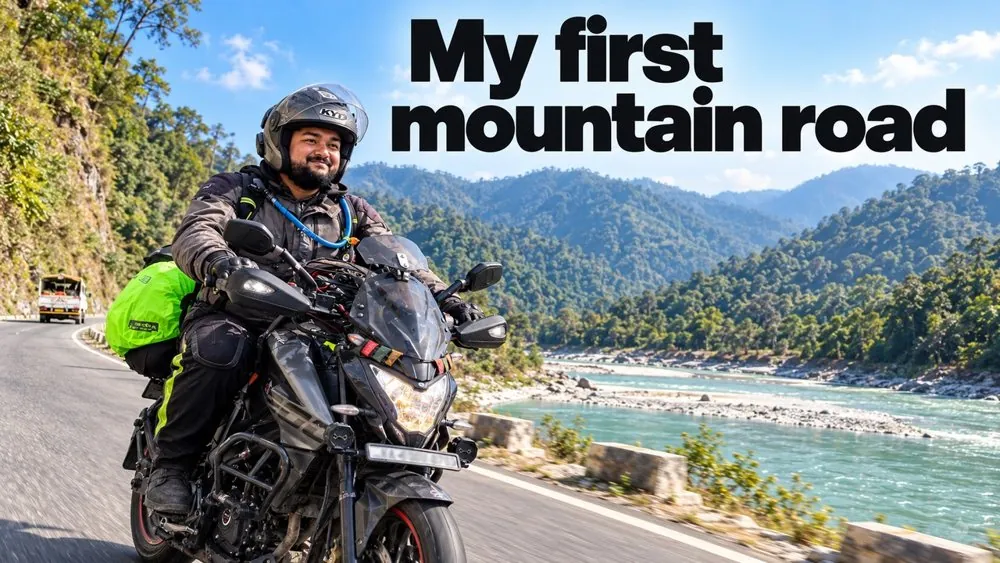
Everything I ride with, told the way it gets used: choosing it, packing it, what it does when the road turns on you, what failed, and what I changed. Two bikes, the mods that turned a 2017 Pulsar NS200 into a tourer, luggage, riding gear, cameras and gadgets. The full shelf waits at the end.
People ask what it takes to tour solo. Here's my honest answer in numbers. They're read live from my kit list, so they change when the list does. Tap a tile to jump to that shelf.
Nobody starts with all of this. Mine arrived one piece at a time.
Kit timeline: nine years of adding things.
Nobody buys a full touring kit in one go. Mine grew a piece at a time.
2017
Booked in September, the Pulsar NS200 is delivered around 14 November. A city naked, for now.
October: a centre stand for the KTM. The NS200 has now done around 70,000 km.
If I were starting from zero today, this is the order I'd buy in.
What I'd buy first on a budget.
This isn't a brand list. It's the order I'd spend in if I were starting from zero, built only on one idea: protect the parts that are hardest to fix first. Open each step for the reasoning.
1A certified helmet that fits
Your brain is the one thing a hospital can't rebuild. Spend here first, and fit matters as much as the sticker: a loose helmet can move on impact.
2Gloves
When you fall, your hands go out first by reflex. Palms and knuckles are small, cheap to protect and slow to heal.
3Boots that cover the ankle
Feet sit right next to the road, the engine and the footpeg. Ankles twist easily under a falling bike. Proper boots also give better grip when you put a foot down.
4A jacket with CE armour
Shoulders and elbows take most slides. Abrasion-resistant fabric plus armour there matters more than the jacket's brand.
5Riding pants
Knees and hips hit next. Jeans tear quickly on asphalt. Riding pants with knee armour close the last big gap in ATGATT.
6A Level 2 back protector
If your jacket came with foam in the back, this is a cheap, large upgrade.
7A rain layer
Cold and wet makes you slow and clumsy, and that is a safety problem, not a comfort one.
8Then luggage, lights and cameras
Everything else, including all my favourite gadgets, comes after the body is covered. A camera never saved anyone in a slide.
Step one is the helmet, so start by reading its sticker.
Helmet stickers, decoded.
The sticker on the back of a helmet is a promise about how it was tested. Here's what the three you'll see most often in India actually mean.
ISI
IS 4151:2015
India's standard for two-wheeler helmets. A quality control order made BIS certification compulsory from June 2021, so making, importing or selling a road helmet here without it is barred. Look for the ISI mark with a licence number, and check the maker's licence on the BIS Care app.
22.06
ECE 22.06
The UN regulation used across Europe and many other countries. It replaced 22.05 and added a rotational test: the helmet is dropped at an angle onto an edged anvil while sensors in the headform measure twisting acceleration. It also tests more impact points and speeds, and gives the visor a harder hit.
DOT
DOT, FMVSS 218
The US federal standard. The manufacturer certifies its own helmets, and the regulator buys samples and tests them afterwards. A DOT sticker on its own doesn't make a helmet legal for road use in India.
What I wear
A KYT R2R Pro, size L (58), with a Pinlock Max insert so the visor doesn't fog in cold rain. It isn't perfect: here's what I'm fixing.
The foam liner works by crushing, and crushed foam doesn't spring back. After a real impact, even with no visible crack, replace it.
Five-step fit check. Tick as you go.
0 of 5. Keep going.
The helmet covers your head. The armour in your jacket covers most of the rest, and it carries a rating too.
Level 1 or Level 2 armour?
CE armour is tested by dropping a weight on it and measuring the force that gets through. Less force through means more protection, so a shorter bar is better. Switch between limb armour and back protectors.
Read the pad, not the jacket
The level is printed on the armour itself, next to the CE mark and the standard number. A "CE" tag on the jacket's label says nothing about which pad is inside.
Shoulders, elbows, back
A touring jacket should carry all three. Plenty ship with foam in the back pocket, so a Level 2 back protector is one of the cheapest upgrades there is.
Chest is separate
Chest protectors have their own part of the standard, EN 1621-3. Check that number if you add one.
Certified pieces only work if they're on you, every single ride.
ATGATT: all the gear, all the time.
ATGATT is a rule, not a vibe: the full set on every ride, including the ten-minute one to the petrol pump. The road doesn't check your trip length before it takes skin. Tap a part of the body to see what protects it and what I wear there.
Start with the head.
Pick a zone on the outline. Each one shows what the gear has to do and the piece I wear for it.
Five zones, one rule: all of it, every ride. Tap a callout for the piece I wear there.
Here's what that looks like on me, depending on the weather.
What I wear, head to toe.
"What should I wear on a tour?" is really three questions: dry, cold or wet. Pick the day and see which of my pieces come out of the bag. Everything here is something I own.
Here's where every bag and mod sits on my loaded NS200.
Anatomy of a loaded bike.
Turning a city bike into a tourer is easier when you can see where everything goes. This is my NS200 in touring trim, drawn by hand. Tap a red dot.
Pick a dot.
Each one opens the part, why it's there, and a link to its card in my kit list. Every one of these is something I actually ride with.
NS200 modLuggageAdd-on
Bags on, now they need filling.
Build your packing list.
Set the trip length and the weather. The list fills itself, with my own kit marked so you can see what I carry. Ticks save in your browser.
How the builder below thinks: length sets the quantities, the weather swaps the layers, extras add their own kit.
Weather
Extras
0%packed
Before any of it goes on the bike, weigh it.
Load calculator: how heavy is your load?
Weigh each bag on a luggage scale, type it in, and see how close you are to your bike's limit and how evenly it sits. The limit is in your owner's manual, usually as the maximum laden weight minus kerb weight. I've left the numbers blank because yours won't match mine.
0kg on the bike
Enter your payload limit to see the margin.
Heavy things low and forward. Saddlebags within a kilo or so of each other.
Leave room for the kit that gets you out of trouble.
The tool roll that earns its space.
You're not rebuilding an engine at the roadside. You're fixing the five things that actually stop a trip: a puncture, a loose bolt, a dead fuse, a slack chain and a broken mount. Tap what you already carry.
Riding solo means the first responder might be you. A small kit covers cuts, burns from a hot exhaust and the slow-burn problems like blisters and dehydration. The bigger kit is knowing what to do.
In the pouch
Sterile dressings, a crepe bandage, adhesive tape, antiseptic wipes, nitrile gloves, small scissors, blister plasters, ORS sachets, a foil blanket, and any medicine you take, with a copy of the prescription.
Helmet stays on
If a rider goes down, don't pull their helmet off. Removing it can worsen a neck injury. The exception is when they can't breathe and you've been trained to do it safely.
Call 112
India's single emergency number connects police, fire and ambulance. Share your live location with someone before each day's ride, and save an emergency contact on your phone's lock screen.
Helping is protected
Since 2019, the Motor Vehicles Act protects Good Samaritans who help road accident victims. Don't hesitate to stop.
Do a course. A one-day first aid course teaches more than any kit list, and a kit is only as good as the hands using it.
Last job before the start: everything that runs on a battery.
Power: keeping everything charged.
A camera, a phone running navigation, a riding display, a watch and a tracker all want power. This is how it flows on my bike. Tap any stop for its card.
Each accessory gets its own fuse, as close to the battery as possible. A chafed wire without one can start a fire.
Switch it with the ignition
Use a relay or an ignition-switched feed so chargers and lights can't drain the battery while you sleep. Trackers are the exception, and they sip.
Seal the sockets
USB ports need caps, and connectors need dielectric grease. Rain finds every open contact.
How many charges is that power bank, really?
–full charges
Banks are rated at their internal cell voltage, and some energy is lost stepping it up to USB and back. 65% is a working guess, not a spec; test yours with a USB meter if it matters.
Packed, weighed and charged. Time to ride.
Photos: where this kit has been.
Gear lists mean little without the miles. These are my own photos. Drag the strip, or scroll it sideways.
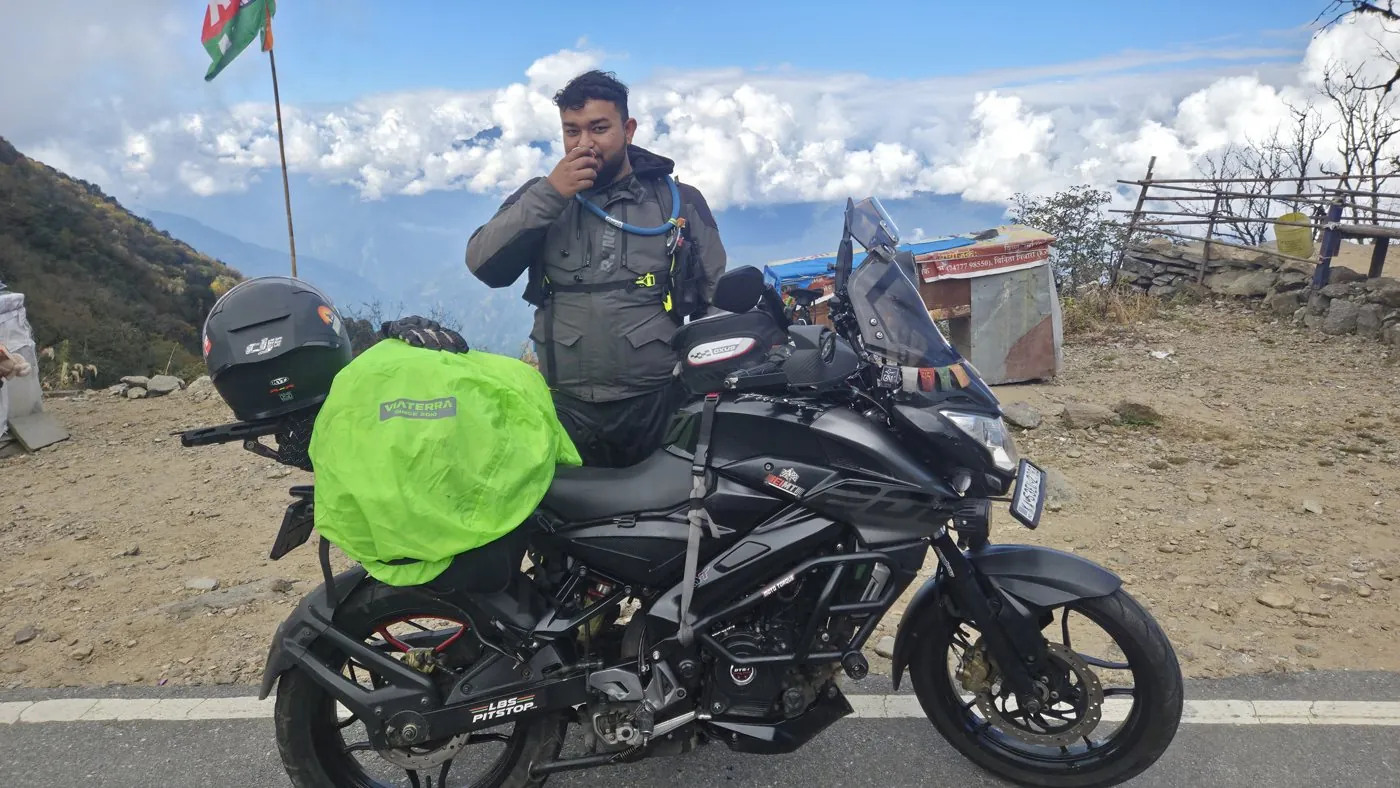
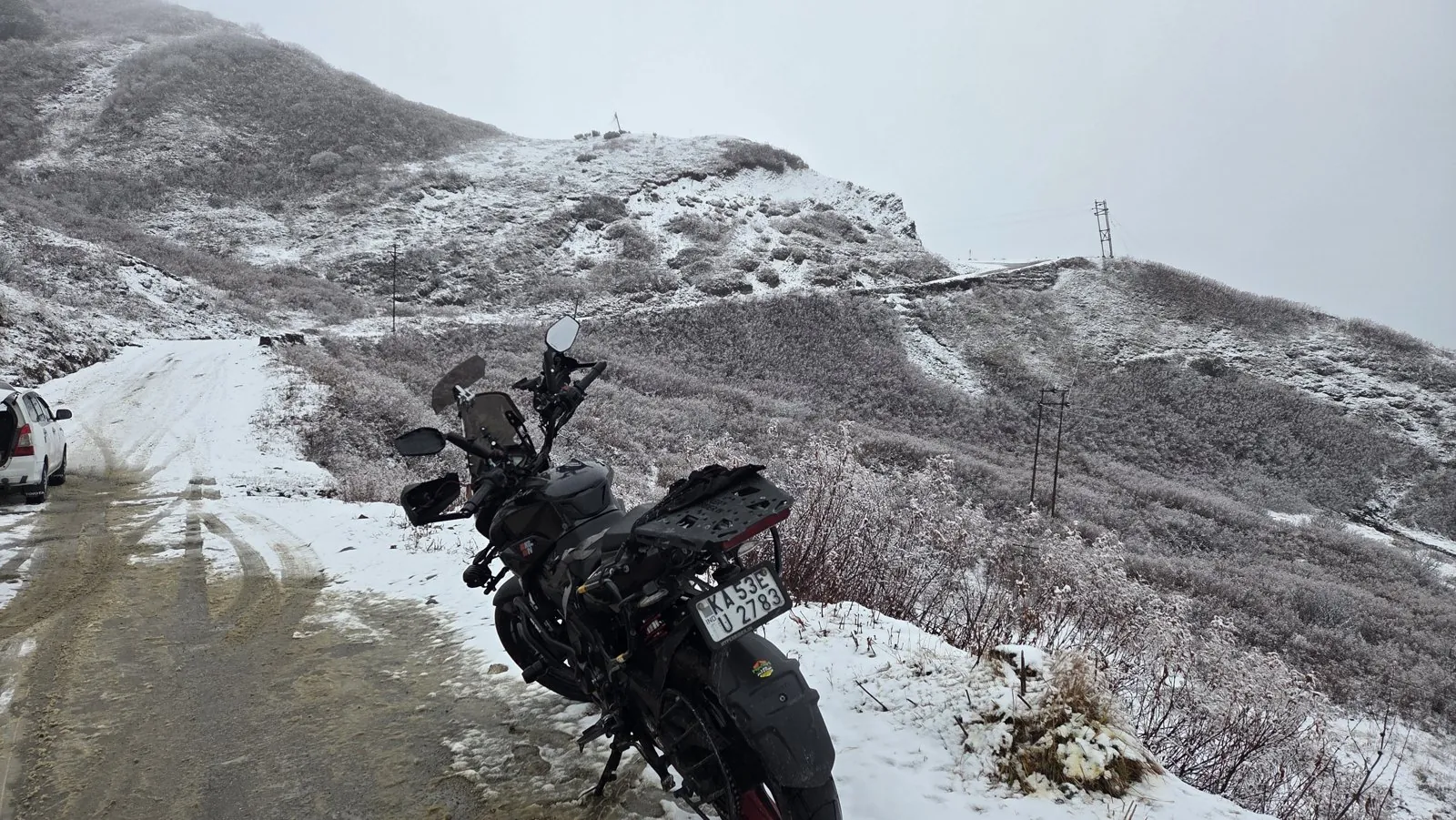
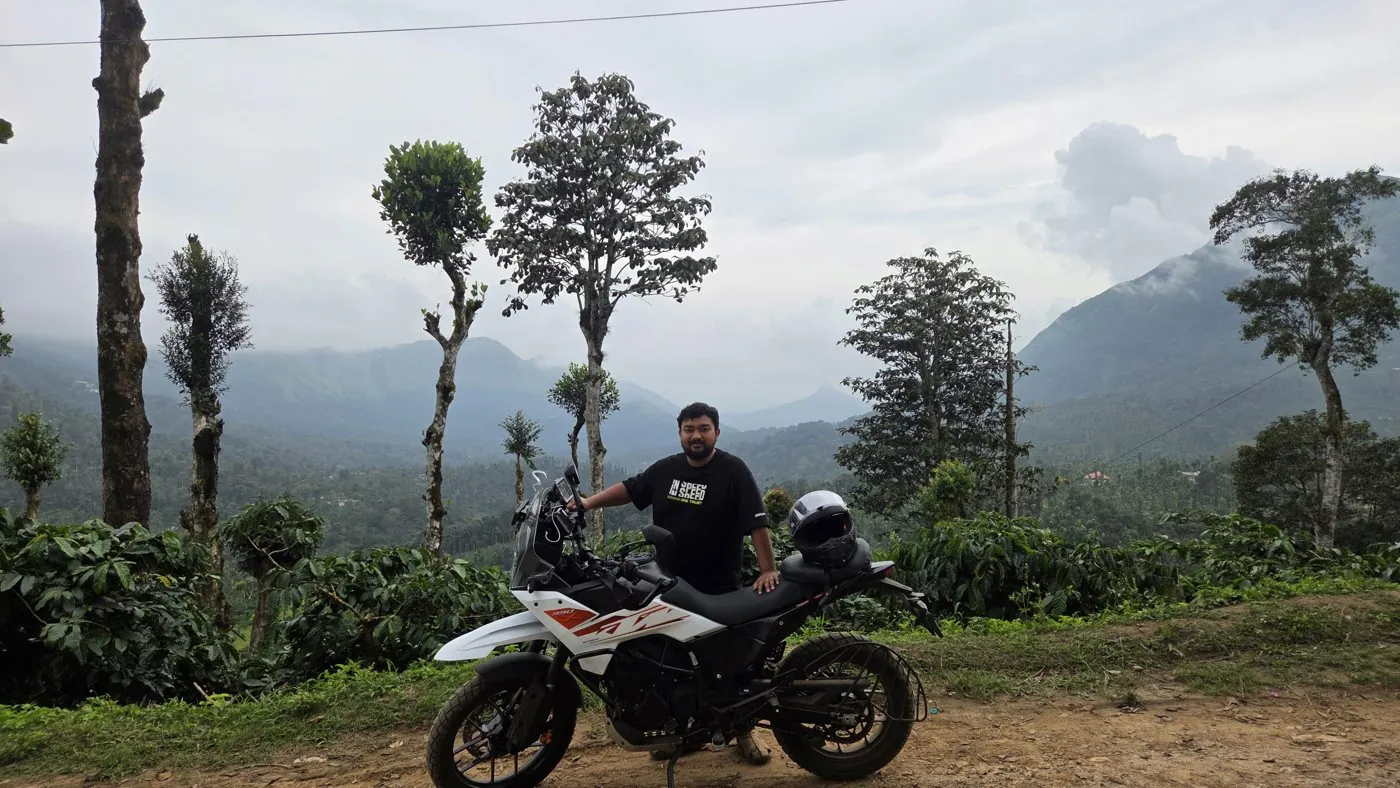
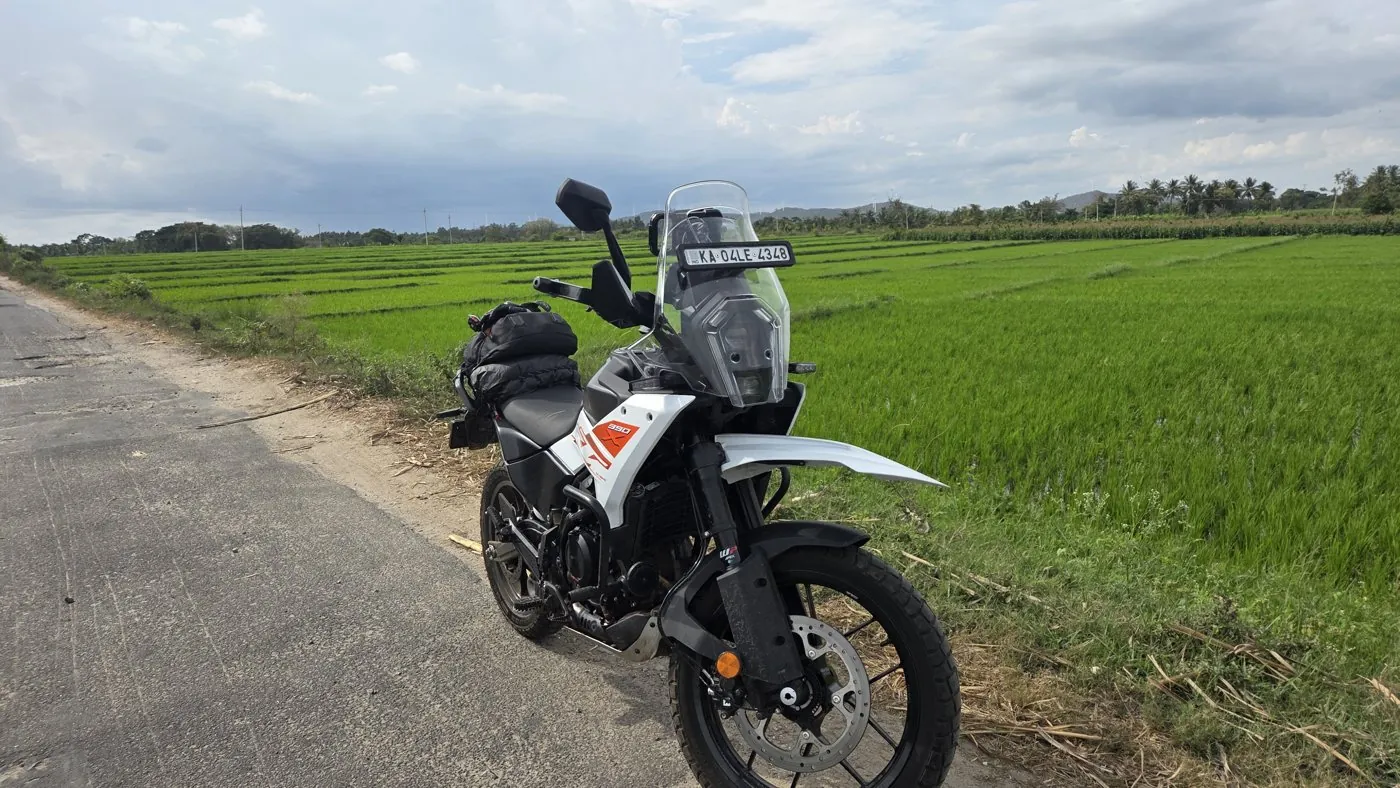
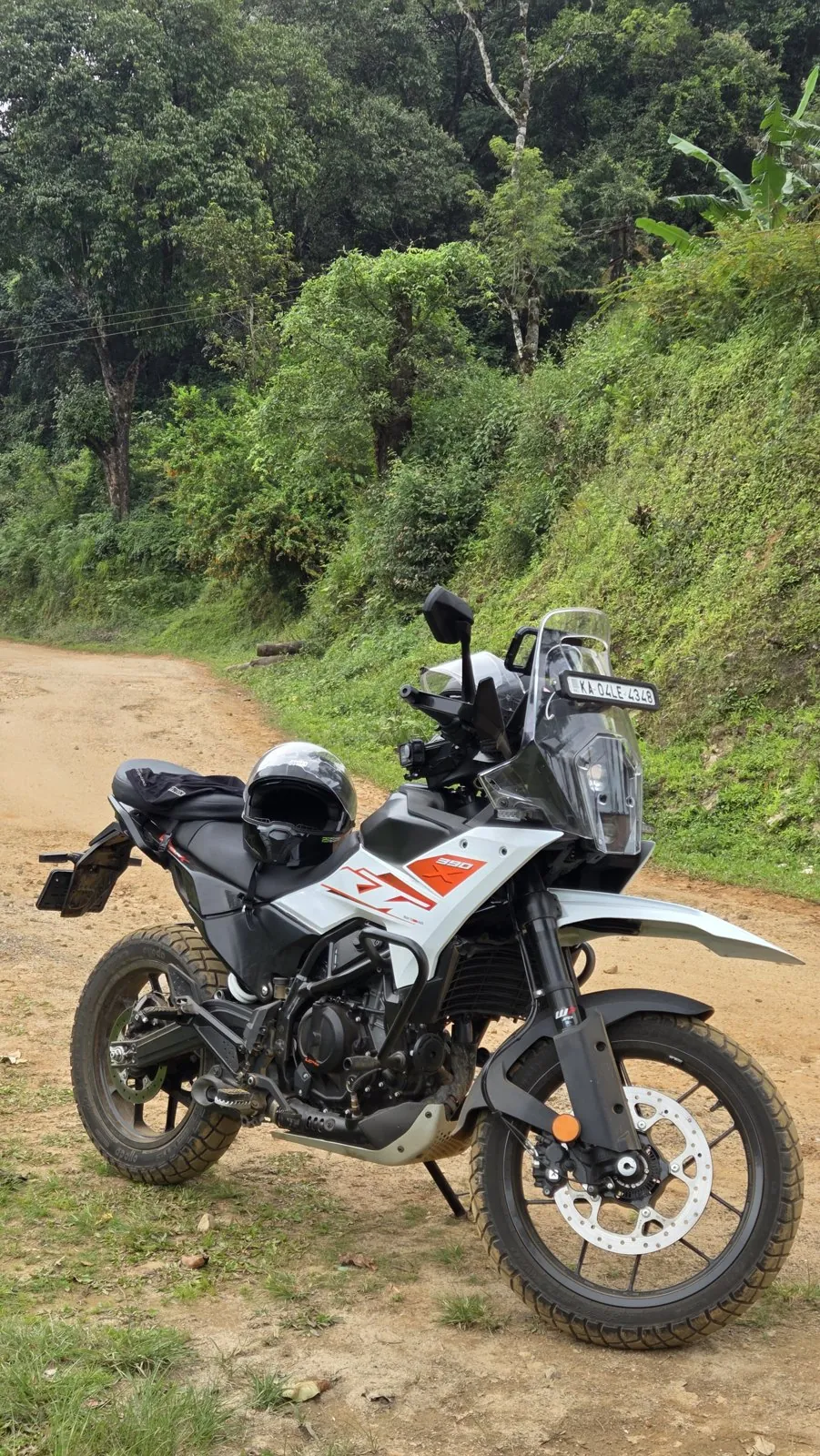
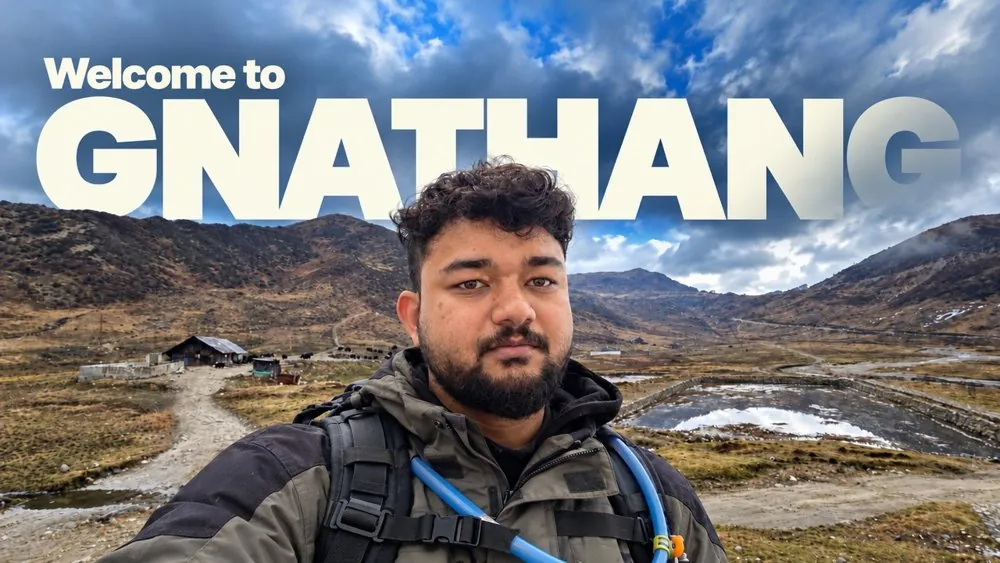
Snow in Sikkim, November 2025Fully loaded, under the rain coverIn the tea hillsThrough the fieldsThe KTM 390 Adventure X Plus
The road changes fast, and so does the air around you.
Layering: dressing for snow and for forty degrees.
On the Sikkim ride I went from the warm plains to snow on the old silk route in under two weeks. The jacket stays the same; what's under it changes. Flip the weather.
What the wind does to you
°C feels like
Wind chill uses the standard formula from Canada and the US weather services, valid at 10 °C and below. It was built for exposed skin, so treat it as a guide to how fast a gap at your neck or wrist will steal heat.
And some days the sky simply opens.
A plan for rain.
Rain itself is fine. Getting caught unprepared is what ruins a day. In my touring photos the luggage wears a bright green rain cover. The rest is routine.
Keep leather gloves and boots away from direct heat. They crack.
Stuff boots with newspaper overnight. Lube the chain once it's dry.
At night, the loaded bike sleeps outside in a town you don't know.
Trackers: knowing where the bike is.
Parking a loaded bike outside a hotel in a town you don't know is a quiet worry. I run two trackers that work in different ways, so losing one doesn't mean losing both.
A 4G GPS tracker
Reports its own position over the mobile network, wherever there's signal.
If you want to film your rides, you don't need a crew. This is the whole rig behind my channel, Roadhook Touring: action cameras for POV, a Sony ZV-E10 for the hero shots, and nothing more.
Kit lists make it look like everything works. It doesn't, and you should hear about the misses before you spend money. This one's mine.
Rynox waterproof socks Let down
I bought them for the wet. In the wet, they were underwhelming. "Waterproof" on the label set an expectation that, for me, the socks didn't meet. My Rynox rain jacket and trousers are a separate story and stay in the bag.
"Waterproof" covers very different builds. Tap one to see what it really promises.
Then there's the thing that isn't broken, just not right yet.
Helmet fit and buffeting: what I'm fixing.
If your helmet starts shaking your head at highway speed, you're not imagining it. Mine does. My KYT R2R Pro is a size L with a Pinlock Max, it feels slightly loose, and the buffeting starts at about 120 to 125 km/h.
How hard the air pushes
40mine buffets at 120–125140
680Pa of wind pressure
That's 4.0 times the push at 60 km/h.
Dynamic pressure, half of air density times speed squared, at sea-level air. The real force on a helmet depends on its shape and on the dirty air coming off the screen. Double the speed and the push goes up four times.
The fitSuspect
A helmet with room to move gets rocked by turbulent air instead of riding through it. The test: strap done up, shake your head hard. The shell shouldn't lag behind your head.
The airflowSuspect
Air peeling off the top edge of a windscreen is messy, and where it lands depends on the screen's height and how tall you sit. Change either and the buffeting moves.
The noiseResearching
I'm looking at reusable riding earplugs. Wind noise over a full day wears you out, and the damage to your hearing adds up over years.
The intercomConstraint
I ride with a Cardo Spirit intercom, so whatever earplug I pick has to let me hear it without cranking the volume.
Fixing problems like these is how the NS200 got built in the first place.
NS200 mods, sorted by the problem they fix.
A shopping list tells you what. This tells you why. Every one of the 24 changes on my NS200, grouped by the job it does. For the engineering behind the big ones, read Yantra.
The KTM is at the start of the same story.
Kitting out the KTM.
A new bike arrives bare, and the temptation is to bolt on everything at once. The KTM 390 Adventure X Plus came home on 21 August 2026. This is what it has gained since, drawn from where I sit. Tap a dot.
From the seat.
Each dot opens the part, why it's there, and its card in my kit list. The NS200's changes are on the mods shelf.
New or nine years old, kit lasts as long as you look after it.
Gear care: look after it and it looks after you.
Good gear is expensive, and most of it dies from neglect, not crashes. Pick a piece to see how to care for it. Always check the maker's label first.
Pull the liner and cheek pads out and hand-wash them in mild soap.
Clean the shell and visor with water and a soft cloth. No solvents or petrol-based cleaners: they can weaken the shell.
Dry it in the shade, never on a hot exhaust or heater.
Don't hang it from the mirror. That dents the liner from the inside.
Take all the armour out before washing.
Gentle cycle, cool water, a technical wash rather than normal detergent, no fabric softener.
Close the zips and Velcro so they don't chew the fabric.
Re-proof the outer shell when water stops beading on it.
Wipe with a damp cloth after dusty or sweaty days.
Condition with a leather conditioner a few times a year so they don't stiffen and crack.
Wet gloves dry slowly at room temperature, shaped on your hands for the last bit.
Brush the mud off before it dries hard.
Stuff wet boots with newspaper and change it every few hours.
Leather uppers need conditioning; check sole stitching and buckles before a long trip.
Empty, shake out grit and wipe the seams after each trip.
Check straps, buckles and mounting points. A frayed strap is how a bag ends up on the highway.
Store dry and unrolled so coatings don't crease and peel.
O-ring chains need an O-ring safe cleaner and lube. Harsh solvents dry out the seals.
Lube a warm chain after the ride so it soaks in, then wipe off the excess.
Check slack every few hundred kilometres on a loaded tour, and after rain.
That's the trip. Here's every piece on one shelf.
Search my kit: looking for one thing?
Type a brand, a part or a job ("brake", "rain", "DJI", "tyre") and jump straight to it.
Want the longer story on any of it? It's in the notes.
Keep reading: reviews, bikes and rides.
The kit is one part of the story. The reviews, the machines and the rides are the rest.
All The Gear, All The Time: a certified helmet, gloves, boots, an armoured jacket and riding pants on every ride, however short.
Which helmet certification is mandatory in India?
IS 4151:2015 with the ISI mark. A quality control order made BIS certification compulsory for two-wheeler helmets from June 2021, so making, importing or selling one without it is barred.
What's the difference between CE Level 1 and Level 2 armour?
Level 2 lets less force through. Under EN 1621-1 (limb armour) the average transmitted force must stay below 35 kN for Level 1 and below 20 kN for Level 2. Under EN 1621-2 (back protectors) the limits are 18 kN and 9 kN.
Is soft or hard luggage better for touring?
Soft luggage is lighter, cheaper and fits more bikes; hard cases lock and shrug off weather. I tour on soft: Rynox Drystack saddlebags on Hyperrider saddle stays, a ViaTerra Claw Pro tail bag, a ViaTerra Oxus tank bag and a ViaTerra handlebar bag.
What camera do you film The Sikkim Diaries on?
A DJI Osmo Action 4 as the main camera, a first-generation DJI Osmo Action as the front camera and a DJI Mic Mini for audio, with a TELESIN magnetic mount and a BluArmor chin mount.
How many charges will a 10,000 mAh power bank give?
Fewer than the label suggests, because some energy is lost in conversion. Multiply the bank's capacity by an efficiency figure (around 0.65 is a reasonable working guess) and divide by your device's battery capacity. The calculator above does it for you.
What should a beginner buy first on a budget?
A certified helmet that fits, then gloves, boots, an armoured jacket and riding pants. Luggage, gadgets and cameras come after the gear that protects your body.