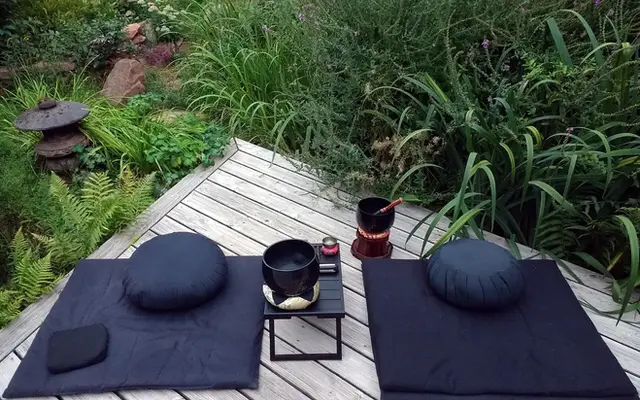
For a psychologically stable adult who wants to learn meditation properly, a 10-day Vipassana course in the S. N. Goenka tradition is worth it: it costs nothing, the teaching is structured, and a controlled study found lower stress and higher well-being that partly lasted six months. It is also hard, with about 10.75 hours of scheduled sitting a day and ten days of silence, and it is not a substitute for therapy. If you have a recent trauma, a history of psychosis, or severe depression or anxiety, talk to a clinician first, and tell the centre.
- ₹0 course fee: teaching, food and lodging are covered by past students' donations.
- 10.75 hours of scheduled sitting a day, about 107 hours over the course.
- The one controlled study found lower stress and higher well-being, partly still there at six months.
- 25.6% of regular meditators in one survey reported a particularly unpleasant experience; retreats and vipassana-only practice raised the odds.
- People with psychosis, recent trauma or severe depression should see a clinician before applying.
The question on r/Meditation usually comes from someone who has just finished a course, or is about to start one, and wants to know whether the payoff matches the pain.
The replies split, as they do on every travel blog: life-changing for some, a week of sore knees and boredom for others, and a quiet minority who found it distressing. Here is the course as it is actually run, what research on Vipassana courses and intensive retreats shows, and how I would decide.
What actually happens on a 10-day Vipassana course?
You live inside the centre for ten full days, follow a fixed timetable from a 4:00 am bell to lights out at 9:30 pm, keep "noble silence", and learn three techniques in sequence. Teaching comes from S. N. Goenka's discourses and from assistant teachers; Goenka began appointing assistant teachers in 1982 and left a system for training more before his death in 2013.
On 1 September 1955, S. N. Goenka, born and raised in Myanmar and Indian by descent, began a ten-day course with Sayagyi U Ba Khin. By his own account he went because of migraine headaches he called incurable and unbearable, and he was relying on morphine injections and sleeping tablets.
He nearly did not go. He worried that a Buddhist technique would pull him away from his Hindu religion, and he went only after U Ba Khin assured him that nothing would be taught except sīla, samādhi and paññā: morality, concentration and wisdom. By the end of the ten days, he wrote, his tension had eased, the migraine had gone, and he no longer needed the morphine. He trained under U Ba Khin for 14 years, settled in India in 1969, and began teaching there. He told the story fifty years later, so treat it as memory, not medical record.
S. N. Goenka: Fifty years on the path of Dhamma, Vipassana Newsletter (Oct 2005); dhamma.org: S. N. GoenkaThe three techniques, in order
The sequence, as dhamma.org describes it, is simple:
- Precepts. First you take five precepts for the course: no killing, stealing, sexual activity, lying or intoxicants.
- Anapana. Attention to the natural breath at the nostrils, to steady the mind.
- Vipassana, from day four. A systematic scan of bodily sensations while training yourself not to react to them.
- Metta, on the last full day. A loving-kindness practice; the silence ends that morning.
The rules
The rules are strict:
- Noble silence covers gestures and notes, not just speech, though you can talk to the teacher and the management.
- No devices: phones, smartwatches and all devices are handed in.
- No reading or writing materials, no note-taking.
- Separation: men and women are fully separated, and couples or friends are asked not to contact each other.
- Full stay: you commit to staying for the full course.
Returning students also take three extra precepts, including no food after midday.
| Time | Activity | Sitting time |
|---|---|---|
| 4:00 am | Wake-up bell | 0 |
| 4:30 to 6:30 am | Meditate in the hall or your room | 2 h |
| 6:30 to 8:00 am | Breakfast and rest | 0 |
| 8:00 to 9:00 am | Group meditation in the hall | 1 h |
| 9:00 to 11:00 am | Meditate in the hall or room, as the teacher instructs | 2 h |
| 11:00 am to 1:00 pm | Lunch, rest, interviews with the teacher | 0 |
| 1:00 to 2:30 pm | Meditate in the hall or room | 1.5 h |
| 2:30 to 3:30 pm | Group meditation | 1 h |
| 3:30 to 5:00 pm | Meditate in the hall or room | 1.5 h |
| 5:00 to 6:00 pm | Tea break | 0 |
| 6:00 to 7:00 pm | Group meditation | 1 h |
| 7:00 to 8:15 pm | Evening discourse in the hall | 0 |
| 8:15 to 9:00 pm | Group meditation | 0.75 h |
| 9:00 to 9:30 pm | Questions in the hall; lights out at 9:30 | 0 |
Add the sitting blocks and you get 10.75 hours a day, or about 107 hours over the course. For comparison, the 8-week MBSR course used in most mindfulness research averaged 23 to 32 hours of home practice across the whole course in published trials. A single Vipassana course is roughly three to four times that dose, packed into ten days.
How much does a Vipassana course cost in India?
Nothing. There are no charges for teaching, food or lodging, and only people who have completed a 10-day course in the tradition are allowed to donate, which a first-timer may do at the end. Teachers and servers are unpaid volunteers.
Your real costs are travel and time off. Dhamma Giri at Igatpuri, the tradition's main centre, is about three hours from Mumbai; centres elsewhere in India and abroad are listed, with course dates and applications, on dhamma.org. Budget about 12 days in all, which is also what Chhattisgarh allows per camp once travel is included.
Some employers now count it as leave. In April 2026 Chhattisgarh's General Administration Department allowed All India Service and state officers up to 12 days of special casual leave per 10-day camp at a recognised centre, on full pay, up to six times in a career, provided they show an admission letter before and a completion certificate after.

What does research say about Vipassana courses?
There is one controlled evaluation of the standard Goenka 10-day course, and it is encouraging but modest in design: lower stress and higher well-being after the course, partly sustained at six months. Most other evidence comes from broader studies of meditation and retreats.
The one controlled study
Rebecca Szekeres and Eleanor Wertheim measured 122 people before and after a community Vipassana course, comparing them with 50 "early enrollers" who filled in the same questionnaires over the same time span while waiting for their own course.
- After the course: lower stress and higher well-being, self-kindness and mindfulness.
- At six months (90 participants): some of the gain had faded, especially for stress, but scores were still better than before the course.
- Mechanism: the more a person's mindfulness improved, the more their stress and well-being improved, consistent with mindfulness being one route by which the course works.
The design leaves real gaps. Everyone chose to attend, the measures were all self-report, and the control group was not randomised. It tells you that people who complete a course usually feel better afterwards, not that the course beats other uses of ten days.
122 attendees of standard residential Vipassana courses completed questionnaires before and after, against 50 early enrollers measured over the same interval before their own course. Stress fell and well-being, self-kindness and mindfulness rose; 90 were followed up at six months, when gains had partly faded but remained above baseline. Limit: non-random comparison group and self-report only.
Read the abstractCan a Vipassana retreat be harmful?
Yes, for a minority. Systematic reviews and large surveys find that unpleasant or harmful experiences during or after meditation are not rare, that they can happen to people with no psychiatric history, and that intensive and insight-style practice is linked to higher reported rates.
What the reviews count
Miguel Farias and colleagues reviewed 83 studies with 6,703 participants. Adverse events appeared in 55 of those studies.
The pooled prevalence was 8.3%, but it varied hugely by design: 3.7% in experimental studies, which mostly use short, gentle programmes, against 33.2% in observational studies of practising meditators. The most common were anxiety, depression and cognitive anomalies such as disturbed perception.
A 2019 survey by Marco Schlosser and colleagues asked 1,232 regular meditators a single question about particularly unpleasant meditation-related experiences: 25.6% said they had had one.
The odds were higher among people with more repetitive negative thinking, among those who practised only "deconstructive" methods such as vipassana, and among those who had ever attended a retreat. The odds were lower among women and religious participants.
See the data as a table
| Prevalence (%) | |
|---|---|
| Experimental studies (Farias 2020) | 3.7 |
| All studies pooled (Farias 2020) | 8.3 |
| Regular meditators, any unpleasant experience (Schlosser 2019) | 25.6 |
| Observational studies (Farias 2020) | 33.2 |
Source: Farias et al., Acta Psychiatrica Scandinavica 2020; Schlosser et al., PLOS ONE 2019 · Different definitions: Farias counts adverse events reported in studies; Schlosser asked meditators about any particularly unpleasant experience they linked to practice.
Two things follow
First, the course's own screening is right. dhamma.org says the course is not a substitute for medical or psychiatric treatment and is not recommended for people with significant mental health problems, because old symptoms can return during or after the course.
Second, a "bad sit" is not the same as harm. Aching knees, boredom, anger at day two and a flood of old memories are common and usually pass.
Symptoms that do not pass after the course, such as persistent panic, sleeplessness, depersonalisation or unusual beliefs, need a doctor, not more sitting.
Searched five databases to October 2019; 83 studies with 6,703 meditating adults met inclusion criteria. 65% of studies reported at least one adverse event. Pooled prevalence 8.3% (95% CI 5 to 12%): 3.7% in experimental and 33.2% in observational studies. Anxiety (33% of reporting studies), depression (27%) and cognitive anomalies (25%) were most common. Limit: adverse events were often poorly recorded, so true rates are uncertain.
Read the paperOnline survey of 1,232 people with at least two months of regular practice (mean age 44.8). 315 (25.6%) reported a particularly unpleasant experience they thought meditation may have caused. Higher odds with repetitive negative thinking, purely deconstructive practice such as vipassana, and any past retreat; lower odds in women and religious participants. Limit: cross-sectional, single-question measure, and no data on severity or duration.
Read the paper (free)Who should not do a Vipassana course yet?
Anyone in acute crisis, anyone with a history of psychosis or bipolar mania, and anyone with recent trauma or severe depression or anxiety should get clinical advice before booking. That matches both the centre's own guidance and the risk factors in the research.
- Recent trauma or bereavement. Ten days of uninterrupted inward attention, with no phone or journal, can bring memories up faster than you can process them.
- Psychosis or mania, past or present. Sleep loss, isolation and intense practice are known triggers. Declare it on the application; the centre can advise.
- Heavy rumination. In Schlosser's survey, repetitive negative thinking predicted unpleasant experiences. A gentler weekly practice first may serve you better.
- People on psychiatric medication. Do not stop it for the course. Tell your prescriber and the centre.
- Anyone expecting a cure. If the goal is treating a disorder, evidence-based therapy comes first. Meditation can be an add-on, not a replacement.

So, is it worth it?
It is worth it if you want an intensive, rule-bound introduction to one meditation system, you are mentally steady, and you can treat ten days as an experiment rather than a guaranteed transformation. It is not worth forcing if your life is in crisis or you mainly want stress relief, which shorter, cheaper-in-time options deliver with better evidence.
Here is how I would weigh it.
| Upside | Downside |
|---|---|
| A free, well-organised course | A big time cost: about 12 days with travel |
| Enough hours to actually learn a technique | Physical pain from long sitting |
| A total break from screens, which most people never get | A real but minority risk of distressing experiences |
| Evidence of reduced stress afterwards | Gains fade unless you keep a daily practice |
The six-month data suggest the benefit depends on keeping some daily practice going.From Szekeres and Wertheim, 2015
If you want to test the water first, try a few weeks of 20 to 30 minutes a day with the approach in how to start meditating, and see how your mind reacts to sustained attention on the breath.
For a comparison of methods by evidence, see meditation techniques ranked by evidence. For what the technique did in an Indian prison, read the Tihar Jail Vipassana story, and for whether any of this shows up on brain scans, see does meditation change the brain. For the rest of the mind world, start at Manthan.
- Check the timing. Pick a course with no deadline or family event in the week after; most people need two or three quiet days to come back.
- Practise sitting. Two weeks of daily 30-minute sits, plus hip and back stretching, make the first days less brutal.
- Be honest on the form. Declare mental health history and medication. The centre uses it to advise, not to judge.
- Set a rule for leaving. Decide in advance that you will talk to the teacher before quitting, so a bad afternoon does not end the course.
- Plan the after. Decide what daily practice you will keep, even 20 minutes, since gains faded at six months in the one controlled study.
What's new
- Chhattisgarh gives government employees up to 12 days of paid special leave for 10-day Vipassana camps People Matters, Apr 2026
- Punjab chief minister leaves for a four-day vipassana session in Bengaluru amid political criticism ThePrint, Jul 2026
- Review of 40 intensive retreat and workshop studies finds short-term stress gains but weaker effects on burnout, and few controlled trials Journal of Clinical Medicine, 2026
Questions people ask
Can you leave a Vipassana course midway?
You are asked to commit to the full ten days, and leaving early is discouraged because the technique is taught in stages. If you feel you must leave, speak to the teacher or the management first; they can often help with the specific difficulty.
How many hours a day do you meditate in Vipassana?
The published timetable schedules about 10.75 hours of meditation a day, between 4:30 am and 9:00 pm, of which about 3.75 hours are group sittings in the hall and the rest in the hall or your room.
Is Vipassana religious?
The technique comes from the Theravada Buddhist tradition as taught by Sayagyi U Ba Khin in Myanmar and S. N. Goenka, but the course presents it as non-sectarian, and people of all faiths attend. You are not asked to convert or perform rites; you are asked to keep the precepts during the course.
Can I bring my phone or a book?
No. Phones, smartwatches and all devices are deposited on arrival, and reading and writing materials are not allowed. Families can reach you through the centre management in an emergency.
Is Vipassana good for anxiety?
Course participants report lower stress afterwards, but anxiety is also the most common adverse effect reported in meditation research. If anxiety is a diagnosed problem, see a clinician first and treat the course as a possible add-on.
Sources
- dhamma.org: The Code of Discipline for Meditation Courses (timetable and rules)
- dhamma.org: Vipassana Meditation (course structure and donations)
- dhamma.org: S. N. Goenka
- S. N. Goenka: Fifty years on the path of Dhamma, Vipassana Newsletter, Vipassana Research Institute (2005)
- Ministry of Health and Family Welfare: Tele-MANAS
- Vipassana Research Institute: Dhamma Giri Today
- Szekeres RA, Wertheim EH. Evaluation of Vipassana meditation course effects. Stress and Health 31(5):373-381 (2015)
- Farias M et al. Adverse events in meditation practices and meditation-based therapies: a systematic review. Acta Psychiatrica Scandinavica 142(5):374-393 (2020)
- Schlosser M et al. Unpleasant meditation-related experiences in regular meditators. PLOS ONE 14(5):e0216643 (2019)
- Lindahl JR et al. The varieties of contemplative experience: a mixed-methods study of meditation-related challenges in Western Buddhists. PLOS ONE 12(5):e0176239 (2017)
- Kral TRA et al. Absence of structural brain changes from mindfulness-based stress reduction. Science Advances (2022)
- People Matters: Chhattisgarh employees can now take paid leave for meditation camps (2026)
- ThePrint: Punjab CM leaves for vipassana in Bengaluru (2026)
- Novak AM, Lev-Ari S. Intensive interventions for burnout, stress and occupational well-being: a critical review. Journal of Clinical Medicine (2026)

Sapta (Saptarshi Sarkar) is a mechanical engineer turned marketer in Bengaluru and a solo touring rider. He writes the seven Saptaverse blogs. Work with him or read more of Mindblog.