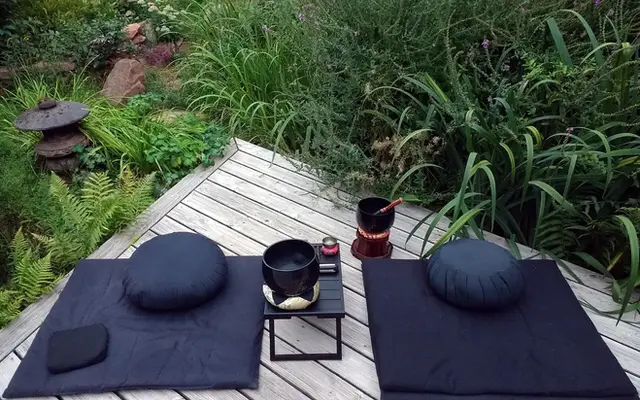
If you meditated 10 hours a day for 10 days, you would be doing a standard Vipassana course in the S.N. Goenka tradition, about 107 hours of practice. The research shows lower stress and higher mindfulness and well-being afterwards, partly lasting six months, but also a real rate of difficult experiences: anxiety, sleep changes and, rarely, serious crises. It changes how you relate to your mind more than it measurably changes your brain's structure.
- 10.75 hours of scheduled sitting a day, about 107.5 hours in ten days.
- That is roughly 3x the average home practice in an 8-week MBSR course (32 h).
- Community data: stress down (d ≈ 0.79) and mindfulness up after a course, partly lasting six months.
- 58% of US meditators report at least one adverse effect; 9% one that impairs functioning.
- No controlled study shows structural brain change from a single 10-day course.
Ten hours a day sounds absurd until you notice that it is a timetable people follow on purpose. Courses run on donations at centres across India, from Igatpuri in Maharashtra to Bengaluru, and the schedule has not changed in decades.
That makes it one of the few extreme mental interventions with a fixed "dose" that researchers can study.
What does 10 hours a day of meditation actually look like?
It looks like a 4 am bell and a day of sitting broken only by meals, a discourse and sleep. One of the best-known people to have walked into it cold is a historian.
In 2000, Yuval Noah Harari was in the middle of a history PhD at Oxford and, by his own account, in the middle of an existential crisis. A friend had nagged him for about a year to take a Vipassana course; Harari thought it was "some kind of mystical nonsense" and finally gave in.
The instruction, he recalls, was simply to observe directly what is happening right now. After only the second day he was "completely awestruck": it was the most rigorous practice he had met, and he was not asked to believe anything. Years later, he told the Pariyatti Journal, he meditated about two hours a day, sat a long course every year and served at least two 10-day courses. He is the same historian who later wrote Sapiens.
Pariyatti Journal: Uncovering Realities, an interview with Yuval Noah HarariThe published code of discipline for courses in the Goenka tradition sets this timetable:
| Time | Activity | Meditation hours |
|---|---|---|
| 4:00 am | Wake-up bell | 0 |
| 4:30-6:30 am | Meditate in hall or room | 2.0 |
| 8:00-9:00 am | Group meditation | 1.0 |
| 9:00-11:00 am | Meditate as instructed | 2.0 |
| 1:00-2:30 pm | Meditate in hall or room | 1.5 |
| 2:30-3:30 pm | Group meditation | 1.0 |
| 3:30-5:00 pm | Meditate as instructed | 1.5 |
| 6:00-7:00 pm | Group meditation | 1.0 |
| 7:00-8:15 pm | Discourse | 0 |
| 8:15-9:00 pm | Group meditation | 0.75 |
| 9:30 pm | Lights out | 0 |
Add the right-hand column and you get 10.75 hours a day. Over 10 full days that is
The rules that strengthen the dose
On top of that come the rules that make the dose stronger:
- "Noble silence": no talking, gestures or notes with other students until the last full day.
- Five precepts, including no intoxicants.
- Simple vegetarian food, and for returning students no food after midday.
In practice, the course is also a 10-day removal of most of the inputs that normally fill an Indian adult's day.

How does 107 hours compare with the meditation in most studies?
It is roughly three times the formal practice in the most-studied programme. Mindfulness-Based Stress Reduction (MBSR), the 8-week course behind most lab research, involves weekly classes plus daily home practice. In a combined analysis of two randomised trials published in Science Advances in 2022, MBSR participants logged an average of 32 hours of home practice (range 2 to 85). The authors cite earlier MBSR work averaging 23 hours.
See the data as a table
| Practice hours (h) | |
|---|---|
| Earlier MBSR studies (mean) | 23 |
| MBSR in Kral 2022 (mean) | 32 |
| MBSR in Kral 2022 (top of range) | 85 |
| 10-day Goenka course (scheduled) | 107.5 |
Source: Kral et al., Science Advances 2022; dhamma.org timetable · MBSR figures are home practice only; the 10-day figure is scheduled sitting time, not verified actual practice.
Your retreat dose in MBSR-course equivalents
The last output is the point people miss. At 20 minutes a day, the common recommendation in beginner guides, 107.5 hours takes about 323 days. A retreat compresses close to a year of daily practice into ten days, which is exactly why its effects, good and bad, are stronger.
What do studies find after a 10-day Vipassana course?
The best community study found lower stress and higher well-being, self-kindness and mindfulness after a standard course, with some of it fading by six months. Sarah Szekeres and Eleanor Wertheim in Australia compared 122 people attending a 10-day course in the Goenka tradition with 50 people who had enrolled for a later course, and followed 90 of the attendees for six months. The 2025 systematic review below reports their post-course effects as about d = 0.79 for stress, d = 0.68 for mindfulness and d = 0.75 for well-being and self-kindness. Stress crept back the most, but six-month scores were still better than before the course.
A quasi-experiment with 122 course participants and 50 waitlisted controls, and a 6-month follow-up of 90. The course reduced subjective stress and raised well-being, self-kindness and mindfulness; changes in mindfulness tracked the other changes, suggesting it is part of the mechanism. Limit: not randomised, all self-report, and people who choose a silent retreat differ from those who don't.
Read the abstractThe wider evidence is thin but consistent. A 2025 systematic review in Cureus by Giridharan and colleagues found 11 Vipassana studies from 2010 to April 2025, including three randomised trials, with benefits for stress, anxiety, mindfulness and migraine. It also found small samples (median 40), no blinding in 10 of 11 studies, heavy reliance on self-report, and no study that systematically recorded adverse events.
Eleven studies (3 RCTs, 2 single-arm trials, a pilot and 5 observational studies) on Vipassana in retreats, labs and classrooms. Reported benefits include lower stress and anxiety, higher mindfulness, and fewer migraine days in one trial. The authors rate the evidence moderate. Limit: small, mostly unblinded studies, self-report, and adverse effects not studied.
Read the paper (free)For a non-extreme version of the same question, see is a 10-day Vipassana course worth it, and for how Vipassana compares with other methods, meditation techniques ranked by evidence.

Can 10 days of meditation go wrong?
Yes, and intensive retreats are where it most often does. In 2017 Jared Lindahl, Willoughby Britton and colleagues interviewed 60 Western Buddhist practitioners from Theravāda, Zen and Tibetan traditions who had challenging experiences, plus 32 teachers and clinicians. They mapped 59 kinds of experience across seven domains. Because the study deliberately sought people with difficulties, these are not population rates, but they show what difficulties look like.
See the data as a table
| Share reporting (%) | |
|---|---|
| Fear, anxiety, panic or paranoia | 82 |
| Change in motivation or goals | 78 |
| Positive affect | 75 |
| Somatic energy | 63 |
| Sleep changes | 62 |
| Changed self-other boundaries | 53 |
| Social impairment | 50 |
Source: Lindahl et al., PLoS One 2017 · Purposive sample selected for challenging experiences; not a prevalence estimate.
The numbers that matter
The numbers that matter for this what-if: 72% of the challenges happened during or just after a retreat, and 41% of practitioners were meditating 10 or more hours a day when they began. 73% reported moderate to severe impairment in at least one area, median duration was one to three years, 17% reported suicidality and 17% had an inpatient stay. Again, this is a sample chosen for difficulties.
Qualitative interviews with 60 practitioners and 32 experts produced a taxonomy of 59 experience types in 7 domains and 26 influencing factors. Most challenges clustered around retreats and high-intensity practice. Limit: purposive sampling of people with problems, mostly white Western practitioners, and retrospective recall.
Read the paper (free)The representative estimate
The representative estimate came in 2025. Nicholas Van Dam and colleagues surveyed 886 US adults, matched to the country's meditator population, using a 30-item checklist. About 58% reported at least one adverse effect, about 30% found one challenging or distressing, and 9% reported one that impaired their functioning. People who had attended residential retreats were more likely to report an impairing effect, as were those with recent mental health symptoms. The authors stress that this is not a reason to fear meditation, but it is a reason to screen, which is what the course application forms try to do.
Does meditating that much change your brain?
Not in any way we can reliably measure from short courses. Early MRI studies reported grey-matter changes after 8 weeks of MBSR, but the largest test, Kral and colleagues' 2022 pooled analysis of two randomised trials with 218 meditation-naive people, found no evidence that MBSR changed grey-matter volume, density or cortical thickness compared with either a waitlist or an active control.
Ten days is shorter still, though more intense, and no comparable controlled imaging study of a Goenka course exists.
It changes how you relate to your mind more than it measurably changes your brain's structure.
Functional changes are better supported: the attention and mind-wandering networks behave differently during and after practice, which is covered in the default mode network and does meditation change the brain. The long-term practitioner studies, such as the monks' gamma study, involve tens of thousands of hours, not one course.

Why do some people feel transformed and others feel worse?
Because the same 107 hours land on very different starting points. Lindahl's interviewees named the practitioner's worldview, the teacher relationship, the intensity and consistency of practice and the practice approach as the most common influences, each cited by over 90% of them.
Van Dam found recent psychological distress raised the odds of adverse effects. The Szekeres study found that gains in mindfulness tracked gains in well-being, which suggests the people who benefit most are those who leave with a skill they keep practising.
In India the course has also been taken into hard settings, most famously at Tihar Jail in Delhi in the 1990s, told in the Tihar Vipassana story.
- Before. Try daily sitting for a few weeks first, using a beginner's meditation guide, and disclose any mental health history on the form.
- During. Expect physical discomfort and restlessness. Speak to the teacher if anything frightens you; talking to the teacher and management is allowed during silence.
- After. The six-month data says some of the benefit fades. Keeping a daily practice, even a short one, is the obvious way to hold on to the skill; that is my inference, not a tested result.
Ten hours a day for ten days is a fixed, donation-run course that adds up to about 107.5 hours of practice, roughly three MBSR courses of home practice compressed into ten days. Controlled community data shows lower stress and higher mindfulness with moderate effect sizes, partly lasting six months. The same intensity raises the risk of difficult experiences, and retreat attendance is linked to more impairing side effects. For a mentally well person who prepares, it is a reasonable experiment; for someone with a psychiatric history, it needs a doctor's view first.
What's new
- A representative US survey finds nearly 60% of meditators report at least one side effect, and 9% one that impairs functioning Association for Psychological Science, Aug 2025
- India's UN mission hosts the second World Meditation Day at UN headquarters with close to 700 participants Permanent Mission of India, Dec 2025
- A systematic review of 11 Vipassana studies rates the evidence moderate and calls for larger trials Cureus, 2025
What if next?
- What if a thought had weight? Ten days of watching thoughts makes them feel heavy. Physics says each bit weighs about 3 × 10−38 kg.
- What if you could stop time for everyone but yourself? Meditators talk of time slowing down; doing it for real would leave you in a dark, airless box.
- What if your brain ran on a phone battery? All that sitting still still costs the brain about 17 watts, and a flagship phone battery would last about an hour.
Questions people ask
Is a 10-day Vipassana course dangerous?
For most participants it is not, and community studies report benefits. But intensive retreats are linked to more impairing side effects, and the organisers advise people with significant mental health problems not to attend without medical advice. Screening and honest disclosure matter.
Can you really meditate for 10 hours a day as a beginner?
The timetable schedules 10.75 hours, and most first-timers manage it with breaks in posture, sitting in their room for some sessions. It is physically uncomfortable for the first days, and that discomfort is part of what the course teaches people to observe.
What happens after a Vipassana course?
Many people report feeling calmer and more aware. The six-month data from Szekeres and Wertheim shows gains partly fading, especially for stress, while staying above pre-course levels. Continued daily practice appears to be what keeps them.
Does Vipassana change the brain?
No controlled imaging study has shown structural change from a single 10-day course, and the largest MBSR imaging trial found none after 8 weeks. Functional changes in attention networks are better supported.
Sources
- Dhamma.org: Code of Discipline for Meditation Courses (accessed 2026) (source for the timetable, silence, precepts and mental health advice)
- Szekeres R.A., Wertheim E.H.: Evaluation of Vipassana meditation course effects, Stress and Health (2015)
- Giridharan S. et al.: The Impact of Vipassana Meditation on Health and Well-Being, Cureus (2025) (source for the effect sizes of the Szekeres study and evidence quality)
- Lindahl J.R. et al.: The varieties of contemplative experience, PLoS One (2017) (source for the 41%, 72% and category percentages)
- APS: Does meditation come with side effects? (Van Dam et al., Clinical Psychological Science) (2025)
- Kral T.R.A. et al.: Absence of structural brain changes from mindfulness-based stress reduction, Science Advances (2022) (source for 218 participants and 32 h home practice)
- Permanent Mission of India to the UN: second World Meditation Day press release (2025)
- Pariyatti Journal: Uncovering Realities, an interview with Yuval Noah Harari (source for the story: first course in 2000, daily practice, annual long course)
- Ministry of Health and Family Welfare: Tele MANAS
More on meditation and the mind on the Manthan world page.

Sapta (Saptarshi Sarkar) is a mechanical engineer turned marketer in Bengaluru and a solo touring rider. He writes the seven Saptaverse blogs. Work with him or read more of Mindblog.