
The default mode network (DMN) is a set of brain regions, centred on the medial prefrontal cortex, the posterior cingulate cortex and precuneus, and the angular gyrus, that becomes more active when you stop attending to the outside world. It supports thinking about yourself, other people, your past and your future. It is the machinery of mind-wandering, which a 2010 smartphone study found in 46.9% of waking moments, and its main hubs are relatively quieter in experienced meditators.
- Four hubs: medial prefrontal cortex, posterior cingulate and precuneus, angular gyrus, medial temporal lobe.
- 46.9% of waking moments were spent mind-wandering in a sample of 2,250 adults.
- 10.8% vs 4.6%: what you think about predicts happiness better than what you are doing.
- Unpleasant wandering costs about 24 points of mood on a 100-point scale; pleasant wandering costs nothing measurable.
- Meditators show quieter DMN hubs, but the evidence is small-sample and mostly correlational.
The network was found by accident. Brain-imaging studies of the 1990s compared a task with a resting baseline, and a consistent set of areas kept showing lower activity during the task than at rest.
In 2001 Marcus Raichle's group at Washington University in St Louis argued that these areas were not idle at rest but running an organised "default mode", and two years later Michael Greicius and Vinod Menon at Stanford showed they form a connected network. Since then the DMN has been the subject of more than 8,000 studies.
Here is what it is, what it does, how it ties to happiness and rumination, and what meditation research does and does not show.
What is the default mode network?
The default mode network is a group of brain regions that deactivate when you focus on an external task and reactivate when attention turns inward.
In the late 1990s Gordon Shulman, a former student of the attention researcher Michael Posner, pooled brain scans from nine PET studies covering 134 people at Washington University. He was hunting for a system that switched on whenever attention was engaged. It never appeared. What did appear was the opposite: a consistent set of areas that went quieter whenever people read, moved a hand or did any demanding task.
His colleague Marcus Raichle saw that dip as the opening. The field resisted. At the time, Raichle later told The Psychologist, the mindset was that a task turns the brain on, so activity at rest was dismissed as noise. His 2001 answer used oxygen supply and demand to show the resting brain was busy, not idle. The paper, the magazine wrote, landed like a bomb.
The Psychologist (British Psychological Society): The restless brainHow Raichle defined a true baseline
Raichle's 2001 paper in PNAS made the case with a physiological measure, the oxygen extraction fraction: the share of the oxygen delivered by blood that brain tissue actually uses. In the awake brain at rest, eyes closed, that fraction was remarkably uniform across regions, which let the team define a true baseline.
Measured against it, a specific set of areas reliably dropped below baseline during many different goal-directed tasks.
The 1997 pattern behind it
The Washington University group had already seen this pattern. A 1997 meta-analysis led by Gordon Shulman pooled PET datasets collected since the late 1980s and found consistent task-related decreases in:
- the posterior cingulate and precuneus;
- the left inferior parietal cortex;
- several left frontal regions;
- the medial prefrontal cortex;
- the right amygdala.
Raichle's contribution was to argue that the decreases meant something: an organised baseline mode of brain function, suspended when a task demands attention.
| Hub | Location | Main roles linked to it |
|---|---|---|
| Medial prefrontal cortex (mPFC) | Front, midline | Thinking about yourself, judging personal relevance, thinking about others' minds |
| Posterior cingulate cortex and precuneus (PCC) | Back, midline | Core connector hub; autobiographical memory; early target in Alzheimer's disease |
| Angular gyrus | Side of the parietal lobe | Combining memories and meanings; episodic and semantic retrieval |
| Medial temporal lobe and retrosplenial cortex | Inner temporal lobe, behind the PCC | Recalling past scenes and imagining future ones |
| Ventral mPFC and subgenual cingulate | Lower front midline | Altered in depression and linked to rumination |
Using quantitative PET measurements of blood flow and oxygen metabolism, the authors mapped the oxygen extraction fraction across the resting adult brain and found it nearly uniform, with no regions "active" relative to the hemisphere mean; the only significant deviations were in the visual system. That uniform baseline gave meaning to a set of regions that consistently decrease their activity during a wide range of goal-directed tasks, which the authors proposed as an organised default mode suspended during focused behaviour. The limit: the paper defines the network from deactivations and metabolism, not from what people are thinking, so the link to mind-wandering came from later work.
Read the paper (free)What does the default mode network actually do?
It builds and replays your inner narrative. Vinod Menon's 2023 review in Neuron, written 20 years after he and Greicius named the network, groups the evidence under five functions:
- self-reference;
- social cognition;
- episodic and autobiographical memory;
- language and semantic memory;
- mind-wandering.
His synthesis is that the DMN integrates memory, language and meaning into a coherent internal story of your own experience, which is central to a sense of self.
One network, many jobs
That explains the overlap of jobs. Remembering last Diwali, imagining tomorrow's meeting, wondering what a friend meant by a message and rehearsing what you should have said all draw on the same hubs. All of them are simulations built from personal memory and meaning rather than from current sensory input.
The DMN is not the "doing nothing" network. It is the "thinking about things that are not here" network.My summary of Menon (2023)
When it fails to switch off

It is also not opposed to focus in a simple on-off way. Menon describes work in which attention lapses were marked by weaker deactivation of the posterior cingulate, precuneus and angular gyrus along with weaker sensory responses.
So when the DMN fails to quiet down during a task, performance suffers. The cost of a wandering mind during work shows up as slower, sloppier responses. I unpack that cost in attention residue and task switching.
A review by one of the scientists who named the network. It traces the PET findings of the 1990s, the 2003 resting-state connectivity study that seeded the posterior cingulate and medial prefrontal cortex, and the rapid findings of DMN dysfunction in Alzheimer's disease, depression and schizophrenia. In Alzheimer's the disruption mostly hits the posterior cingulate, retrosplenial cortex and medial temporal lobe; in depression it centres on the ventral medial prefrontal and subgenual cingulate cortex, linked to rumination. The limit: it is a narrative review with a personal angle, and functions such as "internal narrative" are an interpretation across many correlational imaging studies.
Read the paper (free)How much of the day does the mind wander, and does it make us unhappy?
About half the day, and yes, on average it does. Matthew Killingsworth and Daniel Gilbert at Harvard built an iPhone app that pinged people at random waking moments and asked three questions:
- how they felt (0 to 100);
- what they were doing (22 activities);
- whether they were thinking about something other than what they were doing.
Analysing 2,250 adults (mean age 34, 58.8% male, 73.9% in the US), they found mind-wandering in 46.9% of samples and in at least 30% of samples during every activity except making love.
Where the mind goes matters
People were less happy when their minds wandered, during every activity, including the least enjoyable ones. Wandering to pleasant topics did not lift mood above staying on task; neutral and unpleasant topics lowered it, the unpleasant ones sharply.
Time-lag analyses suggested that mind-wandering generally came before the unhappiness rather than after it. And what people were thinking predicted their happiness better than what they were doing: mind-wandering explained 10.8% of within-person variance in happiness, the activity only 4.6%.
Use this to check what you just read against your own day. It applies the study's averages to your waking hours; your own mix will differ.
How much of your day goes to mind-wandering
See the data as a table
| Regression slope vs on-task (points (0-100 scale)) | |
|---|---|
| Pleasant topic | -0.52 |
| Neutral topic | -7.2 |
| Unpleasant topic | -23.9 |
Source: Killingsworth & Gilbert, Science 2010 · Pleasant topics: not significant. Share of mind-wandering samples: pleasant 42.5%, neutral 31%, unpleasant 26.5%.
An experience-sampling study using a web app on iPhones, drawing on a database of nearly a quarter of a million samples from about 5,000 people in 83 countries. The analysed sample of 2,250 adults showed mind-wandering in 46.9% of moments. Minds wandered more to pleasant topics (42.5% of samples) than to neutral (31%) or unpleasant ones (26.5%), but only on-task and pleasant-topic thinking were equally happy; neutral (slope -7.2) and unpleasant (-23.9) wandering were clearly worse. Mind-wandering explained 10.8% of within-person and 17.7% of between-person variance in happiness. The limit: iPhone owners in 2009 were a skewed sample, and the causal claim rests on time-lag analysis, not an experiment.
Read the paper (free)Is the default mode network behind rumination and depression?
It is involved, though "overactive DMN causes depression" is too simple. Studies soon after the network's discovery found altered DMN connectivity in major depression, with abnormally strong contributions from the subgenual cingulate cortex.
Menon's review places depression-related changes mainly in the ventral medial prefrontal and subgenual cingulate regions. These are the areas tied to self-focused, repetitive negative thinking, the loop clinicians call rumination.
Rumination as a stuck simulation
The useful way to read this is mechanical. The DMN generates self-related simulations; in rumination, those simulations get stuck on the same negative content and keep pulling attention away from the present. That matches the Killingsworth and Gilbert result that unpleasant mind-wandering carries the biggest mood cost.
It also explains why therapies that train people to notice and step back from thoughts, including mindfulness-based cognitive therapy, target this network. Evidence on how well they work is covered in mindfulness: the hype and the evidence.
Does meditation quiet the default mode network?

In experienced meditators, the main DMN hubs are relatively less active during meditation, but the evidence is small-sample and correlational. Judson Brewer and colleagues at Yale scanned experienced meditators and matched meditation-naive controls during three practices: concentration, loving-kindness and choiceless awareness.
The medial prefrontal and posterior cingulate cortices were relatively deactivated in the experienced group across all three. The meditators also showed stronger coupling between the posterior cingulate and regions involved in self-monitoring and cognitive control, both during meditation and at rest.
Correlation, then a first test of causation
The study compared people who already meditated a lot with people who did not, so it cannot show that meditation caused the difference. Newer work is starting to test causation.
| Study | Design | People | What it can show |
|---|---|---|---|
| Brewer et al., PNAS 2011 | Experienced meditators vs novices, one scan | Small groups | A difference exists; not what caused it |
| Mindfulness 2026 | Real vs sham posterior cingulate neurofeedback at 7 tesla | 40 beginners | An early causal test over one week |
In the 2026 study, 40 beginners meditated inside a 7-tesla scanner; half saw live feedback from their own posterior cingulate, half saw someone else's signal. The real-feedback group developed a stronger negative link between the posterior cingulate and the dorsolateral prefrontal cortex and reported less combined depression, anxiety and stress over the following week. Forty people over a week is a start, not a verdict. For the broader picture, see does meditation change the brain.

What did Indian texts say about the wandering mind?
They described the problem in the same terms and prescribed practice. In the sixth chapter of the Bhagavad Gita, Arjuna tells Krishna that the mind is restless, turbulent, strong and obstinate, and that restraining it seems as hard as restraining the wind (6.34).
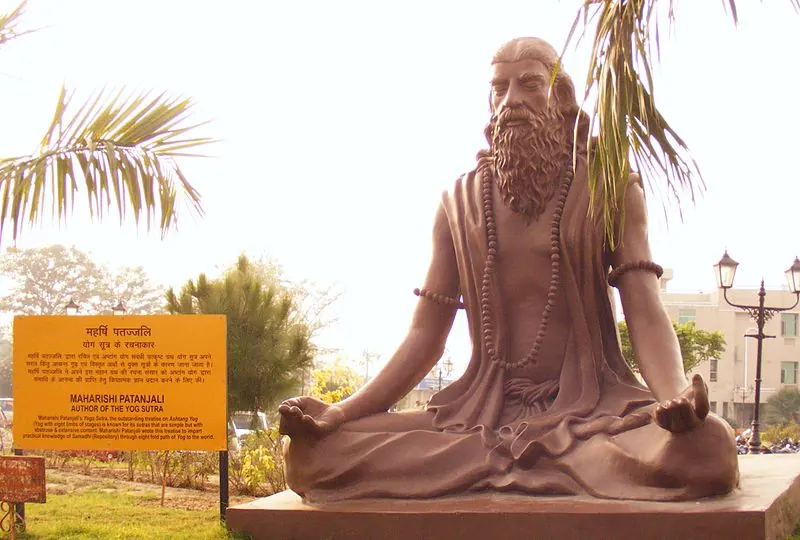
Krishna agrees that the mind is hard to control and answers that it is brought under control by steady practice (abhyasa) and detachment (vairagya) (6.35). Patanjali's Yoga Sutra, usually dated to the early centuries CE, defines yoga itself in sutra 1.2 (yogas chitta vritti nirodhah) as the restraint of the fluctuations of the mind.
What the overlap does and does not prove
The neuroscience does not prove these traditions right about the self or liberation; that is a different question, taken up in the self, atman and anatta in neuroscience.
What it does show is that the experience they described, a mind that keeps leaving the present and pays for it in mood, is measurable, common and linked to a specific network. And the remedy they prescribed, repeated practice of returning attention, is the one now being tested in scanners. I also find that the network explains why silence and solitude feel productive for some kinds of thinking, which I explore in silence, solitude and thinking.
What's new
- 7-tesla neurofeedback from the posterior cingulate helps 40 beginners meditate, with lower distress over a week PsyPost (Mindfulness journal), Feb 2026
- Focused-attention meditation changes cerebrospinal fluid flow in 23 experienced meditators vs 27 controls PsyPost (PNAS paper), Dec 2025
- Menon's 20-year review recasts the DMN as the brain's "internal narrative" system Neuron, Aug 2023
Questions people ask
Is the default mode network bad?
No. It supports autobiographical memory, planning, imagining the future and understanding other people. The cost appears when it stays active during tasks that need outside attention, or when its content gets stuck on negative, self-focused loops.
Can you turn off the default mode network?
Not fully, and you would not want to. Focused tasks reduce its activity, and experienced meditators show relatively lower activity in its main hubs during practice. The realistic goal is quicker noticing and switching back, not silence.
Does meditation really change the brain, as the Harvard headline said?
Some differences are real but modest and mostly from small studies. Brewer's 2011 study showed lower DMN hub activity in experienced meditators versus novices, which is a correlation. Newer randomised and neurofeedback studies are testing causation with samples of tens of people, so treat big claims with care.
How much time do we spend mind-wandering?
About 47% of waking moments in the Killingsworth and Gilbert sample of 2,250 adults, and at least 30% during every activity they measured except sex. The rate was higher than lab studies usually find.
Sources
- Raichle ME, MacLeod AM, Snyder AZ, Powers WJ, Gusnard DA, Shulman GL. A default mode of brain function. PNAS 98(2):676-682 (2001)
- Menon V. 20 years of the default mode network: a review and synthesis. Neuron 111(16):2469-2487 (2023)
- Killingsworth MA, Gilbert DT. A wandering mind is an unhappy mind. Science 330:932 (2010)
- Brewer JA, Worhunsky PD, Gray JR, Tang YY, Weber J, Kober H. Meditation experience is associated with differences in default mode network activity and connectivity. PNAS 108(50):20254-20259 (2011)
- PsyPost: High-precision neurofeedback accelerates the mental health benefits of meditation (2026)
- PsyPost: Neuroscientists find evidence meditation changes how fluid moves in the brain (2025)
- The Psychologist (British Psychological Society): The restless brain, on the discovery of the default mode network (2009)
- Bhagavad Gita 6.34 and 6.35, text and translation
- Wikipedia: Yoga Sutras of Patanjali (sutra 1.2 and dating)
- Harvard Medical School: Harvard neuroscientist: meditation not only reduces stress, here's how it changes your brain

Sapta (Saptarshi Sarkar) is a mechanical engineer turned marketer in Bengaluru and a solo touring rider. He writes the seven Saptaverse blogs. Work with him or read more of Mindblog.


