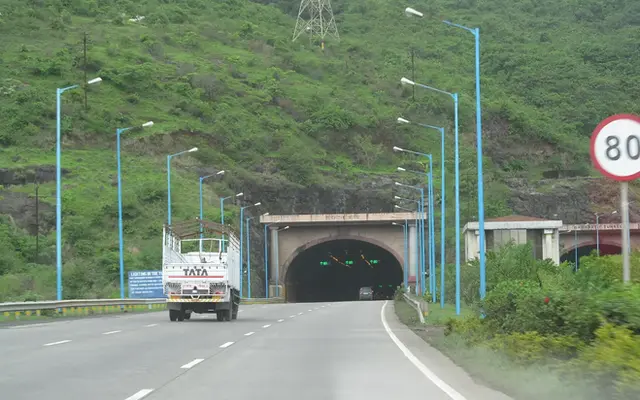
Two-wheeler accident deaths in India reached 46.2% of all road deaths in 2024, out of 1,77,175 people killed, according to the Ministry of Road Transport and Highways (MoRTH). The share was about 30% in 2014. For a touring rider the pattern is clear: national highways, the 6 pm to 9 pm window, speed and an unworn or badly worn helmet account for a large part of the toll, and all four are things you can plan around.
- 46.2% of India's 1,77,175 road deaths in 2024 were two-wheeler riders or pillions, up from about 30% in 2014.
- 36.3 deaths per 100 crashes in 2024, against 21.6 in 2005: crashes have become far more lethal.
- 6 pm to 9 pm is the peak crash window, exactly when a touring day tends to end.
- 42% lower risk of death with a helmet, in a Cochrane review of 61 studies.
- Speed squared: 80 km/h hits like a fall of about 25 m; 120 km/h like 57 m.
This is not an argument against riding. It is an argument for reading the numbers the way an engineer reads a failure report: find the failure modes that repeat, and design them out of your own trips.
MoRTH's annual Road Accidents in India report is built from police FIR data sent by the states. It undercounts some things and lumps others together, but it is the only national dataset we have, and its broad shape has held steady for a decade.
How many two-wheeler riders die on Indian roads each year?
About 80,000 two-wheeler users died in 2024: 46.2% of 1,77,175 deaths works out to roughly 81,900 people, or more than nine every hour. In 2023 the share was 44.8% of 1,72,890 deaths, which is roughly 77,000 people.
The 81,900 and 77,000 are calculated in this post from MoRTH's 2024 total and two-wheeler share (The Policy Edge) and its 2023 total and share (PTI via The Week); the hourly rate divides 81,900 by 8,760 hours in a year.
The News Minute's reading of MoRTH data puts it simply: about five riders died every hour in 2014, and about nine every hour by 2023.
Why the share keeps climbing
The total is rising more slowly than the two-wheeler share. Overall road deaths grew about 24% in the decade to 2023, while two-wheeler deaths nearly doubled. Part of that is fleet growth:
- registered two-wheelers rose from about 13.9 crore in 2014 to about 26.3 crore in 2022 (The News Minute, 2025);
- they now make up roughly three-quarters of all registered vehicles.
More bikes on the road means more bikes in crashes, even if each rider's risk per kilometre did not change.
See the data as a table
| Share of road deaths (%) | |
|---|---|
| 2014 | 30 |
| 2023 | 44.8 |
| 2024 | 46.2 |
Source: MoRTH Road Accidents in India 2023 and 2024, via The News Minute (2014 figure), PTI and The Policy Edge · 2014 share is a rounded figure from The News Minute analysis of MoRTH data.
The severity number is the one that should worry a highway rider most. In 2005, India recorded 21.6 deaths for every 100 crashes. In 2024 it was 36.3.
Crashes are not only more frequent, they are more lethal, and the most plausible reason is speed: wider, smoother roads let everyone go faster, and the human body has not been upgraded to match.
In the first week of May 2023, a 25-year-old Dehradun YouTuber, Agastay Chauhan, rode his 1,000 cc Kawasaki Ninja ZX-10R onto the Yamuna Expressway with four friends to film a video for his channel, which had about 1.2 million subscribers. In his last video he said he would take the bike to 300 km/h and see if it could go beyond.
Near the 47-mile point, in the Aligarh area, the bike hit the divider. Police said the action camera he wore had recorded 294 km/h moments before the crash. His helmet broke into several pieces on impact, and he died of head injuries on the spot. The Aligarh DIG told reporters plainly that he was overspeeding and that police had seized the video.
The Tribune: Vlogger Agastay Chauhan dies in bike crash on Yamuna Expressway (May 2023); Madhyamam: YouTuber died at 294 km/h, police say (May 2023)At 294 km/h the energy in a crash is about 54 times that of a 40 km/h one. No helmet standard is written for that, which is the point the rest of this piece keeps returning to.
Calculated in this post from the 294 km/h police said the rider's action camera recorded (Madhyamam, May 2023), a 40 km/h comparison speed, and the rule that kinetic energy rises with the square of speed (Wikipedia: Kinetic energy): (294 / 40)² ≈ 54.
Which roads kill the most riders?
National highways carried 36.6% of all road deaths in 2024 (64,772 people) while accounting for about 31% of crashes (MoRTH 2024). That gap is the severity problem in one line: a crash on a national highway is more likely to kill than a crash elsewhere, because closing speeds are higher.
The 2023 report gives the full split by road class, and it is worth seeing as a whole, because "other roads" (district roads, village roads and city streets) still hold the largest single share.
| Road category (2023) | Crashes | Share of crashes | Deaths | Share of deaths |
|---|---|---|---|---|
| National highways | 1,50,177 | 31.2% | 63,112 | 36.5% |
| State highways | 1,05,622 | 22.0% | 39,439 | 22.8% |
| Other roads | 2,24,744 | 46.8% | 70,339 | 40.7% |
| All roads | 4,80,583 | 100% | 1,72,890 | 100% |
See the data as a table
| Share of deaths (%) | |
|---|---|
| National highways | 36.5 |
| State highways | 22.8 |
| Other roads | 40.7 |
Source: MoRTH Road Accidents in India 2023, via PTI/The Week
Straight roads and rural roads
Two other details matter for touring:
- Straight roads: 67% of 2023 crashes happened on straights, and curves, potholes and steep grades together accounted for only about 14.5%. The image of the killer ghat is misleading; the killer is the long straight where speeds creep up and attention drifts.
- Rural roads: rural areas took 70.8% of deaths in 2024. Touring is mostly rural riding, on roads where trauma care is further away.
In a Hyderabad hospital study covered below, 42.8% of the two-wheeler users who died did so before reaching hospital, which is why the golden hour matters so much on a highway.

What time of day is most dangerous for riding?
The 6 pm to 9 pm window recorded the highest share of crashes in MoRTH's 2024 report, followed by 3 pm to 6 pm. The same evening peak appeared in the 2022 data.
For a long-distance rider this is the worst possible overlap:
- you are at the end of a long day;
- the light is going;
- commuters and trucks are all on the road;
- oncoming headlights wreck your night vision.
Fatigue makes it worse
Fatigue sharpens the problem. A French study on an instrumented Honda CBF1000 found that emergency braking was worse in the early morning, with longer stopping distances, and that handling at low speed improved through the day as body temperature rose.
That study was small (12 riders), but it fits what every tourer knows: your reactions are not the same at hour 14 as at hour 2.
This is where planning beats bravery. On my own long rides the habit that stuck is a stop roughly every 250 km and a plan that respects daylight.
On the November 2025 ride from Bengaluru to Kolkata, about 2,000 km went by in under 39 hours elapsed, with about 26 hours and 42 minutes of actual riding; the rest was stops. That ratio is the point. Long days are survivable when the clock is built around rest, not around the next town.
Why are so many riders dying without helmets?
Because helmet use is still patchy, and because a cheap or unfastened helmet behaves like no helmet in a crash. IndiaSpend and The News Minute report that about 73% of roughly 75,000 two-wheeler riders and pillions who died in 2023 were not wearing a helmet.
The India Status Report on Road Safety 2024 from IIT Delhi's TRIP Centre found that more than half of riders wear helmets in only seven states.
A Cochrane systematic review of 61 observational studies. In the higher-quality studies, wearing a helmet was linked to about a 42% lower risk of death and a 69% lower risk of head injury in a crash. The evidence on neck injury was weak, but lower-quality studies did not suggest helmets raise neck-injury risk, which settles an old excuse. Limit: no randomised trials (they would be unethical), and the review could not show which helmet type is best.
Read the paper (free)The team enrolled 378 injured two-wheeler riders and pillions arriving at five emergency departments in Hyderabad. Only 19.6% wore a helmet correctly. Not wearing one was linked to about five times the risk of intracranial injury (relative risk 4.99). Of the 42 who died, 42.8% died before reaching hospital, and 16 of the 19 pre-hospital deaths had no helmet. Limit: one city, hospital-based, so it misses riders who never reached care.
Read the paper (free)Put those two papers together and the arithmetic of touring changes. A rider who crashes wearing a certified, correctly sized and fastened full-face helmet has a very different survival curve from one who crashes in a half-shell with the strap dangling.
A helmet with the strap dangling is a hat. The single cheapest risk reduction on two wheels only works when it is buckled.
Is speed really the main cause?
Over-speeding accounted for 68.1% of the deaths that police attributed to traffic-rule violations in 2023, and close to 70% in 2024. Treat that figure with care: Indian police reports tend to file most crashes under speeding, partly because it is the easiest box to tick.
But physics backs the direction even if the exact number is soft. Crash energy rises with the square of speed, so going from 60 to 90 km/h raises the energy your body must absorb by 2.25 times, not 1.5 times.
Calculated in this post from the rule that kinetic energy equals half of mass times speed squared (Wikipedia: Kinetic energy): (90 / 60)² = 2.25, against 90 / 60 = 1.5 for speed alone.
How hard is a crash at your cruising speed?
At 80 km/h, the calculator shows an impact equal to falling about 25 metres, roughly an eight-storey building. At 120 km/h it is about 57 metres.
No jacket or helmet is designed for that. Protective gear buys you survival in the lower band of speeds where most crashes start, which is a strong reason to keep cruising speed modest on two-lane roads with mixed traffic.
Who is dying, and does that look like a touring rider?
The profile in the data is young, male and on the road for work or commuting. People aged 18 to 45 made up 66.1% of deaths in 2024, and men 85.8%.
Many of the riders killed every hour are not tourers at all; they are delivery workers, farm workers and commuters riding small-capacity bikes, often without proper gear, on roads with no lane for them.
That matters for how a touring rider reads the numbers. Your own risk is shaped by choices that the average victim did not or could not make:
- a bigger, better-braked motorcycle;
- a full-face helmet and riding jackets with armour;
- daylight discipline and planned rest.
The data does not say touring is safe. It says the risk is unevenly spread, and much of it follows behaviour.
Using verbal autopsy data and GBD models, the authors estimated 2,18,876 road-injury deaths in India in 2017, well above police counts. Motorcyclists were 30.9% of them (67,524), and their death rate of 4.9 per 1,00,000 was above the global average. Road injury was the leading cause of death for men aged 15 to 39. State death rates varied up to 2.6-fold. Limit: modelled estimates with wide uncertainty intervals, and data only to 2017.
Read the paper (free)The GBD number is a useful reminder that MoRTH's police-based counts are a floor, not a ceiling. If the true toll is higher, the case for taking the controllable risks seriously is stronger, not weaker.

Which risks can a careful long-distance rider actually reduce?
Most of the big drivers in the data can be cut on your own trips. Here is how I would map the national numbers to touring decisions, ordered by how much they move the needle.
| Risk in the data | What the numbers say | What a tourer can do |
|---|---|---|
| No helmet or poor helmet | About 73% of rider deaths in 2023 without a helmet; 42% lower death risk with one (Cochrane) | Full-face, certified, correctly sized, strap always fastened, replaced after a crash |
| Speed and severity | 36.3 deaths per 100 crashes in 2024, up from 21.6 in 2005 | Cap cruising speed on undivided roads; ride to sight distance, not to the speedometer |
| Evening hours | Peak crash window 6 pm to 9 pm (2024) | Finish riding by dusk on unfamiliar roads; plan the day backwards from sunset |
| Highways | 36.6% of deaths on national highways (2024) | Stay visible, avoid riding in trucks' blind spots, use stops every 200 to 250 km |
| Rural distance from care | 70.8% of deaths in rural areas (2024); many deaths before hospital (Fitzharris) | Carry a first-aid kit, share live location, know the next hospital town |
| Single-vehicle falls | A share of two-wheeler deaths involve no other vehicle | Fresh tyres, correct pressures, ABS, and slowing for unknown surfaces |
I have written separately about building a solo touring safety plan, about how many kilometres a day is sensible, and about 1,000 km days, where fatigue management is the whole game. If you ride with friends, the gap and formation rules in group riding done right come straight from the same stopping-distance physics.
Are expressways the answer for two-wheelers?
For now, they are not an option. Most of India's new access-controlled expressways bar motorcycles entirely, so long-distance riders are pushed onto the older highways and service roads where mixed traffic and severity are both higher.
The Yamuna Expressway crash above is the other side of the same coin: a road built for speed is only safe at speeds a rider can survive. Whether the ban makes sense is a separate argument, which I take apart in why bikes are banned on Indian expressways. The short version: the ban protects slow scooters from 120 km/h cars, but it also keeps capable touring motorcycles off the safest roads in the country.

What does this mean for the bike and the gear you choose?
Gear and hardware matter because they work in exactly the cases the statistics describe. Anti-lock brakes prevent the locked-wheel slide that turns a near miss into a fall, which is why MoRTH proposed in June 2025 to make ABS compulsory on all new two-wheelers, with two certified helmets supplied at sale.
Bright clothing and a working headlight help other road users see you; a 2021 systematic review of 27 conspicuity studies concluded that contrast with the background is what counts. The bike and kit I use for long rides are on the gear page, and the engineering side of brakes and tyres lives in the Yantra world.
What's new
- MoRTH's Road Accidents in India 2024: 1.77 lakh deaths, two-wheelers 46.2% The Policy Edge, Jun 2026
- Draft rule: ABS on all new two-wheelers and two BIS helmets at sale Autocar India, Jun 2025
- Why nine bike riders die every hour: a decade of MoRTH data The News Minute, Nov 2025
- 1.72 lakh died in 4.80 lakh road accidents in 2023 PTI via The Week, Aug 2025
Questions people ask
Is it too risky to ride a motorcycle in India?
The national risk is high, with two-wheeler users making up 46.2% of road deaths in 2024. But that average includes riders without helmets, without training and on overloaded commuter bikes. A rider who wears a certified full-face helmet, rides by day on long trips, keeps speed in check and takes regular breaks removes a large share of the risk the data describes.
What is the most dangerous time to ride in India?
MoRTH's 2024 report found the most crashes between 6 pm and 9 pm, followed by 3 pm to 6 pm. For touring, the practical rule is to finish the day's ride by dusk on unfamiliar roads.
How many two-wheeler riders die every day in India?
About 224 a day in 2024, based on 46.2% of 1,77,175 deaths. That is a little over nine every hour.
Calculated in this post from MoRTH's 2024 total and two-wheeler share (The Policy Edge): 0.462 × 1,77,175 ÷ 365 ≈ 224.
Do helmets really save lives in a crash?
Yes. A Cochrane review of 61 studies found helmets cut the risk of death by about 42% and head injury by about 69%. In a Hyderabad hospital study, riders without helmets had about five times the risk of brain injury.
Are national highways more dangerous than city roads?
They are more lethal per crash. National highways had about 31% of crashes but 36.6% of deaths in 2024, because speeds are higher. City streets have more minor crashes; open highways have more fatal ones.
Sources
- The Policy Edge: MoRTH Road Accidents Report 2024, highways, over-speeding and young adults (2026)
- PTI via The Week: 1.72 lakh people died in 4.80 lakh road accidents in 2023 (2025)
- MoRTH: Road Accidents in India 2023 (2025)
- The News Minute: Why 9 bike riders die every hour (2025)
- Liu B.C. et al.: Helmets for preventing injury in motorcycle riders, Cochrane Database of Systematic Reviews (2008)
- Fitzharris M. et al.: Crash characteristics and patterns of injury among hospitalized motorised two-wheeled vehicle users in urban India, BMC Public Health (2009)
- India State-Level Disease Burden Initiative: Mortality due to road injuries in the states of India, The Lancet Public Health (2020)
- Bougard C. et al.: Effects of time of day and sleep deprivation on motorcycle-driving performance, PLoS ONE (2012)
- Abdul Khalid M.S. et al.: Motorcycle conspicuity issues and intervention, a systematic review, Iranian Journal of Public Health (2021)
- Autocar India: ABS likely mandatory on all new bikes and scooters from January 2026 (2025)
- Summary of the India Status Report on Road Safety 2024, TRIP Centre, IIT Delhi (2024)
- The Tribune: Vlogger Agastay Chauhan dies in bike crash on Yamuna Expressway (May 2023; story block)
- Madhyamam: Famous YouTuber dies in crash while racing bike at 294 kmph, police (May 2023; 294 km/h, helmet broke on impact)

Sapta (Saptarshi Sarkar) is a mechanical engineer turned marketer in Bengaluru and a solo touring rider. He writes the seven Saptaverse blogs. Work with him or read more of RoadHook Rides.