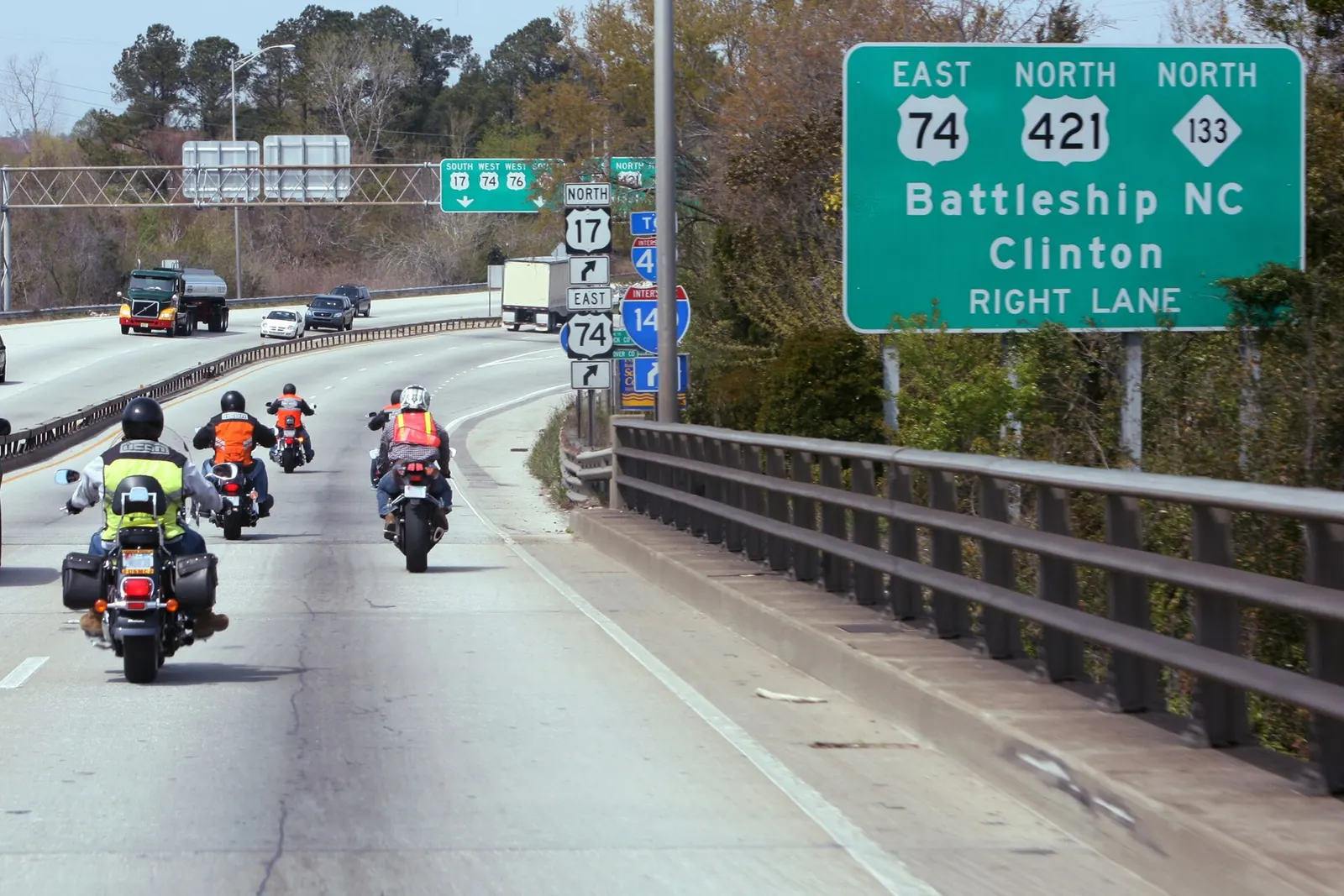
The safest group ride formation for motorcycles on an open, straight road is staggered: riders alternate between the left and right thirds of the lane, with at least a two-second gap to the bike directly ahead in the same line, which leaves about one second to the bike diagonally ahead. On ghats, curves, narrow or broken roads and at night, switch to single file with the same two-second gap. A lead rider sets pace and route, a sweep rides last and never leaves anyone behind, and a corner-marker system replaces the instinct to chase.
- Two seconds to the bike in your own line, which leaves about one second to the bike diagonally ahead.
- 22 m every second at 80 km/h; a full stop from that speed takes about 78 m.
- Single file on ghats, hairpins, broken roads, rain and at night.
- Lead and sweep are the two most experienced riders; the newest ride right behind the lead.
- Never chase: a corner marker and a regroup point replace the urge to catch up.
Most club rulebooks give these rules without the reasons, so riders treat them as etiquette and drop them when the road gets fun. The reasons are physics.
A motorcycle at 80 km/h covers 22 metres every second, and a rider who is surprised needs time to react before the brakes even start working. This post works through those numbers, then turns them into roles, signals, comms and a plan for when the group gets separated on a mountain road.
Why does a group need a formation at all?
Because in a group, the biggest risk is usually the vehicle in front of you, not the truck coming the other way. When the lead brakes for a pothole or a cow, every rider behind has to react in turn, and each reaction adds delay.
A formation is a way of giving every rider enough distance to absorb that delay, plus a clear escape line if braking is not enough.
The stakes are high in India. Two-wheeler users were 46.2% of the 1,77,175 people killed on Indian roads in 2024, and national highways, where most touring happens, carried 36.6% of deaths. I go through those numbers in India's two-wheeler death toll.
Group riding does not cause that toll, but a disorganised group multiplies the ways it can add to it.
On the morning of Monday, 4 December 2023, a group of seven riders on Harley-Davidsons set out at about 7:30 am from Golf Course Road in Gurugram, heading towards Sohna. On the Kundli-Manesar-Palwal (KMP) Expressway near Pachgaon, a truck ahead of them braked suddenly, without a signal, according to the complaint filed with the police.
What followed was a chain collision of eight vehicles, including the truck, two cars and small goods carriers. Two riders, both 45-year-old businessmen, were trapped under a truck and died during treatment. Gurugram Police registered a case against the truck driver at Bilaspur police station. The fault was the truck's; the lesson for any group is that the gap you keep is the only thing you control when the vehicle ahead stops dead.
Free Press Journal: two Harley-Davidson riders killed in eight-vehicle crash on KMP Expressway (Dec 2023)How much distance does a motorcycle need to stop?
More than most riders think, and most of the extra is reaction, not braking. Stopping distance has two parts:
- Reaction distance: what you travel before your hand and foot act. It grows in proportion to speed.
- Braking distance: what the bike needs to stop once the brakes bite. It grows with the square of speed.
Twelve male riders did emergency stops on an instrumented Honda CBF1000 with combined ABS braking, at 20 and 40 km/h, at four times of day, with and without a night's sleep. Reacting to a light they knew would come, they averaged a 0.37 s reaction time. At 40 km/h the total stopping distance was 13.19 m (3.93 m reacting, 9.12 m braking), an average deceleration of about 4.4 m/s². Stops were longer in the morning sessions and shortest at 6 pm. Limit: a small sample, a known signal (real surprises take longer) and low test speeds.
Read the paper (free)Take that measured 4.4 m/s² as a realistic average for ordinary riders braking hard on a dry road, and assume a one-second reaction to a real surprise.
That is generous: the riders in that study knew a signal was coming and still needed 0.37 s. The table shows what the arithmetic gives.
| Speed | Distance per second | Two-second gap | Reaction distance (1 s) | Braking distance (4.4 m/s²) | Total stop |
|---|---|---|---|---|---|
| 40 km/h | 11.1 m | 22 m | 11 m | 14 m | 25 m |
| 60 km/h | 16.7 m | 33 m | 17 m | 32 m | 48 m |
| 80 km/h | 22.2 m | 44 m | 22 m | 56 m | 78 m |
| 100 km/h | 27.8 m | 56 m | 28 m | 88 m | 115 m |
Two lessons come out of that table.
- The gap is not a stopping distance. A two-second gap is far shorter than a full stop at any speed above about 40 km/h. It works only because the rider ahead is also braking; what the gap really buys is time to react plus a margin for being a weaker braker than the person in front.
- A dead stop needs a way around. If the bike ahead stops dead, because it hits something or falls, no realistic following gap lets you stop in a straight line. That is the whole case for the staggered formation.
Use this to check what you just read, with your own speed, gap and braking.
Is your group gap enough?
What is a staggered formation, and when should you use it?
Staggered formation puts riders alternately in the left and right thirds of the lane, so each rider has a clear line of sight past the bike ahead and a clear escape path beside it.
With a two-second gap to the bike in the same line, the rider diagonally ahead is only about one second away. That keeps the group compact without anyone sitting directly behind another.
Where the lead sits in India
In India, where traffic keeps left and overtakes on the right, I would put the lead on the right third of the lane. That gives the lead the best view of oncoming traffic and of the road ahead for overtakes.
It also keeps the second rider, on the left, slightly away from the oncoming lane.
Which formation for which road
| Road or condition | Formation | Gap to the bike in your line | Why |
|---|---|---|---|
| Divided highway, good surface, daylight | Staggered | 2 s minimum | Compact group, escape space beside each bike |
| Two-lane road with oncoming traffic | Staggered, wider spacing | 2 to 3 s | Room for cars to cut back in after overtaking you |
| Ghats and hairpins | Single file | 2 s or more | Each rider needs the full lane width for their line |
| Broken surface, gravel, water crossings | Single file | 3 s or more | Riders swerve around holes; braking is weaker |
| Rain | Single file or wide stagger | 4 s | The UK Highway Code says gaps should at least double on wet roads |
| Night | Single file | 3 s or more | Shorter sight distance; headlights dazzle the rider ahead |
| Towns, toll plazas, fuel stops | Single file, close | Walking pace spacing | Keep the group together through junctions |
Why ride single file on ghats and curves?
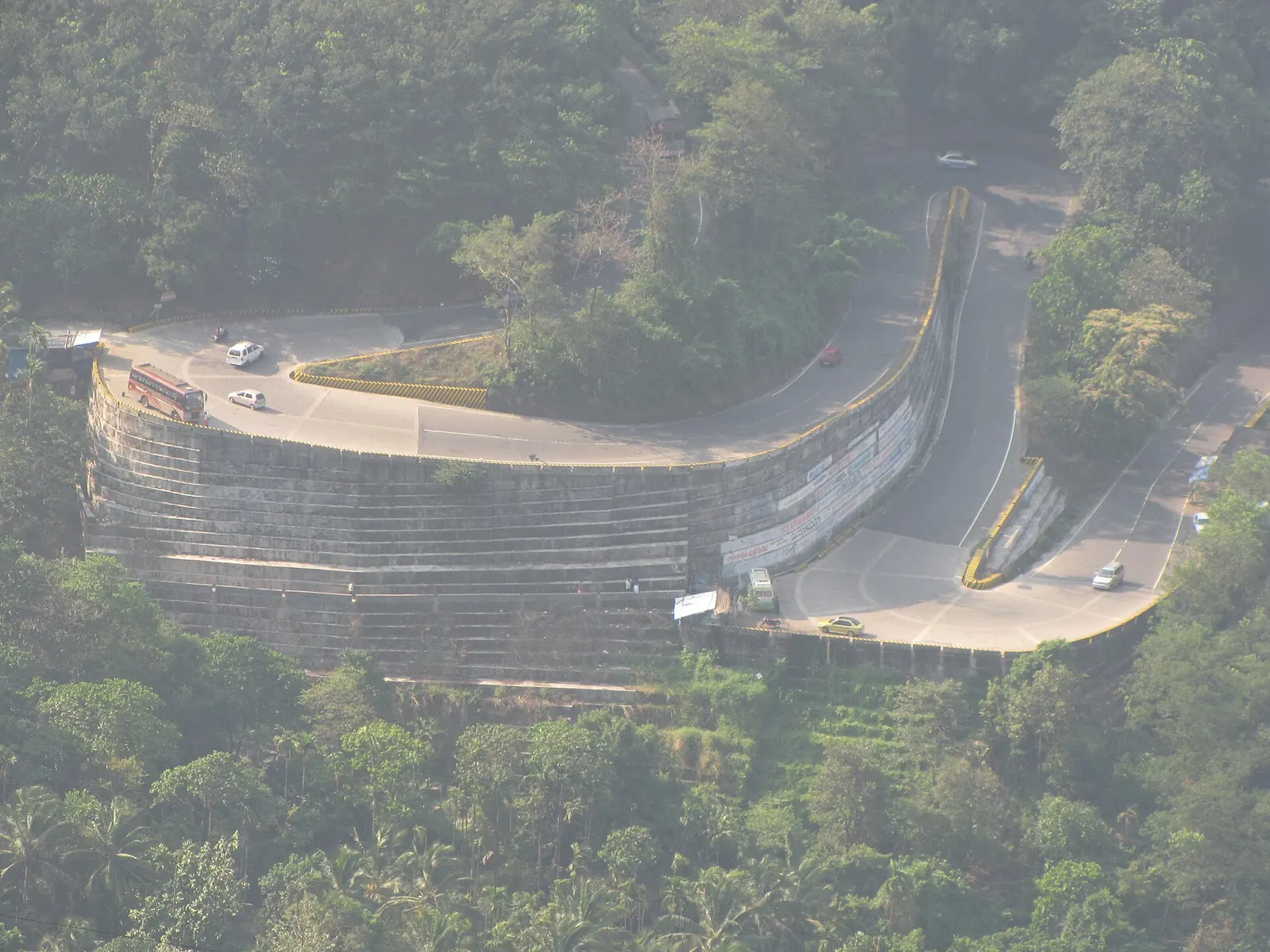
Because a corner needs the whole lane. Going into a left-hander you want to start wide on the right of your lane, and for a right-hander you start wide on the left. A rider locked into one third of the lane by the formation cannot take a safe line.
On a ghat the rider ahead may also brake mid-corner for a bus cutting the apex, and side-by-side staggering leaves nowhere to go.
My post on how ghat roads and hairpin bends are designed explains the curve geometry that makes this so.
What do the lead and the sweep actually do?
The lead sets the pace for the slowest rider, and the sweep makes sure nobody is ever alone. Everything else is detail.
- Lead. Knows the route, sets a pace the least experienced rider can hold, signals hazards early, calls stops, chooses where the group overtakes and never overtakes in a way the group cannot follow safely.
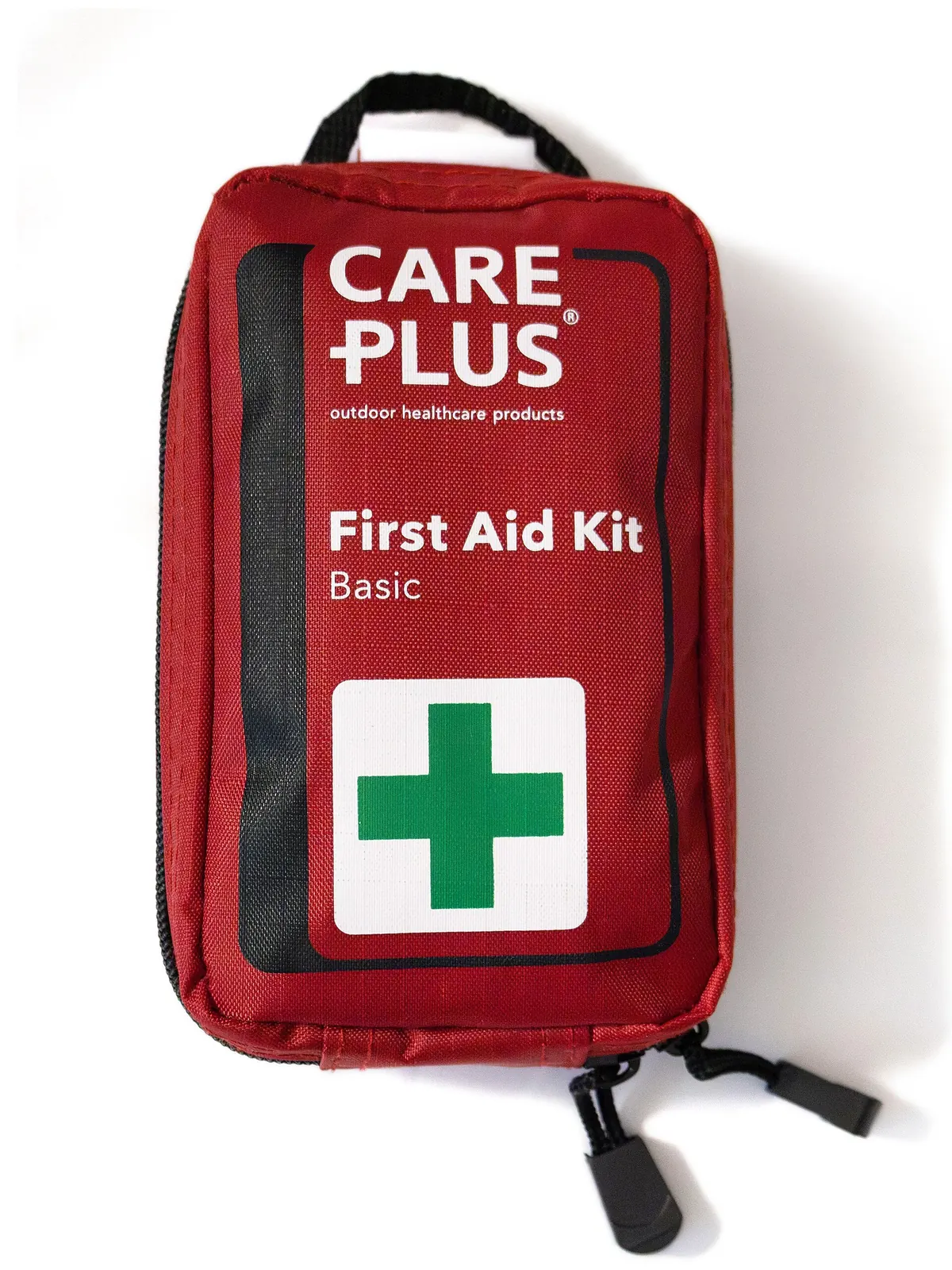
- Sweep. Rides last, carries the first-aid kit and basic tools, stops with anyone who stops, and is the only rider allowed to fall back. The sweep should be one of the most experienced riders, not the newest.
- Newest riders. Ride right behind the lead, where the pace is steadiest and the lead can watch them in the mirror.
- Group size. Large groups break up anyway at traffic lights and overtakes. I would split anything above six or seven bikes into sub-groups, each with its own lead and sweep, a few minutes apart.

What should you do when the group splits on a ghat?
Nothing dramatic, if you agreed the system before you started. Groups split all the time: a truck overtakes into the middle, a rider stops for a photo, a level crossing closes.
The danger is not the split itself. It is riders behind the gap speeding up to catch the group, overtaking blind on a mountain road.
- Use a corner marker. At every turn off the main road, the rider behind the lead stops where the next rider can see them and points the way. They wait until the sweep arrives, then rejoin just ahead of the sweep. The group never needs to stay in sight.
- Never chase. If you lose sight of the rider ahead, keep your own pace. The marker will be waiting at the next turn.
- Agree a regroup point. Every 50 to 100 km on mountain roads, or at every fuel stop, the lead stops and waits for the sweep.
- The sweep stops with anyone who stops. Always, without exception. The group waits at the next regroup point and sends someone back only if the sweep does not arrive in an agreed time.
- Share live location. In areas with patchy signal, as on most northeastern and Himalayan routes, fix the regroup point before you lose coverage, not after.
Which hand signals should every group agree on?
Keep it to signals everyone can recognise at a glance, and agree them at the briefing. Groups differ, so the meaning matters less than everyone sharing it.
| Signal | Meaning |
|---|---|
| Left hand pointing down to the left, or right foot out for the right side | Hazard on the road on that side |
| Left arm out, palm facing back, moved down | Slow down |
| Left arm up, fist | Stop |
| Arm raised, one finger up | Single file |
| Arm raised, two fingers up | Staggered formation |
| Tapping the fuel tank | Need fuel |
| Tapping the top of the helmet | Rider behind, come up and lead, or "you lead" |
| Hand to mouth | Food or drink stop |
How should a group use intercoms?
Use them for the information hand signals cannot carry, and keep the channel quiet. I use a Cardo Spirit, and the most useful habit with any intercom is radio discipline: short calls, hazards first, the lead and sweep talk, everyone else listens unless they have something urgent.
Music or chatter on the group channel means a hazard call gets missed.
- Lead: "Pothole left", "Bus coming, single file", "Fuel in 5 km".
- Sweep: "All together", "Rider 4 stopping, I'm with him", "Clear to overtake behind".
- Everyone: hand signals still apply, because not everyone has an intercom and links drop in the mountains.
Does being seen matter more in a group?
It matters for the whole group, because a car that fails to see the first bike may pull out into the middle of the line. A group is more visible than a single rider, but it is also longer, and drivers misjudge its length and speed.
Following PRISMA guidelines, the authors reviewed 27 studies on how visible motorcycles are to other road users, by day and by night. Most looked at the front of the bike, especially daytime running headlight colour and layout; fewer looked at rear and brake lights, bike colour, or rider clothing and helmet colour. Their conclusion is that contrast with the surroundings is what makes a motorcycle conspicuous. Limit: a review of mixed-quality studies with no pooled effect size.
Read the paper (free)For a group, that means:
- headlights on, all day;
- at least one high-visibility jacket at the front and back (the lead and sweep);
- reflective strips on luggage for dusk.
My own kit is on the gear page, and the full list for a long tour is in the touring packing list.

Is group riding safer than riding solo?
It is different, not automatically safer.
| A group brings | A group also brings |
|---|---|
| Help after a breakdown or a fall | Peer pressure |
| Shared navigation | Chasing to keep up |
| Someone to raise the alarm | A pace that may suit the strongest rider rather than you |
I ride solo most of the time, and the planning that replaces a group's safety net is in my solo touring safety plan. If you ride in a group, the formation, the roles and the "never chase" rule are what make it pay off.
What's new
- Road Accidents in India 2024: highways and speed remain the key risks The Policy Edge, Jun 2026
- Draft rule proposes ABS on every new two-wheeler sold in India Autocar India, Jun 2025
- Highway Code rule 126 on the two-second gap and stopping distances GOV.UK, 2026
Questions people ask
What is the two-second rule on a motorcycle?
Pick a fixed point that the bike ahead passes, then count two seconds; you should not reach the point before you finish. At 80 km/h that is about 44 m. Double it in rain, as the UK Highway Code advises for wet roads.
Where should the most experienced rider ride in a group?
At the front as lead and at the back as sweep. The newest riders go right behind the lead, where the pace is steady and the lead can watch them.
Should a group ride side by side?
No. Riding side by side removes the escape space each rider needs. Use a staggered formation on straight roads and single file elsewhere.
How many bikes should be in one riding group?
There is no official number, but large groups split at every overtake and junction. Six or seven bikes per sub-group, each with its own lead and sweep, keeps a group manageable.
What should you do if you lose the group?
Do not chase. Keep your own pace, look for the corner marker at the next turn, and stop at the agreed regroup point. The sweep will be behind you.
Sources
- Bougard C. et al.: Effects of time of day and sleep deprivation on motorcycle-driving performance, PLoS ONE (2012)
- Abdul Khalid M.S. et al.: Motorcycle conspicuity issues and intervention, a systematic review, Iranian Journal of Public Health (2021)
- GOV.UK: The Highway Code, rule 126, stopping distances (2026)
- MoRTH: Notification S.O. 1522(E) on maximum speed limits (2018)
- The Policy Edge: MoRTH Road Accidents in India 2024 (2026)
- European Commission: Road Safety Thematic Report, Powered Two-Wheelers (2024)
- Autocar India: ABS likely mandatory on all new bikes and scooters (2025)
- Free Press Journal: Two Harley-Davidson riders killed after eight vehicles collide on KMP Expressway (Dec 2023; source for the story)

Sapta (Saptarshi Sarkar) is a mechanical engineer turned marketer in Bengaluru and a solo touring rider. He writes the seven Saptaverse blogs. Work with him or read more of RoadHook Rides.