
On an Indian motorcycle tour, plan 300 to 450 km a day on good plains highways, 150 to 250 km a day in the hills, and often under 200 km a day in the high Himalaya, where a 180 km stage can take 8 to 12 hours. I have done several 800 to 1,000 km days, but those were planned efforts with early starts and short stops, not a touring pace you repeat day after day.
- 300 to 450 km a day on plains highways, 150 to 250 km in the hills, often under 200 km in the high Himalaya.
- Hours, not kilometres: distance = moving hours × moving average, and the road sets the average.
- 20.8% of India's road accidents in 2023 happened between 18:00 and 21:00; arrive an hour before sunset.
- 8.2 times the odds of an injury crash for drivers who felt sleepy (Connor et al., 2002).
- One spare day for every four or five riding days.
The question looks like it is about distance. It is really about hours: how many you can ride in daylight, how many of those you are moving, and how fast you move on that road.
A forum thread on xBhp shows the usual mistake. A rider planning Mumbai to Leh asked for help, and the most useful reply did not quote kilometres at all. It said to:
- avoid the slow Mumbai-Agra road after Indore;
- allow 7 to 8 days for Mumbai to Srinagar and back;
- keep 3 to 4 spare days.
That is the right instinct. This post turns it into numbers you can plug in.
How many km per day is realistic on a bike trip in India?
A realistic daily distance is your riding hours multiplied by your moving average, minus stops, and the moving average changes far more by road than by bike. The table shows how sourced journeys translate into averages, and what that means for a day of about eight hours in the saddle.
| Road and terrain | Evidence | Implied average (km/h) | Comfortable day (km) |
|---|---|---|---|
| Four-lane national highway, plains | Arithmetic of a 1,000 km day ridden in 16 hours | About 60 overall, including stops | 350 to 450 |
| Two-lane state road or hill highway | Mixed traffic, towns, ghats | 35 to 45 | 200 to 300 |
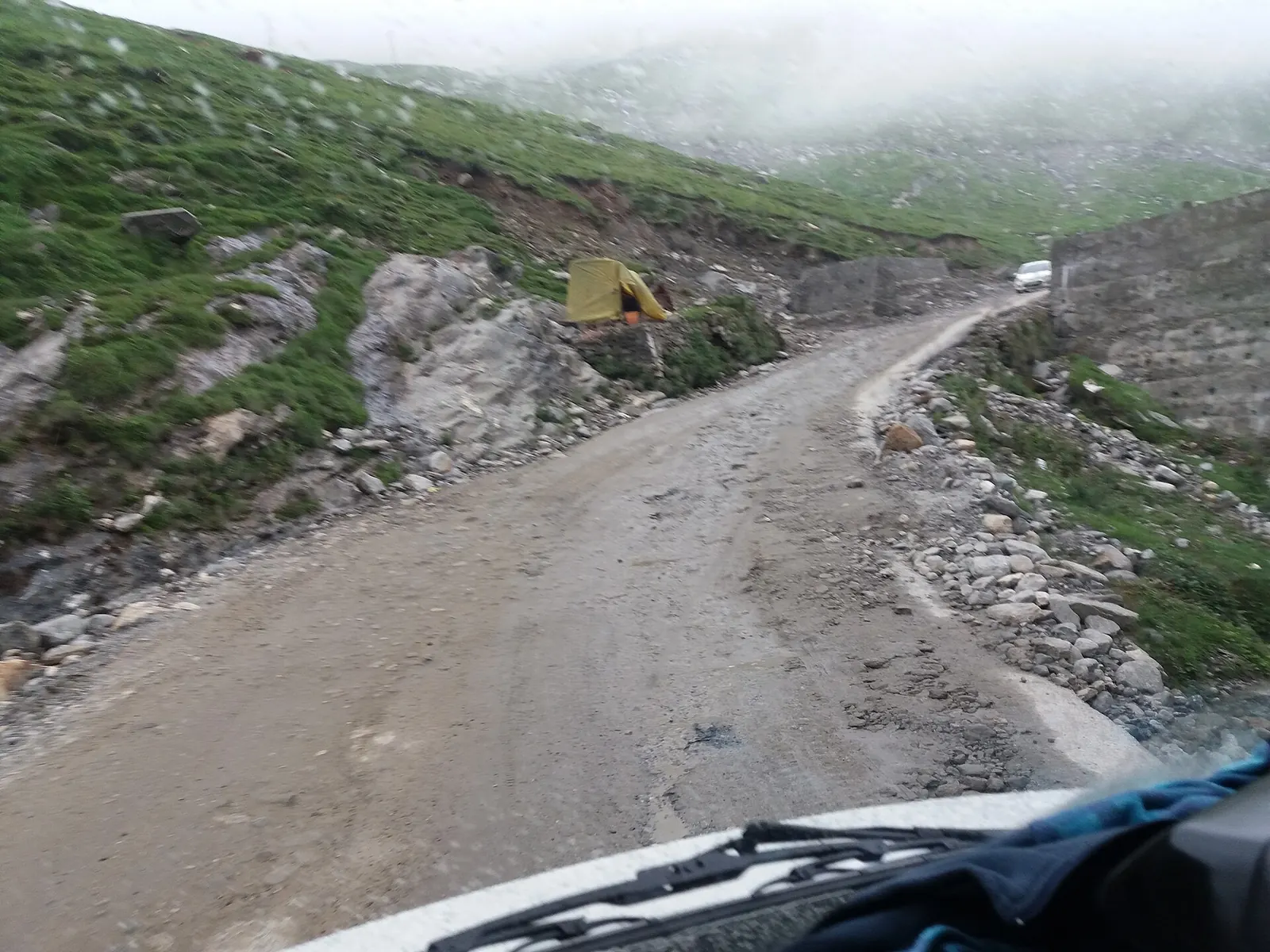
| Himalayan highway (Manali to Kaza) | 180 to 200 km in 8 to 12 hours | 15 to 25 | 150 to 200 |
| Broken gravel (Spiti, 2016 trip report) | Long stretches at 20 to 30 km/h | 20 to 30 | 120 to 180 |
| Gramphu to Batal, water crossings | About 47 km in 4 to 5 hours | About 10 | Plan the stretch, not the day |
The hill and gravel figures come from a 2026 Spiti road-status page and a Tripoto trip report. The two-lane row is my working assumption for planning; replace it with your own logged averages after the first day.
The plains row is the upper bound, set by riders who do 1,000 km days; at a touring pace, you will spend far more time stopped. Use this to check your own day.
Daily distance from your hours and speed
Try the default: ten hours, 55 km/h moving, four stops of 25 minutes. You get about 458 km and an overall average of about 46 km/h. Halve the moving speed for a mountain day and the distance halves too, even though you are just as tired.
Calculated in this post from the default inputs the calculator above shows (10 hours, 55 km/h moving, four stops of 25 minutes): (10 − 4 × 25/60) × 55 ≈ 458 km, and 458 / 10 ≈ 46 km/h. These inputs are the post's assumptions, not measurements.
What limits daily distance more: road, daylight or fatigue?
In the plains, daylight and fatigue limit you; in the mountains, the road does. A long plains day is easy to fill with 350 to 450 km, but the same hours in the high Himalaya might give you 150 to 200 km (see the table above, which rests on Travel Coffee), and the cold and altitude make you tired sooner.
Daylight
Daylight is the hard ceiling most people forget, because it shrinks exactly when touring season is best in the south and east.
| City | Mid-December daylight | Mid-June daylight |
|---|---|---|
| Bengaluru | 11.4 h | 12.9 h |
| Delhi | 10.3 h | 14.0 h |
| Leh | 9.9 h | 14.4 h |
An October Ladakh day has about three hours less light than a June one.
See the data as a table
| Bengaluru (h) | Delhi (h) | Leh (h) | |
|---|---|---|---|
| Jan | 11.4 | 10.5 | 10.1 |
| Feb | 11.7 | 11.2 | 10.9 |
| Mar | 12.0 | 11.9 | 11.9 |
| Apr | 12.4 | 12.8 | 13.0 |
| May | 12.7 | 13.6 | 13.9 |
| Jun | 12.9 | 14.0 | 14.4 |
| Jul | 12.8 | 13.8 | 14.2 |
| Aug | 12.6 | 13.2 | 13.5 |
| Sep | 12.2 | 12.4 | 12.4 |
| Oct | 11.9 | 11.5 | 11.4 |
| Nov | 11.5 | 10.7 | 10.4 |
| Dec | 11.4 | 10.3 | 9.9 |
Source: Computed from the NOAA solar position equations for each city latitude · Sunrise to sunset; mountains block early and late sun in valleys, so usable light is shorter.
Fatigue
Fatigue is the third limit, and it is not linear. The first 300 km cost less than the next 300. My own planning habits, built over several 800 to 1,000 km days on a 2017 Pulsar NS200:
- stop about every 250 km;
- keep food stops short;
- stay out of city centres;
- plan fuel from reliable stations rather than whatever comes next.
Those habits make a big day possible; they do not make it free.
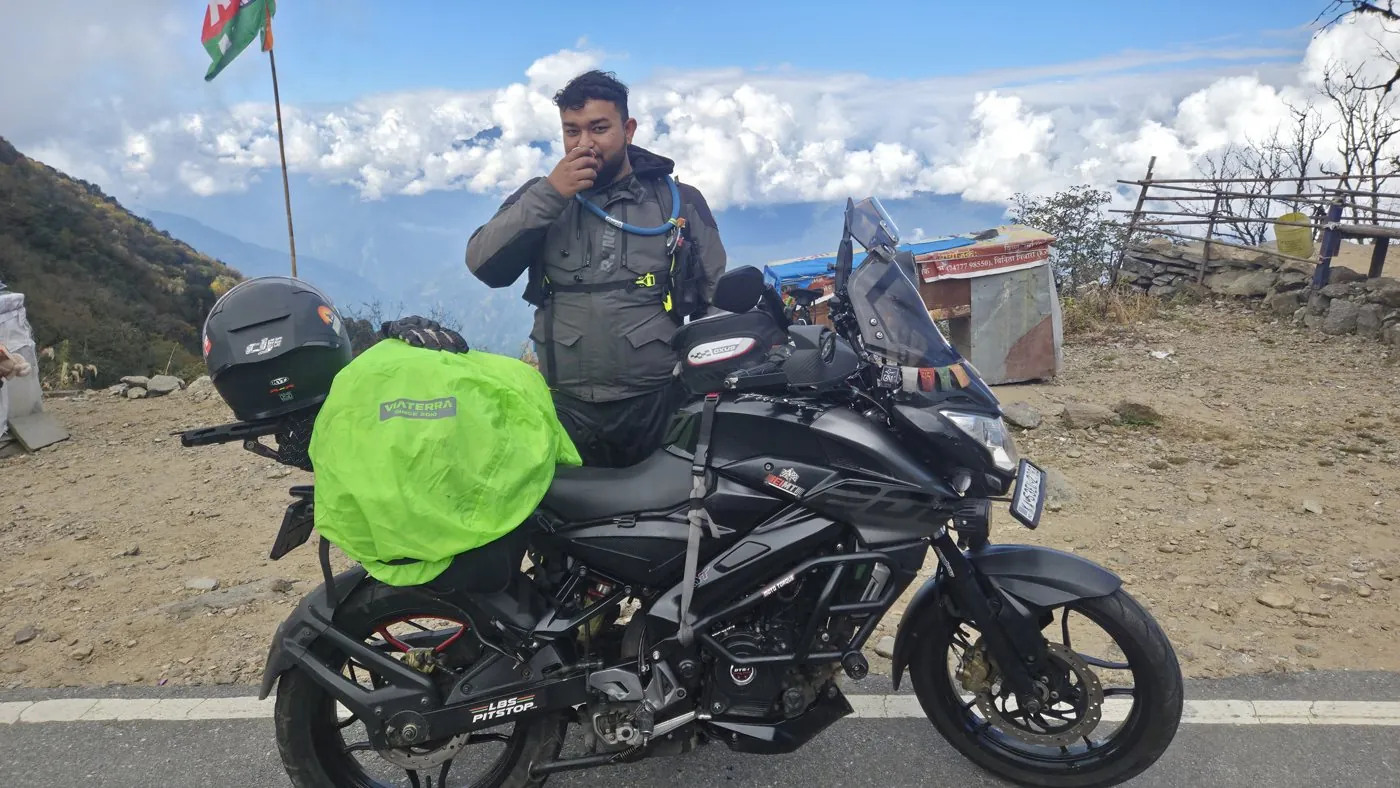
The clearest example from my own log is the start of the November 2025 Sikkim ride. I left Bengaluru on 10 November on NH16 and rode to a hostel in Visakhapatnam that night, about 1,100 km by my odometer, past Chittoor, Guntur and Khammam. The next day went on through Berhampur and Kharagpur to Kolkata.
The mission report for the two days reads about 2,000 km in 38 hours 57 minutes elapsed, of which 26 hours 42 minutes were riding. That is about 75 km/h while moving but only about 51 km/h overall, because more than 12 hours went to stops and rest, with a halt roughly every 250 km. The overall average, not the speedometer, decides how far you get.
Sapta: Bengaluru to Kolkata by bike, about 2,000 km on NH16 in 2 daysPut those numbers into the calculator above and you will see the same effect.
Is it safe to ride after dark to make the distance?
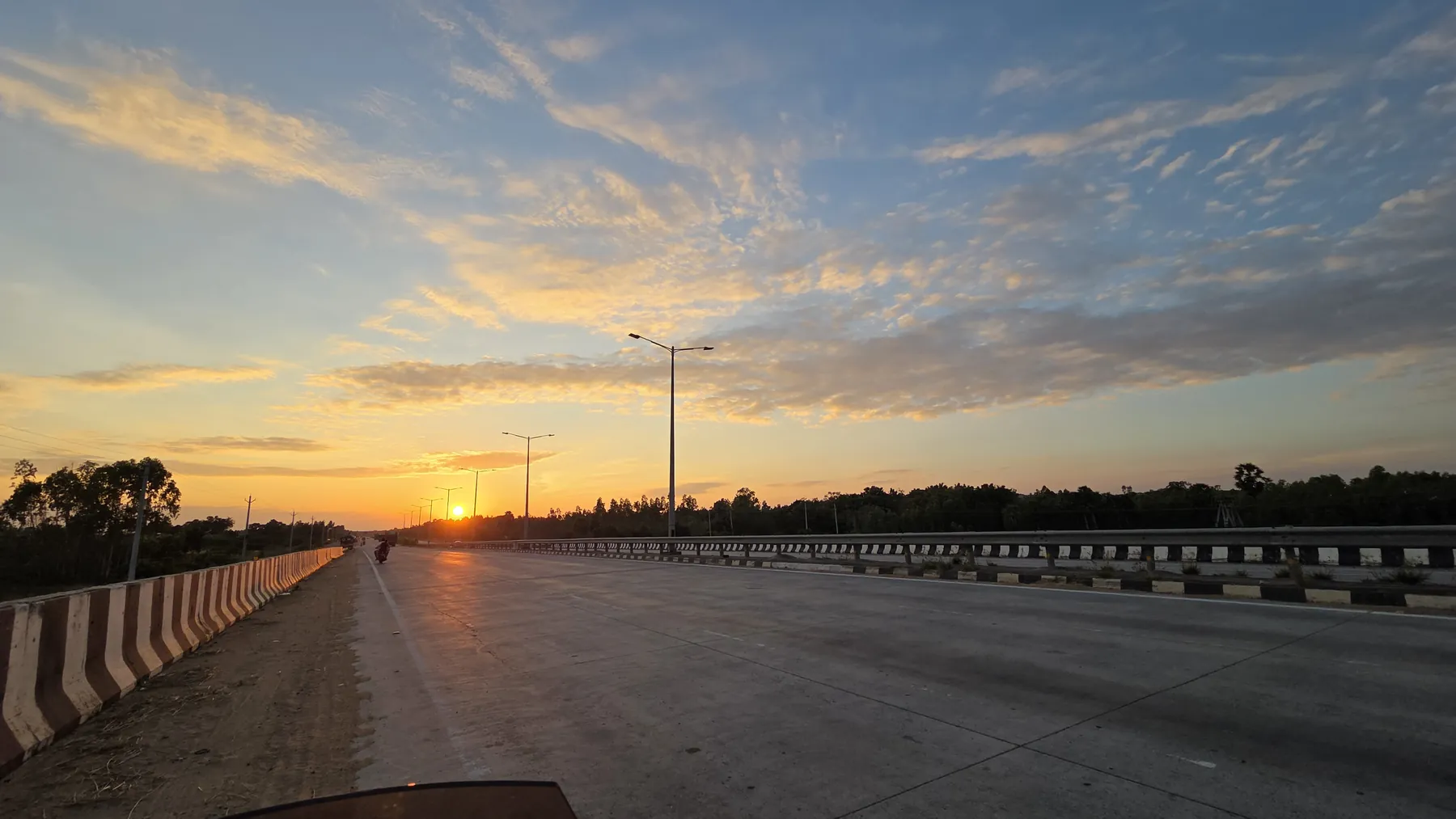
Riding after dark is the most common way a planned day goes wrong, and India's crash data shows why: 20.8% of all road accidents in 2023 happened between 18:00 and 21:00, the highest of any three-hour window.
That window is when tired touring riders are still trying to reach the night's stop.
See the data as a table
| Share of accidents (%) | |
|---|---|
| 06-09 | 10.2 |
| 09-12 | 14.1 |
| 12-15 | 14.9 |
| 15-18 | 17.6 |
| 18-21 | 20.8 |
| 21-24 | 11.5 |
| 00-03 | 5.1 |
| 03-06 | 4.7 |
Source: MoRTH, Road Accidents in India 2023, Table 7.3 · 1.2% of accidents had no recorded time. Shares are of accidents, not of traffic, so busy hours look worse partly because more people are on the road.
The official annual compilation of police-reported crashes for calendar 2023, released in August 2025. India recorded 4,80,583 accidents and 1,72,890 deaths. Two-wheeler riders were 44.8% of all deaths (77,539 people). National highways, only about 2.1% of the road network, carried 31.2% of accidents and 36.5% of deaths. By time of day, 18:00 to 21:00 had the most accidents (20.8%), followed by 15:00 to 18:00 (17.6%), and 03:00 to 06:00 had the fewest (4.7%), a pattern stable over five years. Limit: police data under-reports crashes and records accidents, not exposure, so it cannot tell you the risk per kilometre at each hour.
Read the report (free)The low 03:00 to 06:00 share does not mean pre-dawn riding is safe. It means few people are on the road. Research on drivers shows that the hours before dawn are the most dangerous per person driving, which is the next section. For more of the national picture, see my essay on two-wheeler road deaths and what they mean for tourers.
What does research say about fatigue and long riding days?
Sleepiness, not distance, is what raises crash risk, and both a road study and a motorcycle simulator study show how sharp the effect is. A long day that ends with a sleepy rider is the dangerous combination.
Compared 571 car drivers involved in injury crashes in the Auckland region (April 1998 to July 1999) with 588 randomly sampled drivers on the same roads. After adjusting for confounders, drivers who rated themselves sleepy had 8.2 times the odds of an injury crash; five hours of sleep or less in the previous 24 hours raised the odds 2.7 times; driving between 2 am and 5 am raised them 5.6 times. About 19% of injury crashes were attributable to acute sleepiness. Limit: car drivers in New Zealand, not riders in India, and sleepiness was self-reported after the fact.
Read the paper (free)Sixteen healthy men rode 60-minute sessions (city, country and 40 minutes of highway) on a motorcycle simulator at 07:00, 11:00, 15:00 and 19:00, once after normal sleep and once after 30 hours awake. Sleep deprivation worsened lane-position control, speed-limit violations, falls and EEG-recorded microsleeps, and the biggest disturbances came on the highway segment. Stress hormones rose but did not offset the decline. Limit: a small simulator study with young men; real roads add heat, wind and vibration, which likely make things worse, not better.
Read the abstractThe highway finding matters for Indian touring. A long, straight four-lane stretch is where you make the most distance and where sleepiness bites hardest. Heat makes it worse; my post on riding in a heatwave covers hydration and timing.
How should you plan a multi-day trip's daily distances?
Plan daily distances backwards from the hardest day, keep the rest below your comfortable number, and leave one spare day per four or five riding days. A sustainable trip feels slightly short every day.
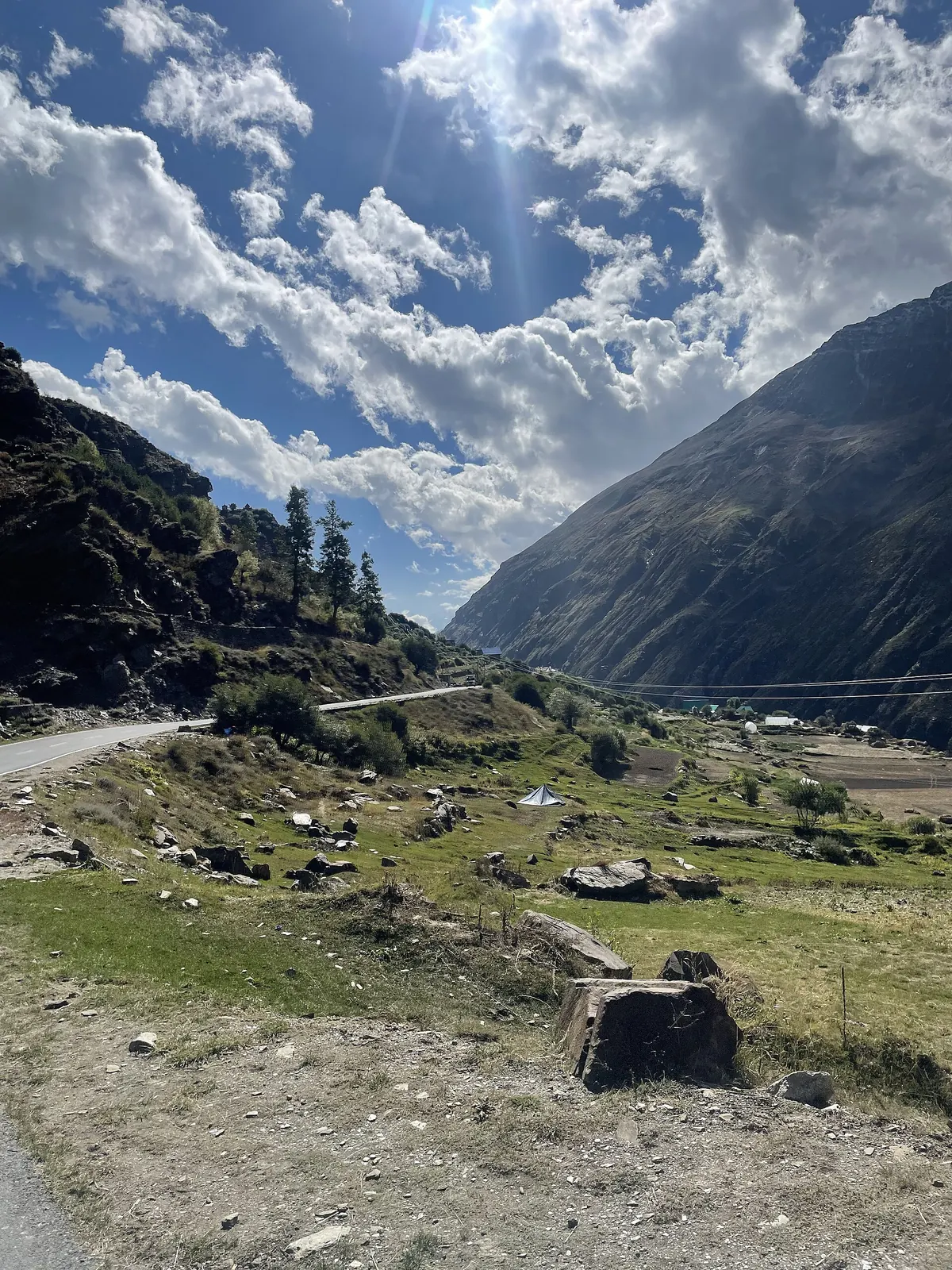
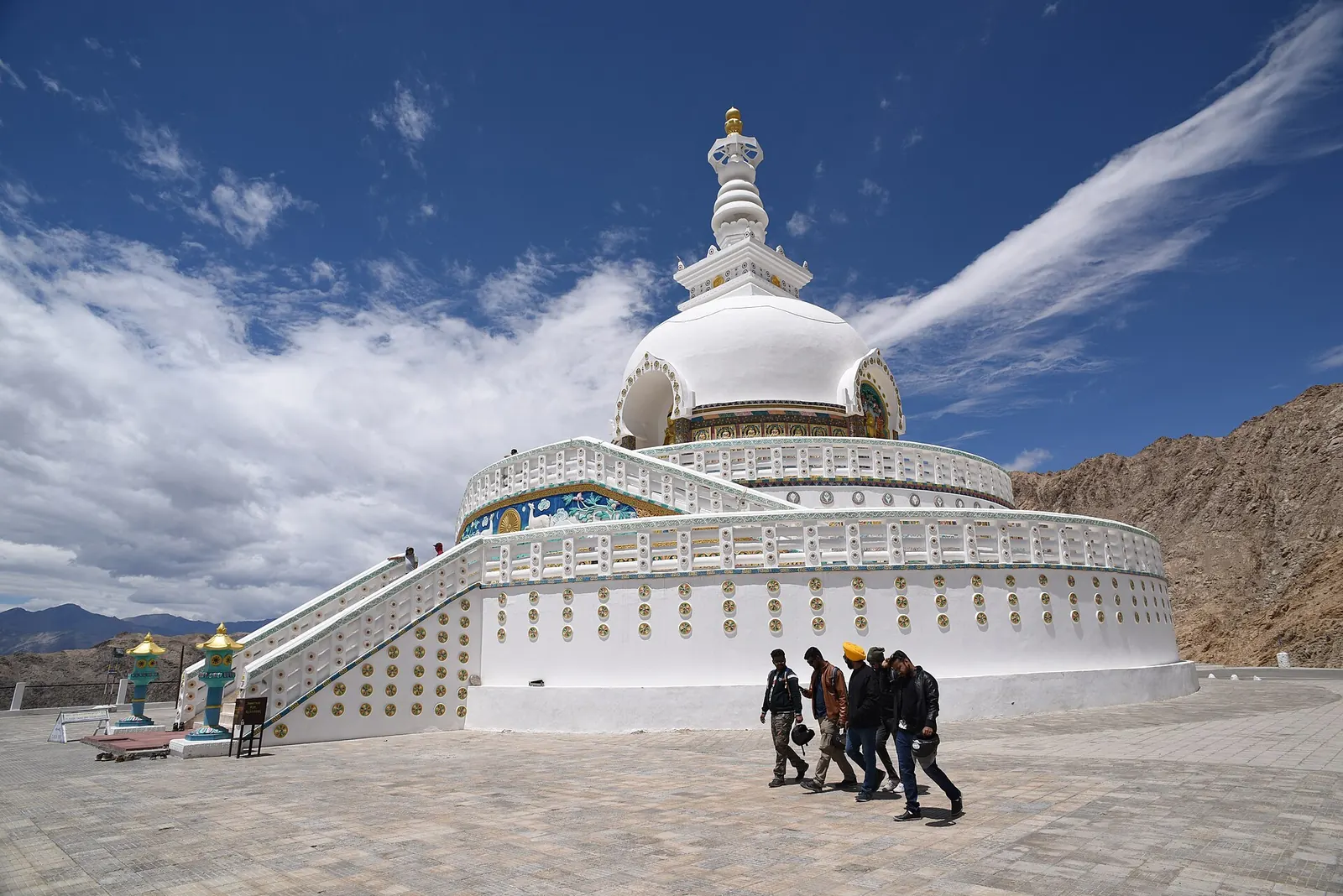
- Mark the fixed stages. Some legs have no stops in between, like the 428 km Manali-Leh highway, which is normally split with a night at Keylong or Jispa. Plan those first.
- Set a finish time, not a distance. Aim to arrive an hour before sunset. Use the daylight chart for your month and latitude.
- Use your own moving average. Log the first day and recalculate. Loaded bikes, groups and heat all cut it.
- Fix stop spacing. A stop about every 250 km, or every two hours in the mountains, keeps fatigue down; fuel range sets the hard maximum. See fuel range planning.
- Allow for repeat days. One long day is fine for a fit, experienced rider; three in a row is a different thing. On a 12-day trip, plan one or two long transfer days and keep the rest moderate.
- Write down the stop rule. If you are yawning, drifting in the lane or missing signs, stop. Twenty minutes of rest is cheaper than any crash.

What about Iron Butt-style 1,000 km days?
A 1,000 km day in India is possible on a well-set-up bike, but it is an event with its own plan, not a touring benchmark.
Over 16 to 18 hours of riding, which is how I use long-distance days to test my limits, you will ride through the 18:00 to 21:00 window when crash numbers peak, and often through the pre-dawn hours that the sleepiness research flags.
What makes such a day survivable is boring:
- a fresh, rested start;
- highways that bypass towns;
- stops at a fixed rhythm;
- food that does not make you drowsy;
- a rule to end the day if sleepiness shows up.
The Iron Butt format and its certification rules have their own post: the 1,000 km ride in India. If you ride alone, add a check-in plan from my solo touring safety plan, and see the gear I use for long days.
What's new
- Road Ministry report: 1.72 lakh people died in 4.80 lakh road accidents in 2023 PTI via The Week, Aug 2025
- Analysis of the 2023 crash report: two-wheeler users remain the largest group killed OpenCity, Sep 2025
Questions people ask
Is 500 km a day too much on a motorcycle?
Not on a four-lane plains highway for a rested, experienced rider; at a 55 km/h moving average with four 25-minute stops, it takes about 10.8 hours. It is too much in the hills, where averages fall to 15 to 45 km/h.
Calculated in this post: 500 km at 55 km/h is 9.1 hours of moving time, plus four 25-minute stops (1.7 hours), about 10.8 hours. The calculator above shows 55 km/h and 25 minutes as its default assumptions.
How many km can a beginner ride in a day?
Start with 200 to 300 km on familiar highways and finish in daylight. The 2016 Spiti rider on Tripoto, who had never ridden more than 100 km in a day, opened with 430 km and spent the rest of the trip catching up on fatigue and mechanical problems.
How long does it take to ride Manali to Leh?
The highway is 428 km. The usual plan is two days, and a 2026 route guide recommends Keylong or Jispa over Sarchu for the first night, because high passes, rough patches and altitude keep averages low.
Should I start before dawn to cover more distance?
Start at first light, not hours before it. Crash records show few accidents between 03:00 and 06:00 because few people are driving, but case-control research found that driving between 2 am and 5 am raised injury-crash odds 5.6 times.
Sources
- MoRTH: Road Accidents in India 2023 (report mirror on OpenCity) (2025)
- Connor, J. et al.: Driver sleepiness and risk of serious injury to car occupants. BMJ (2002)
- Bougard, C. et al.: Motorcycling performance and sleepiness during an extended ride on a dynamic simulator. Physiological Measurement (2020)
- xBhp: Leh Ladakh on bike in October (route-planning thread) (2020)
- Travel Coffee: Spiti valley road status (Sep 2026)
- Tripoto: Spiti, a rider is born (trip report) (2016)
- Discover with Dheeraj: Manali-Leh highway status 2026 (Oct 2026)
- NOAA Global Monitoring Laboratory: Solar calculator and equations
- Wikipedia: Leh–Manali Highway
- PTI via The Week: Road Ministry report on 2023 accidents (Aug 2025)
- OpenCity: Road crashes in 2023 (Sep 2025)

Sapta (Saptarshi Sarkar) is a mechanical engineer turned marketer in Bengaluru and a solo touring rider. He writes the seven Saptaverse blogs. Work with him or read more of RoadHook Rides.


