
Wind chill on a motorcycle is the temperature your exposed skin feels when the riding speed adds to the wind. Using the standard North American wind chill formula, a 5 °C morning at 60 km/h feels like about -2 °C, and a 0 °C pass at the same speed like about -9 °C. Most of the extra chill arrives by 40 km/h; going faster adds a little more, while the real damage comes from wind stripping the insulation out of your clothes.
- -8.8 °C is how a 0 °C morning feels on bare skin at 60 km/h.
- V0.16 in the formula means most of the chill arrives by about 40 km/h, then it flattens.
Calculated in this post from the NWS wind chill formula: at 0 °C air it gives -7.4 °C at 40 km/h and -11.3 °C at 120 km/h.
- 62% of clothing insulation was lost in a 7 m/s wind at -5 °C in a chamber study.
- 6.5 °C per 1,000 m: a pass 2,000 m above town starts about 13 °C colder before any wind.
Calculated in this post from the standard-atmosphere lapse rate of 6.5 °C per 1,000 m (San Diego State University) and an example height of 2,000 m: 2 x 6.5 = 13 °C.
- Windproofing and sealed gaps beat extra thickness for keeping hands working.
Riders feel cold long before the thermometer says it is cold, and the reason is airflow. Still air next to your skin and trapped inside your layers is the insulation; wind blows it away.
This post uses the wind chill index that the US National Weather Service and Environment Canada publish, puts it in a calculator with riding speed and altitude, and then looks at what lab research says about how wind cuts through clothing.
How does the wind chill formula work?
The current wind chill index models heat loss from an exposed human face in moving air. In metric units it reads: wind chill = 13.12 + 0.6215·T − 11.37·V0.16 + 0.3965·T·V0.16, where T is air temperature in °C and V is wind speed in km/h.
The NWS publishes the same formula in °F and mph, and says it is valid only at or below 10 °C (50 °F) and above about 5 km/h (3 mph) of wind.
The index began with a bottle of water in Antarctica. During the US Antarctic Service Expedition of 1939–1941, the researchers Paul Siple and Charles Passel timed how fast water froze in small plastic cylinders hung out in the wind. From that rate of heat loss they estimated how fast exposed skin would chill, and published the formula in 1945. Siple coined the term wind chill.
A water bottle is not a face, and the old values ran much too cold. So in 2001 the index was rebuilt on people: volunteers at a Canadian military research centre in Toronto walked for 90 minutes at 10, 0 and -10 °C while a wind tunnel blew 4.5, 12.5 and 18 mph at them. Because of limits on human experiments, winds were kept to 27 mph (about 43 km/h) or less. Every number above that, including your highway speed, is the model talking.
Weather Underground (Bob Henson): How wind chill got started, 2019Two details that matter for riders
- It flattens with speed. The V0.16 term means chill rises steeply at low speeds and then flattens: going from standstill to 40 km/h costs far more warmth than going from 80 to 120 km/h.
Calculated in this post from the NWS wind chill formula: at 0 °C air, 20 to 40 km/h adds 2.2 °C of chill, 80 to 120 km/h adds 1.5 °C.
- Your face gets the full speed. The formula takes wind measured at the standard 10 m mast height and scales it down to face height. On a motorcycle the full riding speed hits your face, so the real chill on exposed skin is somewhat colder than the number the formula gives.
| Air temp | 20 km/h | 40 km/h | 60 km/h | 80 km/h | 100 km/h | 120 km/h |
|---|---|---|---|---|---|---|
| 10 °C | 7.4 | 6.0 | 5.1 | 4.4 | 3.9 | 3.4 |
| 5 °C | 1.1 | -0.7 | -1.8 | -2.7 | -3.4 | -4.0 |
| 0 °C | -5.2 | -7.4 | -8.8 | -9.8 | -10.6 | -11.3 |
| -5 °C | -11.6 | -14.1 | -15.7 | -16.9 | -17.9 | -18.7 |
| -10 °C | -17.9 | -20.8 | -22.6 | -24.0 | -25.1 | -26.1 |
Values are wind chill in °C from the NWS and Environment Canada formula, using riding speed as the wind speed.
Environment Canada rates wind chill of -10 to -27 as moderate risk, -28 to -39 as high risk (exposed skin can freeze in 10 to 30 minutes) and -40 to -47 as very high (5 to 10 minutes).
Use this to check what you just read: enter the town forecast, your speed and how far the pass climbs above town.
Wind chill for your ride
How cold is a Ladakh or Sikkim morning on the bike?
Colder than the town forecast. Take Leh in October: the IMD normal minimum is 0.3 °C. At 60 km/h that already feels like about -8 °C on bare skin.
Khardung La is about 1,850 m higher (5,359 m against 3,513 m at the Leh weather station; the pass is also claimed at 5,602 m), and with the standard lapse rate of 6.5 °C per 1,000 m the air there on the same morning would be near -12 °C. At only 40 km/h on the climb, that feels like about -23 °C, within reach of Environment Canada's high-risk band.
Calculated in this post from the Leh October minimum of 0.3 °C (IMD normals), the 1,850 m height difference and the NWS formula: 0.3 - 6.5 x 1.85 = -11.7 °C air, then -23.1 °C at 40 km/h.
The town forecast is for the town. The pass above it starts about 6.5 °C colder for every 1,000 m, before the wind takes its share.
See the data as a table
| Leh (3,500 m) (°C) | Gangtok (1,650 m) (°C) | |
|---|---|---|
| Jan | -13.1 | 5.5 |
| Feb | -9.2 | 7.3 |
| Mar | -3.7 | 10.1 |
| Apr | 1.6 | 12.7 |
| May | 6.2 | 14.9 |
| Jun | 11.3 | 17.1 |
| Jul | 15.9 | 17.7 |
| Aug | 15.1 | 17.7 |
| Sep | 9.2 | 16.7 |
| Oct | 0.3 | 13.8 |
| Nov | -7.2 | 10.2 |
| Dec | -11.7 | 7.2 |
Source: India Meteorological Department normals (Leh 1951-2020, Gangtok 1991-2020), as tabulated on Wikipedia · Passes above these towns are colder by roughly 6.5 °C per 1,000 m of height.
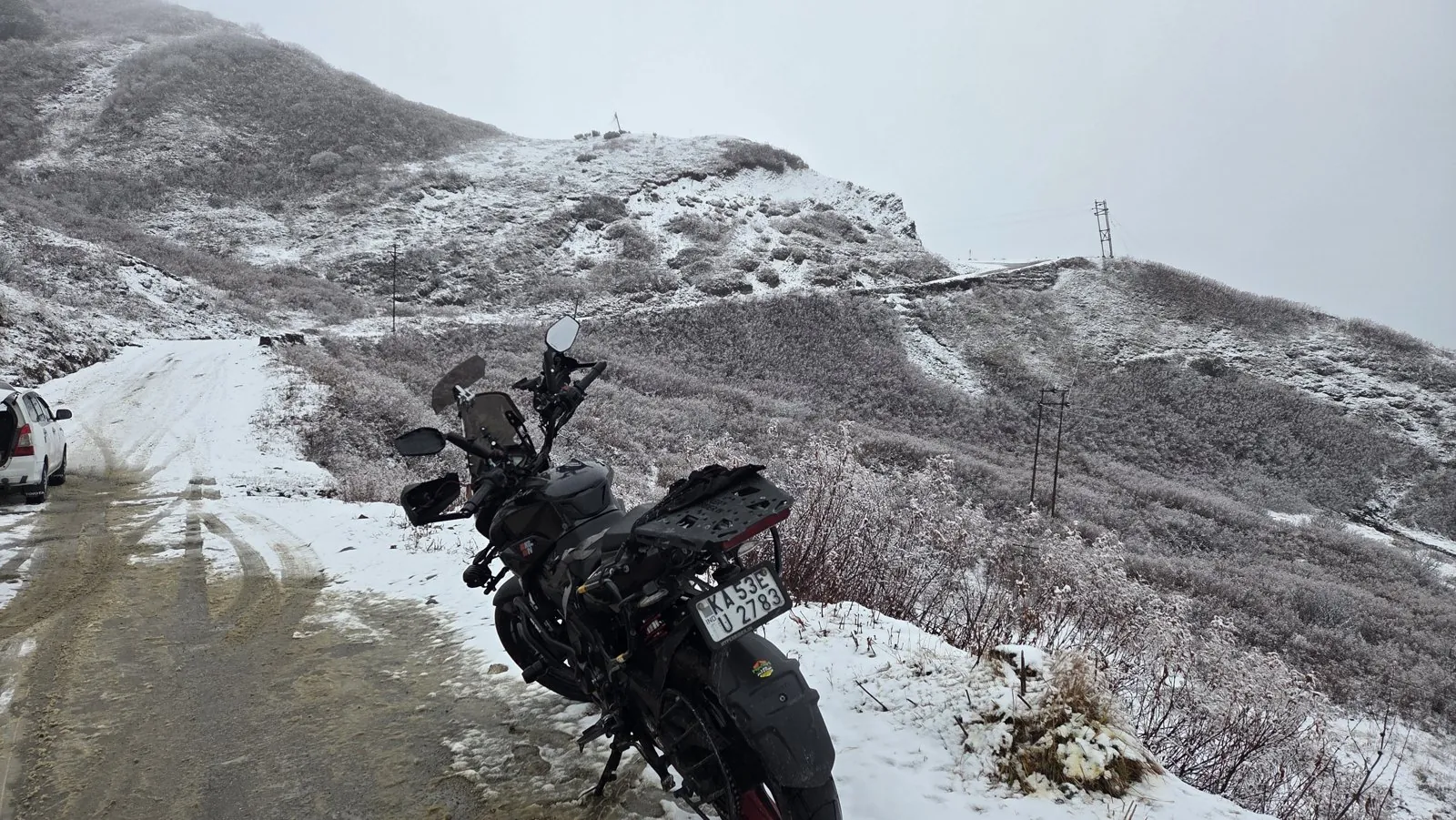
Sikkim is milder in town but not on the passes. Gangtok's November minimum is about 10 °C, yet Baba Mandir on the old Silk Route sits near 4,120 m, about 2,500 m higher, which by the same lapse rate is some 16 °C colder. In November 2025 I had ice forming on my visor near Baba Mandir. The October question for Ladakh is answered in detail in riding Ladakh in October.
Why do layers stop working at riding speed?
Because insulation is mostly still air, and wind pushes through fabric and pumps air out of the gaps at cuffs, collar and waist. A recent chamber study measured how much.
Ten healthy young men in typical Korean winter clothing (a hooded down jacket, gloves, about 2.1 clo of insulation) walked for an hour at 4 km/h in a -5 °C chamber, with fan wind at 0, 2, 4.5 and 7 m/s (up to about 25 km/h). At 7 m/s, the clothing's effective insulation fell to about 0.8 clo, roughly 62% less.
Finger temperature at the end of the walk was about 12.9 °C against 23.7 °C in still air, and mean skin temperature 26.9 °C against 29.6 °C. Core temperature did not differ, yet hands were rated "very cold". The limit: ten young men walking, not riding, at wind speeds well below highway speed.
Read the paper (free)For a rider, that result says three things:
- Hands go first. Your core may be fine while your hands lose dexterity, which is exactly what you need for clutch, brake and throttle.
- Windproofing beats thickness. A thin windproof shell over a fleece beats a thick, airy sweater under a mesh jacket.
- Sealing gaps (collar, cuffs, jacket-to-trouser zip) does as much as adding a layer.
Cold hands are not just discomfort; they are slower hands on the controls.
The authors linked 36,079 hospital attendances for motorcycle crashes in Sabzevar, Iran, from 2011 to 2017 to daily temperature with distributed lag models. On days of extreme cold (a 1st-percentile maximum of 3.1 °C) crash attendances were 12% higher than at the optimum temperature, and on extreme-heat days (42.4 °C) 20% higher; using mean temperature, extreme cold raised risk 20%.
About 11% of attendances were attributable to non-optimal temperatures. The limit: one city, male riders only, no data on traffic volume, and the cold effect weakened after adjusting for dust and visibility.
Read the paper (free)The heat side of the same curve is covered in riding in a heatwave.

What should you wear for a cold pass at riding speed?
Build the outfit from the skin out with one rule: nothing the wind can blow through on the outside, and nothing that soaks sweat on the inside. Here is a practical stack for wind chills down to about -20 °C.
| Layer | Job | What to look for |
|---|---|---|
| Base layer | Move sweat off the skin | Merino or synthetic, close fitting, never cotton |
| Mid layer | Trap still air | Fleece or thin down; two thin layers beat one thick one |
| Wind barrier | Stop the airflow that strips insulation | Windproof liner or rain shell worn as a wind layer |
| Riding jacket and trousers | Abrasion and impact protection | Close the vents; overlapping zip between jacket and trousers |
| Neck and face | Seal the biggest gap | Balaclava or neck tube; a Pinlock visor insert to stop fogging |
| Hands | Keep dexterity | Insulated, windproof gloves; thin liners; heated grips or handguards on long cold rides |
| Feet | Stay dry | Waterproof boots, wool socks; carry a dry spare pair |
For reference, my own cold-weather kit is Rynox Vapor Pro base layers, a Rynox balaclava, the Rynox Advento Pro jacket, a Rynox rain jacket and trousers, and a Pinlock Max insert in a KYT R2R Pro helmet. The full kit list is on the gear page, and what else to pack for the cold is in the touring packing list.
How do you plan a cold ride around wind chill?
- Use the forecast for the pass, not the town. Subtract about 6.5 °C per 1,000 m of height if only the town forecast is available, then run the calculator.
- Start a little later on the coldest stretch. Leaving after the sun has been on the road for an hour can lift air temperature several degrees and melt overnight ice.
- Ride slower over the top. The table shows the drop from 60 to 40 km/h saves only about 1.5 °C of chill, but a slower pace also gives you grip margin for ice and black ice on shaded bends.
- Stop before you are cold. Warm up at regular stops on long cold stretches, and put the wind layer on before the climb.
- Keep hydrated. Cold suppresses thirst, and dehydration also worsens altitude symptoms, as explained in the altitude sickness post.
Snow and frozen water crossings need their own technique, covered in water crossings and snow riding. More cold-country routes are on the Ride Atlas page.

What's new
- First light snow reported at Baralacha La on the Manali to Leh highway on 13 October 2026; last season's closure order came on 20 November 2025 Discover with Dheeraj, Oct 2026
- Chamber study shows a 7 m/s wind cuts winter clothing insulation by about 62% at -5 °C Journal of Physiological Anthropology, 2026
- Ladakh Tourism advisory warns winter temperatures can fall to -30 °C from October to March Ladakh Tourism, 2026
Questions people ask
Does wind chill lower the temperature of my bike or engine?
No. Wind chill describes heat loss from warm skin. An object cannot be cooled below the air temperature by wind; wind only gets it there faster. A bike parked at 2 °C will not freeze its water at 60 km/h, though a wet road at 0 °C can.
Is 5 °C cold enough to need winter gloves on a bike?
For more than half an hour, yes. At 80 km/h a 5 °C morning gives a wind chill of about -3 °C, and the Korean study found fingers dropped to about 13 °C even at -5 °C with a much gentler wind and proper gloves. Numb fingers slow your clutch and brake.
Why does wind chill not rise much above 60 km/h?
Because the formula scales with wind speed to the power of 0.16. Most of the boundary layer of warm air on your skin is already gone at moderate wind; more speed removes only a little more. That is also why the table flattens on the right.
Can I get frostbite riding in Ladakh in summer?
On exposed skin it is unlikely in July and August, when Leh's mean minimum is about 15 °C (IMD normals). It becomes a real risk on the high passes from October, when early-morning wind chill on the climb can fall below -20 °C.
Sources
- US National Weather Service: Wind Chill Chart and formula
- Environment Canada: Wind chill and the Wind Chill Index, risk categories
- Kim DH et al.: Thermoregulatory responses to air temperature of -5 °C at different wind speeds, Journal of Physiological Anthropology (2026)
- Zare Sakhvidi MJ et al.: Extreme environmental temperatures and motorcycle crashes: a time-series analysis, Environmental Science and Pollution Research (2022)
- Weather Underground, Bob Henson: How wind chill got started (2019; Siple and Passel 1939–41, formula published 1945; 2001 Toronto volunteer tests up to 27 mph; source for the story)
- Wikipedia: Paul Siple (developed the wind chill factor with Charles Passel; coined the term)
- The Canadian Encyclopedia: Wind chill (Siple and Passel froze water in plastic vials in the Antarctic wind)
- Wikipedia: Leh climate table (IMD normals)
- Wikipedia: Gangtok climate table (IMD 1991-2020 normals)
- Discover with Dheeraj: Manali Leh Highway status 2026 (2026)
- Ladakh Tourism Department: Travel advisory

Sapta (Saptarshi Sarkar) is a mechanical engineer turned marketer in Bengaluru and a solo touring rider. He writes the seven Saptaverse blogs. Work with him or read more of RoadHook Rides.


