
Hand-painted Bollywood posters were made from the 1920s to the 1990s by studio artists who painted a design on canvas, photographed it and printed it, while separate crews painted giant cinema hoardings by hand. The craft ended in about a decade: digital poster design arrived in Bombay in 1992, and cheap flex printing in the late 1990s and 2000s made a printed banner cheaper per cinema than a painted one. Today the surviving originals sell as art, and a few painters still work to order.
- 1924: Baburao Painter's Kalyan Khajina poster, one of the earliest surviving.
- Studio posters began as a 30 × 40 inch canvas, photographed in daylight and printed about 1.5 lakh times.
- 1992: digital poster design arrives in Bombay.
- In 2003 a painted banner cost about $26 per cinema, a printed one about $15.
- A ₹5 street poster now sells for up to ₹1.61 lakh at auction.
Indian cinema was sold by paint for most of its history. The poster on the wall and the hoarding above the cinema were the film's first trailer.
The people who made them were among the most-seen artists in the country, almost none of them famous. This is their history: the methods, the economics that killed the craft, and what designers can still learn from it.
When did hand-painted film posters start in India?
Hand-painted film posters in India date to the silent era: one of the earliest surviving is for Kalyan Khajina (1924), designed and painted by the Kolhapur director Baburao Painter himself. From then until the 1980s, the standard film poster began as a painting.
The studio poster method
The studio method was precise. Ranjani Mazumdar's 2003 study in Seminar describes it:
- Paint at print size. A specialist painted the design on a canvas of about 30 by 40 inches, the same size as the final print, because enlarging lenses were not yet available in India.
- Photograph it. The canvas was photographed in natural sunlight with a large camera, and the negative went to the printer.
- Print by the lakh. The posters were printed on cheap paper and pasted across cities and towns.
A single design took about a week.
The hoarding method
Hoardings were different work. They were painted directly at full size on canvas, scaled up from a small design with a grid.
The V&A describes the same grid method for the Bombay firm Balkrishna Arts: rough sketches from film stills, client approval, then a grid to enlarge the design onto the canvas.

A film scholar's study of how Bombay posters were made and sold, based on interviews with designers, printers and publicists. Key numbers: canvases of about 30 x 40 inches painted at print size and photographed in sunlight; enlargement lenses only after 1985; digital design introduced in 1992 by Rahul Nanda of HR Enterprises; about 1,50,000 posters printed per film; posters sold on the street for ₹5 until the early 1990s and to collectors for ₹15,000–40,000 by the early 2000s. She also notes the 1976 Bengal law against defacing property with posters, later extended to Delhi. The limit: it is a short essay drawn from industry interviews, not an archival history.
Read the essay (free)Who painted the posters and hoardings?
Most poster and hoarding painters were trained in small studios rather than art schools, and worked anonymously for distributors and cinemas. A few names survive:
- Baburao Painter, at the start;
- Rahat Gola, poster artist in Bombay's later decades;
- studios such as Balkrishna Arts;
- M. F. Husain, who painted cinema hoardings in Bombay in the 1930s before he became India's best-known modern painter.
In October 2003 a reporter from the Christian Science Monitor climbed into the studio of Sheikh Rehman, a cavernous room behind the screen of the Alfred Talkies in Bombay. It had been his father's studio before him, and he had worked there for 20 years. Rehman had once painted Raj Kapoor and Madhubala; now he stood shirtless on a scaffold with a close-knit crew, adding gloss and detail to oversized heroes and sirens for third-run action films. He could name only three other cinema painters still working in the whole city. The rest, he said, had gone to paint election posters, which paid better. He saw himself as perhaps the last master of a dying art, and admitted he was struggling to make a living.
Christian Science Monitor: Indian posters lose local touch (2003)Posters that changed with the box office
Painters worked from publicity stills, and posters were revised when a song or scene became popular. The curator Iqbal Rizvi's 2025 Delhi show displayed four different posters for Lakhon Mein Ek (1971), changed to match the film's box-office run.
Chennai's giant banners
In Chennai the scale was larger. Tamil cinema used enormous banners and plywood cut-outs of stars, built by teams in which artists drew outlines and carpenters cut the boards.
The banner artist Lovely Karuppasamy told DT Next that painters charged ₹10–50 per square foot in their prime. They worked on bamboo tati boards with cotton cloth and distemper-primed paint, at first in red, black and blue and later with fluorescent colours.
| Year | Event |
|---|---|
| 1924 | Baburao Painter paints the Kalyan Khajina poster, one of the earliest surviving |
| 1930s | M. F. Husain paints cinema hoardings in Bombay |
| 1951–56 | Guru Dutt's Baazi (1951) and C.I.D. (1956) posters, classics of the painted style |
| 1976 | West Bengal law makes defacing property with posters punishable; later extended to Delhi |
| 1978 | Don poster, a peak of the action-era style |
| After 1985 | Enlargement lenses reach India; cut-and-paste photo posters replace full painting |
| 1990s | Cable TV's look influences posters |
| 1992 | Rahul Nanda introduces digital design and the first digital billboards in Bombay |
| 2002 | V&A commissions Balkrishna Arts to paint a hoarding for its Cinema India exhibition |
| 2003 | A Bombay painter can name only three other working cinema painters in the city |
| Late 2000s | Flex printing and legal limits end Chennai's banner trade |
| 2017 | NFAI acquires about 2,500 film posters dating back to 1942 |
| 2025 | Delhi's Poster Bolte Hai show; a Sholay poster lot sells for ₹1.61 lakh |
Why did hand-painted posters die?
Hand-painted posters and hoardings died because printing became cheaper per screen, faster and portable. A painted hoarding was made once for one cinema; a printed vinyl banner could be made in hours and sent to twenty.
The 2003 numbers
The economics were reported plainly by the Christian Science Monitor in October 2003:
| Banner | Cost | Cinemas served |
|---|---|---|
| Hand-painted canvas | $80–100 | 3 or 4, before the weather ruined it |
| Computer-designed plastic | Up to $300 | More than 20 |
Per cinema, the printed banner was already cheaper, and it showed the stars as photographs, which audiences raised on cable TV now expected. The chart below works out the cost per theatre from those figures.
See the data as a table
| Cost per theatre (US$) | |
|---|---|
| Hand-painted canvas | 25.7 |
| Printed plastic banner | 15 |
Source: Christian Science Monitor, October 2003 · Painted: midpoint $90 across 3.5 theatres. Printed: $300 across 20 theatres (the report says more than 20, so this overstates the printed cost).
Three more forces
- Computers. From 1992 Bombay's publicity houses (Glamour, HR Enterprises, Studio Links and others) built posters digitally, which cut the painter out of the poster entirely.
- Multiplexes. They began to outpace single-screen halls, the cinemas that had hung painted hoardings.
- Laws. Cities restricted wall posters and roadside banners, from the 1976 Bengal law onward, which shrank the space painted publicity lived in.
The workforce collapse
The workforce collapsed fast. In 2003 the Bombay painter Sheikh Rehman, working behind the screen at Alfred Talkies, could name only three other cinema painters still working in the city.
In Chennai, the advertising consultant Mara Varman estimates that 75% of banner artists moved to other jobs, and Karuppasamy counts only five to ten painters left.
The irony is durability: flex fades in about six months, while a well-painted board lasts 10–15 years, by Karuppasamy's account.

Painted vs printed banner: cost per cinema
Did shop signs go the same way?
Yes. Hand-painted shop signs followed the same path as film hoardings, a little later and more slowly, as flex and vinyl-cut stickers took over. Small towns and old markets still have painters, but they are few and old.
Ahmedabad's sign painters in 2024
A 2024 report from the People's Archive of Rural India on Ahmedabad's sign painters gives the details. Sheikh Jalaluddin Kamaruddin, 71, has painted signs for about 50 years in five scripts: Gujarati, English, Hindi, Urdu and Arabic.
He skips pencil drafts, judges letter size by eye and uses a wooden ruler for straight strokes. The trade's numbers:
- ₹120–150 per square foot charged;
- ₹800–1,000 for a two-day board;
- three paint coats, each taking about a day to dry;
- only about 50 painters left in the city, by another painter's estimate.
Several have moved to plexi cutters and computers; one bought a cutter for ₹25,000 and a computer for ₹20,000. Some digital print shop owners still prefer hand-made signs, even at a higher price.
The craft survives in two niches: heritage and fashion. Hand-painted lettering is now commissioned for cafés and brands that want to look local, and that demand is where many younger painters earn. My post on Indian truck art covers the other place the tradition still runs at scale: the backs of lorries.
What made a painted Bollywood poster look the way it did?
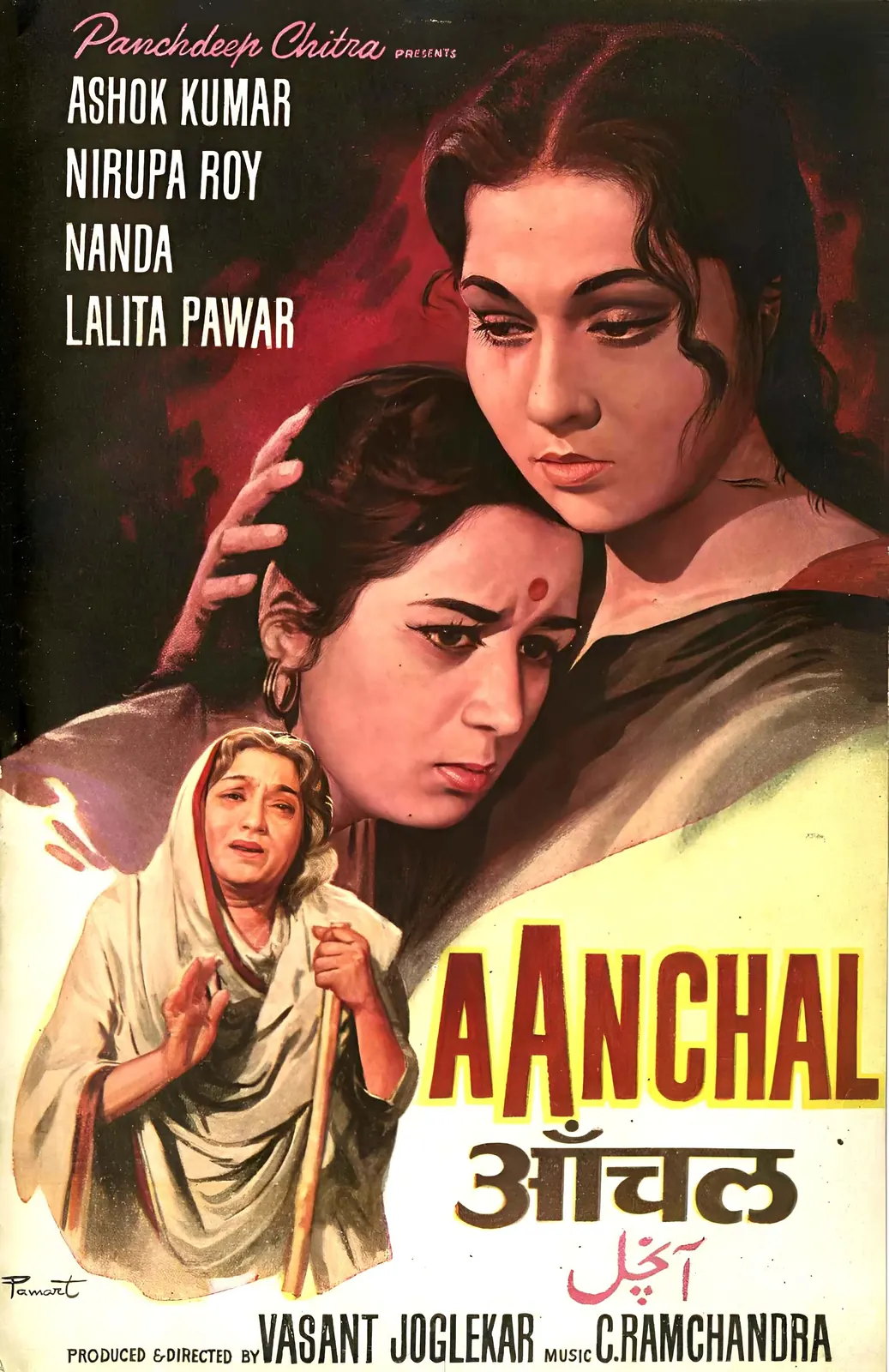
The painted style came from the job: sell a film from across a street, to people who might not read the title. So the stars' faces were huge and lit like icons, colours were saturated and complementary, and the lettering was custom for each film.
- Faces first. The likeness of the star was the product. Faces were painted larger than life, often with dramatic side lighting and coloured shadows.
- Hot colour pairs. Red against green, yellow against purple, orange against blue. Painters used complementary contrast because it carries over distance and survives fading.
- Collage composition. Several scenes floated around the lead pair, a visual trailer: the villain, the song, the fight, the mother.
- Hand lettering as identity. Each title was drawn as a logo, often in more than one script, with extrusions and outlines. Before computers, that consistency lived in the painter's hand, a fair answer to the forum question about how brand consistency worked without software.
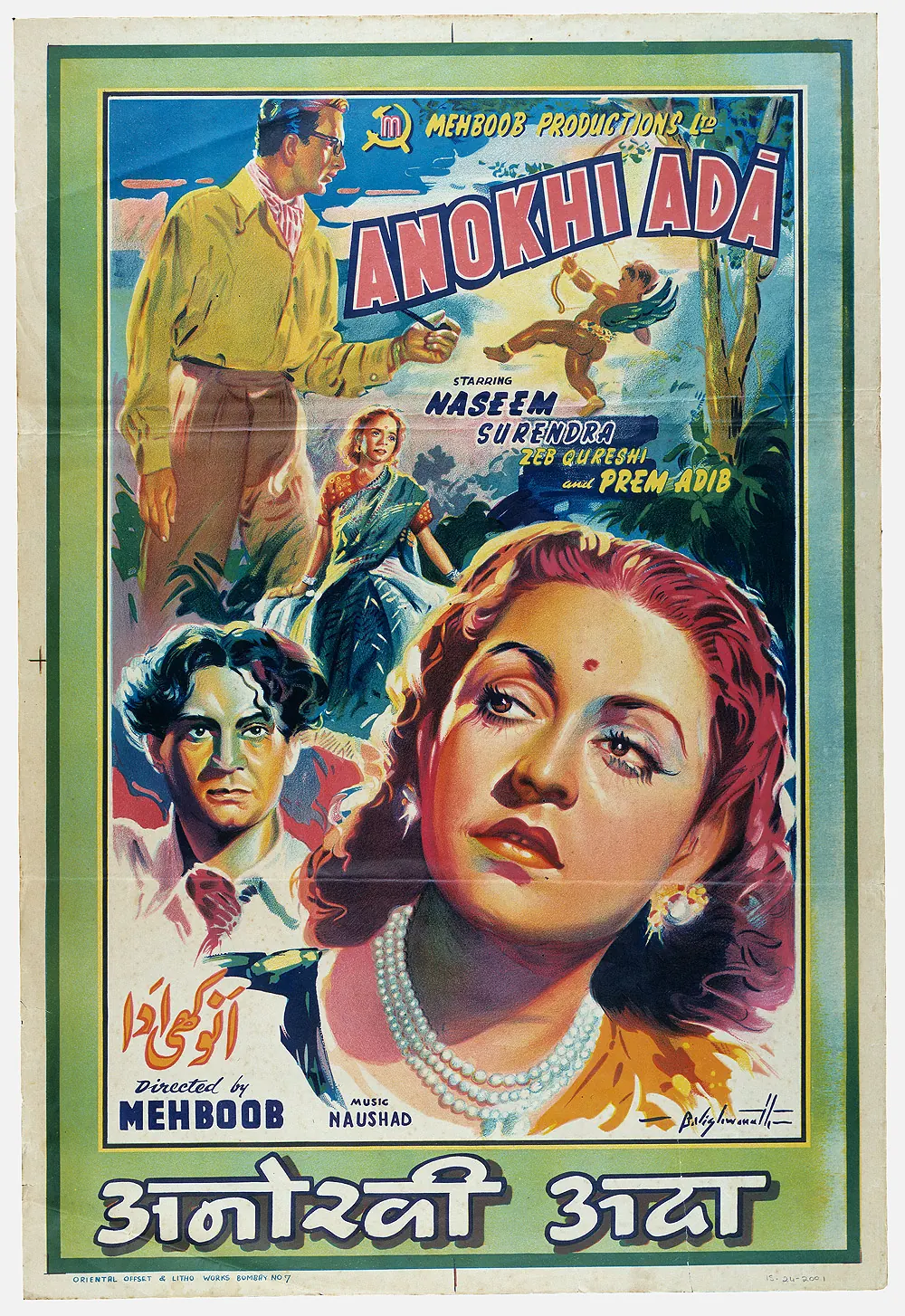
That last point matters for designers. A film title was a brand mark redrawn by many hands across posters, hoardings, song booklets and newspaper ads, and it still had to look like itself. It survived because the letterforms were simple and distinctive.
The same lesson appears in why logos look dated: marks that depend on a technique date with it; marks built on a strong idea survive a change of medium. Satyajit Ray's own film posters, made in Calcutta in the same decades, are the high-design version of this tradition; see Satyajit Ray as a graphic designer.
An ethnography of Tamil film fan clubs and the images they put into public space: billboards, posters, painted murals and banners around film releases and festivals in Tamil Nadu. Gerritsen argues that fans use these images both to bond with the star and to present their own ambitions, and that the fight over street images ties into city politics and the drive to make cities look "world class". It is useful here because it shows why Tamil Nadu's street images were policed and cleared, which helped end the painted banner. The limit: it studies fan-made images after the shift to print, not the painters' craft itself.
Read the thesis (free)How much are hand-painted Bollywood posters worth now?
Original hand-painted posters and lithographs now sell as collectibles, from a few thousand rupees to lakhs for rare classics. A poster that sold for ₹5 on the street before the early 1990s could fetch ₹15,000 to ₹40,000 by the early 2000s, according to Mazumdar.
Auctions
Auction houses now run dedicated sales. At deRivaz & Ives' aABC auction in Mumbai on 23 August 2025:
- an original Sholay poster with its song-synopsis booklet sold for ₹1.61 lakh;
- a rare six-sheet Sholay poster sold for ₹74,750;
- the sale totalled ₹3.31 crore.
Archives
Archives are collecting too. In August 2017 the National Film Archive of India acquired about 2,500 posters going back to 1942, about 1,500 of them for Hindi films.
The centrepiece was a 10 by 5 foot, six-sheet Mughal-e-Azam (1960) poster, an offset print of a hand-painted original.
Why the value rose
Mazumdar's point about this market is sharp: the poster was a cheap mass print, and its value now comes from being taken out of the street and put on a wall, where it gains the "aura" of a rare object.
For the painters, the irony is that their work is worth most now that almost none of them can sell new work. For the fine-art end of the same market, see the most expensive Indian paintings ever sold.
What's new
- Delhi's Poster Bolte Hai show displays 42 film posters, curated by Iqbal Rizvi ThePrint, Aug 2025
- deRivaz & Ives' Mumbai auction sells Sholay posters for up to ₹1.61 lakh The Week (PTI), Aug 2025
- Chennai's banner painters recall how flex printing erased their trade DT Next, Jul 2026
Questions people ask
Who painted Bollywood posters?
Mostly studio artists whose names were rarely credited: Baburao Painter in the silent era, poster artists such as Rahat Gola later, firms such as Balkrishna Arts for hoardings, and the young M. F. Husain, who painted hoardings in 1930s Bombay.
When did Bollywood stop using hand-painted posters?
The shift ran from the late 1980s to the early 2000s. Photographic cut-and-paste posters came after 1985, digital design in 1992, and by 2003 only a handful of hoarding painters were still working in Bombay.
Why were film posters painted instead of photographed?
Early on, printing photographs at poster size in colour was costly and enlargement lenses were not available, so a painted canvas photographed at full size was the practical master. Painting also let artists exaggerate faces, colour and action beyond what a still could show.
Are hand-painted shop signs still made in India?
Yes, but by a shrinking group. In Ahmedabad, painters estimate about 50 remain, charging around ₹120–150 per square foot; many now also run sticker and flex businesses.
Sources
- Ranjani Mazumdar: The Bombay film poster, Seminar 525 (2003; source for methods, 1992 shift, prices)
- ASAP Art: The film poster as art object, excerpt from Ranjani Mazumdar (2021)
- Christian Science Monitor: Indian posters lose local touch (2003; source for banner costs, painter count and the Sheikh Rehman story)
- Victoria and Albert Museum: Cinema India hoarding by Balkrishna Arts, IS.115-2002 (2002)
- Roos Gerritsen: Fandom on display, PhD thesis, Leiden University (2012)
- Preminda Jacob: Media spectacles, the production and reception of Tamil cinema advertisements, Visual Anthropology 11(4) (1998)
- DT Next: Chennai's forgotten art, how flex printing erased hand-painted banners (2026)
- People's Archive of Rural India: In Ahmedabad, the painters of signs (2024)
- Wikipedia: M. F. Husain (2026)
- ThePrint: Delhi show salutes Bollywood's poster painters (2025)
- The Week (PTI): deRivaz & Ives aABC auction nets ₹3.31 crore (2025)
- Media India: 2,500 Indian film posters archived by NFAI (2017)

Sapta (Saptarshi Sarkar) is a mechanical engineer turned marketer in Bengaluru and a solo touring rider. He writes the seven Saptaverse blogs. Work with him or read more of Artblog.


