
A good bike trip packing list for India is short and sorted by bag: documents and the things you need while moving go in the tank bag, heavy and dense items go low in the saddlebags, and light, bulky clothing goes in the tail bag. Beyond riding gear, carry a puncture kit and pump, a basic tool roll and spares, rain layers that actually seal, thermal base layers for anything above 3,000 m, a medicine kit with a pulse oximeter for the Himalaya, and earplugs. Everything else is optional.
- Sort by bag, not by category: tank bag for what you touch, saddlebags for weight, tail bag for bulk.
- Heavy goes low and forward; mass high and far back hurts handling most.
- Four layers for the cold: thermal base, mid, armoured jacket, separate rain shell on top.
- Pulse oximeter and a doctor-checked AMS kit are on the Ladakh Tourism advisory list.
- 100+ dB(A) of wind noise at highway speed is why earplugs ride in the tank bag.
- 50 km loaded test ride a week before you leave catches most luggage problems.
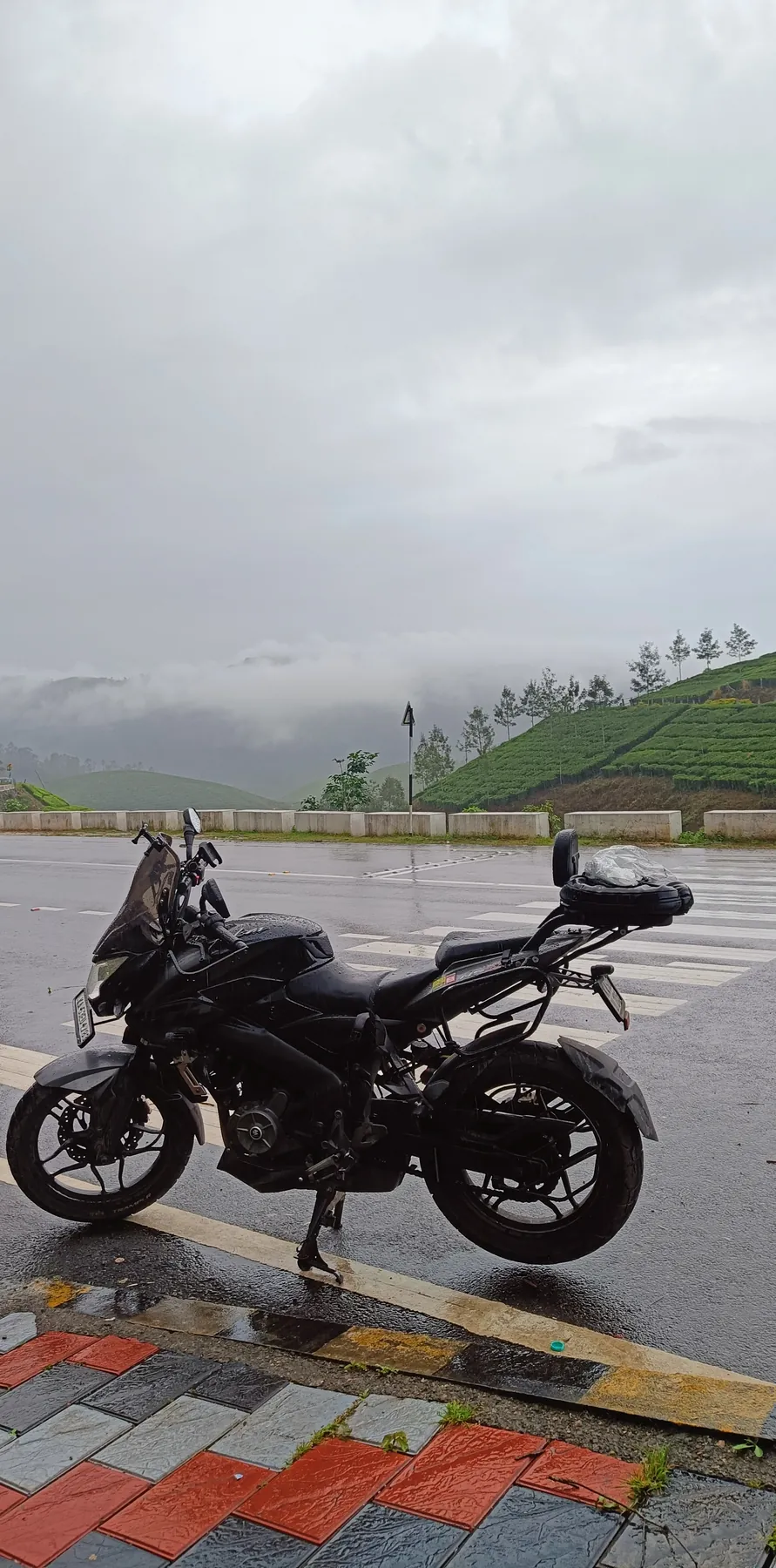
This is the system I use on long solo rides, from the Bengaluru to Kolkata run on NH16 to East Sikkim. My luggage is a ViaTerra Claw Pro tail bag, a ViaTerra Oxus tank bag and Rynox DryStack saddlebags, first on a Pulsar NS200 I converted into an upright tourer and now on a KTM 390 Adventure.
Where I name gear, it is what I own. Where I give numbers, they come from the Ladakh Tourism advisory, the Indian Railways rules or the research cited below.
In the last week of May 2023, snow fell on Baralacha La, the pass between Lahaul and Ladakh on the Manali–Leh road, and more than 400 vehicles were caught in a jam about 10 km long: over 90 cars, 30 motorcycles and the rest trucks (Outlook, PTI, May 2023).
On the evening of Friday 26 May, after a tourist coming down from the pass raised the alarm, police teams from Darcha and Keylong, the Border Roads Organisation, Mountain Journey Jispa and local hoteliers began a rescue that ran through the night. Over 250 people stranded with their cars and motorbikes were brought out, the sick among them were given medical aid, and the light vehicles were moved to safety within 15 to 16 hours. Late May counts as the start of the riding season; that night, the warm and dry layers each rider had packed were all they had.
Outlook (PTI): Over 250 people stuck in Lahaul-Spiti after snowfall rescuedHow should you split luggage across tank bag, tail bag and saddlebags?
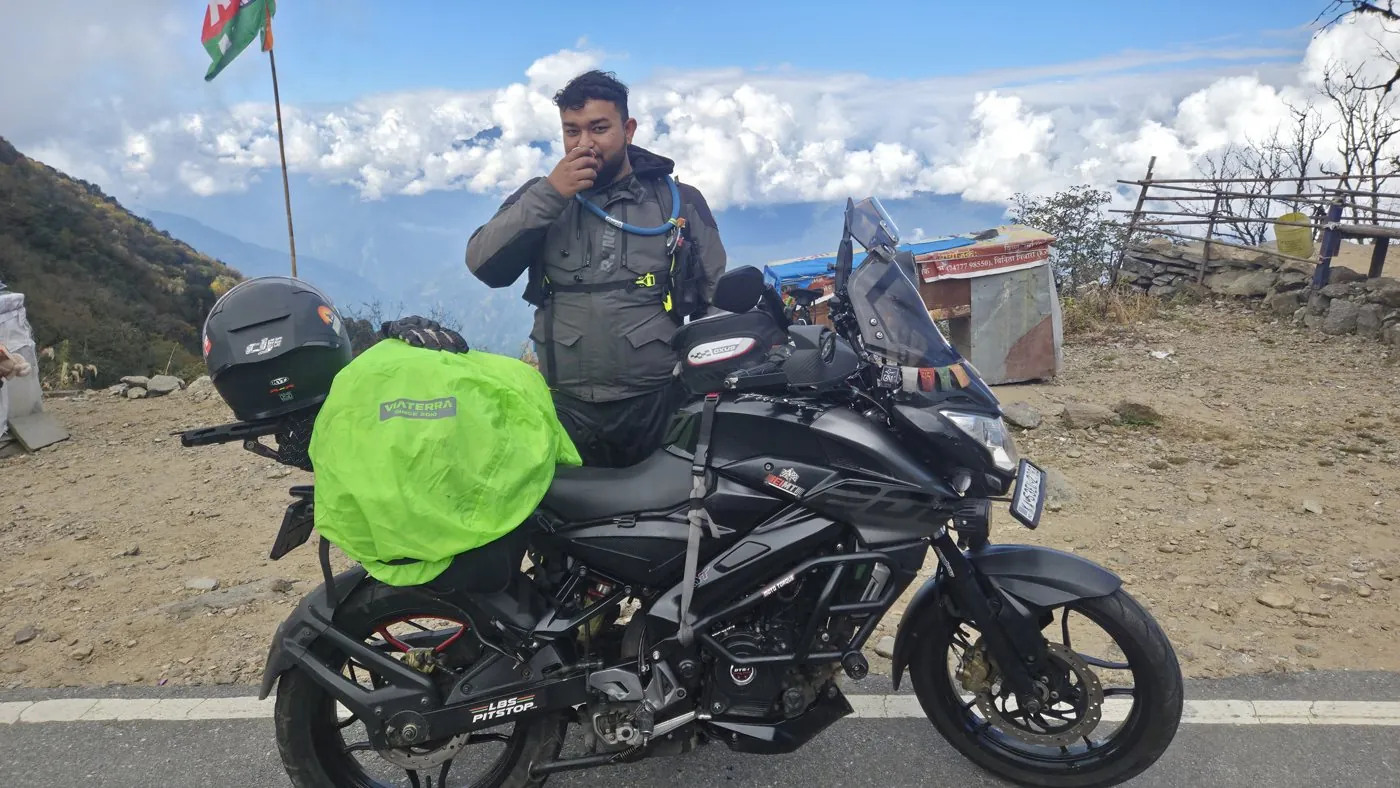
Put weight low and close to the bike's centre, and put what you reach for most within arm's length. A motorcycle's handling suffers most from mass placed high and far behind the rider, a point motorcycle luggage designers have long made.
So the heaviest items belong in the saddlebags, as far forward and as low as the mounts allow, and the tail bag carries light, bulky things.
| Bag | What goes in | Why there |
|---|---|---|
| Tank bag | Documents folder, phone, power bank, cash, sunglasses, snacks, earplugs, lip balm, permit printouts | Reachable at checkposts and fuel stops without getting off |
| Left saddlebag | Rain jacket and trousers, medicine kit, first aid, water | Needed fast when the weather turns, and reachable from the kerb side |
| Right saddlebag | Tools, puncture kit, pump, spares, chain lube, spare tube | Dense and heavy, so it rides low |
| Tail bag | Clothes, thermals, sleeping layers, toiletries, chargers | Light and bulky; only opened at the hotel |
| On you | Licence, phone, a little cash, the bike key's spare | Survives if the bike or bags are lost |
Two rules make this work in practice:
- Kerb side first. India drives on the left, so when you pull onto the shoulder the left side of the bike faces the kerb. Put the rain gear and first aid on the left and you will not stand in the traffic lane to dig for them.
- Pack in unpacking order. The thing you need first goes on top of every bag.
Use this to check what you just read against your own bike's limit:
Will your load fit the bike?
Which documents should you carry on an Indian bike trip?
Carry the driving licence, RC, insurance and PUC on paper, with copies in DigiLocker or mParivahan, plus at least two spare photo IDs and passport-size photos for permits.
On a long trip the paper matters because the places that check papers (Sikkim, Arunachal, Ladakh) are also the places where the network fails.
- Permits: Arunachal's e-ILP printed; Sikkim's PAP needs two photos per permit; see the Sikkim permit guide and the Tawang e-ILP guide.
- Ownership: if the bike is not in your name, an owner's authorisation; Sikkim forum advice asks for a notarised affidavit.
- Train backup: an RC photocopy and ID if you might ship the bike home by rail; the parcel office asks for both (how to send a bike by train).
- Medical: blood group, allergies and an emergency contact on a card in the jacket.
What tools and spares should you carry?
Carry what fixes the five failures that actually stop a tour. Everything else is a mechanic's job:
- punctures;
- a loose or dry chain;
- a blown fuse or bulb;
- a cut cable;
- loose fasteners.
| Item | Why |
|---|---|
| Tubeless puncture kit and compact pump or CO₂ | The most common roadside stop; check your pump fits the valve |
| Spare tube (for spoke wheels) | Tubed tyres can't be plugged |
| Tool roll: the bike's own kit plus axle spanner | Chain adjustment needs the axle nut size |
| Chain lube and a rag | Re-lube at the interval in your manual, and sooner after rain or dust |
| Fuses, a headlight bulb or spare relay | Small, cheap, and a night-time breakdown otherwise |
| Clutch and accelerator cable | Rarely needed, impossible to find in the high Himalaya |
| Cable ties, insulation tape, a small hose clamp | Fixes cracked mounts, loose luggage straps and wiring |
| Tyre pressure gauge | Load changes the right pressure; check the manual's loaded figure |
The fasteners item is from experience. My KTM's headlight buzzed between 4,500 and 5,500 rpm; tightening its hardware fixed it. Carry the Allen keys and spanners your bike's fasteners need, and check them at every long stop.
How do you layer for rain and cold on a long ride?
Layer for the coldest point of the day, not the average: a thin thermal base layer, an insulating mid layer, a riding jacket, and a fully separate rain shell over the top.
In Ladakh the Tourism Department warns that temperatures can drop to -30°C between October and March and asks visitors to carry cold-weather gear and thermals in those months.
- Base: synthetic or merino thermals, top and bottom. I use Rynox Vapor Pro base layers and a balaclava.
- Mid: a fleece or light down jacket that packs small; the one item worth its space in the tail bag.
- Riding layer: jacket and trousers with armour. Mine are a Rynox Advento Pro jacket and ViaTerra Spencer trousers.
- Rain shell: a separate jacket and trousers that go over everything. A built-in liner soaks the outer shell and stays cold; an over-suit sheds water.
- Hands and feet: waterproof gloves or overgloves, and waterproof boots. Waterproof socks are not a substitute: my Rynox pair underwhelmed in the wet.
- Visor: a Pinlock insert. Near Baba Mandir in November 2025 I had ice on the visor; a fogged or frozen visor is a bigger risk than cold hands.
To see how fast wind steals heat at riding speed, use the wind chill calculator for riders, and for the opposite problem, riding in a heatwave.

What should a Himalayan first-aid and AMS kit contain?
The Ladakh Tourism Department's advisory lists the medicines it recommends visitors carry, plus a first-aid kit and a pulse oximeter. Treat the list as something to take to your doctor, not a prescription; several items need one.
The advisory asks visitors to rest at least 48 hours in Leh before going higher, then gain no more than 300 to 500 m a day above 3,000 m, with a rest day for every 1,000 m gained, 3 to 4 litres of water a day and no alcohol. Its medicine list covers acetazolamide (Diamox) on a doctor's advice, paracetamol or ibuprofen, ORS, domperidone for nausea, and azithromycin only on prescription. It asks travellers to carry a pulse oximeter and, if symptoms worsen, to stop climbing and descend 500 to 1,000 m. The limit: it is guidance, not a clinical trial, and doses need a doctor who knows your history.
Read the advisory (free)The crash half of the kit
On top of that list, a rider's kit needs things for crashes:
- Wounds: sterile dressings, crepe bandage, antiseptic, tape and scissors;
- Fractures: a SAM-type splint or a triangular bandage;
- Burns: burn gel, for the exhaust burn that comes with most low-speed falls;
- You: disposable gloves.
Keep it in the same bag every trip so anyone who stops to help can be told where it is. The acclimatisation schedule itself is in a day-by-day acclimatisation plan for Ladakh.
Why are earplugs on every serious packing list?
Because wind noise inside a helmet at highway speed is loud enough to damage hearing over a long day. Above about 40 km/h, wind turbulence, not the engine, is the main source of what you hear, and at highway speeds levels exceed 100 dB(A) in most helmets.
From 40 km/h up, the engine was at least 18 dB below what the rider heard: the noise is the wind.Summarising Brown and Gordon, The Open Acoustics Journal (2011)
The authors put a dummy head with binaural microphones inside two helmets on a motorcycle at seven speeds from 0 to 120 km/h. From 40 km/h up, the engine was at least 18 dB below the measured level, so wind was the main source; at 120 km/h, several low-frequency bands hit 108 dB and every band from 50 to 400 Hz exceeded 100 dB. Active noise-cancelling earmuffs inside a helmet cut noise by up to 26 dB. A survey of 126 riders found 63.5% wore earplugs and 46.8% reported tinnitus. The limits: one motorcycle, two helmets and a small, self-selected survey.
Read the paper (free)See the data as a table
| Share of riders (%) | |
|---|---|
| Want a quieter helmet | 95.2 |
| Object to noise levels | 92.1 |
| Wear earplugs | 63.5 |
| Report tinnitus | 46.8 |
Source: Brown and Gordon, The Open Acoustics Journal (2011) · US survey, October 2009 to May 2010; 118 men and 8 women.
My own helmet, a KYT R2R Pro, fits slightly loose and buffets at 120 to 125 km/h, which is part of why I am now looking at reusable riding earplugs.
| Earplug type | Good at | Trade-off |
|---|---|---|
| Foam, disposable | Cheap; carry spares | Fiddly to roll with gloves; wear out in days |
| Filtered reusable | Easier to live with day after day | Cost more; easy to lose one |
Carry two pairs in the tank bag. Earplugs reduce noise but also make sirens harder to hear, so pair them with mirrors you actually use.
What can you leave at home?
Leave anything you can buy at the next town and anything you are packing just in case for a single day of the trip.
On Indian routes you are rarely more than a day from a market. The exceptions are the high Himalayan stretches and the Northeast border roads, and that is where the fuel, cables and medicines matter.

- Too many clothes: two sets of riding base layers, one set for evenings, laundry every third night.
- Full-size toiletries: buy as you go.
- A heavy lock and chain: a disc lock and a tracker do more. My KTM carries an Onelap LocoShield GPS tracker and a Samsung SmartTag2.
- Camping gear: unless you plan to camp, it is the heaviest optional thing on the bike.
- Hard cases: heavier than soft bags and harder on the subframe in a fall.
How do you check the pack before day one?
Do a full loaded test ride of at least 50 km a week before you leave, at highway speed and on a bad road, and repack anything that moves.
Most luggage problems show up in the first hour: straps that loosen, bags that touch the exhaust or the rear tyre under compression, and a tail bag that blocks the indicator or number plate.
- Weigh it. Use a luggage scale and plug the numbers into the calculator above.
- Set the suspension and tyre pressure to the manual's loaded figures.
- Check clearances by sitting on the loaded bike and bouncing the rear.
- Check the light and plate are visible from behind.
- Waterproof test: a bucket of water over each bag, then look inside.
For the trips this list was made for, see the Leh Ladakh bike trip guide, and for the bikes themselves, my gear page.
What's new
- Ladakh bans single-use plastics and littering, with checks at entry points UT Ladakh administration, Jun 2026
- Draft rules propose ABS on all new two-wheelers and two BIS helmets with every sale Autocar Professional, Jun 2025
- Sikkim moves high-altitude permits online with QR codes PTI via The Week, Nov 2025
Questions people ask
What should a couple carry for a Leh bike trip?
The same list, halved where you can share: one tool roll, one medicine kit, one pump, but two rain suits and two sets of thermals. A pillion adds load, so check the payload in the calculator and use soft saddlebags low on the bike rather than a tall pile on the rack.
Are waterproof socks enough in the monsoon?
Mine underwhelmed in the wet. The weak point of any sock or boot is the open top, where rain running down the leg gets in; waterproof boots with rain trousers worn over the boot top close that gap, and socks are a backup.
Do I need a pulse oximeter for Ladakh?
The Ladakh Tourism advisory asks visitors to carry one, and to give oxygen and descend if saturation and symptoms worsen. It is small, cheap and tells you when a headache is more than a headache.
Hard panniers or soft bags for Indian roads?
Soft bags are lighter, cheaper to repair, and kinder to the subframe in a low-speed fall, which is the common crash on broken mountain roads. Hard cases lock and stay dry; weigh which matters more on your route.
How much luggage is too much?
Anything that takes you over the bike's payload limit, or that you have not touched by the end of the first week. Ship it home from a city post office or skip it next time.
Sources
- Department of Tourism, UT Ladakh: Travel advisory (2026)
- Brown and Gordon: Motorcycle Helmet Noise and Active Noise Reduction, The Open Acoustics Journal 4: 14–24 (2011)
- UT Ladakh: LG orders strict ban on single-use plastics and littering (2026)
- Autocar Professional: Draft notification to mandate ABS and two helmets in all two-wheelers (2025)
- Indian Railways Parcel Management System: two-wheeler booking rules (2026)
- Darjeeling Tourism: North Sikkim permits and visitor questions (2017–2024)
- xBhp: Need suggestions for a couple riding to Leh
- Outlook (PTI): Over 250 people stuck in Lahaul-Spiti after snowfall rescued, many still stranded (May 2023; source for the story)

Sapta (Saptarshi Sarkar) is a mechanical engineer turned marketer in Bengaluru and a solo touring rider. He writes the seven Saptaverse blogs. Work with him or read more of RoadHook Rides.


