Ted Simon reached India in 1976, about three years into the four-year round-the-world ride on a 500 cc Triumph Tiger 100 that became Jupiter's Travels (1979), and left from Delhi for Pakistan on 5 May 1977. His India chapter runs from Madras, where he landed by ship from Penang, through Ceylon, the Karnataka and Goa coast, Nepal, Darjeeling and Assam, to Delhi and Amritsar. His own notebooks, published in instalments on his website since 2024, give the dates, the costs in rupees and the repairs, which is what this account follows.
- 500 cc Triumph Tiger 100: the bike Simon rode for four years and 45 countries, 1973 to 1977.
- Roughly ten months in the subcontinent, from Madras in 1976 to the Pakistan border on 7 May 1977.
- 102 rupees: his whole bill to ship himself and the bike from Rameswaram to Ceylon on 4 October 1976.
- About 40 km/h: his day average on Indian roads in 1976, set by traffic and broken surfaces.
- 21 km per litre: what his Siliguri log works out to, two-up and loaded.
Jupiter's Travels is the book that turned round-the-world motorcycling into a genre. Ewan McGregor and Charley Boorman cited it for their Long Way Round in 2004 and met Simon in Ulan Bator on the way.
Most of what is written about it covers Africa and the Americas. India was one of the longest stays of the trip, and in 2023 Simon wrote that of his four notebooks, the India notes were by far the most detailed. Here is what they say, set against what has changed on Indian roads since.
Who is Ted Simon, and what was the Jupiter's Travels ride?
Ted Simon, born on 1 May 1931 in Germany and raised in London, was a Fleet Street journalist who set out in late 1973, sponsored by The Sunday Times, to ride round the world on a Triumph Tiger 100 of 500 cc. The ride took four years and crossed 45 countries.
He studied chemical engineering at Imperial College before journalism, which shows in his notebooks: he logs mileage, tappet settings and oil use as carefully as he logs people.
Accounts disagree on the distance. The Wikipedia article on Simon gives more than 64,000 miles (about 103,000 km); the article on the book gives 126,000 km, which would be about 78,000 miles. Neither cites a log.
The book was published in 1979. In 2001, at about 70, he set out again on a BMW R80GS on roughly the same route, which became Dreaming of Jupiter (2007).
| Item | Detail | Source |
|---|---|---|
| Bike | Triumph Tiger 100, 500 cc | Wikipedia (Jupiter's Travels; Ted Simon) |
| Dates | Late 1973 to 1977 | Wikipedia; Simon's notebooks |
| Distance | 64,000+ miles (103,000 km) or 126,000 km | Two Wikipedia articles disagree |
| Countries | 45 | Wikipedia |
| Odometer at Siliguri, 9 Jan 1977 | 21,018 miles (unexplained; see below) | Simon's notebook |
| Book | Jupiter's Travels, 1979; sequel Dreaming of Jupiter, 2007 | Wikipedia |
How did Ted Simon arrive in India?
He came by sea. In 1976 he crossed from Penang to Madras on a passenger ship, a four- to five-day passage across the Bay of Bengal.
The ship was the MV Chidambaram, which ran the Penang to Madras route and had once been a small transatlantic luxury liner called the Pasteur. The company first insisted that "white people" travel first class; Simon objected, the rule bent, and he was sold a second-class ticket among middle-class Indian students.
On the second day he found third class: poorer Indian families living in wire cages in the hold for the whole voyage, cooking their own food, with no open deck he could see. Then, during a brief stop at the Andaman Islands, a man of about 60 went into the water. He stayed afloat on lifebuoys while a white-fin shark of 7 to 8 feet circled, and the crew struggled to lower a lifeboat. By the time it reached him he had been in the sea for about an hour, and getting him aboard took a long time more.
Ted Simon, Jupitalia: From My Notebooks in 1976, Leaving Penang for India on the MV ChidambaramIn Madras he had an introduction to a retired army officer, Colonel Murari, whose home was in Kilpauk on the city's edge. The household included a resident guru, Rajaram, whose daughter's wedding was being prepared; Simon notes him joking that 4,000 people were coming. Rajaram studied him and told him things about his childhood.
Then a telegram came through the Lucas office in Madras, where he had left contact details: his stepfather had died. He left the bike with Lucas and flew home in July, returning on 15 September, ten weeks later.
Simon is transcribing the notebooks he kept on the 1973–77 ride and publishing them with short present-day notes in square brackets. The India instalments cover the Chidambaram voyage, Madras, the Rameswaram ferry (with a full rupee breakdown), Ceylon, Bangalore to Goa and Kolhapur, Nepal, Darjeeling and Assam in January 1977, and the departure from Delhi on 5 May 1977. They are the closest thing to a primary record of the India leg, with dates, distances, prices and repair logs. The limits: they are private notes, sometimes undated or misdated (he flags one of his own odometer readings as a mistake), and they record his opinions of the time, some of which he now questions.
Read the notebooks (free)What did a 1970s Indian workshop do to his Triumph?
When he came back to Madras in September 1976 the Lucas workshop had cleaned and polished the bike beautifully. Underneath the shine, three things were wrong:
- the chain had rusted solid in places;
- the battery had been reconnected with the wrong earth;
- the ignition key was lost, so he rode off on a temporary wire connection until it turned up the next day.
It is a story every Indian rider who has collected a bike from a service centre will recognise.
Polished outside, rusted chain inside: a 1976 service-centre handover that any Indian rider in 2026 would recognise.
His maintenance log, stop by stop
His later notes read like a maintenance log. Riders today do the same jobs at the same points, before a long leg and after a hard one.
| Where and when | What he did to the Triumph |
|---|---|
| Mangalore, 4 Nov 1976 | Regreased the steering head with new balls, renewed a brake cable, noted the front brakes might need relining |
| Siliguri, 9 Jan 1977 | Tightened the chain, opened the chain oiler, reset the tappets, cleaned the air filter, worried about oil use |
| Delhi, May 1977 | Fitted a new sprocket, chain and tyres before the run to Pakistan |

What did it cost to take a motorcycle from India to Ceylon in 1976?
On 4 October 1976 Simon took the ferry from Rameswaram to Ceylon, and his notebook adds up the whole crossing at 102 rupees for himself and the bike. Officials told him that white passengers were now made to travel first class, at 22 rupees extra each, supposedly so they could be first off the boat.
The motorcycle's fare was 14.25 rupees. Handling, port charges, a tip and drinks while waiting took the Indian side to 90; on the Ceylon side he paid 5 rupees handling, 1 rupee port charge and 6 rupees towards the upkeep of the floating wharf.
| Item (4 Oct 1976) | Rupees |
|---|---|
| Motorcycle fare | 14.25 |
| Handling, India side | 10 |
| Port charge, India side | 2 |
| Tip | 10 |
| Drinks and cigarettes while waiting | 4 |
| His own passenger fare (stated total) | 50 |
| Handling, port and wharf charges, Ceylon side | 12 |
| Total as he recorded it | 102 |
The timings are the real story: 14 hours and 15 minutes from the start of formalities to standing on Ceylon, for a sea crossing of about 25 miles (Simon's notebook: India and Ceylon).
The next day, 20 miles down the road to Mannar, his reserve tank turned out to hold only nine miles' worth, and the driver of a passing vehicle sold him a pint of fuel.
What did Ted Simon see on the Karnataka and Goa coast?
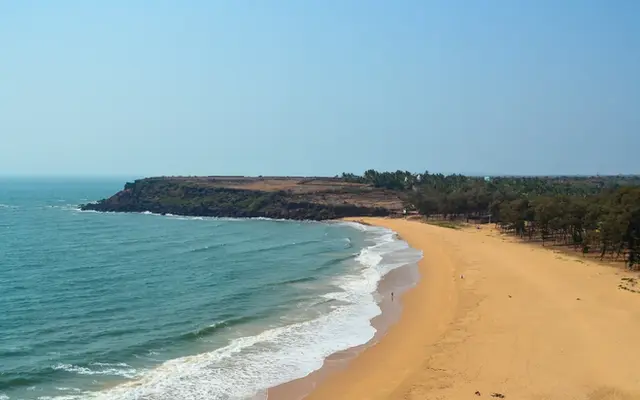
In November 1976 he rode Bangalore to Mangalore, then up the coast to Goa, and his notes give the speeds: often 40–45 mph on the open road, but an overall average of only 25 mph because of traffic and bad sections.
Leaving Mangalore at 7 am on 5 November he was chased down, 20 miles out, by two local brothers on a Royal Enfield Bullet who had waited from 6 am to ride with him and bought him breakfast. He turned off to Jog Falls, almost dry after the monsoon, three streams dropping 960 ft.
Karwar, Goa and Kolhapur
At a truck stop in Karwar a cook asked where he was going and answered his own question: Goa going, nice place, his own home. Simon wrote in 2014 that the phrase stuck with him for almost forty years.
In Goa he stayed with a retired London art editor, then rode inland to Kolhapur, where a group of Jain businessmen took him to a cave sadhu, a jaggery works and a temple school, which he described as his first encounter with the Jain religion.

See the data as a table
| Speed (km/h) | |
|---|---|
| Bangalore to Mangalore, open road | 68 |
| Bangalore to Mangalore, day average | 40 |
| Pokhara to Kathmandu, day average | 39 |
Source: Ted Simon, notebooks published on Jupitalia (converted from mph) · Open road is the midpoint of his 40–45 mph. Pokhara to Kathmandu was 120 miles in 5 hours.
Where did Simon ride after Nepal?
After a winter in Nepal, including the Annapurna trek from 13 December 1976, he crossed back into India near Siliguri on 6 January 1977, went up to Darjeeling on the 7th and then east into Assam for the Manas and Kaziranga sanctuaries, on permits from the Indian consulate in Kathmandu.
He was now riding two-up with Carol, a fellow traveller, and at Siliguri they had to strip the luggage because the bike was overloaded.
The Siliguri log
His Siliguri log has the most numbers of the whole India chapter:
- odometer 21,018 miles;
- oil now down to the full mark, after using a lot in the last 100 miles;
- plugs a good colour;
- 398 miles since Hetauda in Nepal on 20 plus 10 litres of fuel.
That works out to about 13.3 miles a litre, roughly 21 km per litre, two-up and loaded on mountain roads.
Calculated in this post from the figures in Simon's Siliguri log: 398 miles on 20 plus 10 litres is 13.3 miles a litre, and one mile is 1.609 km.
The odometer figure looks low for a bike more than three years into a world ride, and Simon himself flags another reading on the same page as a mistake. The published notes don't explain it, so treat it as his log, not a trip total.
Fuel economy: Simon's Triumph vs your bike

How did Ted Simon leave India?
He left Delhi at 3.30 pm on 5 May 1977 and bought 93-octane petrol at a flyover. Within a few hours:
- he had three near misses with buses;
- he was pushed off the road on both sides;
- he was knocked down by a rickshaw driver.
He stopped, rested and told himself to calm down or he would die. He spent the night at a tourist complex about 90 miles out and reached Amritsar at 4 pm the next day.
He visited the Golden Temple, which he found orderly and peaceful, then crossed into Pakistan on 7 May with a police escort, past signs left over from the Emergency, which had just ended with the election.
That last ride is the part of his India story that has aged least well, because the danger he describes is still there. India's 2023 road accident report counts more deaths among two-wheeler riders than any other group. The piece on two-wheeler road deaths goes into what the numbers mean for touring riders, and the solo touring safety plan covers how to ride highways like the one out of Delhi.
The government's annual count, compiled from police data across states, recorded 4,80,583 road accidents in 2023, up 4.2% on 2022, with 1,72,890 deaths and 4,62,825 injuries. Two-wheeler riders were 44.8% of everyone killed, the largest group, and pedestrians 20.4%. National Highways carried 31.2% of accidents but 36.5% of deaths (63,112), and overspeeding accounted for 68.1% of deaths linked to traffic violations. The limit: police-recorded data are known to undercount, and the report does not separate touring riders from commuters.
Read the report summary (free)See the data as a table
| Share of deaths (%) | |
|---|---|
| Two-wheeler riders | 44.8 |
| Pedestrians | 20.4 |
| All other road users | 34.8 |
Source: MoRTH, Road Accidents in India 2023, via PTI · All other road users is the remainder of the total of 1,72,890 deaths.
What has changed on India's roads since Simon's ride?
The biggest change is scale: National Highways now total about 1.46 lakh km and include 3,052 km of access-controlled expressway by the end of 2025, against 93 km in 2014 (IANS, December 2025).
| Then and now | Simon, 1976–77 | A rider in 2026 |
|---|---|---|
| Day average | About 40 km/h (25 mph) | Set by fatigue and safety, not the road |
| Expressway | None | 3,052 km access-controlled (end 2025) |
| What stays the same | Crowds round a foreign bike, generous strangers, paperwork at every crossing | |
What has not changed is what he describes so well: the crowds that gather round a foreign bike, the generosity of strangers like the Mangalore Bullet brothers, and the bureaucracy at every crossing.
Simon came back to India in 2013 to open India Bike Week in Goa, riding from Mumbai on a Royal Enfield Bullet. His blog post about it is not flattering about the scenic back roads his hosts chose.
Nearly forty years after the Karwar cook, he found the old Indian road was still there, if you went looking for it.
Simon's ride came forty years after another foreigner's, Robert Fulton's 1933 ride on a Douglas through Rajputana, Kashmir and the Khyber; read One Man Caravan in India. The history of the Grand Trunk Road covers the road Simon took out of the country, and the Konkan coastal ride guide covers the coast he rode up. For more, see the Yatri ride atlas.
What's new
- Ted Simon publishes his notebook on leaving India in May 1977 Jupitalia, Jul 2025
- Notebook instalment: Nepal to Darjeeling and Assam, January 1977 Jupitalia, Mar 2025
- 1.72 lakh people died in road accidents in 2023, two-wheeler riders 44.8% PTI via The Week, Aug 2025
Questions people ask
What bike did Ted Simon ride in Jupiter's Travels?
A 1973 Triumph Tiger 100, a 500 cc twin. On his second trip, from 2001, he rode a modified BMW R80GS.
How long was Ted Simon in India?
His notebooks put him in Madras by mid-1976 and leaving Delhi on 5 May 1977, with a ten-week break in England in July to September 1976 and visits to Ceylon and Nepal in between. Roughly ten months in the subcontinent in all.
Where did Ted Simon go in India?
Madras (Chennai), Auroville and the temple towns, Rameswaram (ferry to Ceylon), Bangalore, Mangalore, Jog Falls, Karwar, Goa, Kolhapur, then Nepal, Siliguri, Darjeeling, Assam (Manas and Kaziranga), Delhi and Amritsar.
Is Jupiter's Travels worth reading for Indian riders?
Yes, for the India chapter alone: it shows the country through the eyes of a sharp, sometimes grumpy outsider in 1976–77. Read it next to his published notebooks, which add the dates and prices the book leaves out.
Sources
- Ted Simon: From My Notebooks in 1976, Leaving Penang for India on the MV Chidambaram (2024)
- Ted Simon: From My Notebooks in 1976, Into India (2024)
- Ted Simon: From My Notebooks in 1976, India and Ceylon (2024)
- Ted Simon: From My Notebooks in 1976, Back Down India's West Coast (2025)
- Ted Simon: From My Notebooks in 1977, Nepal to India (2025)
- Ted Simon: From My Notebooks in 1977, Leaving India (2025)
- Ted Simon: The Indians are coming, on India Bike Week (2014)
- Ted Simon: The Overland Event and notes from India (2023)
- Wikipedia: Ted Simon
- Wikipedia: Jupiter's Travels
- PTI via The Week: 1.72 lakh people died in 4.80 lakh road accidents in 2023 (2025)
- IANS: India's highway network crosses 1.46 lakh km (2025)

Sapta (Saptarshi Sarkar) is a mechanical engineer turned marketer in Bengaluru and a solo touring rider. He writes the seven Saptaverse blogs. Work with him or read more of RoadHook Rides.