A bike's fuel range on a long ride is tank litres times the mileage you actually get on tour, minus a safety buffer of 20% or more. Touring mileage usually runs 10 to 30% below the brochure figure because of speed, luggage, headwind and tyre pressure. On the longest Indian gap, about 323 km from Keylong to Karu on the Manali to Leh highway, most 12 to 15 litre bikes need a few litres of spare fuel.
- Range = tank × touring km/l × (1 − buffer), with a buffer of at least 20%, and 25% in the mountains.
- Touring mileage runs 10 to 30% below the brochure figure; measure yours loaded, tank to tank.
- Drag power grows with the cube of speed: 120 km/h needs about 3.4 times the aero power of 80 km/h.
- The ~323 km Keylong to Karu gap beats most 12 to 15 litre tanks on a loaded bike.
- E20 costs about 3 to 5% of range in E10-era bikes, per the government.
Running dry is rarely about the tank being too small. It is about planning a gap with the wrong km/l, or with no margin for a detour, a closed pump or a slow crawl through a landslide zone.
In mid-May 2026, after the government's first fuel price hike in response to the oil shock from the war in West Asia, deliveries from depots to highway pumps fell behind. Business Today found outlets in six states (Maharashtra, Madhya Pradesh, Rajasthan, Bihar, Uttar Pradesh and Uttarakhand) rationing what was left in their tanks, and in about a dozen cases pumps briefly stopped selling or imposed strict limits.
A group returning from Bihar to New Delhi, a run of over 1,000 km, was allowed at most ₹500 of petrol per station all the way to Agra and had to refuel every few kilometres. A couple driving from Maharashtra to Delhi met caps of ₹1,000 to ₹2,000. The attendants' message was to save what was in the underground tanks until the next tanker came; the petroleum ministry said no dry-outs had been flagged to it.
Business Today: Highway fuel crunch, several pumps in 6 states ration supplyThe fix is a small sum done before the ride, with honest inputs. This post builds that sum from the physics up, then applies it to Ladakh's real pump gaps.
How do you calculate real fuel range for a long ride?
Use this: range = tank (litres) × touring km/l × (1 − buffer). The two inputs people get wrong are the km/l and the buffer.
- Tank: use the full-tank figure from the manufacturer, not "up to reserve". KTM lists 14 litres for the 390 Adventure X, for example.
- Touring km/l: measure it yourself with a tank-to-tank fill on a loaded highway day. Do not use the ARAI or WMTC test figure. Those are measured on a light, unloaded bike over a mixed urban cycle.
- Buffer: treat 20% as the floor. On a road with no alternative pump, a closure or a wrong turn adds kilometres you did not plan for.
A worked example
Here is how I'd check it with my own numbers. On the KTM 390 Adventure X Plus I logged about 26.5 km/l on a Bengaluru to Mulbagal run at 100 to 120 km/h, and about 22 to 24 km/l when riding hard.
Take the hard-riding number, 23 km/l, and a 14 litre tank: 322 km to empty, or about 258 km with a 20% buffer. On the plains that comfortably covers my habit of stopping roughly every 250 km. In Ladakh it does not cover the Keylong to Karu gap.
Touring fuel range and spare fuel for a pump gap
Why does speed cut mileage so sharply?
Aerodynamic drag grows with the square of speed, so the power needed to push through the air grows with the cube. Rolling resistance barely changes with speed. Above about 60 km/h on a motorcycle with an upright rider, air is the main load on the engine.
Here is the arithmetic, using a drag area (CdA) of 0.55 m², which sits inside the range measured for street bikes with an upright rider in the Warwick study below, and sea-level air at 1.225 kg/m³. Drag power is ½ × air density × CdA × speed³:
| Speed | Aero drag power | vs 80 km/h |
|---|---|---|
| 60 km/h | about 1.6 kW | 0.42× |
| 80 km/h | about 3.7 kW | 1.00× |
| 100 km/h | about 7.2 kW | 1.95× |
| 120 km/h | about 12.5 kW | 3.38× |
Fuel use does not triple between 80 and 120 km/h, because the engine also burns fuel to overcome friction and runs more efficiently at higher load. But the direction is clear, and road tests agree.
Dropping from 110 to 90 km/h on a long highway day is the single easiest way to stretch a tank.
The team fitted a mileage-measuring kit to the carburettor of a Bajaj Pulsar 180 and rode it on highway, earth and gravel roads at different speeds and tyre pressures. Against an average of 46.79 km/l, mileage was 20.9% higher at 30 to 40 km/h and 27.35% lower at 80 km/h. Dropping tyre pressure by 5 psi below the recommended 28 front and 30 rear cut highway mileage by up to 6.11%. The best highway figure was 55.97 km/l. The limit: one bike, one rider, short runs measured in millilitres, and speeds only up to 80 km/h.
Read the paper (free)The authors measured drag area in a full-scale wind tunnel for four motorcycles with a rider in separate leathers, then modelled energy use over the WMTC 3.2 test cycle. Bare bikes measured 0.26 to 0.31 m²; adding an upright rider raised that to 0.50 to 0.59 m², and tucking in cut it to 0.33 to 0.43 m². That roughly 30% cut in drag area reduced modelled energy use by 19 to 22% for three of the four bikes, and by under 5% for the Harley-Davidson LiveWire. The limit: the bikes were sport and street models on a standard cycle, not loaded adventure tourers with panniers, which add frontal area.
Read the paper (free)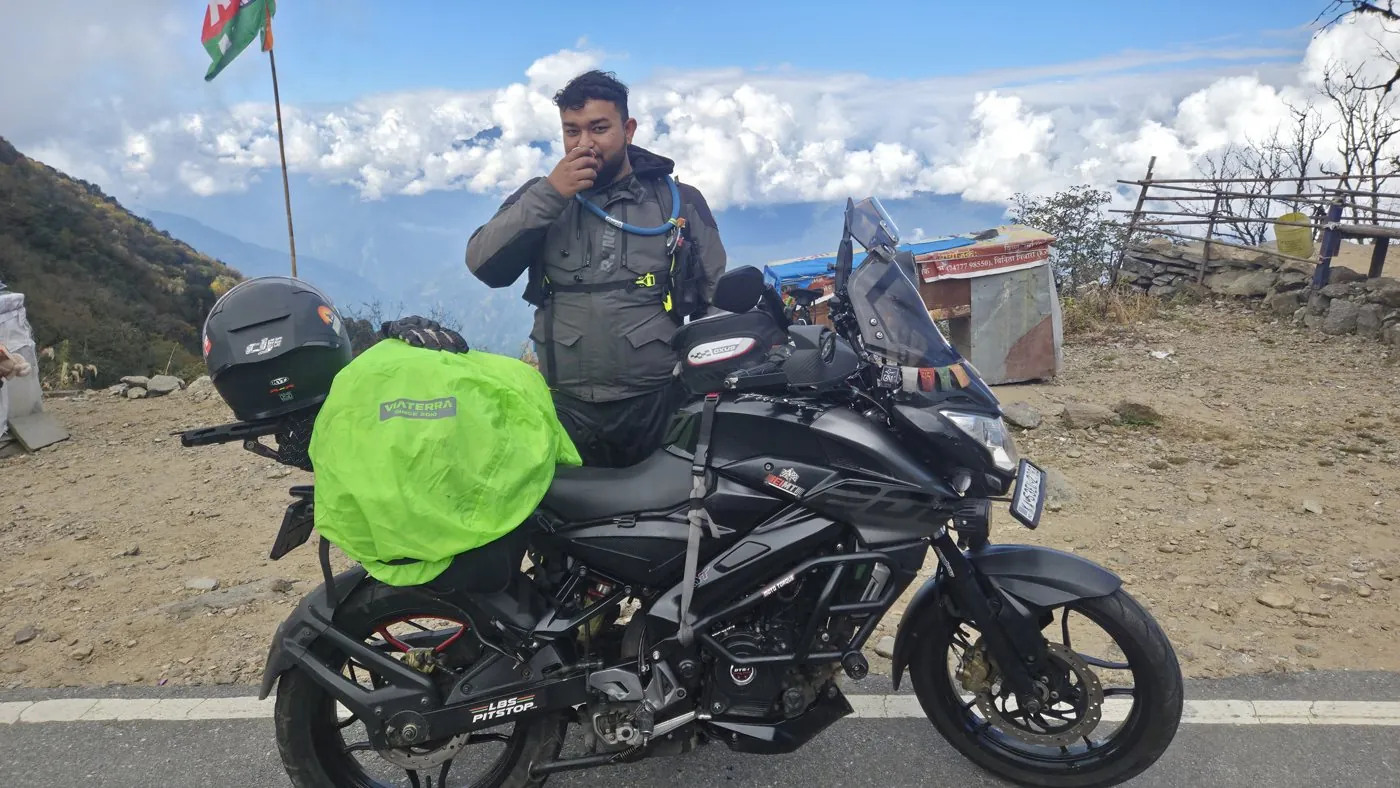
How much do luggage, a pillion and tyre pressure cost?
Weight mostly costs you on climbs and in stop-start riding; frontal area costs you at speed. A loaded tourer pays both. For the calculator, these are the sizes I would use, with where each comes from:
| Factor | Typical penalty | Basis |
|---|---|---|
| Riding at 80 km/h vs mixed average | Up to 27% | Pulsar 180 road test (2024) |
| Upright vs tucked rider | About 20% energy | Warwick wind-tunnel study (2023) |
| Tyres 5 psi low | Up to 6% | Pulsar 180 road test (2024) |
| E20 petrol in an E10-era bike | About 3 to 5% | Government reply in Rajya Sabha, Jul 2026 |
| Luggage and pillion | Measure it | No good open data for loaded Indian tourers; do a loaded tank-to-tank test |
Does altitude change fuel range?
Yes, in two opposite ways. Thinner air means less drag: the standard atmosphere puts air density at 3,500 m at roughly 70% of sea level (Engineering Toolbox table: 0.909 kg/m³ at 3,000 m and 0.819 at 4,000 m, against 1.225 at sea level), so the aero load at a given speed drops. But the engine also makes less power, and how it fuels depends on the system.
- Fuel injection reads manifold or barometric pressure and trims the fuel to match the thinner air, so mixture stays near correct and mileage often holds up or improves at steady speed.
- Carburettors meter fuel by the pressure drop across a jet, not by air mass, so at altitude the mixture goes rich. You burn more fuel for less power. On my carburetted 2017 NS200 at Gurudongmar in 2022, the bike at times could not go faster than about 40 km/h.
Then there is the riding itself:
- low gears on climbs;
- long stretches at walking pace over broken road;
- engine-braking descents.
On Himalayan routes I would add 10 to 15% to the terrain penalty in the calculator and keep the buffer at 25% or more.

Where are the longest pump gaps in Ladakh?
The Keylong to Karu stretch of the Manali to Leh highway is the famous one, but the Changthang plateau has longer loops. These figures come from Discover with Dheeraj's Ladakh fuel guide, updated in September 2026; other guides give a longer Manali to Leh number, 345 km from Tandi to Karu and 330 to 365 km, so plan to the longer end.
| Stretch | Approx. gap | Notes |
|---|---|---|
| Keylong or Tandi to Karu (Manali to Leh) | 323 km | Other travel guides quote 345 km (Tandi to Karu) and 330 to 365 km. Fill at both Tandi and Keylong |
| Diskit to Tangtse (Nubra to Pangong via Shyok) | 160 km | About 220 km if you go via Wari La |
| Tangtse to Nyoma (via Chushul) | 156 km | Nyoma pump opened in 2024 at about 13,684 ft |
| Nyoma to Karu via Tso Moriri and Taglang La | 291 km | Only 147 km via Chumathang directly |
| Leh, Hanle, Umling La, Tso Moriri, Leh circuit | About 450 km | Longest no-pump loop on the list |
| Srinagar to Leh | About 100 km at most | Pumps at Sonamarg, Kargil, Khalsi and others |
Fuel sold informally at dhabas in Pang, Hanle and elsewhere exists, but quality and supply are not guaranteed. Treat it as an emergency option, not a plan.
See the data as a table
| No-pump distance (km) | |
|---|---|
| Leh-Hanle-Umling La-Tso Moriri-Leh loop | 450 |
| Keylong/Tandi to Karu | 323 |
| Nyoma to Karu via Tso Moriri | 291 |
| Diskit to Tangtse via Wari La | 220 |
| Diskit to Tangtse via Shyok | 160 |
| Tangtse to Nyoma via Chushul | 156 |
| Nyoma to Karu via Chumathang | 147 |
Source: Discover with Dheeraj: Fuel availability in Ladakh (updated Sep 2026)

How much spare fuel should you carry, and how?
Carry enough to cover the longest gap at your loaded mileage plus 20 to 25%, and no more: every litre is about 0.75 kg on the back of the bike. Work it out per bike, not per group, because a 125 cc commuter and a 650 cc twin burn at very different rates.
- Measure loaded mileage on a highway day before the trip, tank to tank.
- List every gap on the route, including side trips like Hanle or Tso Moriri.
- Run the calculator for the worst gap with a 25% buffer on mountain roads.
- Fill at every pump in the mountains, even when half full. Tandi and Keylong both, Karu on the way out.
- Use proper containers: metal jerrycans or fuel-grade bottles strapped low and away from the exhaust. Never mineral water bottles.
- Keep the fuel log on the ride. A sudden drop in km/l is often the first sign of a dragging brake, a low tyre or a choked air filter.
If you plan a long single-day run instead, the same logic underpins the 1,000 km Iron Butt plan: pump stops set the rhythm of the day. For daily distances on Indian roads see how many km a day is realistic, and for what the fuel will cost, the Ladakh trip cost breakdown. Route-level fuel notes are in the Leh Ladakh guide and the Spiti guide. My own bikes and their accessories are on the gear page.

What does fuel cost in Ladakh compared with the plains?
Petrol in Leh cost ₹106.17 a litre on 10 November 2026. Prices differ by state VAT, not by altitude, so Leh is not the expensive fill people expect.
| City | Petrol, 10 Nov 2026 |
|---|---|
| Leh | ₹106.17 a litre |
| Chennai | ₹107.76 a litre |
| Mumbai | ₹111.21 a litre |
| Kolkata | ₹113.51 a litre |
At 23 km/l, a 3,000 km Ladakh loop burns about 130 litres, roughly ₹13,800.
What's new
- Government tells Rajya Sabha that E20 cuts fuel economy by about 3 to 5% in some E10-era vehicles, with no abnormal wear Business Today, Jul 2026
- Manali to Leh highway reopened to two-way civilian traffic on 1 June 2026; no new pumps reported on the Keylong to Karu stretch Discover with Dheeraj, Oct 2026
- Petrol in Leh holds at ₹106.17 a litre in November 2026 Business Today, Nov 2026
Questions people ask
Is a 10 litre jerrycan enough for Manali to Leh?
For most bikes it is more than enough. With these example inputs, a bike doing 25 km/l loaded needs about 13 litres for 323 km, or about 16 litres with a 20% buffer. With a 13 to 15 litre tank, 1 to 3 litres of spare fuel covers it. Small-tank bikes and thirsty big twins are the ones that need the full 10.
Calculated in this post from the 323 km Keylong to Karu gap (Discover with Dheeraj) and the example mileage: 323 ÷ 25 = 12.9 litres, and 12.9 ÷ 0.8 = 16.2 litres with the 20% buffer.
Can I buy petrol at Sarchu or Pang?
Sometimes, from dhabas selling it in bottles at a premium. Availability and quality are not guaranteed, and there is no official pump between Keylong and Karu.
Does riding slower really save that much fuel?
Yes. In the Pulsar 180 test, mileage at 80 km/h was 27% below the bike's average, and 30 to 40 km/h was 21% above it. Dropping from 110 to 90 km/h on a long highway day is the single easiest way to stretch a tank.
Does E20 petrol reduce my bike's range?
The government's July 2026 statement puts the loss at about 3 to 5% in vehicles designed for E10. On a 300 km range that is 9 to 15 km, small but worth adding to your buffer if your bike predates E20 certification.
Sources
- Bhat SAR, Bhandari S, Bastakoti D: Study of Two-wheel Vehicle's fuel consumption under the Influence of tire Inflation Pressure, Journal of Engineering and Sciences (2024)
- Kirca MC, McGordon A: Effect of Rider Position on the Energy Consumption of an Electric Motorcycle, University of Warwick (2023)
- Discover with Dheeraj: Fuel availability in Leh Ladakh (updated Sep 2026)
- Discover with Dheeraj: Manali Leh Highway status 2026 (2026)
- KTM: 390 Adventure X specifications (2026)
- Business Today: Govt admits E20 impact on pre-2023 vehicles (2026)
- Business Today: Petrol price in Leh today (2026)
- Petroleum Planning and Analysis Cell (PPAC): retail price data
- Sapta: Gurudongmar by bike, what thin air did to my carb NS200 (2022 ride)
- Business Today: Highway fuel crunch, several pumps in 6 states ration supply amid replenishment delays (May 2026; source for the story)

Sapta (Saptarshi Sarkar) is a mechanical engineer turned marketer in Bengaluru and a solo touring rider. He writes the seven Saptaverse blogs. Work with him or read more of RoadHook Rides.