
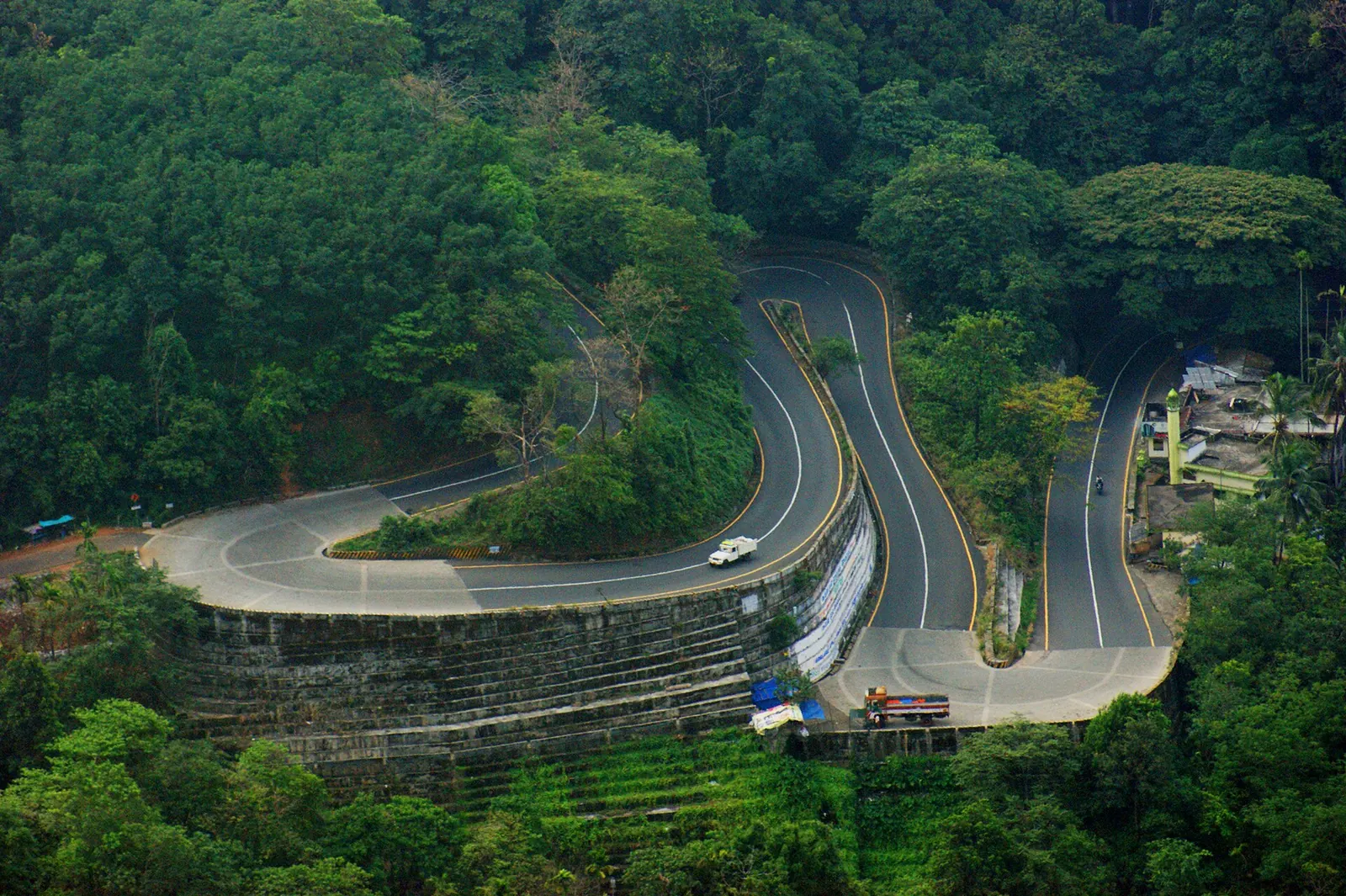
Indian ghat road hairpin bends are designed, under the Indian Roads Congress code IRC:52-2019, for a minimum speed of 20 km/h, an inner-edge radius of at least 14 m, a gradient no steeper than 2.5% through the bend and 10% superelevation. Hill highways around them are designed for 40 to 50 km/h with only 45 to 60 m of stopping sight. A rider who arrives faster than the design speed runs out of sight distance, grip and road width at the same time.
- 20 km/h is the design speed of an Indian hairpin under IRC:52-2019; the hill road around it is drawn for 40 to 50 km/h.
- 14 m inner radius and about 20 m of sight at the apex: arrive faster and the margins vanish.
- 13°, 27°, 42°: the lean a 14 m bend needs at 20, 30 and 40 km/h.
- 2.5% is the most a hairpin may slope, so the steep climbing is pushed into the straights between bends.
- About 2.2 MJ of heat for every 1,000 m a 220 kg bike and rider descends; engine braking must take its share.
Hill roads look chaotic, but they are drawn to a short list of numbers:
- how steep (gradient);
- how tight (radius);
- how far you can see (sight distance);
- how much the road tilts (superelevation).
Knowing those numbers explains why the same hairpin feels easy on the way up and frightening on the way down, why the outside of a bend is often broken, and why long descents eat brakes. Everything below comes from the IRC code and published crash research, applied to a motorcycle.
What are the design rules for a hairpin bend in India?
IRC:52-2019, Guidelines for the Alignment Survey and Geometric Design of Hill Roads, sets the numbers for a hairpin. They apply "where unavoidable", which on Indian hill roads is often.
| Parameter (clause 6.10) | Value | What it means on a bike |
|---|---|---|
| Minimum design speed | 20 km/h | The bend is drawn for walking-pace traffic. Anything faster eats into margins |
| Minimum inner radius | 14.0 m | Tighter than most city roundabouts; the inside line is very tight |
| Roadway width at apex | 11.5 m (double-lane NH/SH), 9.0 m single-lane, 7.5 m district roads, 6.5 m village roads | A bus turning on a district road uses most of the 7.5 m |
| Minimum transition length | 15 m | The curvature builds over just 15 m, so the turn-in is abrupt |
| Gradient through the bend | Max 2.5% (1 in 40), min 0.5% (1 in 200) | The bend itself is nearly flat; the steep bits are just before and after |
| Superelevation | 10% (1 in 10) | The road tilts toward the inside, which helps only if you are on the correct line |
| Gap between successive hairpins | At least 60 m | On a tight series, you are braking for the next one as you exit the last |
The details that decide the surface
The code also asks for a cross drain 20 m before each hairpin and full-width surfacing at the bend.
Where those are missing, water runs across the apex and gravel collects on the inside, which is exactly where a rider wants to put the front tyre.
How steep can a ghat road be?
On a mountainous hill road IRC:52-2019 sets a ruling gradient of 5%, a limiting gradient of 6% and an exceptional 7%, with steep terrain below 3,000 m allowed 6, 7 and 8%.
Exceptional grades may run for no more than 100 m at a stretch, and the total rise or fall over any 2 km is capped at 100 m in mountainous terrain and 120 m in steep terrain (IRC:52-2019, clauses 6.9.1.6 and 6.9.1.7).
On 15 April 2026 a van carrying tourists from Malappuram in Kerala was coming down the Valparai to Pollachi ghat road in the Western Ghats, a stretch of more than 40 sharp hairpin bends. After a steep descent it crashed through a safety wall and fell to the road below. Nine people died. Reports suspected that the brake liners had overheated on the way down and the driver lost control. If the reports are right, it was the descent before the bends, not the bends themselves, that delivered more heat than the brakes could shed.
Onmanorama: Valparai tragedy and safety for tourists (April 2026)| Gradient class | Mountainous, and steep terrain above 3,000 m | Steep terrain up to 3,000 m |
|---|---|---|
| Ruling (normal design) | 5% (1 in 20) | 6% (1 in 16.7) |
| Limiting (where the terrain forces it) | 6% (1 in 16.7) | 7% (1 in 14.3) |
| Exceptional (max 100 m at a time) | 7% (1 in 14.3) | 8% (1 in 12.5) |
Two details that explain how a ride feels
- The steep bits are between the bends. Because the bend itself is held to 2.5%, the climb is pushed into the straights between hairpins, which are often at the limiting or exceptional grade.
- The descent never lets up. The "100 m per 2 km" cap means a long ghat descends at an average of about 5% for kilometre after kilometre.
Older ghats built before these codes, such as the colonial-era roads up the Western Ghats, can be steeper; the story of one is in the Bhor Ghat history.


Which ghat roads have the most hairpins?
Tamil Nadu's Kolli Hills road leads any Indian list, with about 70 numbered hairpins over roughly 24 km. The Western Ghats roads to Valparai and Dhimbam and the Gata Loops on the Manali to Leh highway follow. Counts below are from published route descriptions; the full ranked list is in the roads with the most hairpin bends.

See the data as a table
| Hairpin bends (bends) | |
|---|---|
| Kolli Hills (Tamil Nadu) | 70 |
| Valparai (Tamil Nadu) | 40 |
| Dhimbam (Tamil Nadu) | 27 |
| Sirumalai (Tamil Nadu) | 26 |
| Gata Loops (Ladakh) | 21 |
| Yercaud (Tamil Nadu) | 20 |
| Meghamalai (Tamil Nadu) | 20 |
| Yelagiri (Tamil Nadu) | 14 |
Source: Wikipedia: Ghat Roads (route descriptions); Gata Loops count from route guides · Kolli Hills is given as 70 or 72 bends depending on the source.

What lean angle does a 14 m hairpin need?
At the 20 km/h design speed, a 14 m radius needs a lean of about 13°, which is gentle. At 30 km/h it needs about 27°, and at 40 km/h about 42°, which is close to the limit of a loaded touring bike on a dusty surface.
Calculated in this post with these example inputs: the 14 m inner radius and 20 km/h minimum design speed in IRC:52-2019, plus 30 and 40 km/h as speeds a rider might carry. The formula is in the next paragraph.
The lean angle on a flat road is the arctangent of v²/(g·R), where v is speed in m/s, g is 9.81 m/s² (standard gravity) and R is the radius you actually ride.
What the road's tilt does, and does not, do
Superelevation helps by tilting the road toward the inside, so the tyre needs less sideways grip. IRC:52 balances three quarters of the design-speed side force with superelevation and only one quarter with friction.
The catch is that 10% tilt only helps on the correct side of the road. On the downhill lane of a hairpin turning the other way, or when you cut across the crown, the slope can work against you.
Lean angle and grip needed in a bend
Here is how I'd read that calculator. Keep the "side friction still needed" number well under half of what the surface offers, because you also need grip for braking, and a hairpin is where you are most likely to brake while leaned.
On a wet Western Ghats bend in the monsoon, grip can fall to a fraction of the dry figure, so the safe speed drops sharply. Monsoon timing by region is covered in the monsoon onset dates post.
The national standard for hill road geometry. It sets design speeds of 50 km/h ruling and 40 km/h minimum for national and state highways in mountainous terrain, and 40 and 30 km/h in steep terrain. Stopping sight distance is 20 m at 20 km/h, 30 m at 30 km/h, 45 m at 40 km/h and 60 m at 50 km/h, measured from a 1.2 m eye height to a 0.15 m object. Superelevation is capped at 10%, or 7% in snow-bound areas. It recommends escape ramps about every 2 km on long continuous descents, while noting that India has no specific design guideline for them yet. The limit: these are design minimums for new work; many older ghats predate the code.
Read the standard (free)Why are hairpins more dangerous going downhill?
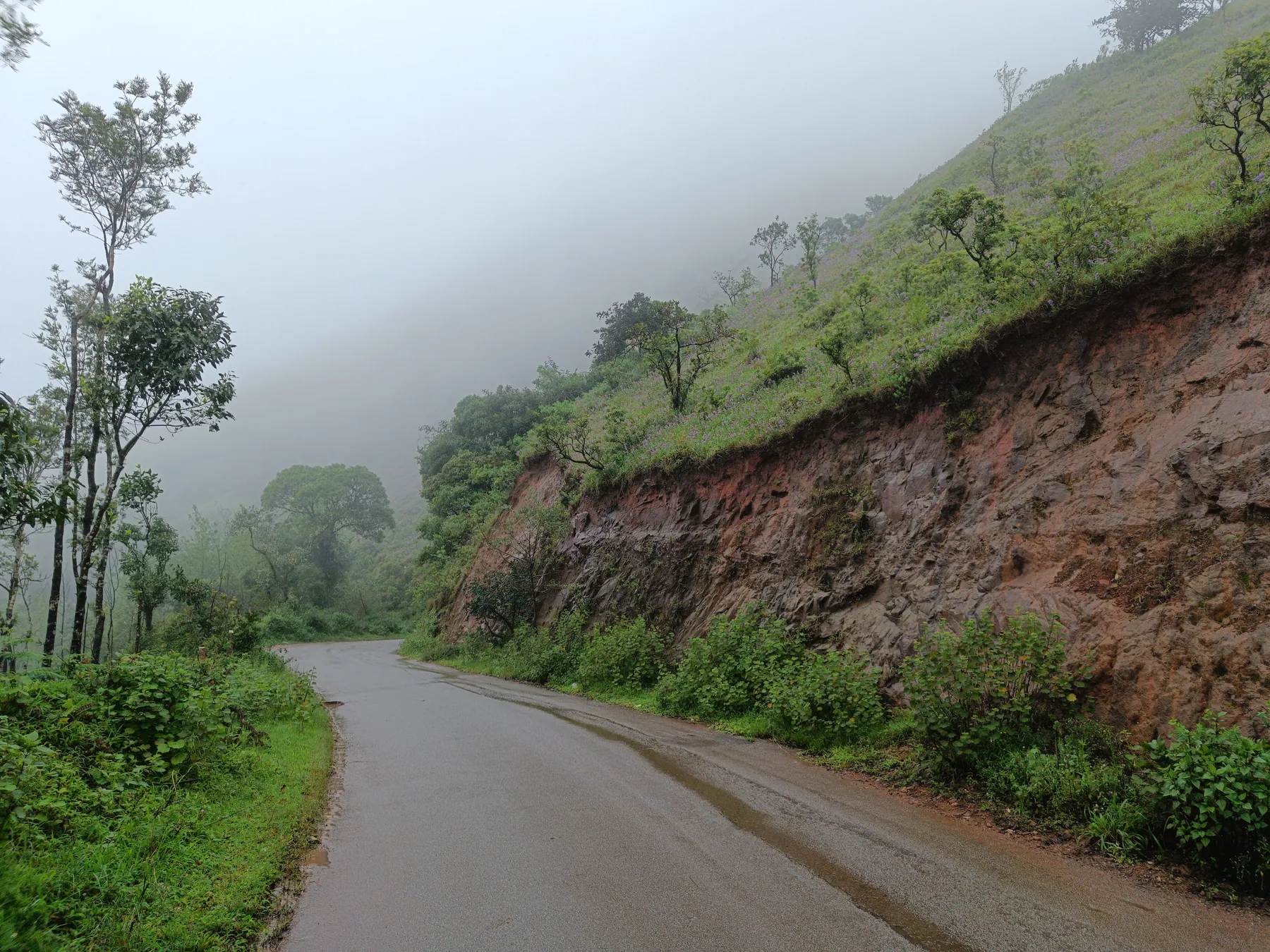
Going down, three things work against you:
- gravity adds to your speed;
- your weight shifts onto the front tyre;
- the brakes are already working when you arrive at the bend.
Coming up, the slope slows you for free. That is why the same hairpin feels relaxed on the climb and tense on the descent.
The energy numbers
The energy numbers are large. A bike, rider and luggage of 220 kg descending 1,000 m releases about 2.2 MJ (mass × 9.81 × height). If the brakes had to absorb all of it over a 20-minute descent, that is close to 1.8 kW of continuous heat into two small discs and their pads.
Calculated in this post with these example inputs (a 220 kg bike, rider and luggage, a 1,000 m descent and 20 minutes) and standard gravity: 220 × 9.81 × 1,000 is about 2.2 MJ, and 2.2 MJ ÷ 1,200 s is about 1.8 kW.
Engine braking in a low gear, the same gear you would climb in, takes much of that load off the brakes. Stopping briefly on a long descent lets discs and fluid cool before they fade.
Use the same gear going down that you would climb in. The engine is the biggest brake you have.
How do curves raise motorcycle crash risk?
Crash studies agree that tight radius is the variable that matters most for riders, and that sight distance and surface magnify it. Most of this research comes from the United States, where curve-level data exist; Indian studies are scarce and mostly hospital-based.
Using 11 years of Florida data (2005 to 2015), the authors matched 1,601 rural two-lane road segments with single-motorcycle crashes against 16,010 crash-free control segments of similar traffic and length, and fitted a conditional logistic model. Sharp curves (radius of 1,500 ft, about 457 m, or less) without a reverse curve were the riskiest design, followed by sharp reverse curves and moderate reverse curves. The Texas DOT design manual, drawing on this line of work, puts sharp curves at almost five times the single-motorcycle crash risk of straight road. The limit: US rural roads are far gentler than Indian ghats, so a 14 m hairpin is off the bottom of their scale.
Read the paperThe team simulated a sedan, a bus and a three-axle truck in ADAMS/Car on curves of 79 to 951 m radius at 50 to 130 km/h, on grades from minus 6 to plus 6% with 6% superelevation and dry pavement. Curves with spiral transitions cut the peak sideways friction demand compared with plain circular curves, by up to about 14% for the sedan and up to 24% for the bus, and the safety margin dropped most at curve entry. The limit: no motorcycle was modelled and only dry roads were tested, but the point about abrupt curve entry carries straight over to a hairpin with only 15 m of transition.
Read the paper (free)How should you ride a hairpin on a ghat road?
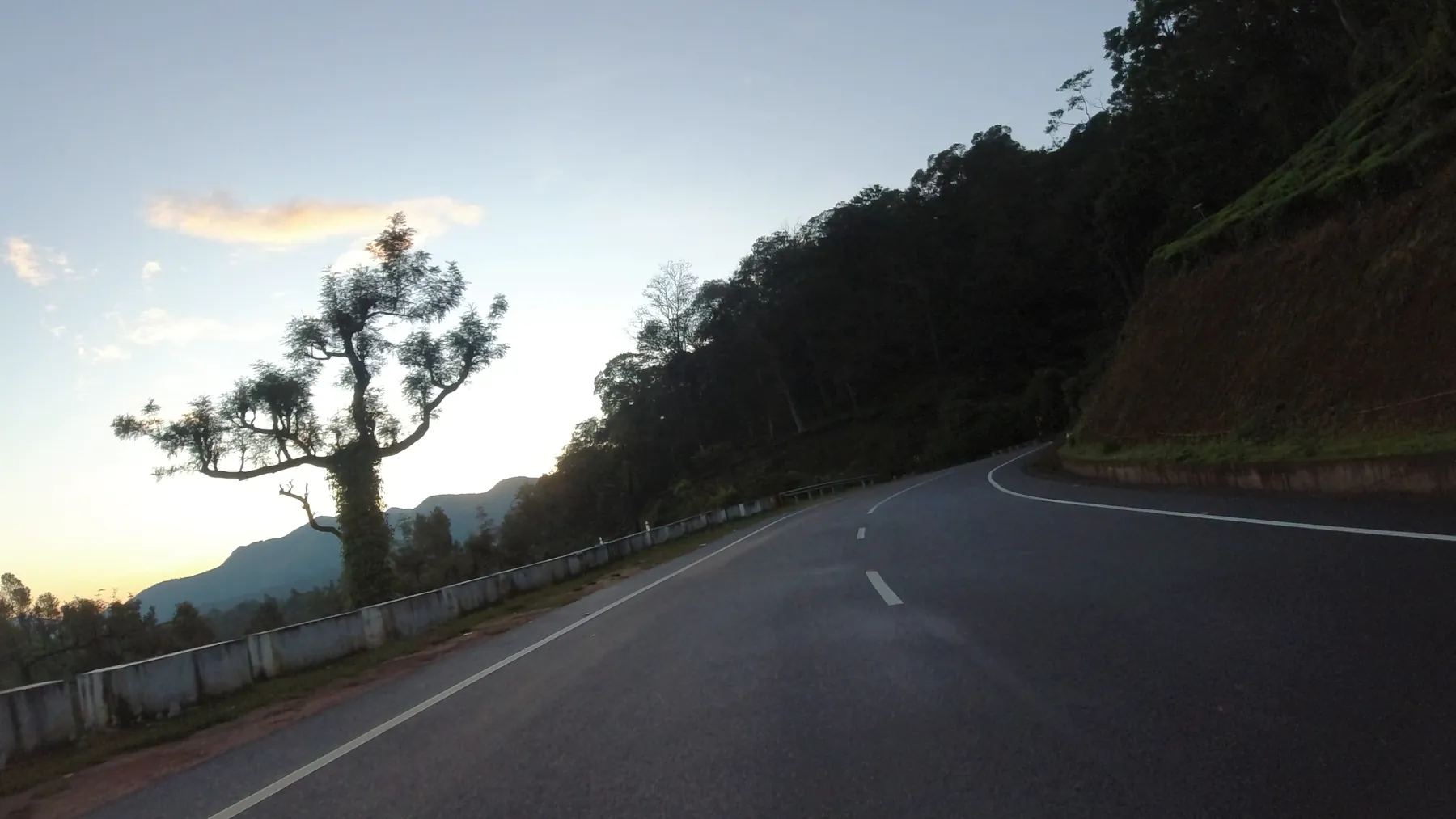
Slow in a straight line, look through the bend, and keep the bike on your side of the road with room to spare. The design numbers above turn into five habits:
- Arrive at design speed. Brake to roughly 20 to 25 km/h before the turn-in point, while upright, near the 20 km/h minimum design speed for a hairpin in IRC:52-2019. Stopping sight at the apex is about 20 m, which only works at about 20 km/h.
- Pick a late, wide entry on right-handers (your lane is on the outside) to see further round the bend before committing. On left-handers your lane is on the inside: stay off the gravel at the edge.
- Expect the outer half to be broken. Heavy vehicles swing wide at hairpins, and with only 7.5 m of width on district roads a bus or truck may take your lane entirely. Horn and hold back.
- Use the right gear going down. One low gear for the whole descent beats riding the brakes. Keep both brakes for the straight before each bend.
- Ride a series as a rhythm. With as little as 60 m between hairpins, finish each exit by setting up the next. In a group, keep a staggered gap, as in the group riding formation guide.
The monsoon makes all of this harder: water on the apex, moss on the inside edge and slides that leave mud across the road. The mechanics of those slides are explained in why Himalayan roads keep sliding, and the coastal ghats that climb off the Konkan are in the Konkan coastal highway guide. More routes are on the Ride Atlas page.
What's new
- Nine die as a van falls from the Valparai to Pollachi ghat road; suspected brake overheating on the descent Onmanorama, Apr 2026
- NHAI's ₹37 crore widening of hairpins 6, 7 and 8 on the Thamarassery ghat (NH 766) causes long jams; multi-axle trucks barred 6 am to 8 pm Onmanorama, Jun 2026
- Potholes open up on Agumbe ghat hairpins on NH 169A after the monsoon News Karnataka, Sep 2026
Questions people ask
Why are hairpin bends numbered?
So drivers know how many are left and where they are. On roads like Kolli Hills, Yercaud and Valparai, numbered boards also help emergency services find a crash site.
Why is the road surface always worse on the outside of a hairpin?
Heavy vehicles cannot make a 14 m inner radius without swinging wide, so their wheels load the outer half, and water from the slope above often crosses there if the cross drain the code asks for is missing. Expect potholes and gravel on the outer line.
Is it safer to ride ghats in first or second gear?
On most bikes, second through a tight hairpin, and the gear you would climb in for a long descent. First gear on many bikes gives abrupt throttle response at walking pace, which is unsettling mid-lean. The aim is steady engine braking without the rear wheel chattering.
What is the steepest gradient allowed on an Indian hill road?
Under IRC:52-2019, 8% (1 in 12.5) as an exceptional gradient in steep terrain below 3,000 m, for no more than 100 m at a time. Older roads, private estate roads and some village roads can be steeper.
Sources
- Indian Roads Congress: IRC:52-2019 Guidelines for the Alignment Survey and Geometric Design of Hill Roads (2019)
- NPTEL: Geometric design of highways, Lecture 17, vertical alignment and IRC gradient limits
- Xin C et al.: Crash modification factors of horizontal curve design features for single-motorcycle crashes, Accident Analysis and Prevention (2019)
- Texas DOT Roadway Design Manual: Motorcyclist design considerations, horizontal curves
- Abdollahzadeh Nasiri AS et al.: Evaluation of Safety in Horizontal Curves of Roads Using a Multi-Body Dynamic Simulation Process, IJERPH (2020)
- Wikipedia: Ghat Roads
- Onmanorama: Valparai tragedy and safety for tourists (2026)
- Onmanorama: Widening works, accidents trigger traffic snarls on Thamarassery Ghat road (2026)
- News Karnataka: Agumbe ghat potholes disrupt NH 169A traffic (2026)

Sapta (Saptarshi Sarkar) is a mechanical engineer turned marketer in Bengaluru and a solo touring rider. He writes the seven Saptaverse blogs. Work with him or read more of RoadHook Rides.


