
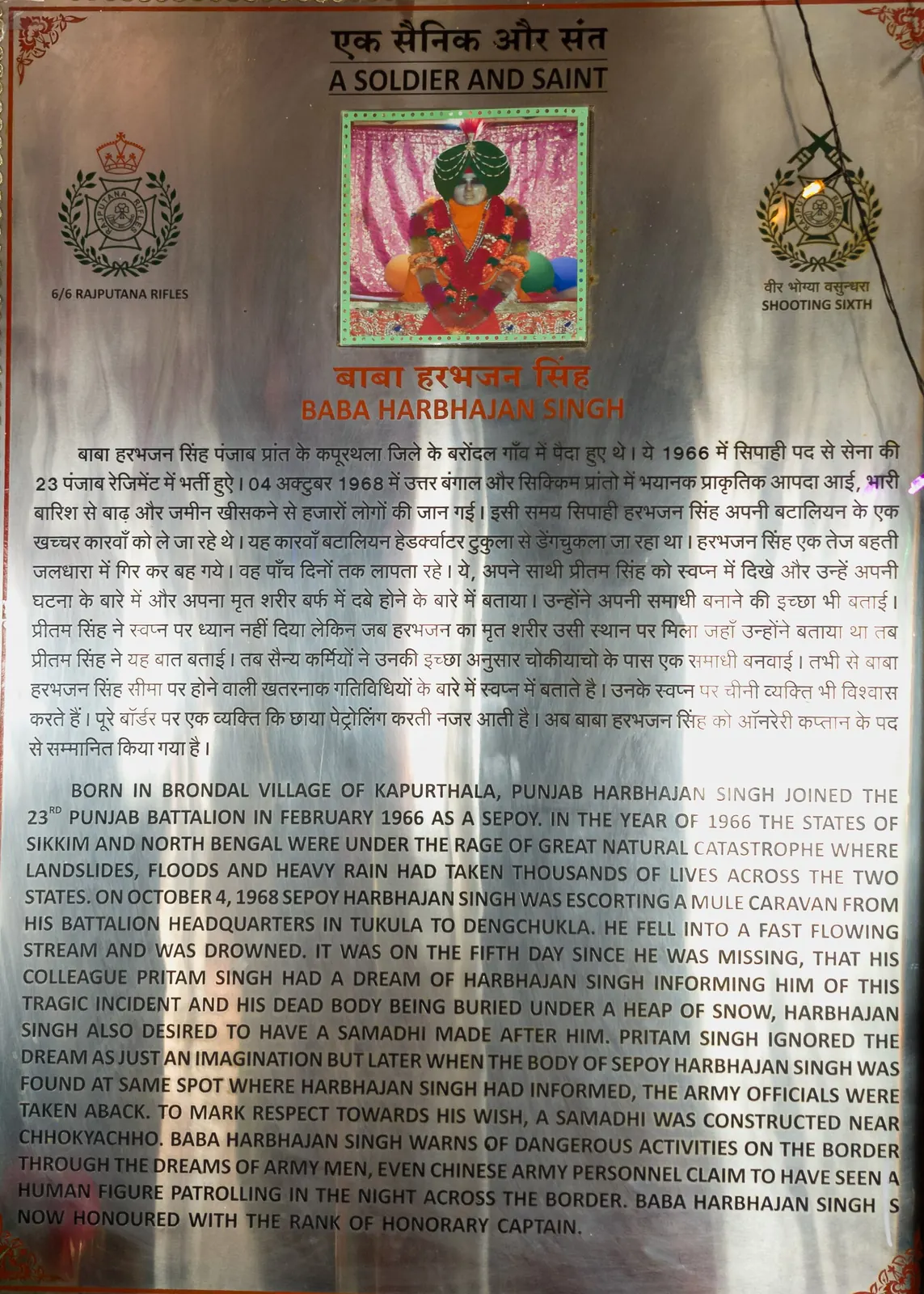
Baba Harbhajan Singh mandir is a shrine maintained by the Indian Army in East Sikkim to Sepoy Harbhajan Singh of the 23rd Battalion, the Punjab Regiment, who drowned near Nathu La on 4 October 1968 at the age of 22. The record is short and plain: he slipped into a fast mountain stream while escorting a mule column of supplies. Everything else, from the dream that found his body to his annual train journey home, is soldiers' tradition, and the honest way to visit is to know which is which.
- 4 October 1968: Sepoy Harbhajan Singh, 23 Punjab, drowned near Nathu La on a supply run.
- Age 22, service number 2456687, born 30 August 1946 in a village now in Pakistan.
- Two shrines: the old one at his bunker, and the newer memorial on the Sherathang to Kupup road.
- Not the war hero: Major Harbhajan Singh, MVC, was killed at Nathu La in September 1967, a different man.
- Legend vs record: the dream, the guardian spirit and the Chinese chair are belief, not documented fact.
Almost every rider who goes up the Gangtok to Nathu La road, or crosses the high ridge of the Old Silk Route from Zuluk, stops at Baba Mandir. The site is easy to treat as a tourist halt with a tea stall.
It is more interesting as a case study in how an army turns a soldier into a guardian figure, and how a story grows from a few documented facts. Below, the documented part comes first, then the legend, then the confusion that still mixes him up with a different soldier of the same name.
Who was Sepoy Harbhajan Singh?

Harbhajan Singh was a sepoy, service number 2456687, of the 23rd Battalion of the Punjab Regiment (23 Punjab), born on 30 August 1946 in a village of undivided Punjab that is now in Pakistan.
The army memorial site Honourpoint and a 2023 piece in The Tribune name the village as Sadrana; Wikipedia gives Sardarpura in present-day Faisalabad district. Both agree on the date and that the village lies across today's border.
When he joined, and where he served
He joined the army in February 1966 according to Honourpoint (which gives 12 February 1966) and The Tribune. Wikipedia's infobox gives an earlier service start, 30 June 1965, without a citation, so the 1966 date is the better-supported one.
He was posted with his battalion to the Nathu La sector of East Sikkim, a year after the September 1967 clashes there between Indian and Chinese troops made the pass one of the most watched points on the border.

How did Harbhajan Singh die near Nathu La?
He drowned in a swollen mountain stream on 4 October 1968 while escorting supplies to a forward post. The board beside the shrine, as quoted on Wikipedia, gives the same story: a fall into a nullah while leading the mules.
On 4 October 1968, Sikkim and North Bengal were under heavy rain, with landslides and floods. Sepoy Harbhajan Singh, 22, was leading a mule column of supplies from his battalion headquarters at Tukla to a forward post at Dongchui La. The track was slippery, the streams were overflowing and the slopes were unstable. At a bad stretch he slipped and fell into a fast-flowing stream. His comrades tried to reach him, but the current carried him away.
The army searched for days. Under standard procedure a missing soldier is listed as a deserter, and so, for a while, was he. His body was found after about three days and cremated. Later the army made him an honorary Captain.
Honourpoint: Sepoy Harbhajan Singh, service no. 2456687An ordinary death for a mountain soldier
That is the whole of the documented event, and it is a very ordinary kind of death for a mountain soldier. Streams that are ankle-deep in the morning run fast with snowmelt and rain by afternoon; mule tracks are narrow and wet.
The Ministry of Tourism's Incredible India page calls the circumstances "mysterious", which is a storyteller's word rather than a record. Honourpoint itself is not consistent on the search, saying "several days" in one place and three days in another.
The government's tourism page is the closest thing to an official public account of the shrine. It records that Harbhajan Singh served in the 23rd Punjab Regiment, died near Nathu La in 1968, and that a memorial near Tsomgo (Changu) Lake was inaugurated in 1983, housing a bronze statue and an empty bed, maintained by the army with regular ceremonies such as changing his uniform and bedsheets. It describes the guardian-spirit belief as a local legend, not as fact. It lists opening hours of 6 am to 8 pm and gives Nathu La's height as 14,140 ft. Its limit: it gives no source for the 1983 date, and The Tribune gives 1982.
Read the page (free)Which parts of the Baba Harbhajan story are record, and which are legend?
The record covers who he was, his unit, his service number, the date and manner of death and the existence of two shrines. The legend covers the dream, the guardian spirit, the Chinese chair and most of the "still on duty" details. The table sorts the most repeated claims by how well they are supported.
| Claim | Status | Best source I could open |
|---|---|---|
| Sepoy, 23 Punjab, no. 2456687 | Record | Honourpoint profile; Wikipedia infobox |
| Born 30 Aug 1946, village now in Pakistan | Record (village name differs) | Honourpoint; The Tribune, 2023 |
| Drowned 4 Oct 1968 escorting a mule column | Record | Honourpoint; shrine board quoted on Wikipedia |
| Made honorary Captain after death | Army tradition, widely reported | Honourpoint; The Tribune |
| A comrade dreamt where his body lay | Legend | The Tribune and Honourpoint call it a dream story |
| He warns soldiers of attacks in dreams | Belief | Uncited on Wikipedia; Incredible India calls it legend |
| Chinese officers leave a chair for him at flag meetings | Unverified anecdote | Only popular articles; no official source found |
| Annual "leave": belongings sent by train to Punjab | Reported practice, may have changed | Wikipedia, citing India Today (2006) and Himal (2002) |
| Shrine built 1982, or memorial inaugurated 1983 | Record, dates differ | The Tribune (1982); Incredible India (1983) |
The annual leave
The annual leave story is the one most riders hear at the shrine. As reported, it ran like this:
- Every year around 11 September, a jeep took his belongings to New Jalpaiguri station.
- A train carried them, with a berth booked in his name and soldiers as escort, to his family's village of Kuka in Kapurthala district, Punjab.
- A monthly sum was reported to go to his mother.
Wikipedia cites a 2006 India Today report and a 2002 Himal Southasian travel piece for this. I could not open either of those original articles, so treat the detail as reported practice from the 2000s, not as something you can assume still happens today.
Why are there two Baba Mandirs, old and new?
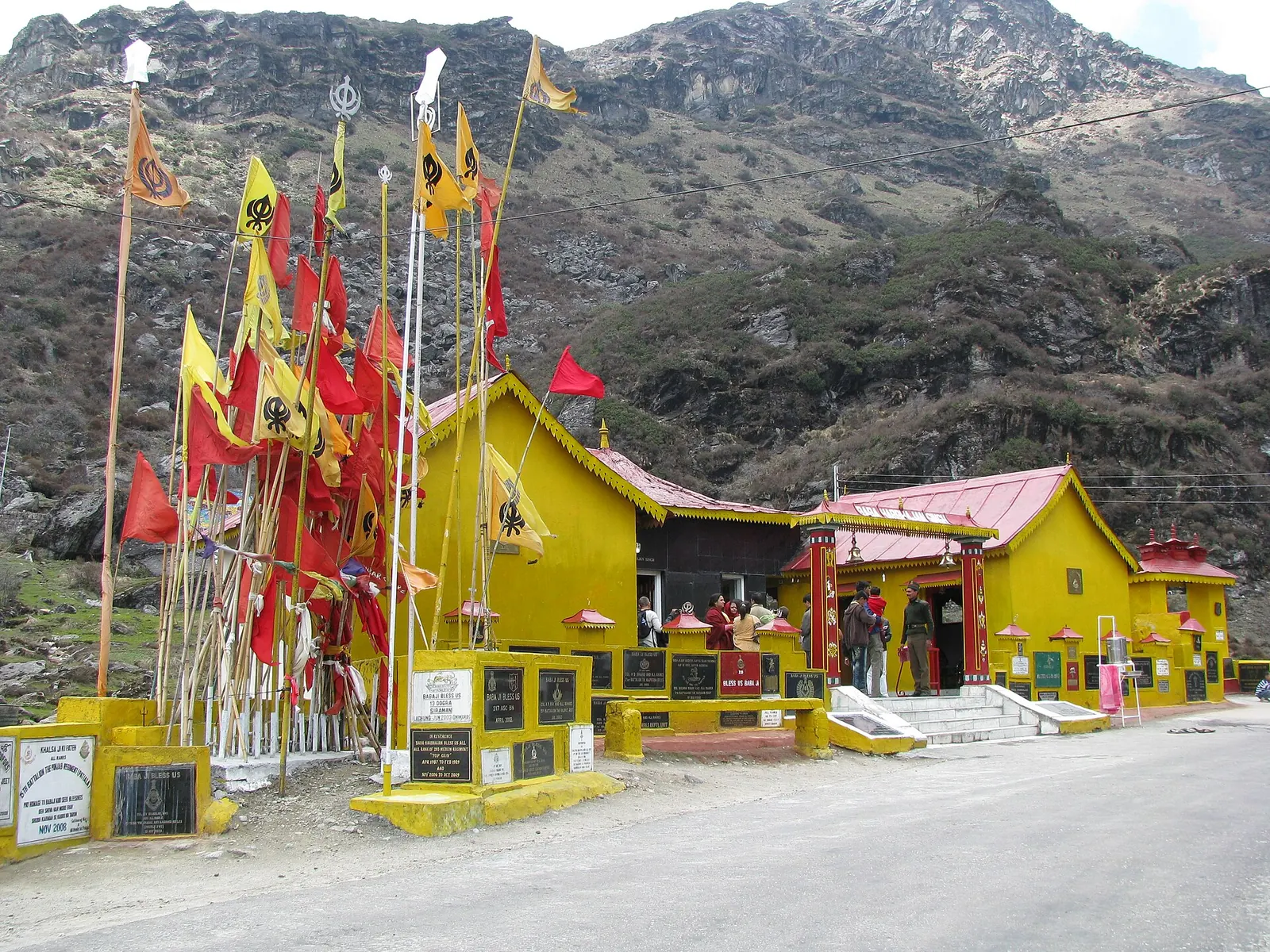
There are two shrines: the old one at the bunker where he was posted, and the newer, larger memorial on the main road between Sherathang and Kupup (NH 717B), which is the one most visitors see.
Wikipedia places the older temple and bunker a few kilometres south of the new one, on the road between Tukla and a lake locally called Heart Lake; it places the new temple east of Abhin Tal lake, south of Nathu La.
Why a second site?
No army document I could open explains the second site, but its position is telling: the new memorial sits on the road that tourist taxis already use for Tsomgo and Nathu La, so families, soldiers and visitors can reach it easily.
The Tribune's 2023 account describes a temple from 1982; Incredible India gives 1983 for the memorial's inauguration. The two dates probably refer to different stages (a temple, then a formal memorial), but I could not confirm that from a primary army record, so both are given here.
What is inside
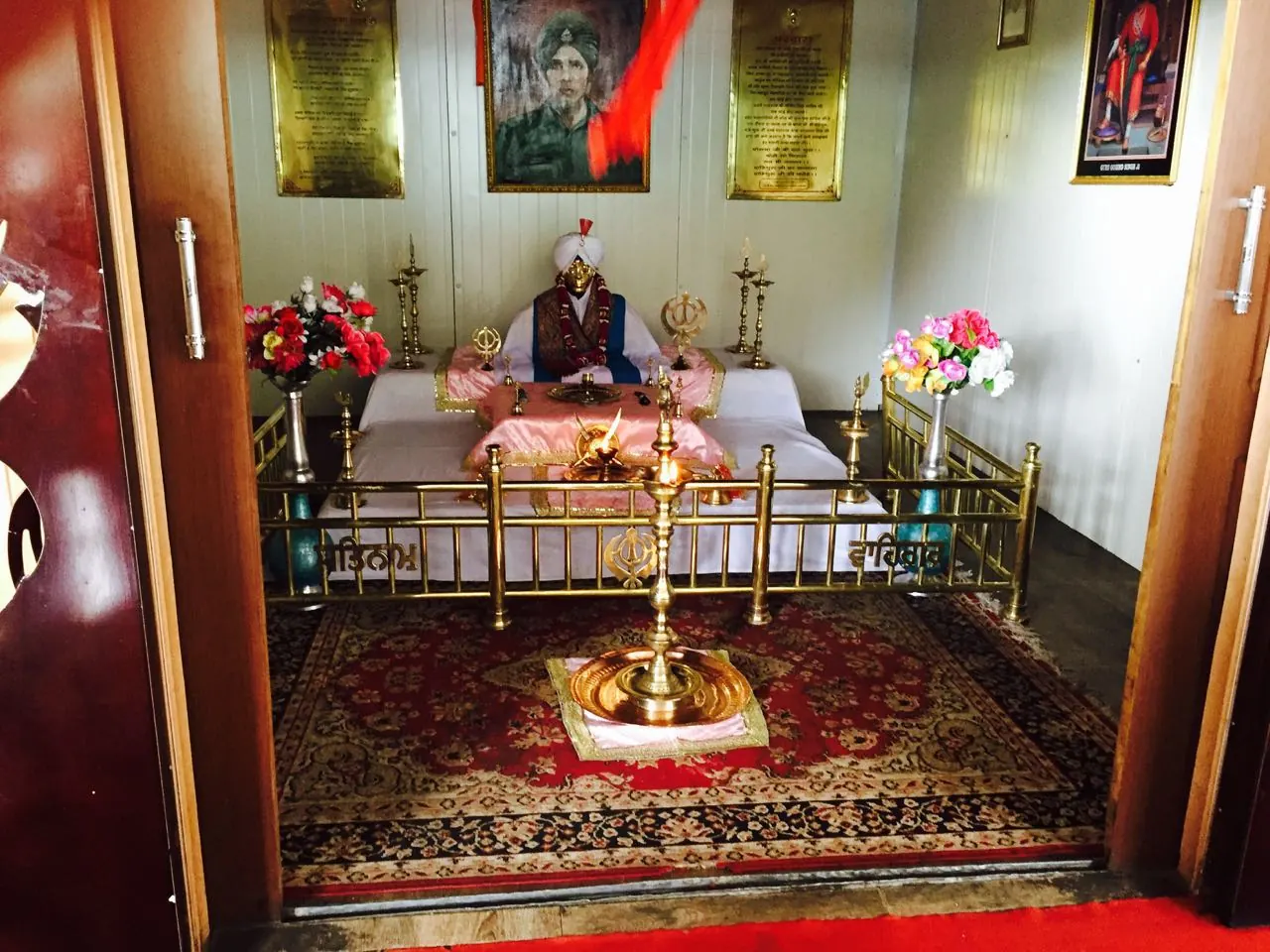
Inside the newer shrine, by the Tribune account, are:
- a bed, his portrait and his uniform;
- his shoes and a walking stick;
- barefoot soldiers from the nearby unit who keep the room.
Many visitors leave bottles of water there to be blessed, in the belief that it cures illness. That belief is part of the shrine's life; it is not something the army claims.
Who was the other Harbhajan Singh of Nathu La?
The other Harbhajan Singh was a Major killed fighting Chinese troops at Nathu La in September 1967, aged 26, and awarded the Maha Vir Chakra after his death; he is a different man, and the two are often confused.
The Tribune's 2023 article sets out his background: he came from Bhatte Bhaini village in Tarn Taran district, matriculated from DAV High School, Patti, in 1956, and joined the army the same year as a boy soldier in the Corps of Signals before being commissioned.
| Sepoy Harbhajan Singh (Baba) | Major Harbhajan Singh, MVC | |
|---|---|---|
| Rank | Sepoy, later honorary Captain | Major |
| Died | 4 October 1968, aged 22 | September 1967, aged 26 |
| How | Drowned on a mule supply run | Killed in the Nathu La clashes |
| Honour | The shrine and its tradition | Maha Vir Chakra (posthumous) |
| Home | Born in a village now in Pakistan; family village reported as Kuka, Kapurthala | Bhatte Bhaini, Tarn Taran |
So within about a year, two soldiers called Harbhajan Singh died at Nathu La, one in battle and decorated for gallantry, one by drowning on a supply run. Many online stories merge them, giving the sepoy a battle death, a Major's rank or the 1967 date.
If an article tells you that Baba Harbhajan Singh died fighting the Chinese, it has mixed the two up.
The sepoy's honour is that he died doing the unglamorous job that keeps a high post alive: carrying its food.
See the data as a table
| Standard air pressure (% of sea-level pressure) | |
|---|---|
| Gangtok (1,650 m) | 82 |
| Kupup (4,298 m) | 59 |
| Nathu La (about 4,310 m) | 59 |
Source: Calculated with the NASA Glenn standard-atmosphere equations; heights from Wikipedia (Gangtok, Kupup) and Incredible India (Nathu La, 14,140 ft) · Model values; real pressure varies a few percent with weather.
What was life like for a soldier on the Nathu La road in 1968?
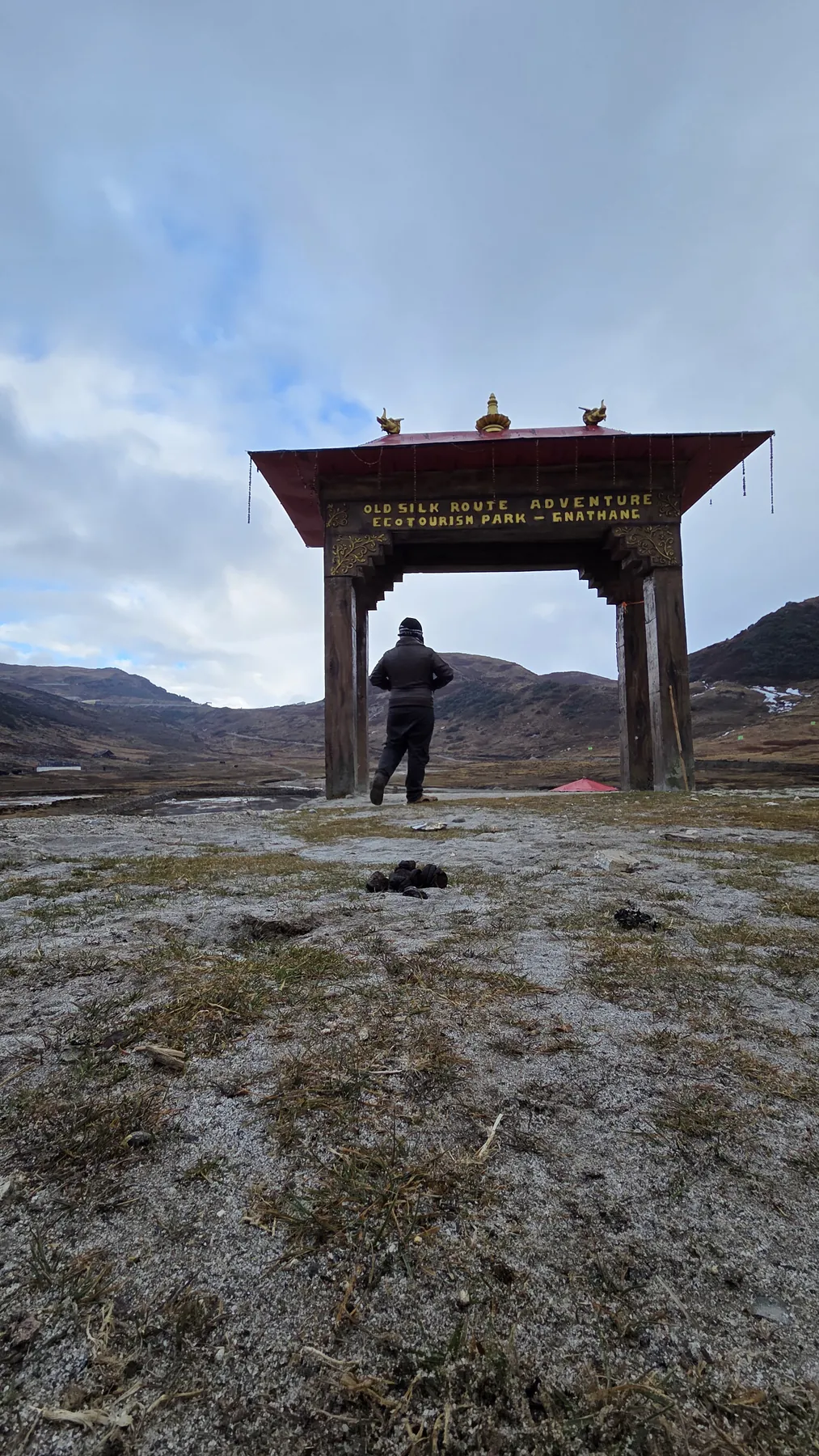
It meant living at 4,000 m and above with roughly 60% of sea-level air pressure, moving stores by mule over tracks that floods and landslides could cut in hours.
The Old Silk Route ridge and the Nathu La road are the same mountain system, and the conditions that killed Harbhajan Singh are the conditions riders now pass through for an afternoon. The difference is that a soldier stays for months.
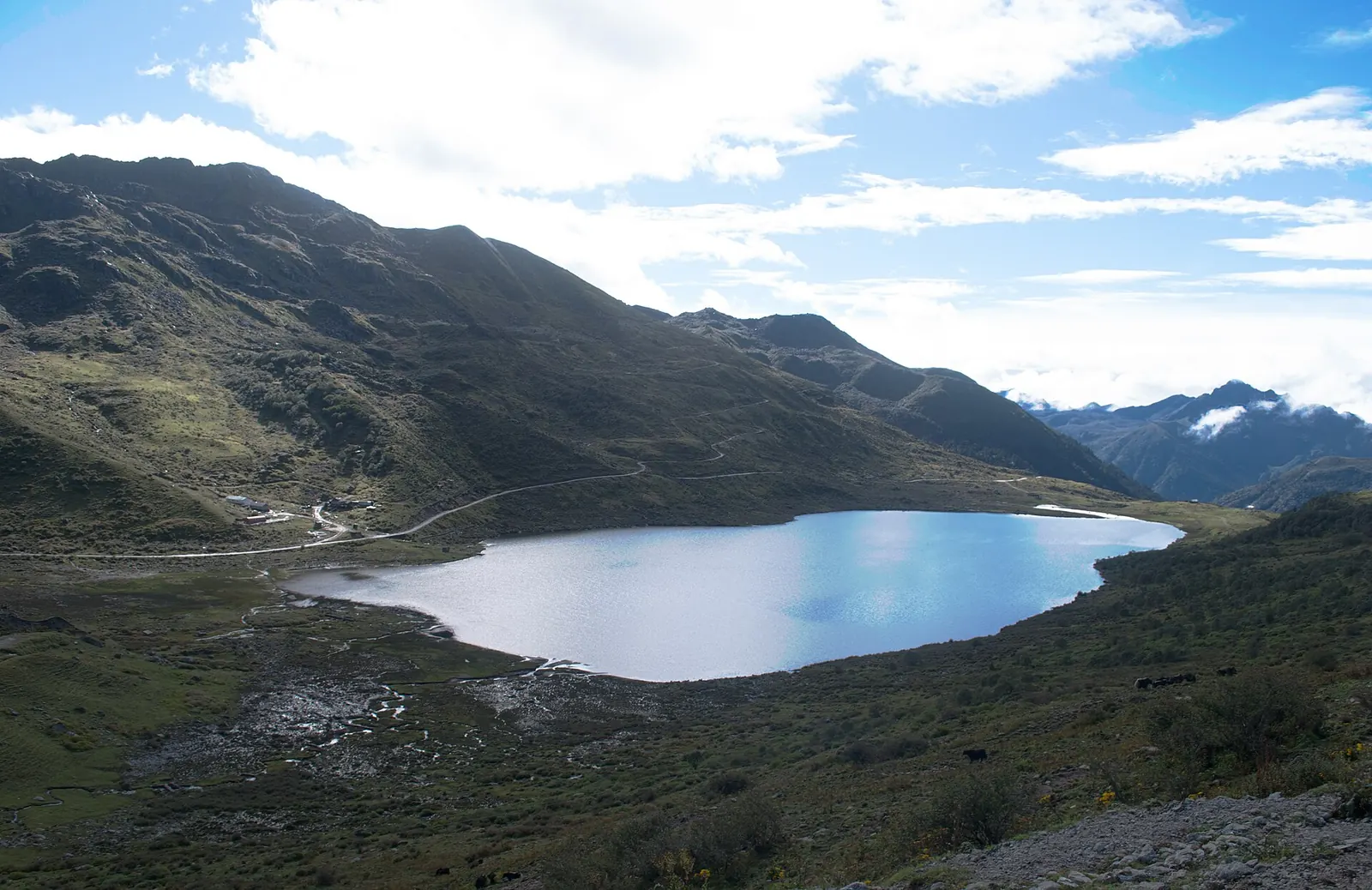
What the modern data say
Modern army data show how hard that is on the body. A study of soldiers in Ladakh found 838 cases of high-altitude pulmonary edema among about 1.42 lakh men inducted to high altitude over four years, and that most cases came within the first week.
Those men had modern acclimatisation schedules and road transport. In October 1968 Harbhajan Singh's own unit was moving stores to a forward post by mule column, the job he died doing.
Army doctors studied all 838 cases of high-altitude pulmonary edema among soldiers posted to Ladakh from 2016 to 2019, out of 1,41,790 men inducted or re-inducted to altitudes between 2,700 m and 7,000 m: an incidence of 5.91 per 1,000. Men under 25 were hit hardest (23.34 per 1,000), 68% of cases started within six days of arrival, and 69.45% occurred in soldiers returning after a short stay in the plains. The study shows that altitude, not combat, is the everyday enemy of troops on these borders. Its limit is that it covers Ladakh and a modern army with set acclimatisation rules, not Sikkim in 1968.
Read the paper (free)
How do riders visit Baba Mandir today?
Riders reach Baba Mandir either from Gangtok via Tsomgo Lake on the Nathu La road, or along the Old Silk Route from Zuluk and Kupup, and in both cases need the East Sikkim protected-area permits. A permit guide last verified in September 2026 says:
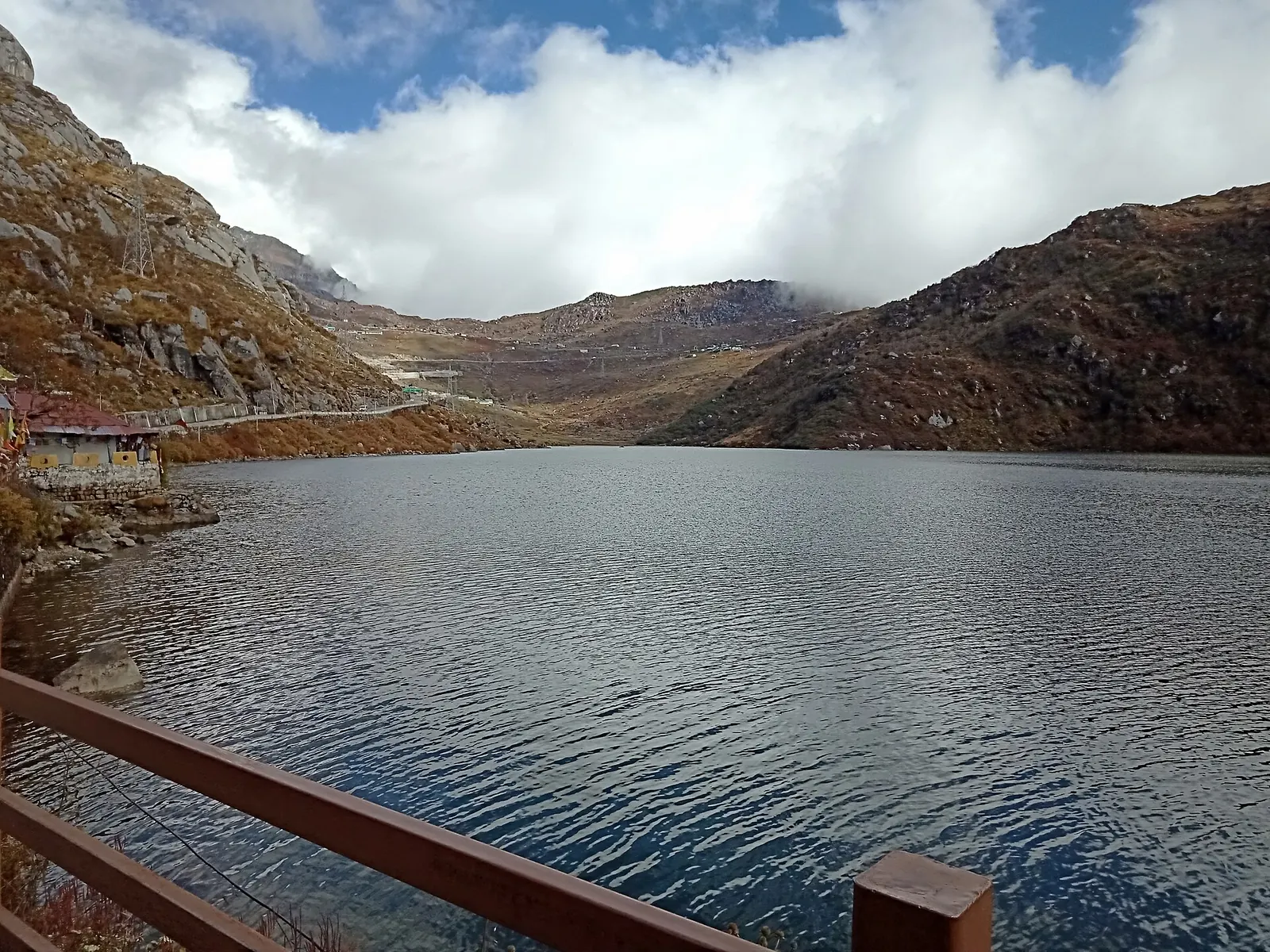
- Tsomgo and Baba Mandir permits for Indian visitors come through the police check post;
- Nathu La permits involve the Tourism Department as well;
- foreigners can go only as far as Tsomgo.
In November 2025 Sikkim's Tourism Department said it was moving these permits online with QR codes.
Weather decides the rest
On 30 October 2026 overnight snow closed Nathu La to tourists while Tsomgo Lake and New Baba Mandir stayed open, which is typical of the season: the shrine, a little lower and on the main road, is often reachable when the pass is not. Go early, carry warm layers, and be ready to turn back.
The full permit process is in the Sikkim permits guide; the trade road through Kupup is in the Old Silk Route history; and the long descent from this ridge to the plains is in Zuluk to the plains.
Baba Mandir is not the only place where Indian soldiers have turned a comrade into a guardian. On the Tawang road in Arunachal, the story of Rifleman Jaswant Singh Rawat at Nuranang follows a similar path from citation to legend; read Jaswant Singh Rawat and Sela Pass.
For the health side of riding at these heights, see altitude sickness on motorcycle tours, and for more Himalayan routes, the Yatri ride atlas.
What's new
- Snow shuts Nathu La to tourists; Tsomgo Lake and New Baba Mandir remain open UNI, Oct 2026
- Sikkim to issue QR-based online permits for Nathu La, Tsomgo and Zuluk PTI via The Week, Nov 2025
- East Sikkim permit rules for Tsomgo, Baba Mandir and Nathu La, verified Sept 2026 Discover with Dheeraj, Oct 2026
Questions people ask
Is Baba Harbhajan Singh's story true?
The core is true and documented: a sepoy of 23 Punjab drowned near Nathu La on 4 October 1968 while escorting supplies. The supernatural parts, such as his body being found through a dream or his spirit warning soldiers, are beliefs held by soldiers and visitors, not recorded fact.
Did Baba Harbhajan Singh die fighting the Chinese?
No. That is a mix-up with Major Harbhajan Singh, who was killed in the September 1967 Nathu La clashes and awarded the Maha Vir Chakra. The sepoy of Baba Mandir died in an accident a year later.
Which Baba Mandir do tourists visit?
Most visit the newer memorial on the road between Sherathang and Kupup, inaugurated in the early 1980s. The older shrine at his bunker is a few kilometres away and less visited.
Can foreigners visit Baba Mandir?
According to a permit guide verified in September 2026, foreign nationals can go only as far as Tsomgo Lake; Baba Mandir and Nathu La are for Indian citizens with permits. Rules change, so check with Sikkim Tourism before you go.
Is Baba Mandir open in winter?
It is often open when Nathu La is closed, as on 30 October 2026, but heavy snow can stop all traffic beyond Tsomgo. Plan a spare day.
Sources
- Honourpoint: Sepoy Harbhajan Singh, service no. 2456687 (source for the 4 October 1968 story)
- The Tribune: The two Harbhajans of Nathu La (2023)
- Ministry of Tourism, Incredible India: Baba Harbhajan Singh Memorial
- Wikipedia: Baba Harbhajan Singh
- Adhya S et al.: Clinico-epidemiological profile of high altitude pulmonary edema (2021)
- NASA Glenn Research Center: Earth Atmosphere Model
- Wikipedia: Kupup
- UNI: Snowfall at Nathu La (2026)
- PTI via The Week: Sikkim set to introduce online permit system (2025)
- Discover with Dheeraj: Sikkim permits guide (2026)

Sapta (Saptarshi Sarkar) is a mechanical engineer turned marketer in Bengaluru and a solo touring rider. He writes the seven Saptaverse blogs. Work with him or read more of RoadHook Rides.


