A bike that never needs fuel is possible only as a light electric bike charged by its own solar panels, and only at modest speeds. One square metre of panel in Indian sunshine collects about 0.75 to 1.3 kWh a day after losses, enough for roughly 40 to 70 km at 30 km/h, but at highway speed a motorcycle needs 75 to 100 Wh per km at the wheel, so the same panel buys only about 10 to 15 km. Regenerative braking cannot help beyond recovering part of what you spent accelerating, because the first law of thermodynamics forbids making energy, and hydrogen is still a fuel.
- About 75 Wh/km at the wheel is what a 250 kg bike and rider need at 100 km/h; at 30 km/h it is about 16 Wh/km.
- 4–7 kWh/m² of sunlight falls on most of India each day; 1 m² of 22% panel turns that into 0.75–1.3 kWh.
- About 16 km/h is the top speed on sunlight alone, in full sun, for a 250 kg bike with a 1 m² panel.
- Regen tops out below 100% of the kinetic energy you put in: about 4 Wh back per stop from 50 km/h.
- Verdict: possible with changes. A light, slow solar commuter never needs fuel. A touring bike does.
This is a tier-2 what-if, so every option gets the same treatment: the governing equation, real numbers carried through, a sensitivity check and a verdict. It starts with what a real bike actually burns.
On 26 June 2005, at the Shell Eco-marathon in Ladoux, France, a team of ETH Zürich students ran a 29 kg carbon-fibre car called PAC-Car II. It was powered by a hydrogen fuel cell developed at ETH and the Paul Scherrer Institute, and its only emission was water. Over a 20.6 km race at an average of 30 km/h it used about 1 g of hydrogen. Converted to petrol, that is 5,385 km per litre, a figure Guinness World Records certified.
PAC-Car II still needed fuel. What it showed is the other way out of the pump: a vehicle that cannot find its energy somewhere else has to need far less of it. A loaded touring motorcycle at highway speed sits at the opposite end of that scale, and that is where this post's numbers begin.
Wikipedia: PAC-Car IIWhat are the assumptions?
Two bikes are used: my touring benchmark and a light commuter designed to live on sunlight. Estimates are marked.
| Symbol | Meaning | Value used |
|---|---|---|
| m | Bike plus rider: tourer / light commuter | 250 kg / 150 kg (estimates) |
| CdA | Drag area of bike and rider | 0.5 m² (estimate) |
| Crr | Rolling resistance coefficient | 0.015 (estimate) |
| ρ | Air density | 1.2 kg/m³ |
| ηpv | Solar panel efficiency | 22% (estimate, good monocrystalline) |
| H | Daily sunshine on India | 4–7 kWh/m² per day |
| ηd | Battery to wheel efficiency | 85% (estimate) |
How much energy does a motorcycle really need?
At the wheel, a bike only fights two forces on flat ground: air drag and tyre rolling resistance. Drag grows with the square of speed, so power grows with the cube. This is the road-load equation:
- Rolling, 250 kg. \( 0.015 \times 250 \times 9.81 = 36.8 \) N at any speed.
- Drag coefficient term. \( \tfrac12 \times 1.2 \times 0.5 = 0.3 \), so drag is \(0.3 v^2\) newtons.
- At 30 km/h (8.33 m/s). Drag 20.8 N, total 57.6 N, so 16.0 Wh/km and 480 W.
Calculated in this post from the road-load equation above and the estimated values in the assumptions table (250 kg bike and rider, drag area 0.5 m², rolling coefficient 0.015), with these example inputs.
- At 100 km/h (27.8 m/s). Drag 231.5 N, total 268.3 N, so 74.5 Wh/km and 7.5 kW.
Calculated in this post from the road-load equation above and the estimated values in the assumptions table (250 kg bike and rider, drag area 0.5 m², rolling coefficient 0.015), with these example inputs.
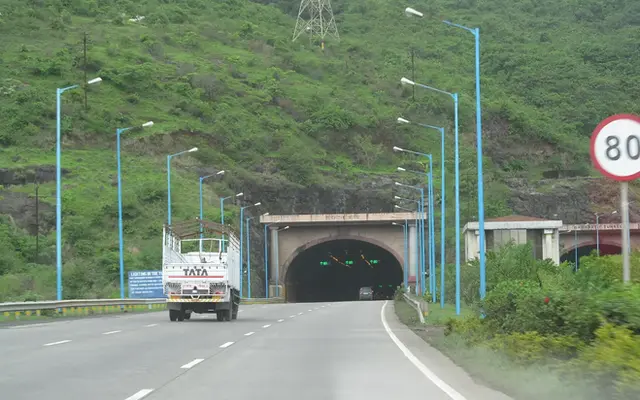
- At 110 km/h, the Mulbagal pace. Total about 317 N, or 88 Wh/km at the wheel.
Check that against the story. The KTM used about 330 Wh of petrol per km (1.2 MJ/km divided by 3.6), and the road needed about 88 Wh/km. That implies an engine-to-wheel efficiency near 26%, which is sensible for a petrol single. The model holds up.
See the data as a table
| Rolling resistance (Wh/km) | Air drag (Wh/km) | |
|---|---|---|
| 20 km/h | 10.2 | 2.6 |
| 30 km/h | 10.2 | 5.8 |
| 50 km/h | 10.2 | 16.1 |
| 80 km/h | 10.2 | 41.1 |
| 100 km/h | 10.2 | 64.3 |
| 120 km/h | 10.2 | 92.6 |
Source: Calculated in this post from the road-load equation (CdA 0.5 m², Crr 0.015, ρ 1.2 kg/m³) · Flat road, no wind, steady speed. Drag dominates above about 40 km/h.
For comparison, Ultraviolette quotes an IDC range of 323 km from the 10.3 kWh battery of its F77 Mach 2, which is about 32 Wh/km on a slow test cycle. That is the right ballpark for a battery bike, and it sets the target any free energy source has to meet.
Calculated in this post from the 10.3 kWh battery and 323 km IDC range on Ultraviolette's F77 Mach 2 page: 10,300 Wh / 323 km = 31.9 Wh/km.
Could solar panels on the bike be enough?
For a slow commuter, mostly yes. For a tourer, no. A motorcycle has little flat area facing the sky. I will be generous and give it 1 m² of panel across a tail, tank and fairing.
Worked solution: daily solar range
- Peak power. At about 1,000 W/m² of full sun: \( 1 \times 1000 \times 0.22 = 220 \) W.
Calculated in this post from about 1,000 W/m² of sun (linked above) and the estimated 22% panel efficiency, for an example 1 m² panel, with these example inputs.
- Daily energy. With 4–7 kWh/m² per day, 22% efficiency and 85% for wiring, heat and charging losses (my estimate): \( 4 \times 0.22 \times 0.85 = 0.75 \) kWh to \( 7 \times 0.22 \times 0.85 = 1.31 \) kWh.
- Energy at the battery per km. At 30 km/h, 16.0 Wh/km at the wheel divided by 0.85 is 18.8 Wh/km.
Calculated in this post from the 16.0 Wh/km road-load result above and the estimated 85% battery-to-wheel efficiency, with these example inputs.
- Range. 750 to 1,310 Wh divided by 18.8 gives 40 to 70 km a day.
Calculated in this post from the 4–7 kWh/m² a day that Invest India reports for most of India, and the estimated 22% panel and 85% system efficiencies, with these example inputs.
- At 100 km/h. 74.5 / 0.85 = 87.6 Wh/km, so the same panel buys 9 to 15 km.
Calculated in this post from the 74.5 Wh/km road-load result above and the estimated 85% efficiency, with these example inputs.
That 20–70 km window lines up with the research on solar cars, which need far more energy per km but carry far more panel.
The authors modelled roof-mounted panels on an electric car charging while parked, including panel temperature effects, with and without sun-tracking. Typical EVs use 13.3 to 26.1 kWh per 100 km on the US EPA cycle. For their conditions, the panels supplied up to 6.32% of a full-charge range in the sunniest summer months and just 1.16% in the darkest winter months. The limit: it is a European-latitude case study of a car, and Indian sunshine is stronger and steadier.
Read the paper (free)Parking in the sun charges a solar car but also heats the cabin, which then needs air-conditioning. The Lisbon team measured a car's thermal behaviour in summer to find the break-even. With 0.5 kWp of panels, parking for less than about 2 hours gave no net gain; above 0.8 kWp, parking in the sun always helped. They cite typical solar-extended range of 10–20 km a day and installed capacities of 200–1,200 Wp. The limit: one car, one climate. A motorcycle has no cabin, so it escapes this dilemma entirely.
Read the paper (free)
How fast could you ride on sunlight alone?
About 16 km/h on a 250 kg bike, or about 21 km/h on a 150 kg one, in full sun with an empty battery. Set the wheel power equal to what the panel delivers and solve for speed.
Calculated in this post from about 1,000 W/m² of sun, the estimated 22% panel and 85% drivetrain efficiencies and the road-load equation, with these example inputs (a 1 m² panel, bikes of 250 kg and 150 kg).
- Power at the wheel. \( 0.22 \times 0.85 \times 1 \times 1000 = 187 \) W.
- 250 kg bike. \( (36.8 + 0.3 v^2) v = 187 \) gives v ≈ 4.4 m/s, about 16 km/h.
Solved numerically in this post from the road-load equation and the 187 W above, which is about 1,000 W/m² of sun times the estimated 22% panel and 85% efficiencies, with these example inputs (250 kg).
- 150 kg bike. \( (22.1 + 0.3 v^2) v = 187 \) gives v ≈ 5.8 m/s, about 21 km/h.
Solved numerically in this post from the road-load equation and the 187 W above, which is about 1,000 W/m² of sun times the estimated 22% panel and 85% efficiencies, with these example inputs (150 kg).
On sunlight alone, a motorcycle becomes a bicycle: about 190 W at the wheel, the steady output of a fit cyclist. Anything faster has to come from a battery filled earlier.
Can regenerative braking keep a bike going forever?
No. It can only return part of the energy you already spent speeding up. Regen turns the motor into a generator when you slow down. The first law of thermodynamics says energy cannot be created, so the most you can recover is the kinetic energy you put in, minus losses in the motor, inverter and battery.
Worked solution: regen in city traffic
- Kinetic energy at 50 km/h. \( \tfrac12 \times 250 \times 13.89^2 = 24.1 \) kJ, or 6.7 Wh.
- Recovered. At 60% round-trip regen efficiency (my estimate), about 4.0 Wh per stop.
- City cycle. Stop every 500 m: spend 26.3 Wh/km cruising plus 13.4 Wh/km accelerating, about 39.7 Wh/km in all.
Calculated in this post from the estimated road-load values in the assumptions table (26.3 Wh/km at 50 km/h) and two stops a km at 6.7 Wh each, with these example inputs: 2 x 6.7 = 13.4 Wh/km.
- Share recovered. Two stops per km return 8.0 Wh, about 20%. On a steady highway, almost nothing.
Calculated in this post from the 4.0 Wh recovered per stop (the estimated 60% regen efficiency is my own assumption) and the 39.7 Wh/km city cycle above, with these example inputs: 8.0 / 39.7 = 20%.
A 2025 review of AI-controlled regenerative braking reports gains of 9.8% to 16.3% in energy recovery from smarter control and claims of up to 63% recovery in mixed driving. None of it gets past the first law: regen reduces how much you need, it never removes the need.
This review compares fuzzy logic, neural networks, reinforcement learning and swarm optimisation for deciding how much braking the motor should do. Reported results include a BLSTM model that improved recovery by 16.3% for aggressive drivers and 9.8% for moderate ones, and hybrid optimised methods claiming up to 63% recovery in urban driving. The limit: it collects simulation and controller results from many studies with different test conditions, so the percentages are not directly comparable, and none is for motorcycles, where most braking is on the front wheel.
Read the paper (free)Isn't hydrogen a way to never need fuel?
No, hydrogen is a fuel. It just makes water instead of CO2. The US Department of Energy lists its energy content at 33.3 kWh per kg. In a fuel cell at about 50% efficiency (my estimate), that is roughly 16.7 kWh of electricity per kg.
- Range per kg: at 40 Wh/km, a fuel-cell commuter would go about 400 km on one kg of hydrogen.
- Storage: hydrogen is so light it must be compressed hugely or chilled to a liquid, and Kawasaki's 2026 patents target exactly that tank-size problem.
- Japan's bet: Suzuki showed a hydrogen-engined Burgman at the 2025 Japan Mobility Show as part of what it calls a multi-pathway approach to carbon neutrality.
- Refuelling: you still visit a station. The question changes from "petrol pump" to "hydrogen pump".

Is there any bike that truly never refuels?
Only one kind, and you cannot have it. NASA's Perseverance rover runs on a radioisotope generator holding 4.8 kg of plutonium dioxide, giving about 110 W at launch and losing a few percent a year. Bolt it to a 150 kg bike:
- Wheel power. \( 110 \times 0.85 = 93.5 \) W.
- Speed. \( (22.1 + 0.3 v^2) v = 93.5 \) gives v ≈ 3.6 m/s, about 13 km/h, day and night, for years.
Calculated in this post from the 110 W at launch that NASA gives for the Perseverance power source, an assumed 85% conversion and the road-load equation, with these example inputs (150 kg bike).
That is a brisk jog, delivered by one of the most tightly controlled materials on Earth. It shows the shape of the answer: never refuelling is easy if you accept very low power.
| Source | Really "no fuel"? | Power or range | Main limit |
|---|---|---|---|
| Solar panel on the bike (1 m²) | Yes | 187 W peak, 40–70 km/day at 30 km/h | Area, angle, shade |
| Solar panel at home, charging a battery bike | Yes, if off-grid | Limited only by roof size | Cost of panels and battery |
| Regenerative braking | No | About 20% back in stop-start traffic | First law of thermodynamics |
| Hydrogen fuel cell | No, it is a fuel | About 400 km per kg at 40 Wh/km | Tanks, stations |
| Radioisotope generator | For years | About 110 W, 13 km/h | Plutonium |
Try it on your own commute
Use this to check what you just read. Put in your panel size and the sunshine where you live, and see how far the bike would go each day.
Solar range per day
Solar does not fail because the sun is weak. It fails because a motorcycle is small and air drag grows with the cube of speed.From the road-load working above
So, can a bike never need fuel?
- Solar on the bike: yes for a light commuter, 40–70 km a day at 30 km/h, about 16–21 km/h on direct sun.
Calculated in this post: the working is in the sections above, from the 4–7 kWh/m² a day in Invest India and the example inputs listed in the assumptions table.
- Regen: no. It recovers roughly a fifth in city traffic and is capped by the first law.
- Hydrogen: no. It is a cleaner fuel, not the absence of one.
- Touring at 100 km/h: about 88 Wh/km at the battery; 1 m² of panel covers 9–15 km of it a day.
Calculated in this post from the 87.6 Wh/km at the battery worked out above and the 0.75–1.31 kWh a day from Invest India's 4–7 kWh/m², with these example inputs.
A bike that never needs fuel is possible if it is light, electric and mostly slow. A 1 m² panel at 22% collects 0.75–1.3 kWh a day in Indian sun, enough for 40–70 km at 30 km/h, and a home rooftop array can cover any daily commute. A touring motorcycle cannot do it on its own skin: at 100 km/h it needs about 75 Wh per km at the wheel, so the same panel buys only 9–15 km.
Perpetual motion is ruled out by the first law of thermodynamics: regen recovers part of your acceleration energy and nothing more. The nearest real thing is an electric bike charged from your own roof.
Battery chemistry decides how much of that sunshine you can store, which is compared in LFP vs NMC scooter batteries and India's electric scooters ranked by range. For the petrol side of the ledger, see India's most fuel-efficient bikes and whether my V-Power habit is worth it in is premium petrol worth it. The bikes themselves are on Gear.
What's new
- Kawasaki files patents for liquid-hydrogen tanks to shrink hydrogen bike fuel systems Cycle World, Apr 2026
- Suzuki shows its hydrogen-engine Burgman with cut-away models Suzuki, Japan Mobility Show, Oct 2025
- Review maps how AI control is raising regenerative braking recovery Frontiers in Artificial Intelligence, 2025
What if next?
- What if an engine had no friction? The other half of the energy problem: stop wasting it.
- How fast could a motorcycle go with no speed limit? Where the cube law of drag stops everything.
- What if motorcycles were invented today, not in 1885? Would anyone pick petrol starting from scratch?
Questions people ask
Can a motorcycle run on solar power?
Yes, slowly. One square metre of panel gives about 220 W in full sun, which moves a 250 kg bike and rider at about 16 km/h on the flat. Charging a battery bike from a home rooftop array is far more practical.
Can regenerative braking charge a battery fully?
No. It can only recover part of the kinetic energy you spent accelerating, about 4 Wh from a 250 kg bike stopping from 50 km/h at 60% efficiency. Energy spent against air and tyres is never recovered.
Calculated in this post from ½mv² for an example 250 kg bike at 50 km/h (6.7 Wh) and an assumed 60% regen efficiency (my estimate), with these example inputs.
Are hydrogen motorcycles coming?
Kawasaki and Suzuki have shown hydrogen-engine prototypes, and Kawasaki filed liquid-hydrogen tank patents in 2026, but neither has announced a production date. Hydrogen still needs refuelling, at 33.3 kWh of energy per kg.
How much energy does a motorcycle use per km?
At the wheel, roughly 16 Wh/km at 30 km/h and 75 Wh/km at 100 km/h for a 250 kg bike and rider. A petrol bike burns three to four times that as fuel because of engine losses; my KTM used about 330 Wh of petrol per km at 100–120 km/h.
Sources
- Diahovchenko, I. et al.: Application of photovoltaic panels in electric vehicles to enhance the range, Heliyon 8(12) (2022) (source for 6.32% and 1.16%, 13.3–26.1 kWh/100 km)
- Gaspar, G., Costa, I. and Centeno Brito, M.: The parking dilemma for solar-powered vehicles, Heliyon 10 (2024) (source for 10–20 km/day, 200–1,200 Wp, 0.5 and 0.8 kWp thresholds)
- Prakash, Z.: Integration of AI and ML in regenerative braking for electric vehicles, a review, Frontiers in AI 8 (2025) (source for 9.8%, 16.3% and up to 63%)
- Invest India: India's rising solar sector (2021) (source for 4–7 kWh/m² per day and 250–300 sunny days)
- US DOE Alternative Fuels Data Center: Fuel properties comparison (source for petrol 112,114–116,090 Btu/gal and hydrogen 33.3 kWh/kg)
- Ultraviolette: F77 Mach 2 (source for 10.3 kWh and 323 km IDC)
- NASA Science: Perseverance rover components (source for 110 W and 4.8 kg plutonium dioxide)
- Suzuki: Hydrogen engine Burgman, Japan Mobility Show 2025 (2025)
- Cycle World: Kawasaki developing motorcycle liquid hydrogen technology (2026)
- Wikipedia: PAC-Car II (source for the 2005 Shell Eco-marathon record of 5,385 km per litre equivalent)

Sapta (Saptarshi Sarkar) is a mechanical engineer turned marketer in Bengaluru and a solo touring rider. He writes the seven Saptaverse blogs. Work with him or read more of RoadHook Machines.