
Motorcycle travel photography works best with a split kit: an action camera on the bike for riding footage, a phone on a damped mount (or in a pocket) for navigation and quick shots, and a real camera packed soft and away from the engine for stops. Apple itself warns that long exposure to high-amplitude vibration from powerful motorcycle engines can degrade a phone's optical stabilisation and autofocus, so damping is not optional. For the shots themselves, pan at 1/30 to 1/125 s, use ND filters in bright sun, and keep batteries warm, because a lithium cell can lose about a third of its capacity near −20 °C.
- Carry cameras by job: one records while you ride, one is always in reach, one makes the best shots at stops.
- Apple warns that high-amplitude motorcycle vibration can degrade iPhone OIS and autofocus.
- A four-stroke single fires at rpm ÷ 120: 50 Hz at 6,000 rpm.
- Pan at 1/30 to 1/125 s; freezing a 60 km/h rider without panning needs about 1/7,100 s.
- Sunny video at 1/50 s and f/4 needs about an ND32; snow needs an ND64.
- Lithium cells lost about 35% of capacity near −20 °C in a 2025 lab test.
What camera kit should you carry on a motorcycle tour?
Carry cameras by job, not by quality: one device that records while you ride, one that is always in reach, and one that makes the best stills and cinematic shots when you stop. Every extra body costs space, charging time and something else to protect from shocks and rain.
My own kit shows the split:
- Sony ZV-E10 (an APS-C mirrorless body): deliberate, cinematic shots;
- DJI Osmo Action 4: point-of-view and dynamic footage;
- Samsung Galaxy S25+: extra coverage;
- Nikon D90: also in the kit;
- Around them: a DJI Osmo Mobile 7P gimbal, a DJI Mic Mini with two transmitters, a TELESIN cage, ND16 to ND64 filters and a circular polariser.
You don't need all of this, but you do need the three roles covered.
In November 2025 I rode my 2017 Pulsar NS200 from Bengaluru to Sikkim and back, the ride I call the Sikkim Diaries. The first leg, Bengaluru to Kolkata on NH16, was about 2,000 km in two days, with a stop roughly every 250 km. From Kolkata the route ran north through Kalyani towards Siliguri and Gangtok.
On 19 November, near Kalyani in West Bengal, the phone fell off its holder. I found it, and the moment made it into the video. It is the cheapest lesson in this guide: the device that navigates is also the device most likely to leave the bike, and a clamp alone is not a plan.
Sapta: The Sikkim Diaries ride notes| Role | Typical device | Rides where | Main risk | What protects it |
|---|---|---|---|---|
| Riding footage | Action camera (Osmo Action, GoPro, Insta360) | Helmet, chest or handlebar mount | Mount failure, stone hits on the lens | Tether, lens guard, rated mount |
| Navigation and quick shots | Phone | Handlebar mount or jacket pocket | OIS damage from vibration, falls | Vibration damper, lanyard, pocket for photos |
| Best stills and cinematic shots | Mirrorless or DSLR with one or two lenses | Padded bag on luggage or on the rider | Dust, shocks, theft at stops | Padded insert, dry bag, lens caps on |
| Audio | Wireless mic | Jacket collar or helmet | Wind noise, lost transmitter | Windshield fur, clip plus tether |
The action camera matters more than it used to. DJI's Osmo Action 4 is rated to work down to −20 °C and is waterproof to 18 m without a case, which covers most of what an Indian tour can throw at it, from monsoon ghats to a frozen Nathu La morning. A phone is rated for none of that by default.
Will motorcycle vibration damage a phone or camera?
It can damage phones, and Apple says so on its own support page: long-term exposure to high-amplitude vibration in certain frequency ranges can degrade the optical image stabilisation (OIS) and closed-loop autofocus in iPhone cameras. Apple advises against attaching an iPhone to motorcycles with high-power or high-volume engines, and recommends a vibration-dampening mount even for scooters and mopeds.
Why a floating lens is fragile
The reason is mechanical. An OIS lens floats on tiny springs and is held in place by voice-coil motors and a gyroscope. That makes it a small mass-spring system, and like any such system it has a resonant frequency.
Shake it near that frequency for hours and the suspension and its magnets take far more abuse than in a pocket. Apple's note lists OIS on every iPhone from the 7 onwards and closed-loop autofocus from the XS onwards, so almost every phone in use is exposed. Other brands use the same kinds of floating-lens designs, even if they publish no warning.
What frequencies reach the bars
What frequencies are we talking about? A four-stroke single fires once every two crank revolutions, so the firing frequency is rpm divided by 120, and the unbalanced crank itself shakes at rpm divided by 60. A 1986 study of mail-delivery motorcycles in Japan (below) found the dominant handlebar frequency matched engine speed, with road input above about 20 Hz coming up through the fork. The table is my arithmetic for a typical single.
| Engine speed | Crank rotation (rpm ÷ 60) | Firing, 4-stroke single (rpm ÷ 120) | Firing, parallel twin, 360° crank (rpm ÷ 60) |
|---|---|---|---|
| 3,000 rpm | 50 Hz | 25 Hz | 50 Hz |
| 5,000 rpm | 83 Hz | 42 Hz | 83 Hz |
| 6,000 rpm | 100 Hz | 50 Hz | 100 Hz |
| 8,000 rpm | 133 Hz | 67 Hz | 133 Hz |
| 9,000 rpm | 150 Hz | 75 Hz | 150 Hz |
Two practical conclusions follow:
- Highway cruising is the worst case. It holds the engine at one speed for hours, which is exactly the steady excitation that wears a resonant part.
- A damper must be soft. It puts an element between bar and phone with its own resonance well below the excitation, so higher frequencies are attenuated instead of passed on. A rigid clamp with no rubber does the opposite.
Mirrorless and DSLR bodies are sturdier, but their lens elements, stabilisation units and zoom cams are also suspended parts, so keep them padded and off direct metal contact.

Where should a camera ride: tank bag, tail bag or on you?
A padded tank bag is the best compromise for a camera you use often, a tail bag or pannier is better for a backup body, and a sling or chest pack is best when you stop every few kilometres. The trade is always between access, shock and heat.
| Location | Access while touring | Shock and vibration | Other risks | Best for |
|---|---|---|---|---|
| Tank bag | Excellent at stops | Moderate; close to the rider's mass, cushioned by the bag | Engine heat on some bikes, magnet or strap shift | Main camera with one lens, phone for photos |
| Tail bag or top box | Poor | High; far behind the rear axle, worst on potholes | Dust, theft from a box left open | Backup body, spare batteries, card wallet |
| Panniers | Fair | High on rigid side cases | Damage in a tip-over | Chargers, cables, drives |
| On the rider (sling, chest pack) | Best | Lowest; your body is the damper | Injury risk in a fall, fatigue | Small body with a short lens |
The rear of a motorcycle sees bigger vertical jolts than the middle because the luggage sits on or behind the rear axle, with only the rear shock and tyre between it and every pothole.
Whatever you choose, use a padded camera insert inside a dry bag, keep lens caps on, and never let the body touch metal. The top answer on the Stack Exchange thread about DSLRs and motorcycle vibration makes the same point: the body is robust, but lens elements can be knocked out of alignment, so pad each lens snugly.
Which mounts work for phones and action cameras?
Use a mount with a built-in vibration damper and a secondary retention, and tether everything that can fall. Mount failures are common, and the cost is the device plus whatever it hits on the road.
- Phone on the bars: a clamp with a rubber or spring damper module, plus a lanyard or second latch. Use the phone for navigation; take photos with it out of the mount when you can.
- Action camera on the helmet chin: the most natural point of view, with your head as a stabiliser. Check helmet maker guidance on adhesive mounts.
- Action camera on the bars or crash guard: shows the bike and the road, but gets the full engine vibration; the camera's electronic stabilisation must do the work.
A real example of why the second latch matters: on my November 2025 ride, the phone fell off its holder near Kalyani in West Bengal (the story above). I found it, and the moment is in the video, but a phone that leaves its holder on a highway can just as easily end up under a truck. That is the case for a tether as well as a clamp.
How do you shoot the bike in a landscape?
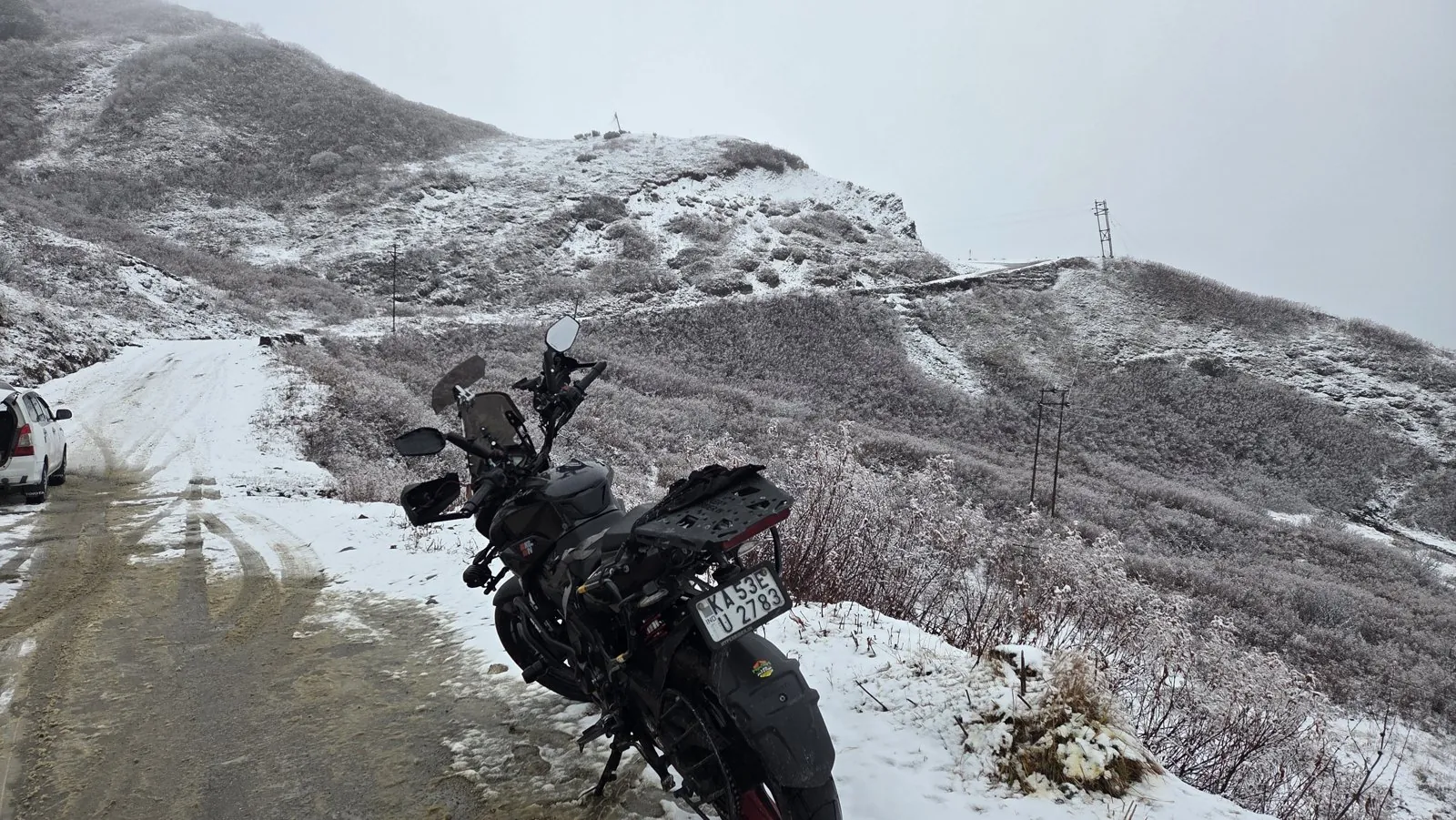
Make the bike small and the road do the work: put the motorcycle on a third of the frame, let the road lead towards it, and choose focal length by how big you want the mountains to look. A wide lens makes the bike big and the peaks distant; a long lens from far away makes the peaks loom over the bike.
The physics behind the sketch is simple: the relative size of two objects in the frame depends only on their distances from the camera. Stand 3 m from the bike with a mountain 5 km away and the bike is huge; stand 150 m away and the ratio changes fifty-fold. This is the "compression" effect explained properly in focal length and perspective compression.
Park the bike, walk 100 to 200 m back down the road, and shoot with the longest lens you have.
On a solo tour, a 10 s self-timer or a phone app trigger puts you in the frame; set focus on the bike first. Between the big views, detail shots (dust on a tank bag, a frosted mirror) carry the story.

How do you take panning shots of a moving motorcycle?
Pan at a shutter speed slow enough to streak the background but fast enough to keep the rider sharp: about 1/30 to 1/60 s for a bike at town speeds, and 1/125 to 1/250 s for fast riding. Wikipedia's examples show the range: an F1 car on a straight blurs its background at 1/250 s, while a running person needs around 1/40 s.
The geometry of a pan
The geometry gives a useful formula. If the bike moves at speed v, at distance d, for exposure time t, the camera must turn by θ = v·t/d radians to follow it. That rotation smears a distant background by roughly f·θ on the sensor, where f is the focal length. Divide by the pixel pitch and you get the streak length in pixels. The same number is how far an unpanned rider would blur, which is why the calculator below answers both questions.
Use this to check what you just read. The defaults are a rider at 60 km/h, 10 m away, a 50 mm lens on an APS-C sensor 23.5 mm wide with 6,000 pixels across (the Sony ZV-E10 class), at 1/60 s: the background streaks about 355 pixels, and freezing the rider without panning would need around 1/7,100 s.
Panning streak and freeze speed
- Set shutter priority. Start at 1/60 s for a bike at 40 to 60 km/h; go to 1/30 s once your pans are smooth, and up to 1/125 s for fast riding.
- Pre-focus. Focus on the spot where the bike will pass, or use continuous autofocus with tracking.
- Stand square to the road. Plant your feet facing the point where you will press the shutter, then twist your upper body towards the approaching bike.
- Swing and keep swinging. Track the rider before, during and after the exposure, and fire a burst. Most frames will miss; one in five sharp is normal.
- Mind the background. Lines of trees, railings or colourful shopfronts streak beautifully; a plain sky streaks into nothing.
For a fuller table of speeds by subject, see the shutter speed chart for moving subjects.
What settings work in harsh sun, snow and for video?
In bright sun, the problem is too much light: the Sunny 16 rule says a sunlit scene is correctly exposed at f/16 and 1/100 s at ISO 100, and snow or sand needs one stop less (f/22). That is fine for stills, but video needs slow shutter speeds, so you need ND filters.
Here is the worked example:
- Pick the shutter. Video at 25 frames per second looks natural with the 180-degree shutter rule: exposure time is half the frame interval, so 1/50 s.
- Pick the aperture. If you also want f/4 for a little background softness at ISO 100, the exposure value is log₂(N²/t) = log₂(16 × 50) ≈ 9.6.
- Compare with the sun. Sunny 16 corresponds to log₂(256 × 100) ≈ 14.6.
- Fill the gap with ND. The gap is 5 stops, so you need an ND32. On snow at a pass, add a stop: ND64.
That is why an ND16 to ND64 set covers most Indian riding days, and why a circular polariser, which also darkens the image, is useful on its own for skies and wet roads.
Shoot RAW for stills when the light is hard. A sunlit snowfield beside a black asphalt road can exceed the range of a JPEG; RAW keeps the highlights recoverable, which RAW, dynamic range and ETTR explains in numbers. At altitude, the light is also bluer in shade, so check white balance before you trust the auto setting.
How do cold, dust and altitude affect your camera?
Cold mainly kills batteries: lithium-ion cells deliver less capacity as temperature falls, and the loss is temporary. A 2025 laboratory study measured a commercial lithium cell module losing about 15% of its room-temperature capacity near −10 °C and about 35% near −20 °C. Battery University gives a similar rule of thumb: at −20 °C most batteries run at about 50% of their performance.
See the data as a table
| Capacity vs room temperature (%) | |
|---|---|
| Room temperature | 100 |
| About −10 °C | 85 |
| About −20 °C | 65 |
Source: Bressan, Campagnoli and Giaretto, Batteries (MDPI), 2025: LiFePO4 module, 3.2 V, 23 Ah · Camera batteries use different lithium chemistries, so treat this as a direction, not an exact figure. DJI rates the Osmo Action 4 at up to 150 minutes at −20 °C versus 160 minutes at 25 °C under its own test settings.
Action cameras are now designed for this. DJI's FAQ for the Osmo Action 4 gives up to 160 minutes of recording at 25 °C and up to 150 minutes at −20 °C under its test settings, which shows what a cold-optimised battery can do. Mirrorless and DSLR batteries are usually less forgiving.
- Condensation: bringing a frozen camera into a warm homestay fogs the lens and can put water inside. Seal it in a zip bag before you go indoors and let it warm up for an hour.
- Dust: change lenses inside the tent or a bag, never on a windy dirt road. Zoom lenses pump air in and out as they extend; a prime or a sealed lens survives dusty passes better.
- Ice: near Baba Mandir in East Sikkim, at about 4,120 m, I had ice forming on my visor. A lens surface outdoors does the same; a lens hood and a microfibre cloth in a dry pocket deal with it.

How do you back up photos and footage on the road?
Back up every night to two places, and keep the copies on different bags or people. A tour produces hundreds of gigabytes of action-camera footage, and a single card or a single drive is one fall away from losing the trip.
- Number your cards. Fill a card, label it, and don't format it until the footage exists in two other places.
- Copy every night. Use a laptop or a phone with a card reader to copy to an SSD. An SSD has no moving parts, unlike a spinning hard drive with its read heads, so it suits a vibrating bike better.
- Split the copies. Keep the SSD on you and the cards in the tank bag, or the reverse. A theft or a fall then costs one copy, not both.
For packing the rest of the bike, the motorcycle touring packing list on RoadHook Rides covers luggage weight and placement, and the photography for phones specifically is in the phone photography guide.
What does the research say?
The authors measured handlebar vibration on an 89 cc single-cylinder four-stroke motorcycle of the kind used by Japanese mail deliverers, ridden on asphalt, unpaved roads and packed snow. The dominant vibration frequency matched engine speed, components above about 20 Hz came through the front fork from the road and tyres, and the maximum level exceeded the ISO exposure guideline. The limit: one small, old commuter bike, and the abstract gives no acceleration values, so use it for the mechanism (engine plus road paths) rather than numbers for modern bikes.
Read the abstract (free)The team tested a commercial LiFePO4 module (3.2 V, 23 Ah) between −20 °C and +55 °C, measuring open-circuit voltage and internal resistance while charging and discharging, and tried localised heating between −20 °C and +10 °C. Capacity fell about 15% near −10 °C and about 35% near −20 °C compared with room temperature, which they modelled with a modified Arrhenius law. The limit: LiFePO4 is not the chemistry in most camera batteries, and one module is a small sample, but the direction and the benefit of warming the cell carry over.
Read the paper (free)What's new
- DJI's Osmo Action 6 brings a variable f/2.0 to f/4.0 aperture and a larger 1/1.1-inch square sensor to action cameras Engadget, Nov 2025
- Insta360 X5 launches with 1/1.28-inch sensors and field-replaceable lenses, useful for riders who scratch lenses on the road RedShark News, Apr 2025
- Twelve unmodified Osmo Action 6 cameras recorded a rocket launch and re-entry, according to DJI Camera Jabber, Aug 2026
Questions people ask
Will the vibrations of a motorcycle harm a DSLR or mirrorless camera?
Short trips in a padded bag are very unlikely to harm it. The risk grows with hours of direct metal contact, rigid mounting on the bars and heavy lenses levering on the mount. Keep the body padded, near the bike's centre or on you, and never bolt a stills camera to the handlebar.
Is it safe to use my phone as a navigation screen on the bike?
Apple says long exposure to high-amplitude vibration can degrade iPhone OIS and autofocus, and advises against mounting on high-power motorcycles. If you do, use a mount with a vibration damper and a tether, and take your photos with the phone in hand. A dedicated navigator or a cheap spare phone avoids risking your main camera.
Why does my camera battery die so fast in the mountains?
Cold slows the chemical reactions inside lithium cells, so they deliver less capacity until they warm up again. Carry spares in an inner pocket and rotate them; the "dead" battery often works again once warm.
Sources
- Apple Support: Exposing your iPhone to high-amplitude vibrations may degrade camera performance (OIS and closed-loop AF warning, models affected)
- Yokomori, Nakagawa and Matsumoto: Handlebar vibration of a motorcycle during operation on different road surfaces, Scand J Work Environ Health (1986)
- Bressan, Campagnoli and Giaretto: Experimental Evidence on the Effect of Temperature on the Performance of a Lithium-Ion Battery, Batteries (2025; −10 °C and −20 °C capacity figures)
- Battery University: BU-502 Discharging at high and low temperatures (50% performance at −20 °C rule of thumb, charging warnings)
- DJI: Osmo Action 4 FAQ (160 min at 25 °C, 150 min at −20 °C, 18 m waterproof)
- DJI: Osmo Action 4 specifications (−20 to 45 °C operating range)
- Wikipedia: Panning (camera) (1/250 s and 1/40 s examples)
- Wikipedia: Sunny 16 rule (f/16 at 1/ISO, f/22 for snow)
- Wikipedia: Shutter angle (180-degree rule)
- Engadget: DJI's Osmo Action 6 is the first action cam with a variable aperture (2025)
- RedShark News: Insta360 introduces X5 360 camera with larger sensor and replaceable lenses (2025)
- Camera Jabber: Twelve stock DJI Osmo Action 6 cameras survived a rocket launch and a 500 °C re-entry (2026)
- Photography Stack Exchange: Will the vibrations of a motorcycle be harmful to a DSLR?
- Photography Stack Exchange: What equipment and settings do I use for panning shots of moving objects?

Sapta (Saptarshi Sarkar) is a mechanical engineer turned marketer in Bengaluru and a solo touring rider. He writes the seven Saptaverse blogs. Work with him or read more of Artblog.


