Yes, a healthy 125cc or 150cc motorcycle can ride to Ladakh and over its passes, solo and lightly loaded. At Tanglang La (5,328 m) the air is only about 58% as dense as at sea level, so a 125 rated at about 11.6 PS has roughly 6.8 PS to work with, which is enough to climb in first and second gear at 20 to 30 km/h. What a small bike cannot do well is carry a pillion plus luggage up long grades, and a carburetted one also runs rich and loses more at height than a fuel-injected one.
- 58%: air density at Tanglang La (5,328 m) compared with sea level, and every non-turbo engine loses power with it.
- About 6.8 PS is what an 11.6 PS Pulsar 125 has left up there; the original Himalayan 411 drops to about 14 PS.
- Carburetted bikes run rich at height: air flow falls with density, fuel flow only with its square root.
- Load, not cc, is the real limit: 220 kg needs about 1.5 PS at 25 km/h on a 6% grade; 380 kg on 10% needs about 4 PS.
- Go solo, under about 20 kg of luggage, on fresh clutch plates, and plan 20 to 30 km/h on the big climbs.
The question appears on every touring forum in some version: "I have a 125, can I do Ladakh or do I need a Himalayan?" The worry is fair. Riders see 400 and 450cc adventure bikes everywhere on the Manali-Leh highway and assume the passes need that power.
They do not, and even Leh's own rental union lists Activa-class scooters on its rate card. But the reason a small bike struggles is specific and measurable, and once you understand it, you can plan around it.
How much power does a bike lose at Ladakh altitudes?
A naturally aspirated engine loses power roughly in step with air density, because each intake stroke draws a fixed volume of air and thinner air carries less oxygen to burn fuel.
Using the standard atmosphere model, density at Leh (3,500 m) is about 70% of sea level, and at Tanglang La (5,328 m) about 58%. That is a loss of about 3% for every 300 m near sea level, easing slightly as you go higher.

See the data as a table
| Air density (%) | |
|---|---|
| Sea level | 100 |
| Keylong 3,080 m | 73.6 |
| Leh 3,500 m | 70.5 |
| Rohtang 3,980 m | 67.1 |
| Sarchu 4,200 m | 65.5 |
| Pang 4,650 m | 62.4 |
| Baralacha La 4,850 m | 61.1 |
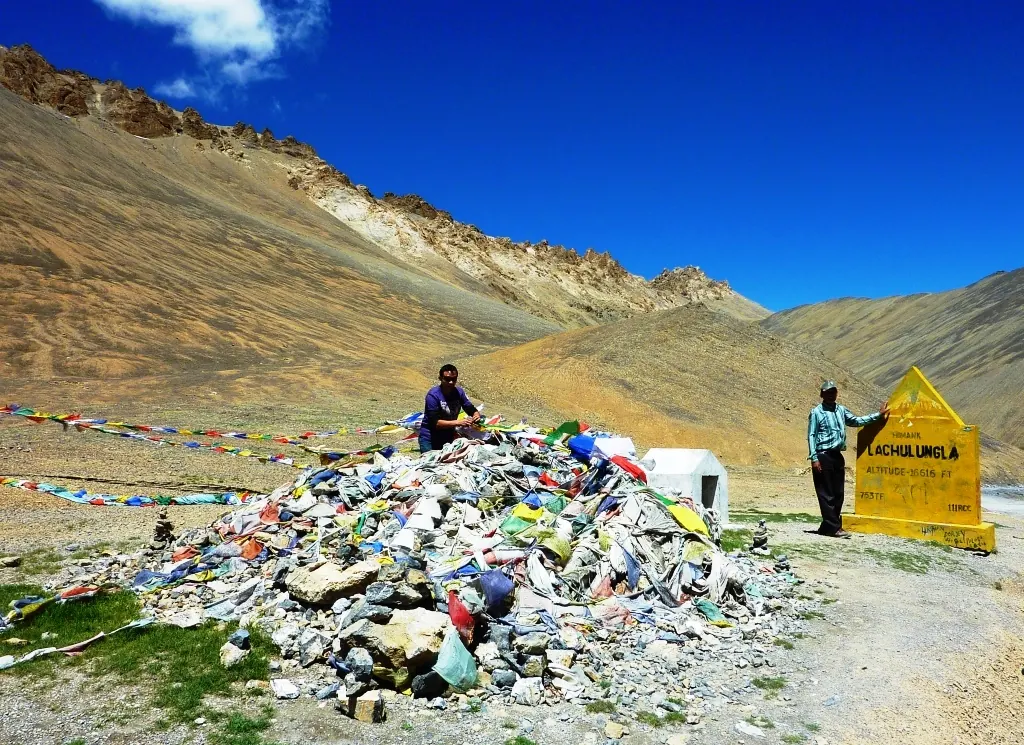
| Lachulung La 5,065 m | 59.7 |
| Tanglang La 5,328 m | 58.0 |
Source: Computed from the NASA Glenn standard atmosphere equations; altitudes from Wikipedia (Leh-Manali Highway) · Standard-day temperatures; a cold morning is slightly denser, a hot afternoon slightly thinner.
For the troposphere (up to 11,000 m), the model sets temperature as T = 15.04 − 0.00649 h (°C, h in metres), pressure as p = 101.29 × [(T + 273.1)/288.08]^5.256 kPa, and density from the gas law as p / [0.2869 × (T + 273.1)]. Plugging in Ladakh altitudes gives about 65.9 kPa at Leh and 51.8 kPa at Tanglang La, against 101.3 kPa at sea level. Limit: it describes an average day; real pressure varies by a few percent with weather and season, and real engines do not lose power in exact proportion to density, because friction and pumping losses do not shrink with it.
Read the model (free)Apply that to real bikes. The chart takes rated outputs from manufacturer figures as listed on Wikipedia and scales them by the density at Tanglang La. The small bike's problem is obvious: an 11.6 PS commuter becomes a 6.8 PS one. But so is the bigger picture: the original 411cc Himalayan, which thousands of riders took to Ladakh, falls to about 14 PS, less than a Pulsar 150 makes at sea level. Every bike is weaker up there; the question is whether yours still has enough.
See the data as a table
| Rated at sea level (PS) | Estimate at 5,328 m (PS) | |
|---|---|---|
| Bajaj Pulsar 125 | 11.6 | 6.8 |
| Bajaj Pulsar 150 | 14.0 | 8.1 |
| Bajaj Pulsar NS160 | 15.5 | 9.0 |
| Bajaj Pulsar NS200 (2012) | 23.5 | 13.6 |
| RE Himalayan 411 | 24.8 | 14.4 |
| RE Himalayan 450 | 40.6 | 23.5 |
Source: Rated figures from Wikipedia (Bajaj Pulsar; Royal Enfield Himalayan); altitude estimate by density ratio from the NASA standard atmosphere · bhp and hp figures converted to PS (x1.014). Estimates ignore that fuel-injected engines hold mixture better than carburetted ones.
Why do carburetted small bikes suffer more at altitude?
A carburettor meters fuel by the pressure drop of air through its venturi, so as air thins it keeps sending nearly the same fuel into less air, and the mixture goes rich. A rich engine loses more power than the density drop alone explains, fouls plugs and burns more fuel.
Fuel-injected bikes measure the incoming air and trim the fuel to match, which is why a fuel-injected small bike copes better at height than a carburetted one of the same size.
Tested a mass-produced carburetted petrol engine in an altitude-simulation dynamometer cell at pressures equal to 0, 400, 800 and 1,200 m, at 1,500 to 4,500 rpm and wide-open throttle, with three carburettor settings and two fuels. The thesis explains the mechanism: air mass flow through a simple carburettor scales with air density, but fuel flow scales with its square root, so the fuel-air ratio rises as density falls. With the sea-level carburettor setting, brake-specific fuel consumption rose 4.9 to 12.9% (depending on rpm) just from sea level to 1,200 m; with the mixture re-leaned for altitude, the rise fell to 2.5 to 4.6%. Limit: one car engine and a maximum of 1,200 m, far below Ladakh, so the numbers at 5,000 m will be larger, not smaller.
Read the thesis (free)In a feature Bike India published in November 2015, the stunt rider Anam Hashim rode a TVS Scooty Zest 110, a 110cc commuter scooter, from Jammu to Ladakh. She spent the first night at Patnitop, took a rest day in Kargil and crossed Namik La and Fotu La to Leh on what the write-up calls a "peppy little scooter".
From Leh she rode the last 50 km or less up to Khardung La, signboarded at 18,380 ft. The road was "like a long off-road track" and it was very cold at the top, but by her account the scooter performed unfazed in the thin air. She did a handstand at the pass board and, advised not to linger at that height, rode back down to her hotel.
Bike India: Top of the world, TVS Scooty Zest 110 and Anam Hashim atop Khardung La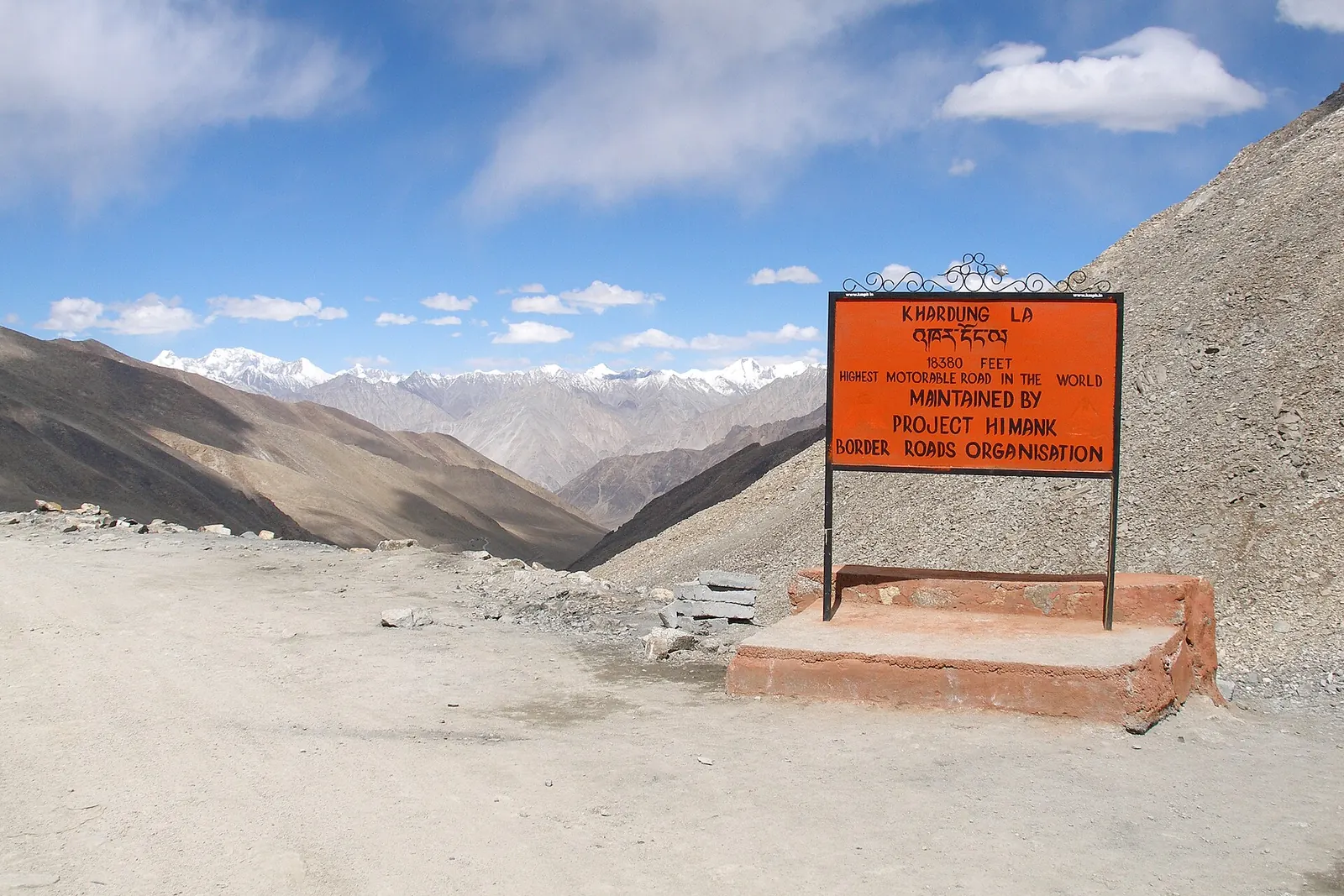
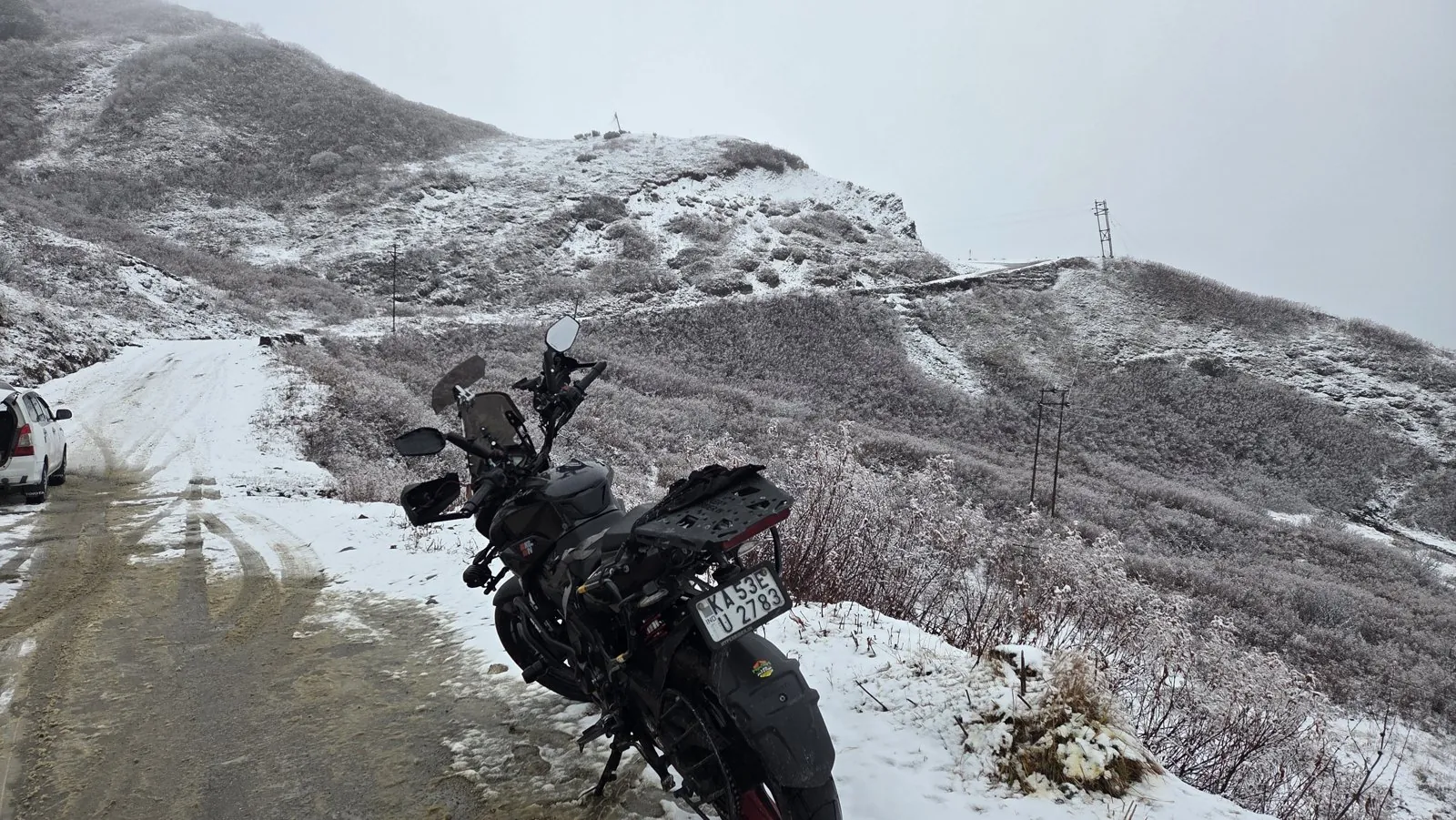
Her write-up gives no climbing speeds, and the maths below shows what a small engine gives up. My own carburetted 200cc NS200 at times could not go faster than about 40 km/h on the climb to Gurudongmar in 2022; a carburetted 125 starts with about half that power.
How much power does a loaded bike need to climb a pass?
Climbing power is weight × speed × gradient, so a small bike's real limit is the total mass on it. Doubling the load on a grade doubles the power needed to hold the same speed, and on a 125 at altitude there is little spare.
Use this to check what you just read: the calculator compares the power needed to hold a speed on a grade with what your engine has left at altitude.
Can my bike hold this speed on this climb?
With the defaults (220 kg, 25 km/h, 6% grade, 11.5 PS at 60% density) the bike needs about 1.5 PS of its 6.9 PS: easily done in a low gear.
Push the load to 380 kg with a pillion and luggage and the grade to 10%, and you need about 4.0 PS, close to 60% of the peak, and the engine has to sit near its rev limit for kilometres. That is where clutches cook and riders stall on hairpins.
A small bike's problem on the passes is rarely raw speed. It is holding a low speed under load, at the right rpm, without slipping the clutch.
Which passes are the real test for a small bike?
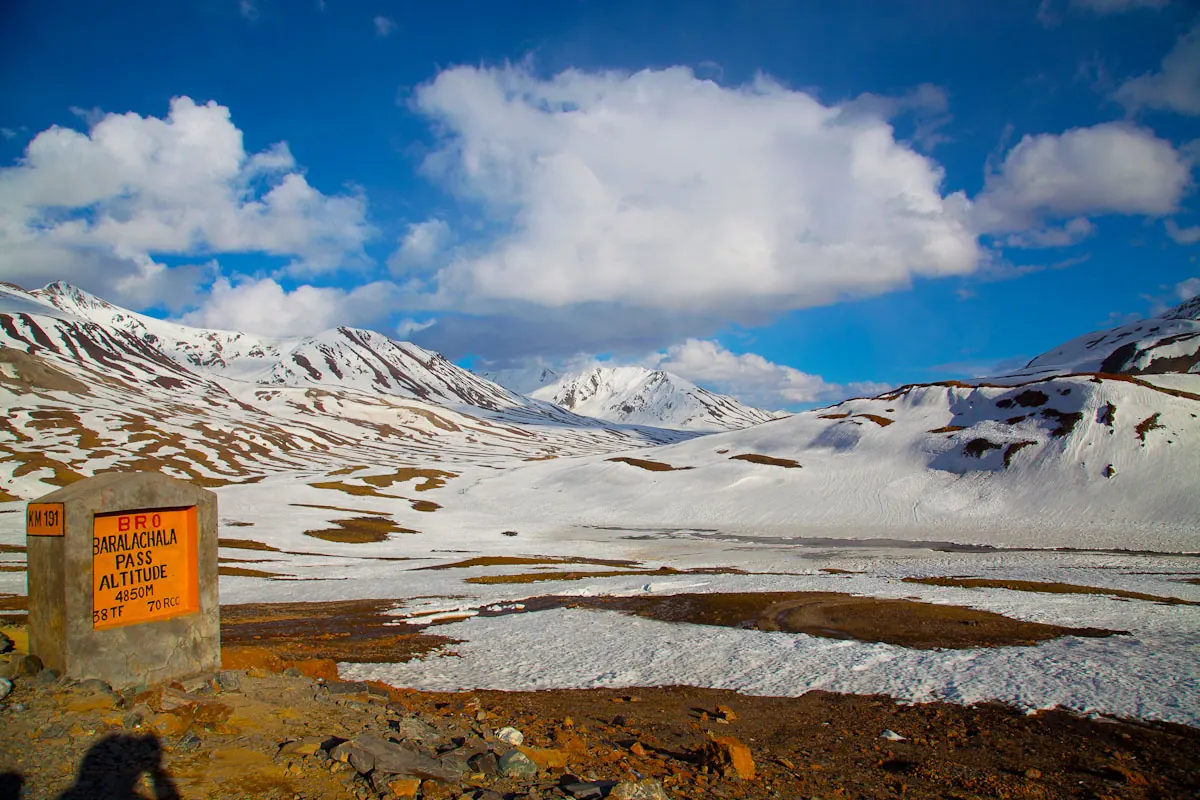
The real tests are the long climbs at the top of the range: the Gata Loops up towards Nakee La, Lachulung La at 5,065 m and Tanglang La at 5,328 m. Baralacha La (4,850 m) is high but its approach is gentler. The table shows each with the estimated share of sea-level power any engine has left.
| Point on Manali-Leh | Altitude (m) | Air density vs sea level | What it means for a 125 |
|---|---|---|---|
| Keylong | 3,080 | 74% | Noticeably softer, still easy |
| Rohtang La (bypassed by Atal Tunnel) | 3,980 | 67% | Tunnel route avoids it |
| Sarchu | 4,200 | 66% | Flat plain; fine in 3rd and 4th |
| Gata Loops (21 hairpins) | about 4,190 at the loops | about 66% | About 500 m of climbing in tight bends; 1st and 2nd gear |
| Nakee La | 4,739 | 62% | Long pull after the loops |
| Lachulung La | 5,065 | 60% | Steep, rough patches; slowest section |
| Pang | 4,650 | 62% | Refuel your body, not the bike (no fuel) |
| Tanglang La | 5,328 | 58% | Highest point; long climb from the More plains |
Altitudes are from the Leh-Manali Highway entry on Wikipedia; density shares are from the standard atmosphere. Khardung La and the roads to Pangong and Nubra repeat the same test from Leh. For the full list of high roads, see my ranking of the highest motorable passes in India.

How should you prepare a 125cc or 150cc bike for Ladakh?
Prepare a small bike for Ladakh by cutting load, checking the clutch and chain, sorting the mixture if it is carburetted, and planning slower days. The bike is rarely what fails; overload and a tired clutch are.
- Go solo. A pillion is the single biggest load. On a 125, ride alone and keep luggage under about 20 kg.
- Fresh clutch plates and cable. Hairpin starts on a small engine mean more slipping. Carry a spare cable.
- Chain and sprockets. A worn set skips under load on steep grades. Some riders fit a larger rear sprocket for lower gearing, at the cost of highway cruising speed.
- Mixture. Carburetted: get a mechanic to plan the jetting before you leave. Fuel-injected: nothing to do.
- Fuel range. A small tank plus the gap between Tandi and Karu needs reserve fuel; small engines are frugal, but work it out in my fuel range post.
- Plan shorter days. Expect 20 to 30 km/h on climbs. Use the daylight, not the clock.
So, 125, 150 or a bigger bike?
The answer splits on how you ride, not on the badge:
- Take the 125 or 150 if it is healthy and you ride solo: slower on climbs, but cheaper to run and easier to pick up.
- Rent a 400 to 450cc bike if you plan two-up with luggage, or want to keep up with a group on bigger bikes.
- Either way, the load you carry matters more than the cc you ride.
The cost difference is in my Ladakh bike trip cost breakdown, and the route plan is in the Leh-Ladakh bike trip guide. Engineering notes on engines live on the Yantra page.
What's new
- Ladakh arrivals near 2025's full-year total by July 2026; 17% came by the Manali road The Tribune, Aug 2026
- Manali-Leh highway opened to civilian traffic on 1 June 2026, with fuel only at Tandi and Karu Discover with Dheeraj, Oct 2026
Questions people ask
Can a scooter go to Ladakh?
Yes, solo and lightly loaded. Leh's rental rate card for 2026 even lists Activa-class scooters at ₹800 to ₹1,200 a day. The same density maths applies, so expect slow climbs and plan shorter days.
Can a 125cc bike carry a pillion to Leh?
It can, but it is hard work. With about 380 kg on a 10% grade, holding 25 km/h takes over half the peak power a 125 has left at 5,000 m, so expect long stretches near the rev limit and a slipping clutch.
Do fuel-injected bikes lose less power at altitude?
They lose the same air, but they keep the mixture right, so they avoid the extra losses of a rich carburettor. A lab test found an unadjusted carburettor used 4.9 to 12.9% more fuel per unit of work at just 1,200 m.
What speed will a 125cc do at Tanglang La?
Expect 20 to 30 km/h on the climb in first or second gear when solo. On the flatter More plains before it, a healthy small bike will cruise faster, limited more by the road than the engine.
Sources
- NASA Glenn Research Center: Earth atmosphere model (metric units)
- Wong, C. T.: The effect of altitude on the performance of a spark ignition engine using an alcohol-blended fuel. MSc thesis, University of Cape Town (1996)
- Wikipedia: Leh–Manali Highway (passes, altitudes, Gata Loops)
- Wikipedia: Bajaj Pulsar (model outputs)
- Wikipedia: Royal Enfield Himalayan (411 and 450 outputs)
- CDC Yellow Book 2026: High-altitude travel and altitude illness (2025)
- Discover with Dheeraj: Manali-Leh highway status 2026 (Oct 2026)
- Discover with Dheeraj: Leh Ladakh bike rental rates (Oct 2026)
- The Tribune: Ladakh draws over 3.3 lakh tourists in first seven months of 2026 (Aug 2026)
- Sapta's ride log (Yatri): Gurudongmar on a carburetted Pulsar NS200 (2022)
- Anam Hashim and Gaurav Nagpal: Top of the world, TVS Scooty Zest 110 atop Khardung La, Bike India (Nov 2015; source for the story)

Sapta (Saptarshi Sarkar) is a mechanical engineer turned marketer in Bengaluru and a solo touring rider. He writes the seven Saptaverse blogs. Work with him or read more of RoadHook Rides.