Food in zero gravity tastes duller, roughly like eating with a cold. The tongue's five basic tastes mostly survive, but body fluids drift towards the head and swell the nose (75% of ISS astronauts in a 2025 study reported congestion), and without gravity the warm aroma above a plate never rises to meet your nose. Chilli heat and salt cut through because they do not depend on smell, which is why astronauts reach for hot sauce, and why a crisp masala dosa would have to become a soft one to survive orbit.
- 60 of 71 astronauts who flew to the ISS between 2000 and 2019 reported at least one nose or sinus problem in flight.
- About 1,000 times slower: my estimate for how much more slowly a food's warm aroma rises in orbit than at a dining table.
- 2.7 mm on Earth, about 2.7 m in orbit: the size below which surface tension, not gravity, decides the shape of your chai.
- Water activity below 0.90: the trick that gave NASA's tortillas a 6-month shelf life, and the trick a space dosa would need.
- 3 of the planned Indian dishes passed space-food testing in time for Shubhanshu Shukla's 2025 flight.
This what-if is far-out, but astronauts live it every day: three meals a day where "down" does not exist. Here is the body, the air, the plate, and a masala dosa that could fly.
Why does food taste bland in zero gravity?
Food tastes bland in zero gravity mainly because flavour is mostly smell, and smell suffers in orbit. The taste buds on your tongue report only sweet, sour, salty, bitter and umami. Everything that makes cumin different from coriander arrives through the nose.
There are two routes for that smell:
- Orthonasal: sniffing through the nostrils, as when you lean over a pot of sambar.
- Retronasal: aroma released in the mouth as you chew, pushed up the back of the throat into the nose when you breathe out. This is the route that turns "salty and sour" into "tamarind rasam".
Spaceflight attacks both. On Earth, gravity pulls blood and tissue fluid towards the feet. In orbit that pull vanishes, fluid redistributes towards the chest and head, and astronauts get a puffy face and a stuffy nose, a pattern NASA's Human Research Program lists among the first changes of spaceflight.
On 23 March 1965, on the first crewed Gemini flight, pilot John Young reached into a pocket of his spacesuit and pulled out a corned beef sandwich he had smuggled aboard. He handed it to commander Gus Grissom. The flight lasted under five hours, and the sandwich lasted a few bites: it began shedding crumbs into a cabin where nothing falls, and crumbs could drift into electronics. Grissom put it away. The crew was reprimanded after landing and later crews were warned not to repeat it. Sixty years on, bread is still rare in orbit, and that one sandwich explains why.
Wikipedia: Gemini 3 (mission record and the corned beef sandwich)The team reviewed medical records of 71 astronauts who flew to the ISS between 2000 and 2019. Sixty of them, about 85%, reported at least one nose or sinus problem during their mission, and nasal congestion was the commonest, at about 75%. Headaches, fatigue and poor sleep travelled with it. The limit: a records review, not a smell test, so it shows a blocked nose is common but does not measure how much flavour is lost.
Read the paper (free)A blocked nose cuts the airflow that carries aroma to the smell receptors, the same reason a cold makes dal taste like hot water. But the evidence on taste itself is honestly mixed.
A review of every taste and smell study from spaceflight and its ground analogues up to 2001. Taste thresholds changed on Skylab-4 and Soyuz 30–31, a Canadian test on Shuttle mission 41-G found no change, and of seven simulated-microgravity studies, five found an effect and two did not. The authors' leading explanation is the headward fluid shift reducing the smell part of flavour, with space sickness, cabin air, stress and mood as contributors. The limit: tiny samples and methods that differ between missions.
Read the abstract (NASA NTRS)Why can't you smell your food in microgravity?
You can't smell food from a distance in orbit because the warm plume that normally carries aroma upward is driven by gravity. With no gravity there is no buoyancy, so the plume never forms.
On Earth, a hot plate warms the air above it. Warm air is less dense, gravity pulls the denser cold air down around it, and the warm air rises in a plume, carrying volatile aroma molecules to your nose. That is natural convection, and its speed scales with gravity.
Worked solution: how fast does the smell of dinner rise?
Assumptions: a plate of food at 60°C in a 25°C room, a plume height scale of 10 cm, and air treated as an ideal gas. Variables: \(g\) is gravity, \(\beta\) the air's expansion coefficient, \(\Delta T\) the temperature difference, \(L\) the length scale and \(D\) the diffusion coefficient of an aroma molecule in air.
- Buoyancy velocity scale. Balancing buoyancy against inertia gives the classic free-convection velocity
\[ v \sim \sqrt{g\,\beta\,\Delta T\,L}, \qquad \beta = \frac{1}{T} = \frac{1}{298\ \text{K}} \]
- At the dining table (1 g).
\[ v \sim \sqrt{9.81 \times \tfrac{35}{298} \times 0.1} = \sqrt{0.115} \approx 0.34\ \text{m/s} \]Real plumes are slower than this upper scale, a few tenths of a metre per second at most, but the aroma reaches a nose 30 cm above the plate in about a second.
- In orbit. Assume a residual acceleration of \(10^{-6}\,g\). Velocity scales as \(\sqrt{g}\), so it drops by \(\sqrt{10^{6}} = 1000\):
\[ v_{orbit} \sim 0.34 \times 10^{-3}\ \text{m/s} \approx 0.3\ \text{mm/s} \]The aroma would take about 15 minutes to drift 30 cm, by which time the food is cold.
- Diffusion alone. Without any flow, molecules spread by diffusion. Taking a typical value \(D \approx 10^{-5}\ \text{m}^2/\text{s}\) for small volatile molecules in air (my working value),
\[ t \approx \frac{L^2}{2D} = \frac{(0.3\ \text{m})^2}{2 \times 10^{-5}\ \text{m}^2/\text{s}} = 4500\ \text{s} \approx 75\ \text{min} \]
Sensitivity check. If the real residual acceleration is a hundred times larger, \(10^{-4}\,g\), the plume speed rises only tenfold to about 3.4 mm/s, still around 100 times slower than on Earth. The conclusion is robust: in orbit, smell only reaches you if a fan or your own mouth carries it.
That matches what NASA's ISS food manager Vickie Kloeris told Scientific American in 2009: food comes in narrow pouches, so the appetising smell never reaches the nose the way it does at a table. Cabin fans keep the air moving to stop exhaled carbon dioxide pooling around a sleeping astronaut's face, and they also sweep away aroma.
| Sense | What it reports | What spaceflight does | Evidence strength |
|---|---|---|---|
| Basic taste (tongue) | Sweet, sour, salty, bitter, umami | Thresholds shifted in some flights, not others | Mixed (Olabi 2002 review) |
| Orthonasal smell | Aroma sniffed from the plate | No rising plume; narrow pouches; blocked nose | Strong physics, few measurements |
| Retronasal smell | Aroma from chewing | Reduced when the nose is congested | Plausible; 75% report congestion (Khan 2025) |
| Trigeminal (chilli, mustard, ginger) | Burn, tingle, cooling | Works without smell, so it stands out | Crew reports, condiment demand |
| Texture and temperature | Crunch, softness, heat | Crisp foods avoided; food often warm, not hot | Food-system design rules |
Why do astronauts crave chilli sauce in space?
Astronauts crave chilli because chilli heat is not a smell or a taste. Capsaicin triggers the TRPV1 pain receptor on trigeminal nerve endings in the mouth, and that signal arrives at full strength even when the nose is blocked.
The demand is well documented. In 2002, ISS commander Peggy Whitson joked that she would not open the hatch to a visiting Shuttle crew unless they brought the spicy condiments they had promised. Crews have flown salsa, hot sauce, Thai chilli-garlic paste and wasabi.
India's own astronaut said the same thing. On the 2025 Axiom-4 mission, Group Captain Shubhanshu Shukla later said he began missing familiar flavours by about day 13 and asked his flight surgeon for something salty. When he landed, his welcome snacks were banana chips and bhakarwadi. (For how capsaicin fires the receptor, see how chilli heat works.)
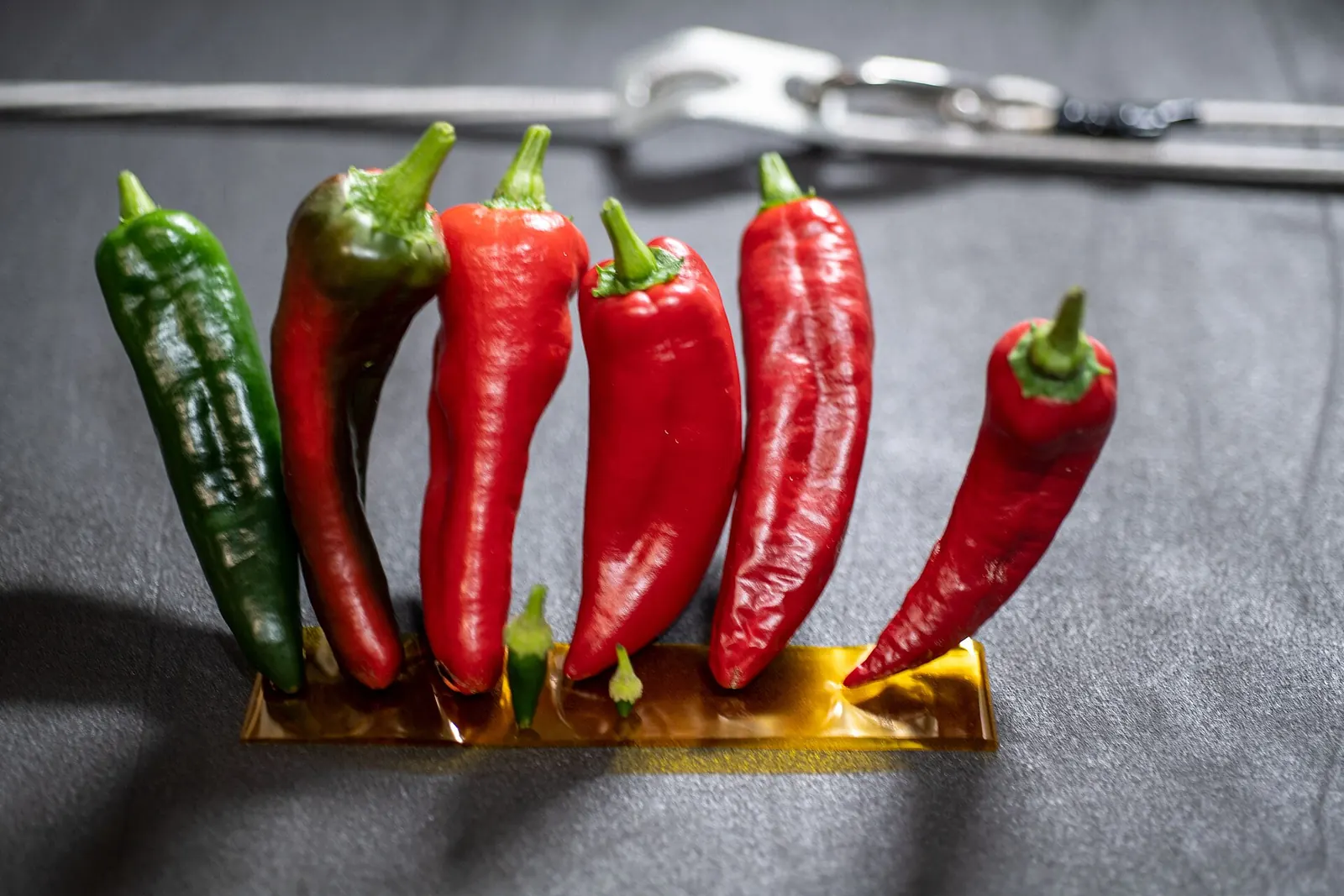
In 2021 NASA went further and grew chillies in orbit. The Plant Habitat-04 experiment ran 137 days, raised 26 peppers on four plants of a dwarf New Mexico chile, and the crew ate the first harvest in tacos. The lead scientist said the fruit came out on the spicy side.
In orbit, chilli is not a garnish. It is the one flavour channel that still has full bandwidth.
How do liquids and crumbs behave in zero gravity?
In zero gravity, liquids are shaped by surface tension instead of gravity, so a spill becomes a floating, wobbling ball that sticks to whatever it touches. Crumbs don't fall; they drift on air currents until a filter or an eye catches them.
The physics has a name: the Bond number, the ratio of gravity's pull to surface tension's grip on a blob of liquid.
- Definition. For a liquid of density \(\rho\), surface tension \(\sigma\) and size \(L\):
\[ Bo = \frac{\rho\, g\, L^2}{\sigma} \]When \(Bo \gg 1\), gravity wins and liquid lies flat as a puddle. When \(Bo \ll 1\), surface tension wins and liquid pulls into a ball.
- The crossover size, called the capillary length, is where \(Bo = 1\). For water at room temperature, \(\sigma = 0.072\ \text{N/m}\):
\[ \ell_c = \sqrt{\frac{\sigma}{\rho g}} = \sqrt{\frac{0.072}{1000 \times 9.81}} \approx 2.7\ \text{mm} \]That is why raindrops are round and a cup of chai on a table is flat.
- In orbit, at \(10^{-6}\,g\), the capillary length grows by \(\sqrt{10^6} = 1000\):
\[ \ell_c^{orbit} \approx 2.7\ \text{m} \]Any blob of chai smaller than a car is controlled by surface tension. A 150 mL cup, about 6.6 cm across as a sphere, has \(Bo \approx 6 \times 10^{-4}\).
So drinks fly in sealed pouches with straws, and sauces are made thick enough to cling to food. A free ball of aamras would stick to the first face, panel or eyeball it met.
Use this to check what you just read. Change the size of the blob and the gravity level, and see whether your sambar would lie in a bowl or float away as a ball.
Will it puddle or float? The Bond number

Crumbs are the bigger hazard: in orbit a crumb floats into a fan, an instrument or an eye. NASA moved to tortillas after 1985, when Mexican payload specialist Rodolfo Neri Vela asked for them on his Shuttle flight.
Tortillas flew on most Shuttle missions from 1985, but commercial ones spoiled on flights longer than 7 days. The team cut the tortilla's water activity below 0.90 by replacing part of the water with glycerin, lowered its pH, and packed it in nitrogen with an oxygen scavenger. Storage at 22°C gave a 6-month shelf life, and the tortillas flew on eight Shuttle missions longer than a week. The limit: a short paper, with acceptance reported only qualitatively.
Read the record (NASA NTRS)Do astronauts actually eat less because food tastes worse?
They eat less, and flavour is one suspected reason among several. A 2020 review led by Andrew Taylor, with Oxford's Charles Spence, reported that ISS astronauts typically eat about 80% of their energy needs, and laid out shelf life, fluid shift, noise, cabin air and stress as possible causes of the gap.
NASA's own 2025 risk record is blunter. It still rates food and nutrition a red risk for Mars, and it counts the toll on current crews:
- 25% of ISS crew from 2000 to 2024 lost more than 5% of body mass in flight;
- 40% of crews were dehydrated by urine measures (2006 to 2018 data, 65 astronauts);
- crews "tire of the available variety over six months", and up to 25% of food choices come from personal preference and fresh items;
- a food system with a 5-year shelf life, needed for Mars, does not exist yet.
See the data as a table
| Share of astronauts (%) | |
|---|---|
| Any nose or sinus problem in flight | 85 |
| Nasal congestion | 75 |
| Dehydrated by urine measures | 40 |
| Lost more than 5% of body mass | 25 |
Source: Khan et al., Laryngoscope Investigative Otolaryngology (2025); NASA Food and Nutrition Risk Record Rev D (2025) · Different samples: 71 astronauts flying 2000-2019 for the nose data; 65 crew (2006-2018) for hydration; 72 crew (2000-2024) for body mass.
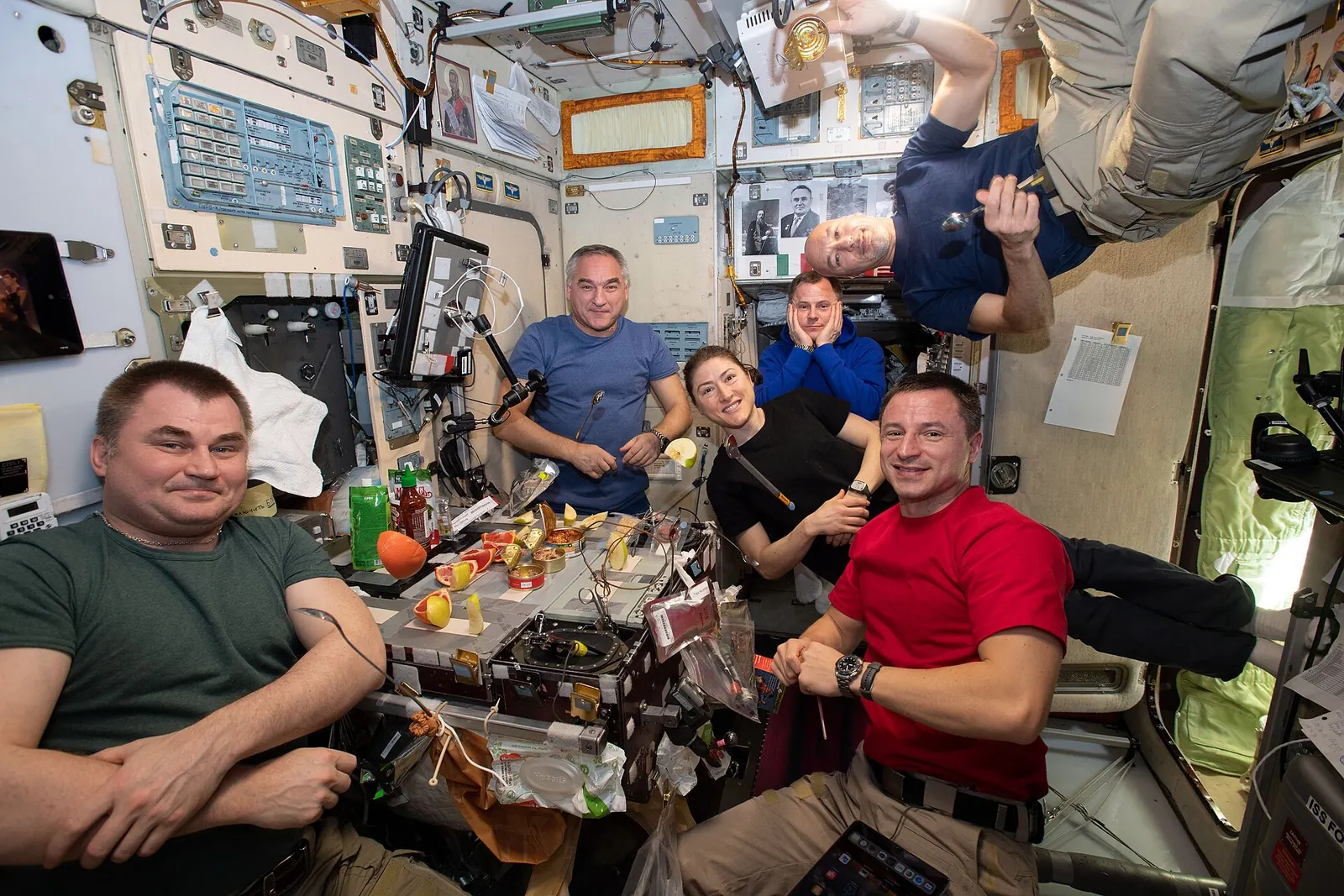
What would a masala dosa need to survive orbit?
A masala dosa could fly only if it gave up its crispness. A crisp dosa is a thin, brittle sheet that shatters into flakes on the first bite, and in orbit every flake becomes a floating hazard. Here is how I would re-engineer each part.
- The dosa. Make it like NASA's tortilla: a thicker, softer, flexible sheet, closer to a set dosa or uttapam, with water activity pushed below 0.90 and packed in nitrogen. It will not be crisp. Crispness and orbit are incompatible.
- The masala. Potato masala is a wet, cooked food, a good candidate for thermostabilising: sealed in a pouch, then heat-sterilised so it keeps for months without a fridge. Warm it in the galley warmer.
- The sambar. Thicken it. A viscous sauce clings to the dosa by surface tension, which in orbit is the force in charge anyway.
- The chutney powder. Dry powder is dangerous because it becomes airborne dust. Mix it with sesame oil into a paste before flight, as many South Indian homes do anyway.
- Flavour boost. Push the chilli, tamarind and salt slightly higher than at home, because the smell channel is turned down. Crews have long done this with condiments. (Umami helps too; more food science lives in Rasa.)
Food in orbit really does taste flatter, mostly because the nose is congested in about three in four astronauts and because, without gravity, aroma rises roughly a thousand times more slowly. Basic tastes and chilli heat survive. A masala dosa can fly only as a soft, low-moisture dosa (water activity below 0.90, the tortilla trick) with a pouched masala, thick sambar and a chutney paste. A crisp dosa is ruled out by the crumb problem, not by any law of nature, so a sealed "crumb box" to eat it in would be the engineering workaround.
Where my model breaks down: cabin fans move air far faster than any orbital plume, so smell does reach astronauts, just unpredictably.
What's new
- Shukla explains why only three Indian dishes passed space-food tests in time for Axiom-4 Business Today, Jul 2026
- Study of 71 ISS astronauts finds most had sinus or nasal problems in flight Futurity / Texas A&M, Nov 2025
- NASA keeps food and nutrition as a red risk for Mars in its revised risk record NASA, Aug 2025
What if next?
- What if you lost your sense of smell tomorrow? Astronauts get a few weeks of it; here is what a lifetime looks like.
- How would you cook dinner on Mars? Gravity comes back, but at 38%, and the air will boil your dal cold.
- What if chillies had never left the Americas? The astronaut's favourite rescue would not exist in Indian food.
Questions people ask
Why do astronauts like spicy food?
Chilli heat is a pain signal through the trigeminal nerve, not a smell, so it stays strong when the nose is blocked. Crews have flown hot sauce, salsa, wasabi and chilli-garlic paste for decades, and NASA even grew chile peppers on the ISS in 2021.
Can astronauts eat bread in space?
Rarely, because bread sheds crumbs that float into equipment and eyes. Tortillas have been the standard since 1985, and NASA developed a version with a 6-month shelf life by lowering its water activity below 0.90.
What Indian food has gone to space?
For Shubhanshu Shukla's 2025 Axiom-4 flight, moong dal halwa, gajar ka halwa and aamras passed testing in time; dishes such as khichdi and pulao did not finish testing before launch. The Defence Food Research Laboratory, which makes food for Gaganyaan, wanted to qualify more.
Sources
- Khan F et al.: Sinonasal pathology in ISS astronauts, Laryngoscope Investigative Otolaryngology (2025) (60 of 71 astronauts; about 75% congestion)
- Futurity / Texas A&M: Nasal congestion is really common among ISS astronauts (2025) (summary of the study figures)
- Olabi AA et al.: The effect of microgravity and space flight on the chemical senses, Journal of Food Science 67(2) (2002) (Skylab, Soyuz and Shuttle results; five of seven ground studies)
- Bourland CT et al.: Development of Shelf Stable Tortillas for Space Missions, NASA (1994) (water activity below 0.90, 6-month shelf life, tortillas since 1985)
- NASA: Food and Nutrition Risk Record, Revision D (2025) (25% body-mass loss, 40% dehydrated, 5-year shelf-life gap)
- FoodNavigator: Rocket science, why does food taste different in space (on Taylor et al., Comprehensive Reviews in Food Science and Food Safety) (2020) (80% of energy needs)
- Scientific American: When it comes to living in space, it's a matter of taste (2009) (Kloeris quotes, Whitson condiments, condiment list)
- NASA: Second pepper harvest sets record on space station (2021) (137 days, 26 peppers, spicy fruit)
- Business Today: Only 3 Indian foods made it to space (2026) (Shukla's cravings, three qualified dishes)
- The Week / PTI: Indian food for astronaut Shukla during ISS stay (2025) (moong dal halwa, mango nectar)
- Wikipedia: Gemini 3 (1965 corned beef sandwich, crumbs, reprimand)

Sapta (Saptarshi Sarkar) is a mechanical engineer turned marketer in Bengaluru and a solo touring rider. He writes the seven Saptaverse blogs. Work with him or read more of Foodblog.