
You would cook dinner on Mars indoors, on electricity, in a pressure cooker. Mars's air is 95% carbon dioxide at about 0.6% of Earth's pressure, so nothing burns outside and open water boils about half a degree above freezing. Inside a NASA-style habitat at 8.2 psi, water boils at about 84°C, which roughly doubles cooking times, and the oxygen-rich air makes any flame a fire risk. An Indian-style pressure cooker on an induction plate brings the boiling point back to about 112°C and solves most of the problem.
- 6.36 millibar: Mars's mean surface pressure, just above water's triple point, so liquid water barely exists there.
- About 84°C: the boiling point inside a habitat held at 8.2 psi (56.5 kPa), NASA's proposed exploration atmosphere.
- About 2 times longer: my Arrhenius estimate for how much slower rice softens at 84°C than at 100°C.
- About 170 g of oxygen: what a methane burner would need to cook one pot of dal, more than the 122 g MOXIE made on Mars in two years.
- About 21% lower: the most heat a pot can boil away per square metre in Mars gravity, by Zuber's critical heat flux law.
This is a tier-2 what-if: far-out, but NASA is planning for it. A Mars mission means two to three years with no resupply, and its food risk record still rates food and nutrition a red risk for Mars. Cooking is part of the fix, because crews eat more when they control their food.
I'll solve it in layers: the planet's air, the habitat's air, the pot, the fire, and finally the kitchen design.
Can you cook outside on Mars?
No. Outside on Mars there is no oxygen to burn and almost no pressure to keep water liquid. NASA's Mars fact sheet gives the numbers:
Water's triple point, where ice, liquid and vapour coexist, sits at 611.66 Pa. Mars's mean pressure, 636 Pa, is only 4% above it. So the range where water is liquid is tiny.
Worked solution: where does water boil on open Mars?
- The Clausius–Clapeyron relation links vapour pressure and temperature through the latent heat of vaporisation \(L\). Near 0°C, \(L \approx 45.05\ \text{kJ/mol}\):
\[ \Delta T \approx \frac{R T^2}{L}\ln\frac{P}{P_{tp}} \]
- Substitute \(T = 273.16\ \text{K}\), \(P = 636\ \text{Pa}\), \(P_{tp} = 611.66\ \text{Pa}\):
\[ \Delta T \approx \frac{8.314 \times 273.16^2}{45{,}050} \times \ln(1.040) \approx 13.8 \times 0.039 \approx 0.5\ \text{K} \]
So on an average day, open water on Mars would boil at about 0.5°C, half a degree above where it freezes. A pot of dal set outside would freeze and boil at the same time, then dry out. In the low basins, where pressure is higher, the window widens a little, but it never gets near cooking temperatures.
A flame is out too. Combustion needs an oxidiser, and 0.16% oxygen at 0.6% of Earth's pressure is about 1 Pa of oxygen, roughly 1/20,000 of the oxygen partial pressure at sea level. Mars's air is closer to a fire extinguisher than to a kitchen.
What temperature does water boil at inside a Mars habitat?
Inside a habitat at NASA's proposed exploration atmosphere of 8.2 psi (56.5 kPa) with 34% oxygen, water boils at about 84°C. That is like cooking at roughly 4,900 m on Earth, the height of the high passes of Ladakh and North Sikkim.
Why not keep Earth pressure? Because astronauts going out on spacewalks must breathe pure oxygen first to purge nitrogen and avoid the bends. A lower cabin pressure with richer oxygen cuts that wait.
NASA planned 12-day chamber runs with six test subjects living at 8.2 psia and 34% oxygen, dropping to 4.3 psia for simulated spacewalks, the first crewed test above 30% oxygen in 48 years. The talk focuses on fire: every textile in the chamber, from clothing to bedding, had to be rated for 36% oxygen, and flame-retardant fabrics were tested for ignition and burn propagation in the "middle pressure range". The limit: a planning presentation for the test, not its results.
Read the presentation (NASA NTRS)Worked solution: boiling point at habitat pressure
- Clausius–Clapeyron from sea level, with \(L = 40.66\ \text{kJ/mol}\) at 100°C:
\[ \frac{1}{T_b} = \frac{1}{373.15} - \frac{R}{L}\ln\frac{P}{101.325\ \text{kPa}} \]
- Habitat, 56.5 kPa:
\[ \frac{1}{T_b} = 0.0026799 + 2.045\times10^{-4}\times 0.584 = 0.0027993 \Rightarrow T_b \approx 357.2\ \text{K} \approx 84^\circ\text{C} \]
- Habitat plus a pressure cooker. Indian domestic cookers are built to IS 2347 with a nominal working pressure of 1.0 kgf/cm², about 98 kPa above the surroundings, so the pot sits at \(56.5 + 98 = 154.5\ \text{kPa}\):
\[ \frac{1}{T_b} = 0.0026799 - 2.045\times10^{-4}\times 0.422 = 0.0025936 \Rightarrow T_b \approx 112^\circ\text{C} \]
For comparison, the same cooker on Earth reaches about 120°C. At the other extreme, the Armstrong limit of about 6.3 kPa is where water boils at body temperature, 37°C. A habitat breach that dropped pressure that low would boil the saliva on a person's tongue, which is why habitats are kept nine times above it.
See the data as a table
| Boiling point (°C) | |
|---|---|
| Earth pressure cooker (199 kPa) | 120 |
| Mars habitat pressure cooker (154 kPa) | 112 |
| Sea level (101 kPa) | 100 |
| Leh, about 3,500 m | 88.5 |
| Mars habitat, 8.2 psi (56.5 kPa) | 84 |
| Armstrong limit (6.3 kPa) | 37 |
| Open Mars, mean (0.64 kPa) | 0.5 |
Source: Clausius-Clapeyron calculation in this post; Armstrong limit and Mars pressure from cited sources · Estimates using a constant latent heat; steam tables differ by under 1°C in this range.

How much longer would dal and rice take?
At 84°C, rice and dal would take roughly twice as long as at 100°C, by an Arrhenius estimate. Cooking is a set of chemical and physical changes (starch gelatinising, cell walls softening), and their rates fall steeply with temperature.
The authors soaked polished rice in water at 30 to 90°C for up to 60 minutes and measured surface and overall grain firmness. Softening followed first-order kinetics, and fitting the Arrhenius equation gave an activation energy of 51.3 kJ/mol for surface firmness (exponential model, R² = 0.89), or 21.3 kJ/mol with a Page model. A gelatinised starch layer and internal voids drove the softening. The limit: soaking below boiling in Japanese rice, not a full cook at 100°C, so I use it as a reasonable range, not an exact constant.
Read the paperWorked solution: the cooking-time penalty
- Arrhenius equation. A rate constant \(k\) depends on absolute temperature \(T\) and activation energy \(E_a\):
\[ k = A\,e^{-E_a/RT} \quad\Rightarrow\quad \frac{t_{84}}{t_{100}} = \frac{k_{100}}{k_{84}} = \exp\!\left[\frac{E_a}{R}\left(\frac{1}{T_{84}} - \frac{1}{T_{100}}\right)\right] \]
- Substitute \(E_a = 51.3\ \text{kJ/mol}\), \(T_{84} = 357.2\ \text{K}\), \(T_{100} = 373.15\ \text{K}\):
\[ \frac{t_{84}}{t_{100}} = \exp\!\left[6170 \times (0.0027995 - 0.0026799)\right] = e^{0.738} \approx 2.1 \]
- In the habitat pressure cooker at 112°C (385.6 K):
\[ \frac{t_{112}}{t_{100}} = \exp\!\left[6170 \times (0.0025934 - 0.0026799)\right] = e^{-0.534} \approx 0.59 \]
Sensitivity check. With the lower 21.3 kJ/mol value, the open-pot penalty shrinks to about 1.4 times. With a tougher process such as softening whole pulses, where activation energies are often higher, the penalty grows. Either way the sign is clear: an open pot in a Mars habitat cooks slowly, and a pressure cooker cooks faster than an open pot on Earth. For how the whistle works, see pressure cooker science.
Use this to check your own case: set the habitat pressure, the cooker's extra pressure and an activation energy.
Mars kitchen: boiling point and cooking time
Why can't you use a gas stove on Mars?
You could, but you shouldn't: every gram of oxygen burnt in a stove is a gram made at great cost, and a flame in 34% oxygen is a fire hazard. Electricity, ideally induction, is the sane choice.
In 2013, six researchers sealed themselves into a dome on the slopes of Mauna Loa in Hawaii for a four-month simulated Mars mission called HI-SEAS. Its purpose was food. Funded by NASA's Human Research Program and led by Jean Hunter of Cornell and Kim Binsted of the University of Hawaii, it compared ready-made meals with meals the crew cooked from shelf-stable, dehydrated ingredients. The winning recipes from a public contest included Moroccan beef tagine and Spam fried rice. When the crew emerged on 13 August 2013, commander Angelo Vermeulen said offering shelf-stable ingredients and the chance to cook seemed to keep people enthusiastic about food.
University of Hawaii News: HI-SEAS Mars food researchers wrap up 4-month mission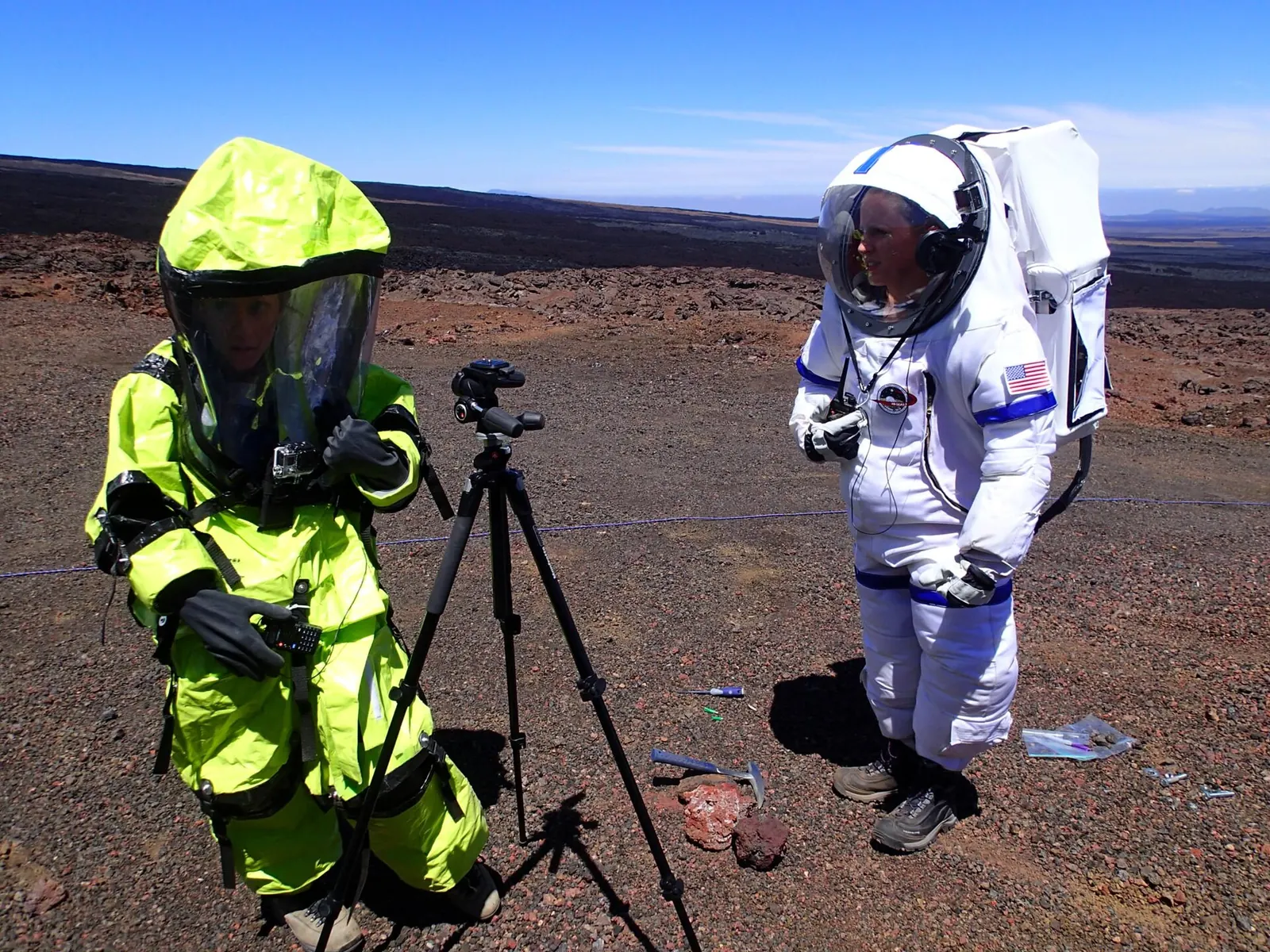
Now the oxygen bill for a gas stove, using MOXIE, the oxygen maker that flew on NASA's Perseverance rover, as the yardstick.

MOXIE split Martian carbon dioxide into oxygen and carbon monoxide using solid-oxide electrolysis. From landing in 2021 to its 16th and final run on 7 August 2023, it made 122 g of oxygen; its best rate was 12 g per hour at 98% purity or better, twice the original goal, and the last run made 9.8 g. NASA says the next step is a full-scale system that also liquefies and stores the oxygen. The limit: a demonstration a few hundred times too small for a crew, run only for about an hour at a time.
Read the NASA releaseWorked solution: the oxygen cost of one pot of dal
Assumptions (mine): dinner for four needs 2 L of water heated from 20°C to the habitat boiling point, plus 30 minutes of simmering at a 300 W heat loss, and a gas stove passes 50% of the fuel's heat into the pot.
- Heat to boil:
\[ Q_1 = m c \Delta T = 2 \times 4180 \times (84 - 20) \approx 535\ \text{kJ} \]
- Heat to simmer:
\[ Q_2 = 300\ \text{W} \times 1800\ \text{s} = 540\ \text{kJ} \]
- Fuel needed at 50% efficiency, methane with a lower heating value of about 50 MJ/kg:
\[ m_{CH_4} = \frac{(535 + 540)\ \text{kJ}}{0.5 \times 50{,}000\ \text{kJ/kg}} \approx 0.043\ \text{kg} \]
- Oxygen needed: \(\text{CH}_4 + 2\text{O}_2 \rightarrow \text{CO}_2 + 2\text{H}_2\text{O}\), so 64 g of oxygen per 16 g of methane, a ratio of 4:
\[ m_{O_2} = 4 \times 43\ \text{g} \approx 172\ \text{g} \]
One pot of dal would burn more oxygen than MOXIE produced in its entire two-year mission, and that oxygen would be pulled from the crew's breathing air. The same meal on an induction plate needs about 1.1 MJ, roughly 0.3 kWh, and no oxygen at all.
On Mars, a gas flame does not burn fuel. It burns the air your crew was going to breathe.
Does lower gravity change frying and boiling?
Yes, a little. Mars has 38% of Earth's gravity, so bubbles rise more slowly and hot oil convects more gently. The cleanest way to measure it is Zuber's critical heat flux, the most heat a boiling surface can pass to the liquid before a vapour film forms and insulates it.
- Zuber's correlation puts gravity inside a quarter power:
\[ q''_{CHF} \propto h_{fg}\,\rho_v \left[\frac{\sigma g (\rho_l - \rho_v)}{\rho_v^2}\right]^{1/4} \quad\Rightarrow\quad \frac{q''_{Mars}}{q''_{Earth}} = 0.38^{1/4} \approx 0.79 \]
- Meaning: a pot base on Mars can boil away about 21% less heat per square metre before it risks film boiling and scorching. Use wider, flatter pots and moderate power.
- Convection: plume speed scales as \(\sqrt{g}\), so smoke and steam rise at about \(\sqrt{0.38} \approx 0.62\) of Earth speed. Mars still has "up", unlike orbit (see what food tastes like in zero gravity).
Deep frying is the real problem, not because of gravity but because of the closed air. Hot oil throws off fine aerosol and smoke, and a habitat cannot open a window. Every gram of oil fume must be filtered out of air the crew breathes for years. The browning reactions that make a tadka smell wonderful also load the air with volatiles.
What would a Mars kitchen look like?
A Mars kitchen would look like a compact Indian kitchen with a laboratory's ventilation. Here is the specification that falls out of the numbers:
| Problem | Number | Kitchen answer |
|---|---|---|
| Low cabin pressure | Boils at about 84°C | Pressure cooker, about 112°C |
| Oxygen is scarce | One gas-cooked dal ≈ 170 g O₂ | Induction, about 0.3 kWh per meal |
| Oxygen-rich air | 34% O₂ | No open flame; fire-rated materials |
| Lower gravity | Critical heat flux down about 21% | Wide flat pots, moderate power |
| Closed air loop | No windows for years | Sealed hood, charcoal and particle filters; no deep frying |
| No resupply | 5-year shelf life needed | Dry staples plus a grow shelf |
The pantry would lean on foods that store dry for years and rehydrate well: rice, dals, millets, dried spices and powders. That is a description of an Indian dry store. Fresh flavour, the first thing crews miss, would come from a grow shelf, which is its own problem (see growing food on Mars).
Cooking on open Mars is impossible: with 0.16% oxygen nothing burns, and at 636 Pa water boils at about 0.5°C, a limit set by water's triple point and the Clausius–Clapeyron relation. Inside a habitat at 8.2 psi it is entirely possible with changes: an open pot boils at 84°C and takes about twice as long, while a standard Indian pressure cooker on an induction plate reaches about 112°C, cooks faster than an open pot on Earth and uses no oxygen. A gas stove would burn about 170 g of oxygen per pot of dal, more than MOXIE made in two years.
Where my model breaks down: I used a constant latent heat and a single activation energy from rice soaking, and real habitat pressures are still being decided. The direction of every answer is robust; the exact minutes are not.
What's new
- NASA keeps food and nutrition a red risk for Mars and flags the 5-year shelf-life gap NASA, Aug 2025
- New kinetic data on how rice softens with temperature Food Chemistry, Jun 2026
- NASA: the 8.2 psi, 34% oxygen habitat atmosphere is still being weighed against fire risk NASA Moon to Mars, Jun 2024
What if next?
- What if chillies had never left the Americas? The pantry staple you'd most want on Mars nearly never reached India.
- What if you had to grow food on Mars? The soil is laced with perchlorate, and the sunlight is 43% of ours.
- What if humans could digest grass? A Mars crew that could eat cellulose would solve half the food problem.
Questions people ask
Would water boil on Mars?
Yes, at about 0.5°C on average. Mars's mean pressure of 6.36 millibar is barely above water's triple point of 6.11 millibar, so open water quickly freezes, boils or evaporates.
Can you light a fire on Mars?
Not in the open air, which is 95.1% carbon dioxide with only 0.16% oxygen. Inside an oxygen-rich habitat you could, which is exactly why habitats avoid open flames.
Does a pressure cooker work at high altitude?
Yes, and it matters more there. A cooker adds a fixed pressure above the surroundings, so it restores much of the lost boiling temperature. In a Mars habitat at 56.5 kPa it lifts the boiling point from about 84°C to about 112°C. Riders who cook at Himalayan altitudes face the same physics (see altitude and the body on a ride).
What do astronauts eat on long missions?
Mostly shelf-stable, pre-packaged food, plus fresh items on resupply. NASA says up to 25% of ISS food choices come from personal preference and fresh foods, and a Mars mission would need a food system with a 5-year shelf life that does not yet exist.
Sources
- NASA NSSDC: Mars fact sheet (6.36 mb pressure, 95.1% CO₂, 0.16% O₂, 3.73 m/s², 214 K)
- Orndoff E, Marmolejo J: Exploration atmosphere and EVA prebreathe protocol validation, NASA JSC (2019) (8.2 psia, 34% O₂, materials rated to 36% O₂)
- NASA/JPL: MOXIE completes Mars mission (2023) (122 g, 16 runs, 12 g/h, 98% purity)
- Tamura M, Ogawa Y: Kinetic analysis of rice grain firmness during soaking, Food Chemistry 513 (2026) (activation energy 51.3 and 21.3 kJ/mol)
- Bureau of Indian Standards: IS 2347:2006 Domestic pressure cookers (1.0 kgf/cm² nominal working pressure)
- Wikipedia: Armstrong limit (about 6.3 kPa, water boils at 37°C)
- Wikipedia: Critical heat flux (Zuber correlation) (gravity to the 1/4 power)
- University of Hawaii News: HI-SEAS Mars food researchers wrap up 4-month mission (2013) (six crew, crew-cooked vs pre-prepared, winning recipes)
- NASA: Food and Nutrition Risk Record, Revision D (2025) (red risk for Mars, 5-year shelf life, 25% preference and fresh food)
- Walton M, Norcross J: Moon to Mars exploration atmosphere, NASA (2024) (history from 5 psia/100% O₂ to 8.2 psia/34% O₂; fire risk)
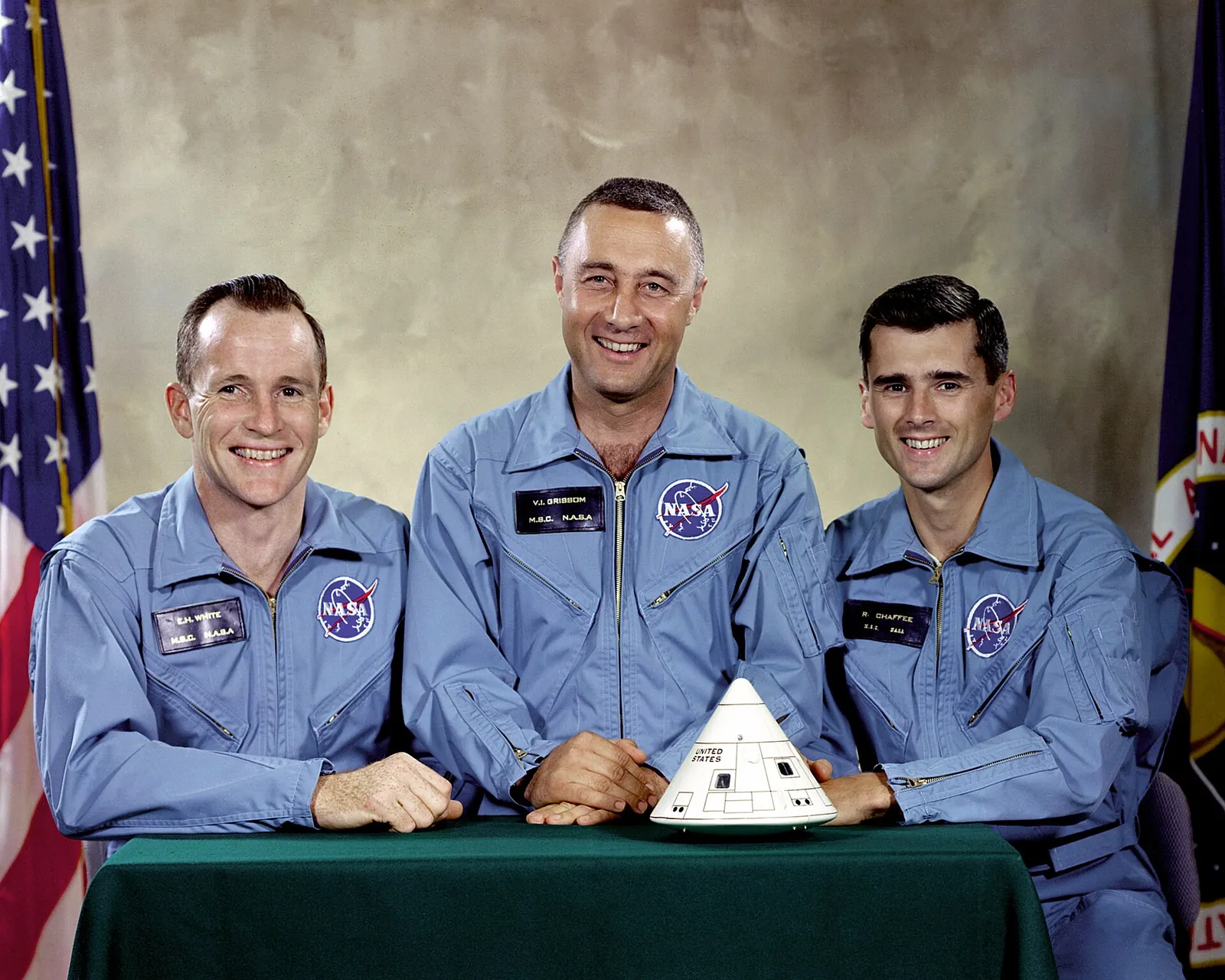
- Wikipedia: Apollo 1 (27 January 1967 fire in pure oxygen at 16.7 psi)
- MIT News: MOXIE experiment reliably produces oxygen on Mars (2022) (target 6 g/h, about a modest tree)

Sapta (Saptarshi Sarkar) is a mechanical engineer turned marketer in Bengaluru and a solo touring rider. He writes the seven Saptaverse blogs. Work with him or read more of Foodblog.


