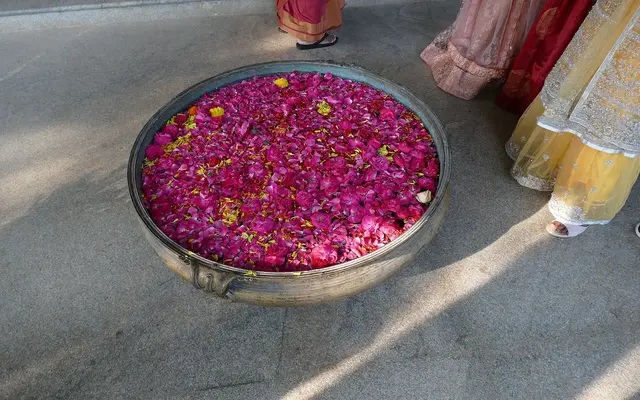
If every Indian wedding of the year happened on one day, about 1 crore weddings would compete for 1.4 billion guests, so the average wedding could have at most 138 guests, because nobody can be in two places at once. The night would need roughly 300 GW of lighting and sound, more than India's record peak demand of 270.82 GW, so most of it would run on diesel generators burning about 1.6 days of the country's diesel. Roads would carry a baraat on every sixth kilometre of the network.
- 80 lakh to 1 crore weddings a year in India, by Jefferies' 2024 estimate.
- 138 guests is the hard ceiling on the average wedding if all happen at once, by the pigeonhole principle.
- 300 GW of wedding load at 30 kW a venue, above India's 270.82 GW record peak.
- 1.6 days of national diesel burned by gensets in one six-hour night.
- A walking baraat cuts a lane to 23% of its capacity.
Indian weddings already bunch up. The Confederation of All India Traders (CAIT) estimated 46 lakh weddings in the 45 days from 1 November to 14 December 2025, an average of about one lakh a day, with far bigger peaks on auspicious muhurat dates.
This post takes that clustering to its logical end: one muhurat, one evening, every wedding. The working is below, with each assumption marked.
How many weddings does India have in a year?
India has about 80 lakh to 1 crore weddings a year, according to a 2024 Jefferies report, which made it the largest wedding market in the world by count. I use 1 crore as the round, upper figure.
What one crowded muhurat already looks like
12 November 2024 was Dev Uthani Ekadashi, the day Vishnu is said to wake after four months of Chaturmas, and the first auspicious date of the winter season. It is an abhuj muhurat, so families need no pandit to fix the hour. Wedding-industry experts expected about 48,000 weddings in the National Capital Region on that one date. Virender Chawla of Chawla Band had 40 bookings across Delhi. Manoj Sindhi, who rents out wedding horses from Karol Bagh, had about 30 bookings for a ghodi in Delhi alone, plus calls from Noida, Ghaziabad and Gurugram, and his band artists were split into morning, afternoon and evening shifts.
India TV (citing Hindustan Times): 50,000 marriages on November 12 in Delhi-NCR? Here's the reason behind this wedding rush (November 2024)That is one region and one date. Now multiply the region by the country and the date by the whole year.
The money
Jefferies put the industry at about $130 billion (roughly ₹10 lakh crore) a year, second only to food and grocery in Indian retail, with an average spend of about ₹12 lakh per wedding. CAIT's season survey across 75 cities is the other main source. It counts 32 lakh weddings in the 2022 season, 38 lakh in 2023, 48 lakh in 2024 and an estimated 46 lakh in 2025, with spending rising from ₹3.75 lakh crore to ₹6.5 lakh crore.
See the data as a table
| Weddings (lakh) | |
|---|---|
| 2022 | 32 |
| 2023 | 38 |
| 2024 | 48 |
| 2025 | 46 |
Source: Confederation of All India Traders (CAIT) season reports · Trade-body survey estimates, not a census.
CAIT's 2025 split of where the money goes is the best guide to what one wedding day would consume. Jewellery is the largest single line at 15%, followed by apparel and catering at 10% each.
| Category (CAIT 2025) | Share of spend | Per wedding at CAIT averages | For 1 crore weddings |
|---|---|---|---|
| Jewellery | 15% | ₹2.12 lakh | ₹2.12 lakh crore |
| Apparel and sarees | 10% | ₹1.41 lakh | ₹1.41 lakh crore |
| Catering | 10% | ₹1.41 lakh | ₹1.41 lakh crore |
| Event management | 5% | ₹70,700 | ₹70,700 crore |
| Light and sound | 3% | ₹42,400 | ₹42,400 crore |
| Photography and video | 2% | ₹28,300 | ₹28,300 crore |
The per-wedding column divides ₹6.5 lakh crore by 46 lakh weddings, which gives ₹14.1 lakh each, close to Jefferies' ₹12 lakh. Multiply by 1 crore and a single wedding day moves about ₹14 lakh crore, more than the Jefferies estimate for a whole year, because CAIT's season weddings skew to bigger cities.
How many guests could each wedding have?
Each wedding could have at most 138 guests on average, and that is a hard mathematical ceiling, not a budget. It follows from the pigeonhole principle: if you put more pigeons than holes, some hole must hold two, and here no guest can be in two halls at once.
Let \(N\) be the population and \(W\) the number of weddings. Each wedding uses two people as the couple. If every other person attends exactly one wedding, the average guest count is
That counts every infant, every patient in hospital and every soldier on duty as a guest, so the practical figure is lower.
Compare that with the guest numbers people quote for Indian weddings, often several hundred, and you see the first casualty of the one-day plan: the big fat wedding becomes a medium-sized one by arithmetic. The distribution would also be lopsided. A family that invites 1,000 people forces several other weddings down toward a few dozen.
There is a social cost the formula hides. Bloch, Rao and Desai showed that wedding size in rural India works as a signal of status; when everyone weds the same night, the signal stops working, because a small wedding no longer says anything about the family.

The authors built a status-signalling model in which the size of the celebration tells the village about the quality of the groom's family. They tested it with survey data from rural Karnataka, randomly choosing seven villages per district and 20 households per village, and used village exogamy (brides marrying outside their village, where less is known about the groom) as a natural experiment. Celebrations were larger when the groom came from another village, consistent with signalling; they report celebration spending of about a third of annual income, on top of dowries averaging around six times annual income. The limit: a 1990s sample from one state.
Read the working paper (free)Could the power grid light a crore weddings at once?
No. At 30 kW per venue (my estimate for lights, sound, catering and fans), a crore weddings draw 300 GW, more than India's all-time peak demand of 270.82 GW, and they would draw it in the evening when the grid is already busy.
- Load per wedding. Assume \(P_w = 30\) kW. A small home function may use 10 kW; a large lawn with LED walls and a DJ can pass 100 kW. This is my estimate, tested below.
- Coincident load. Normally, a utility applies a diversity factor because loads do not peak together. A single muhurat removes the diversity: \( P = W P_w = 10^{7} \times 30\ \text{kW} = 300\ \text{GW} \).
- Against the grid. India's record is 270.82 GW, set on 21 May 2026 with air-conditioners running. The wedding load alone is 1.1 times that, before homes, factories and trains.
The only way through is the way Indian weddings already work: the generator. Diesel gensets turn fuel into electricity at roughly 0.27 litres per kWh at good load (my working figure, typical of mid-sized sets). For a six-hour function:
That is 48.6 crore litres, or about 4.06 lakh tonnes at 0.835 kg per litre. India consumed 91.4 million tonnes of diesel in 2024-25, about 2.5 lakh tonnes a day, so one wedding night burns about 1.6 days of national diesel. Pumps in every wedding district would run dry the evening before.

Your one-day wedding
What would a crore baraats do to the roads?
A crore baraats of 100 metres each would cover 10 lakh km of road, about 16% of India's 63 lakh km network, and every lane they occupy would carry under a quarter of its normal traffic. Traffic engineers can work this out with the Greenshields model, the oldest description of how speed, density and flow trade off on a road.
Greenshields assumed speed falls linearly as cars crowd together. With free-flow speed \(v_f\) and jam density \(k_j\), speed is \( v = v_f (1 - k/k_j) \) and flow (vehicles per hour) is
- Normal capacity. Take \(v_f = 50\) km/h and \(k_j = 150\) PCU per km per lane (my estimates for an urban road). Then \( q_{max} = 50 \times 150 / 4 = 1{,}875 \) PCU per hour per lane, inside the 1,482–2,105 range that Dhamaniya and Chandra measured on Indian urban arterials.
- Behind a baraat. The procession walks at about 3 km/h, so traffic behind it is forced to \(v = 3\). Solving for density: \( k = k_j(1 - v/v_f) = 150 \times 0.94 = 141 \) PCU/km.
- Flow left. \( q = 141 \times 3 = 423 \) PCU per hour, 23% of capacity.
- Network share. \( 10^{7} \times 0.1\ \text{km} = 10^{6}\ \text{km} \), or about 16% of the 63 lakh km network, concentrated, of course, on city roads where weddings happen.
In practice the share in cities would be far higher than 16%, because village roads would be quiet and urban arterials would hold several processions per kilometre. Every arterial in a big city would run at walking pace for the length of the procession window.
The authors collected speed-flow data at 12 midblock sections of four-lane and six-lane divided arterials in four Indian metropolitan cities, with mixed traffic converted to passenger car units. Lane capacity ranged from 1,482 to 2,105 PCU per hour and was strongly related to operating speed; they fitted a second-degree polynomial between capacity and speed and validated it at two new sections within 0.10% error. The limit: midblock sections, not junctions, which are usually the real bottleneck.
Read the paper (free)
How much food and gold would one day take?
One wedding day would serve about 8.4 lakh tonnes of food and, at CAIT's spending pattern, buy roughly 142 tonnes of gold, a quarter of India's 2024 jewellery demand, in a single day of purchases.
The food
Food first. If every one of 1.4 billion people eats one wedding plate of 600 g of cooked food (my estimate), that is \( 1.4\times10^{9} \times 0.6 = 8.4\times10^{8} \) kg. If each plate holds 100 g of raw rice, the rice alone is 1.4 lakh tonnes.
The real constraint is not grain but cooks, vessels and gas, the same burner-power problem that sinks the national chai minute: cooking a lakh tonnes of rice needs it all on the fire at once.
The gold
Gold next. CAIT's jewellery share works out to ₹2.12 lakh per wedding, so a crore weddings spend about ₹2.12 lakh crore. At the IBJA benchmark of ₹1,49,614 per 10 g for 999 gold on 9 October 2026:
This is an upper bound on metal, because part of every jewellery bill is making charges and GST. India's jewellery demand was 563.4 tonnes in all of 2024, according to the World Gold Council, so one day would take 25% of a year's jewellery gold.
Jewellers would need to make it in advance, and the import pipeline would have to fill vaults weeks ahead.
The money is affordable; the counter space is not.The working of this post
How sensitive is the answer?
The guest cap and the grid failure survive every reasonable change in the assumptions; the diesel figure is the softest number and scales directly with load per venue.
| Change | Result |
|---|---|
| 80 lakh weddings instead of 1 crore | Guest cap rises to 173; load 240 GW, still 89% of the record peak |
| 10 kW per venue (small home functions) | Load 100 GW; diesel 0.54 days of national supply |
| 100 kW per venue (big lawns) | Load 1,000 GW; diesel 5.4 days |
| Baraat 50 m instead of 100 m | 8% of the road network occupied |
| Population 1.46 billion | Guest cap 144 |
The model breaks in two places:
- Identical venues: it treats each venue's load as the same, while real weddings range from a home pooja to a five-star ballroom.
- One-day functions: many Indian weddings run over several days; a one-day rule would compress haldi, mehendi and sangeet into the same evening, which raises the load further.
A crore weddings on one day can happen only if they shrink and go off-grid. The pigeonhole principle caps the average guest list at 138; the 300 GW load is 1.1 times India's 270.82 GW record, so it must run on gensets burning about 1.6 days of national diesel; and baraats would cut traffic on every lane they use to 23% of capacity. Spread the same weddings over ten auspicious days, as the calendar already does, and every number falls back inside what India can supply.
For the economics behind the spending, read why Indian weddings cost what they do and why Indian households hold so much gold, with the season's buying guide in how to buy gold at Dhanteras. The traffic numbers connect to Bengaluru's congestion data.
What's new
- CAIT expects 46 lakh weddings and ₹6.5 lakh crore of business in the 2025 season CAIT, Nov 2025
- Where couples are spending most this wedding season: décor, hospitality and taxes EVENTFAQS, Nov 2025
- India's peak power demand hits a record 270.82 GW WION, May 2026
- IBJA benchmark puts 999 gold near ₹1.5 lakh per 10 g 5paisa, Oct 2026
What if next?
- What if a head wobble could generate electricity? A crore wedding guests nodding along would light surprisingly little.
- What if a cricket ball were bowled at the speed of sound? It hits like a rifle round and arrives before the batter has seen it leave.
- What if every Indian train were coupled into one? It would be about as long as the Earth's radius, and the brakes would take hours to reach the back.
Questions people ask
How many weddings happen in India every year?
About 80 lakh to 1 crore, according to Jefferies' 2024 estimate. CAIT counts 46 lakh in the November–December 2025 season alone, which is roughly one lakh a day.
How much does an average Indian wedding cost?
Jefferies estimates about ₹12 lakh on average. CAIT's 2025 season figures work out to about ₹14.1 lakh, with jewellery the largest single share at 15%.
Why are so many Indian weddings on the same dates?
Families pick auspicious muhurat dates from the calendar, and CAIT's season survey shows how concentrated they are: 46 lakh weddings in the 45 days from 1 November to 14 December 2025. That clustering is why venues, caterers and roads are overloaded on a handful of nights.
How much gold do Indians buy for weddings?
No official bridal-only figure exists. India's total jewellery demand was 563.4 tonnes in 2024 (World Gold Council), and CAIT puts jewellery at 15% of wedding-season spending.
Sources
- CAIT: Wedding season 2025 to generate ₹6.5 lakh crore from 46 lakh weddings (2025). Source for season counts, spending and category shares.
- India TV: 50,000 marriages on November 12 in Delhi-NCR? (2024). Source for the story: Dev Uthani Ekadashi, about 48,000 NCR weddings, and the band and ghodi bookings.
- The Week: Weddings now a $130 billion industry (Jefferies) (2024). Source for 8–10 million weddings a year and ₹12 lakh average.
- Bloch F., Rao V., Desai S.: Wedding celebrations as signals of social status in rural South India (working paper of the Journal of Human Resources article) (2002, 2004)
- Dhamaniya A., Chandra S.: Influence of operating speed on capacity of urban arterial midblock sections, International Journal of Civil Engineering (2017). Source for 1,482–2,105 PCU/h lane capacity.
- WION: India's peak power demand hits record for fourth straight day (2026). Source for 270.82 GW.
- Outlook Business: Diesel demand growth falls to lowest since pandemic (PPAC data) (2025). Source for 91.4 Mt diesel in 2024-25.
- PRS Legislative Research: Demand for Grants 2023-24 analysis, Road Transport and Highways (2023). Source for the 63 lakh km road network in 2021-22.
- ThePrint (PTI): Gold demand in India rises to 802.8 tonnes in 2024, WGC (2025). Source for 563.4 t jewellery demand.
- 5paisa: Gold rate benchmark, October 2026 (2026). Source for the ₹1,49,614 per 10 g IBJA price.
- EVENTFAQS: India's wedding economy hits new high (2025)

Sapta (Saptarshi Sarkar) is a mechanical engineer turned marketer in Bengaluru and a solo touring rider. He writes the seven Saptaverse blogs. Work with him or read more of Whyblog.