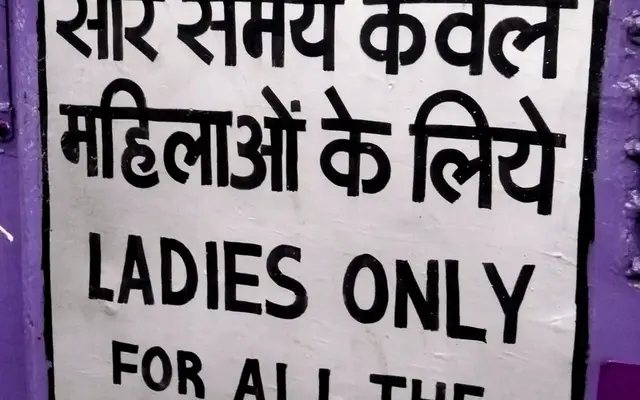
Most staring at foreigners in India is curiosity: in a crowded country where looking at strangers is not considered rude, a visitor who looks different draws long, open looks, and often requests for photos. Staring alone is not a crime in India. It becomes one when it turns into following or repeated contact after you have shown you are not interested (stalking, BNS Section 78, old IPC 354D), words or gestures meant to insult a woman (BNS 79, old IPC 509), or touching (BNS 74, old IPC 354), and for any of those you can call 112.
- Staring is legal; following after a clear "no" is stalking, up to 3 years in jail (5 for a repeat).
- India recorded 83,891 cases of assault to outrage a woman's modesty in 2023, a rate of 12.4 per lakh women (NCRB).
- In a 2025 survey of 12,770 women in 31 cities, 4 in 10 said they felt unsafe; only 1 in 3 who were harassed complained.
- Cross-cultural research finds that how long a gaze feels "normal" varies by culture, which is part of why visitors read Indian stares as hostile.
- The fastest help: 112 (all emergencies), 1091 (women), 1363 (tourists).
Visitors lump three different things together: the curious stare, the photo request, and harassment. Indians who have never lived abroad are often surprised that the first two upset anyone. Separating them is the whole point of this guide, because the right response to each is different.
Why do Indians stare at foreigners?
Indians stare at foreigners mainly because looking at strangers is socially acceptable in India and a foreign face is unusual in most of the country. There is no social rule, as there is in much of northern Europe or North America, that a look held for more than a second or two is a challenge or a come-on.
- Novelty: most Indians, especially outside big tourist cities, rarely see foreigners in person.
- Crowding: in dense streets and trains, people are always in each other's sight lines, so looking is not treated as intrusion.
- Different gaze norms: eye contact rules are learned, and they differ across cultures (see the research below).
- Colour and status: commentators have linked the fascination with fair-skinned foreigners to India's colourism; this is debated and not well measured.
The photo request is the same curiosity with a phone. In November 2025 a foreign woman's viral video said she had been asked for photos about 25 times in an hour; Indian replies split between finding it affectionate and agreeing it can cross into discomfort.
Researchers showed live faces with direct or averted gaze to 20 Finnish and 20 Japanese students and measured heart rate and ratings. Bodies reacted the same way: direct gaze slowed heart rate more than averted gaze in both groups. But judgements differed: Japanese participants rated the same direct gaze as angrier and less approachable than Finns did (approachability 0.60 for Finns vs −1.85 for Japanese). The authors read this as culture shaping how a look is interpreted, not how it is felt. The limit: 40 students, two countries, no Indian sample, so it supports the idea of gaze norms, not any claim about India specifically.
Read the paper (free)
Is staring illegal in India?
No. Looking at someone, even for a long time, is not an offence in Indian law. What the law punishes is conduct with an intent or effect: following, contact after refusal, insulting words or gestures, and touching.
| Behaviour | Legal status | Section (BNS 2023 / old IPC) | Maximum penalty |
|---|---|---|---|
| Staring, taking interest | Not an offence | None | None |
| Asking for a photo, once | Not an offence | None | None |
| Words, sounds, gestures or objects meant to insult a woman's modesty | Offence (cognizable) | BNS 79 / IPC 509 | 3 years simple imprisonment and fine |
| Following or contacting a woman repeatedly despite clear disinterest, or monitoring her online | Offence (cognizable) | BNS 78 / IPC 354D | 3 years and fine; 5 years on repeat conviction |
| Assault or force intending to outrage modesty | Offence (cognizable, non-bailable) | BNS 74 / IPC 354 | 1 to 5 years and fine |
Two details matter for visitors. The stalking section needs "a clear indication of disinterest", so saying no clearly, out loud, matters. And these three sections are written to protect women. This is general information, not legal advice.
How common is harassment in public in India?
Very common, for Indian women as much as for visitors. ActionAid's 2016 survey found 79% of women in Indian cities had faced harassment in public at some point, a level similar to Brazil (86%) and Thailand (86%), as summarised in a 2024 World Bank review.
A journalist writing for Outlook Traveller in 2025 described a night on the Delhi Metro around 9 pm. The coach was nearly empty. A man stood close and kept pressing her to give him her number. She tried to deflect, decided the safest move was to leave, got off five stops early and took a cab home. That was not the end: he found ways to keep calling her from different numbers for nearly eight months. She told the story to introduce the National Commission for Women's NARI 2025 survey, which found that only one in three harassed women files a complaint. Her experience moves up the legal ladder in a few minutes, from unwanted attention on a train to repeated contact that is stalking.
Outlook Traveller: Can women travel safely in India? New report reveals city rankings (2025)Official numbers are lower than survey numbers because NCRB counts registered cases only. In 2023, police registered 4,48,211 crimes against women, a rate of 66.2 per lakh women.
See the data as a table
| Rate per lakh women (per lakh) | |
|---|---|
| All crimes against women | 66.2 |
| Cruelty by husband or relatives (498A) | 19.7 |
| Assault to outrage modesty (354 / BNS 74) | 12.4 |
| Rape | 4.4 |
| Insult to modesty (509 / BNS 79) | 1.3 |
Source: NCRB Crime in India 2023, via The Week (PTI), Sept 2025 · Registered cases only. Under-reporting is large, so a low rate does not mean low risk.
- 83,891 cases of assault to outrage modesty (IPC 354) and 8,823 of insulting a woman's modesty (IPC 509) were registered in 2023.
- Among metro cities, Indore had the highest registered stalking rate in 2022: 8.7 per lakh population (90 cases). A high rate can also mean better reporting.
- The NARI 2025 survey of 12,770 women in 31 cities found verbal harassment was the most common form (58%), and the main hotspots were neighbourhoods (38%) and public transport (29%).
A World Bank economist's review of the evidence on women's travel in low- and middle-income countries. It classes harassment as verbal, visual (leering or staring) and physical, and reports that 79% of women in India have faced public harassment (ActionAid 2016). Citing her own Delhi study, it finds 72% of women college students avoid areas they see as unsafe, 67% avoid going out after dark, and only 4% take no avoiding action. In Delhi, women are 33% of metro riders and one coach in eight is reserved for them. The limit: it is a review that pulls together studies with different definitions, so figures are not directly comparable.
Read the paper (free)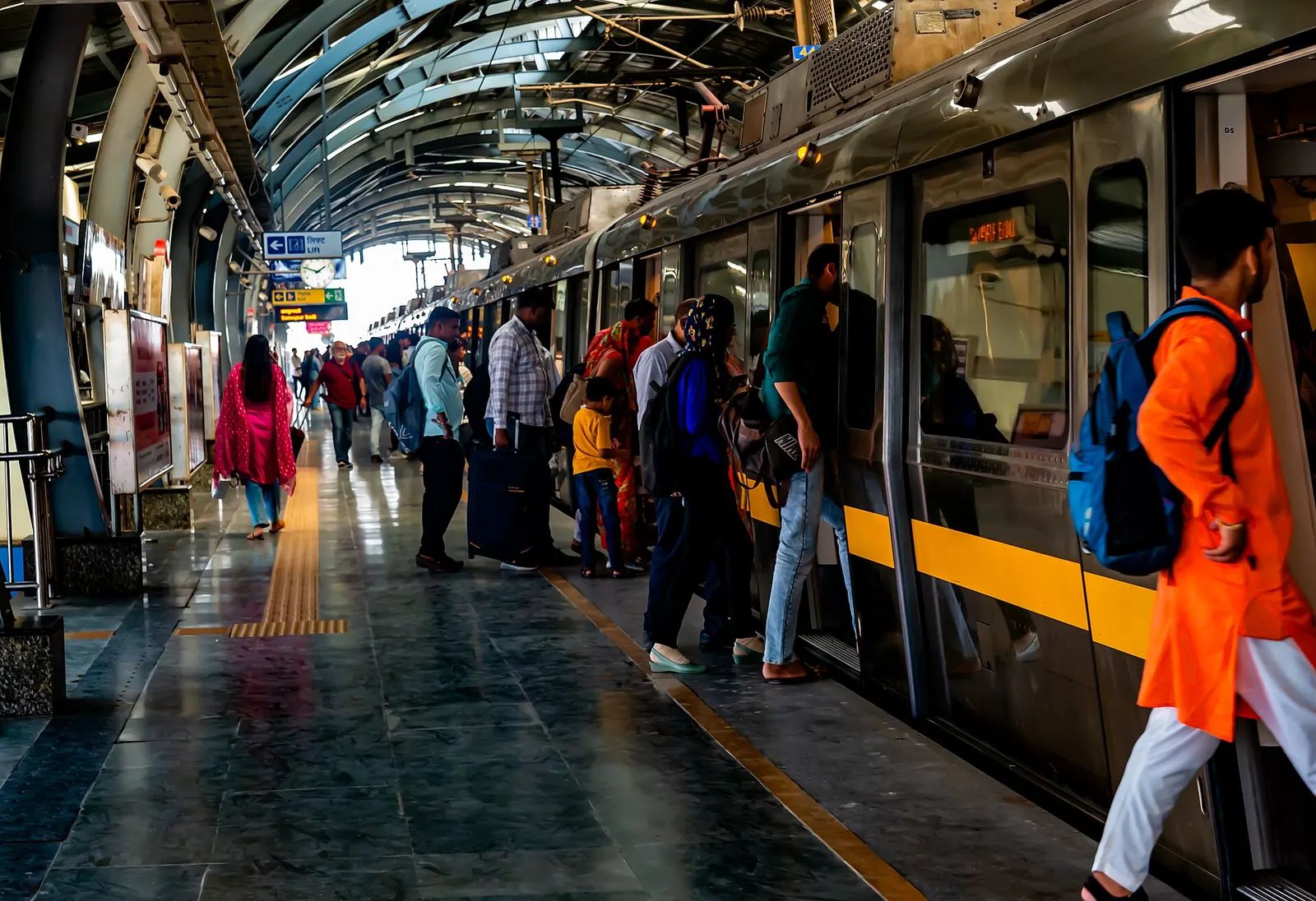
A stare is a question about you. Following is a decision about you. Only the second is a crime.Sapta, on the legal ladder above
When does staring become a warning sign?
Curious staring is static and open: people look, sometimes smile or ask where you are from, and go back to what they were doing. Watch for these shifts instead.
- Movement: the same person appears again on the next street, or gets off at your stop.
- Closing distance: standing close in an empty space, as in the Metro story above.
- Persistence after "no": continued attempts to talk, take photos or get your number.
- Group behaviour: comments and laughter aimed at you, or a group surrounding you.
- Isolation: it is late, the place is emptying, and the attention continues. NARI 2025 found women's sense of safety drops sharply after dark.
What should you do if someone is following you in India?
Move towards people and authority, make it visible, and call for help early. Borker's Delhi data show most women already avoid risk; the steps below add the reporting that only one in three currently does.
- Go where people are. A shop, a hotel lobby, a petrol pump, a ticket counter or a Metro station with security.
- Say it loudly. "Stop following me" in English is understood almost everywhere. Making it public puts pressure on the person and alerts people around you.
- Call 112. It is India's single emergency number. For women's helplines, use 1091 or 181; for tourist help in 12 languages, 1363.
- Use women-only spaces. One coach in eight on the Delhi Metro is reserved for women.
- Record details safely. Time, place, a description, and a photo only if it is safe to take one.
- Report it. Stalking and BNS 79 offences are cognizable, which means police can act without a magistrate's order. The Supreme Court in 2012 ordered states to post plain-clothes women police at bus stands, stations, metros, malls, parks, beaches and temples, and to set up women's helplines.
For more on the law and the data: why India calls street harassment eve-teasing, the outraging-modesty law, harassment on buses and trains, why strangers ask foreigners for selfies and India's emergency numbers. Riders heading out alone can also read the solo touring safety plan.
What's new
- NCRB: 4,48,211 crimes against women registered in 2023, rate 66.2 per lakh The Week (PTI), Sept 2025
- NARI 2025: 4 in 10 urban women feel unsafe; Kohima and Visakhapatnam rank safest Outlook Traveller, 2025
- A visitor's viral post on 25 photo requests in an hour sparks a curiosity-versus-colour debate Business Today, Nov 2025
- Why safe transport for women still lags in Delhi Behanbox, Feb 2025
Questions people ask
Why do Indian men stare so much?
Mostly because looking at strangers is not considered rude in India, and a foreign or unfamiliar face is a novelty. Some staring is harassment, and women of every nationality report it, but a long look by itself is usually curiosity.
Is staring illegal in India?
No. It becomes illegal when it turns into following after a clear no (BNS 78), insulting words or gestures (BNS 79) or touching (BNS 74).
Someone is following me in India, what should I do?
Go into a busy, staffed place, say loudly that you are being followed, and call 112. Do not lead the person to where you are staying. Report it: stalking is a cognizable offence.
Is it rude to refuse a selfie in India?
No. A polite, firm "no, thank you" is accepted by most people. If someone keeps insisting or tries to take photos anyway, move away towards staff or a crowd.
Which Indian cities feel safest for women?
In the NARI 2025 perception survey, Kohima, Visakhapatnam, Bhubaneswar, Aizawl, Gangtok, Itanagar and Mumbai ranked safest, and Patna, Jaipur, Faridabad, Delhi, Kolkata, Srinagar and Ranchi lowest. It measures how safe women feel, not crime rates.
Sources
- Akechi H. et al.: Attention to Eye Contact in the West and East, PLOS ONE (2013)
- Borker G.: Understanding the constraints to women's use of urban public transport in developing countries, World Development (2024)
- The Week (PTI): NCRB data on crimes against women, 2023 (2025)
- Free Press Journal: Indore tops metro stalking rate in NCRB 2022 (2023)
- Outlook Traveller: Can women travel safely in India? (NARI 2025) (2025)
- Bharatiya Nyaya Sanhita 2023, Section 78: stalking
- Bharatiya Nyaya Sanhita 2023, Section 79: word, gesture or act to insult modesty
- Bharatiya Nyaya Sanhita 2023, Section 74: assault to outrage modesty
- LawWeb: Supreme Court directions to curb eve-teasing (30 Nov 2012) (2012)
- Business Today: Viral post on photo requests in India (2025)
- Behanbox: Navigating Delhi, why safe and inclusive transport matters (2025)
- Business Standard (IANS): 1363 tourist infoline in 12 languages (2016)

Sapta (Saptarshi Sarkar) is a mechanical engineer turned marketer in Bengaluru and a solo touring rider. He writes the seven Saptaverse blogs. Work with him or read more of Whyblog.