An RS200 41-tooth rear sprocket fits the Pulsar NS200 with the stock 14-tooth front and a 520 O-ring chain, and Rolon sells it as a kit with a 110-link chain. What it does to your gearing depends on the rear you started with: from a 39T it raises rpm at any speed by about 5%, from a 40T by 2.5%, and from a 43T it lowers rpm by about 4.7%. I fitted the RS200 41T with a Rolon brass chain kit on my 2017 NS200 at about 39,000 to 40,000 km.
- Rolon's RS200 kit: 14T front, 41T rear, 110 links of 520 O-ring chain.
- Retail listings show the 2012–2015 NS200 kit as 14/39 on 108 links, so count your own teeth first.
- Each rear tooth on a 40-tooth sprocket changes gearing by about 2.5%.
- A 140/70-17 rear tyre in place of the stock 130/70-17 cuts rpm by about 2.2% at the same speed.
- Chains start skipping teeth at about 3% elongation; replace well before that.
This is a guide built around one owner's fit: mine. The kit specs come from Rolon part listings, the gearing from arithmetic you can check, and the wear science from two papers. Where I give a number about my own bike, it comes from my service records.
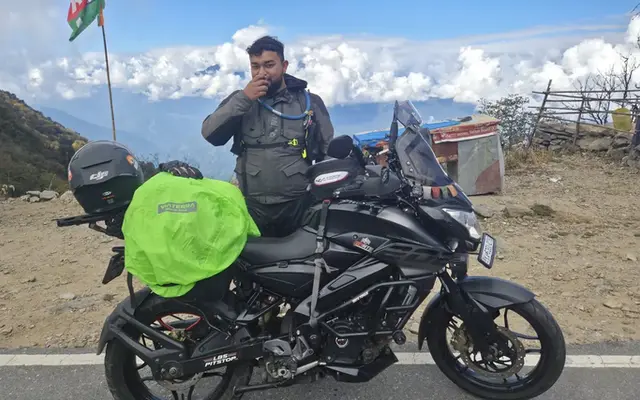
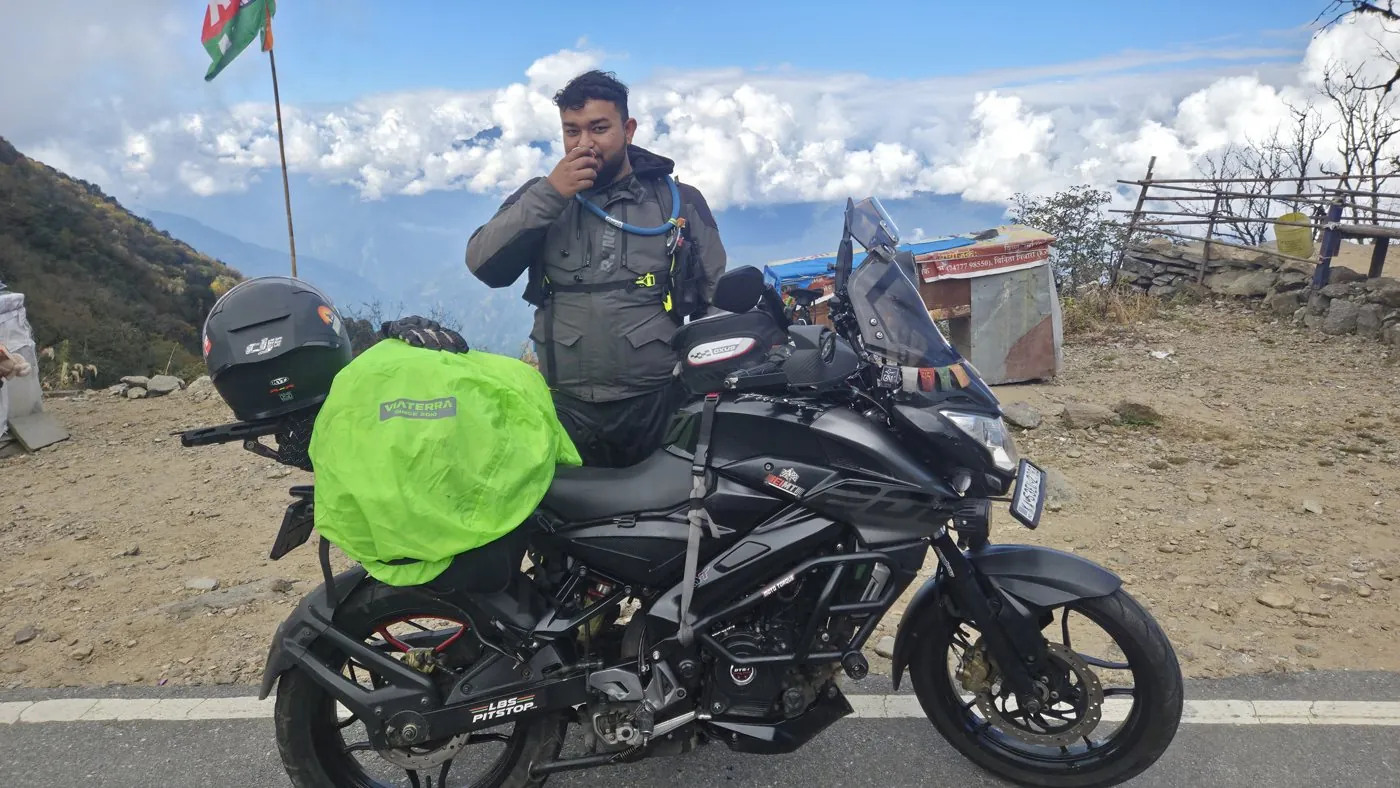
My NS200 was delivered around 14 November 2017 as a stock city naked. Over the next years it became an upright luggage tourer with several 800–1,000 km days behind it. Somewhere around 39,000 to 40,000 km, the drive was renewed in one go: a Rolon brass chain kit with the 41-tooth rear sprocket from the Pulsar RS200, Bajaj's faired sibling. The bike has since done around 70,000 km, including Bengaluru to Sikkim and back in November 2025, and has never needed a tow on tour.
Sapta: everything I changed on my 2017 Pulsar NS200What is in the Rolon chain kit for an NS200 or RS200?
A Rolon kit is a chain plus both sprockets, sold as a matched set. Rolon is the replacement brand of L.G. Balakrishnan & Bros, which ICRA says holds over 60% of India's two-wheeler chain market. Here is what the listings I checked say:
| Kit | For | Front | Rear | Chain |
|---|---|---|---|---|
| Rolon HPOR-281NF | Pulsar RS200 | 14T, rubber-damped | 41T (part S 02 617) | R520 O-ring, 110 links |
| Rolon BSOR183 | NS200 / AS200, Apr 2012 to Aug 2015 | 14T | 39T | 520 sealed, 108 links |
| My NS200 (2017) | As fitted | 14T | 41T, RS200 | Rolon brass kit |
The listings I read don't explain the word "brass" in the kit name; what they do specify is a 520 O-ring sealed chain, and that construction is what matters. The RS200 listing also warns that NS200, AS200 and RS200 share engine cases but can differ in mounting holes, swingarm clearance and tooth count, so match the part number to your exact model, and count the teeth on the sprocket you are taking off before you work out what the change will do.
What does a 41T rear do to an NS200's gearing?
Gearing scales with the sprocket ratio, rear teeth divided by front. With the 14-tooth front kept, the change in rpm at any road speed is simply new rear over old rear, minus one. The answer depends on the rear you started with.
- From 39T: 41 ÷ 39 = 1.051, so about 5.1% more rpm at any speed and 5.1% more pull at the wheel.
- From 40T: 41 ÷ 40 = 1.025, about 2.5% more.
- From 41T: no change in gearing; only the part source changes.
- From 43T: 41 ÷ 43 = 0.953, about 4.7% fewer rpm, a taller cruise.
Tyres move the same number. Bajaj lists a 130/70-17 rear for the NS200; my bike now runs a 140/70 ZR17 (fitted May 2026). The nominal diameters are 613.8 mm and 627.8 mm, so the bigger tyre turns about 2.2% fewer times per kilometre, and the engine with it.
See the data as a table
| Sprocket only (%) | Plus 140/70 rear tyre (%) | |
|---|---|---|
| From 39T | 5.1 | 2.8 |
| From 40T | 2.5 | 0.2 |
| From 41T | 0 | -2.2 |
| From 42T | -2.4 | -4.6 |
| From 43T | -4.7 | -6.8 |
Source: Computed from tooth counts and nominal tyre diameters (Bajaj NS200 manual tyre size) · Positive means the engine spins faster at the same speed.
What is the rpm at 100 km/h?
Bajaj does not publish the NS200's primary and gear ratios in the owner's manual, so nobody can honestly quote an absolute figure from the spec sheet. The fix is to measure: hold 100 km/h on GPS in sixth, read the tachometer, then let the arithmetic carry it to your new setup. Use this to check what you just read.
New rpm at 100 km/h after a sprocket or tyre change
xBhp's long-running World of Sprockets thread suggests keeping a gearing change on a stock bike within about 10%, which every option above meets. If you want to know what your own change did, take the tacho reading at 100 km/h before and after, on the same stretch of road.
The deeper theory, with a full gearbox worked through, is in motorcycle sprocket gearing: what changing teeth does.
Does a bigger rear sprocket wear the chain less?
A bigger sprocket bends each link through a smaller angle as it wraps on, which cuts sliding at the pin and bush. The angle per link is 360° divided by the teeth: 25.7° on a 14-tooth front, 8.8° on a 41-tooth rear. That is why the small front sprocket wears first.
The Bristol team tested chain drives with the same 1:4 ratio and centre distance but larger sprockets (56:14 and 64:16 against 48:12) on a precision dynamometer, at 49 operating points from 70 to 130 rpm and 20 to 150 Nm. Larger sprockets raised efficiency over a 97% baseline by roughly 0.4% to over 1%, most at low torque. They credit lower chain tension, smaller articulation angles and less polygon vibration. The limit: a two-page conference abstract on bicycle chains, so take the mechanism, not the numbers.
Read the paper (free)How do you know when the chain kit is worn out?
A chain is worn out when it has stretched: its pitch grows as the pins and bushes wear, and it no longer sits deep in the sprocket teeth. The stretch is wear, not the steel pulling longer.
The authors built a two-link wear tester, measured worn pins on a roundness tester and modelled the joint with finite elements. They note the rule of thumb that a chain starts skipping teeth at about 3% elongation, and found pins and bushes don't wear along their centreline: bending under load concentrates wear at the pin tips. The limit: a lab study on industrial roller chain, not a motorcycle O-ring chain in rain and dust.
Read the paper (free)
You can measure stretch at home. A 520 chain has a 15.875 mm (5/8 inch) pitch, so 20 pitches of new chain measure 317.5 mm, pin centre to pin centre. Pull the chain tight on the lower run and measure. Use this to check your own chain.
520 chain stretch check
How do you fit an RS200 41T kit on an NS200?
Fitting is a workshop job if you don't have an axle torque wrench and a chain tool, but the checks are the same either way.
- Count before you buy. Count teeth on your current front and rear, and read the part number stamped on the sprockets.
- Match the kit. 520 pitch, 14T front, 41T rear and the link count the kit specifies (110 for Rolon's RS200 kit).
- Check the adjuster. A bigger rear needs more chain. If the axle sits at the front end of its slots, the chain is too short.
- Set slack and alignment. Use the marks on both adjusters, then confirm by sighting along the chain.
- Torque everything. Sprocket bolts, front sprocket retainer and the rear axle, to Bajaj's figures.
- Recheck early. New chains bed in; recheck slack after the first few hundred kilometres.
Each extra rear tooth takes about half a link of chain at the same axle position, so going from 39T to 41T needs about one more link. That is consistent with the 108-link old kit and the 110-link RS200 kit, since chains come in even link counts.
How should you lubricate and clean an O-ring chain?
Bajaj's own NS200 service schedule tells owners to spray the chain with lube every 500 km, and at services to clean it with a 50:50 mix of diesel and SAE 90 oil, then lubricate with SAE 90. On an O-ring chain the grease that matters is sealed inside by rubber rings; the outside lube protects the rollers and the seals.
- Lube a warm chain after a ride, on the inside run, and wipe off the excess.
- Use products marked safe for O-ring chains; harsh solvents can attack the seals.
- After rain or a wash, dry the chain and lube it the same day.
- Check slack on a loaded tour more often than at home; luggage changes it.
The full routine, with what the lube actually does, is in how to clean, lube and adjust a motorcycle chain. Planning chain checks into a long route is part of the touring packing list.
Count the teeth before you order. Every gearing number follows from that one fact.
What's new
Questions people ask
Will an RS200 rear sprocket fit an NS200?
Mine runs one. Rolon's RS200 listing warns that NS200, AS200 and RS200 can differ in mounting holes and clearance, so check the bolt pattern and part number against your bike before buying.
Does a bigger rear sprocket reduce top speed?
It shortens every gear by the same percentage, so the gearing-limited speed at redline falls. Whether real top speed falls depends on whether the bike was limited by gearing or by air drag in the first place.
How long does a Rolon chain kit last?
It depends on lubrication, rain, dust and load more than brand. Measure stretch with the calculator above rather than going by kilometres. Mine went on at about 39,000–40,000 km and had about 25,000 km on it by mid-2026.
Is a brass chain better than a normal chain?
The listings don't define "brass". What matters is the construction: an O-ring chain keeps grease sealed inside the joints, which a plain chain cannot.
Sources
- Kalpurze: Rolon HPOR-281NF RS200 kit (14T, 41T S 02 617, R520 O-ring, 110 links, fitment warning)
- LRL Motors: Rolon BSOR183 kit for NS200/AS200, 2012 to 2015 (14T, 39T, 108 links)
- ICRA: L.G. Balakrishnan & Bros Limited, ratings reaffirmed (2026)
- Bajaj Auto: Pulsar NS200 BS VI owner's manual (tyre sizes, chain lube every 500 km, service cleaning)
- Wragge-Morley et al.: Big Sprockets and Small-Pitch Chains, Journal of Science and Cycling (2024)
- Noguchi et al.: Evaluation of Wear between Pin and Bush in Roller Chain, JAMDSM (2009)
- DriveSpark: Updated Bajaj Pulsar NS200 launched at Rs 1.60 lakh (2026)
- xBhp forum: World of Sprockets

Sapta (Saptarshi Sarkar) is a mechanical engineer turned marketer in Bengaluru and a solo touring rider. He writes the seven Saptaverse blogs. Work with him or read more of RoadHook Machines.