
The Border Roads Organisation (BRO) was formed on 7 May 1960 to build and maintain roads in India's border areas, starting with Project Beacon in Jammu and Kashmir and Project Vartak in the Northeast. It has since built more than 60,000 km of roads, over 1,000 bridges and 19 airfields, including the Atal and Sela tunnels and the world's highest motorable road at Mig La (5,913 m). It has been fully under the Ministry of Defence since 2015, and its capital budget for 2026-27 is ₹7,394 crore.
- 7 May 1960: BRO founded, with Projects Beacon and Vartak (first called Tusker).
- 60,000+ km of roads, 1,000+ bridges and 19 airfields, by BRO's October 2025 count.
- Mig La, 5,913 m: the world's highest motorable road since October 2025, beating BRO's own Umling La.
- 22 of 61 China-border roads were done by March 2016, against a 2012 deadline (CAG, 2017).
- ₹7,394 crore: BRO's capital allocation for 2026-27, roughly double 2022-23 (₹3,500 crore).
If you have ridden anywhere above 3,000 m in India, you have ridden on a BRO road and read its signboards. Yet most riders know BRO only as a logo on a yellow board.
This post is its history in dates: how it started, how its projects are organised, where it has failed audits, and how its budget and ambition have grown since 2020.
Why was the Border Roads Organisation formed in 1960?
BRO was created on 7 May 1960 because India's northern and northeastern frontiers had almost no roads, and the Army could not supply posts it could not reach. The government set up the Border Roads Development Board (BRDB) to coordinate the work and gave it two projects from the start:
- Beacon in Jammu and Kashmir;
- Vartak (first called Project Tusker) in what is now Arunachal Pradesh.
Project Udayak was also raised in May 1960.
The 1962 shadow
The timing tells its own story. BRO was barely two years old when the 1962 war with China was fought along the same frontiers it had been set up to connect.
Much of its later history, from the China border road programme to the tunnels of the 2020s, is about connecting those frontiers properly.
An odd organisation by design
Its parent cadre is its own, the Border Roads Engineering Service and the General Reserve Engineer Force (GREF), yet its executive head, the Director General Border Roads, is an Army lieutenant general. Its motto is Shramena Sarvam Sadhyam, roughly, everything is possible through hard work.
BRO's least likely road is not in India at all. From 2005, more than 300 of its engineers and technicians, guarded by 70 ITBP personnel, designed and built a highway in south-western Afghanistan from Delaram to Zaranj. It ran 218 km, and paving it cost US$152 million.
It was also paid for in lives. Insurgent attacks killed 135 people working on the road: 129 Afghans and six Indians, two of them BRO employees and four ITBP personnel. President Hamid Karzai opened it on 22 January 2009. The trip between Delaram and Zaranj fell from 12 to 14 hours to about two, and landlocked Afghanistan gained a route to the sea through Zabol and Iran's Chabahar port that avoids Pakistan.
Wikipedia: Route 606 (Afghanistan), the Delaram–Zaranj highway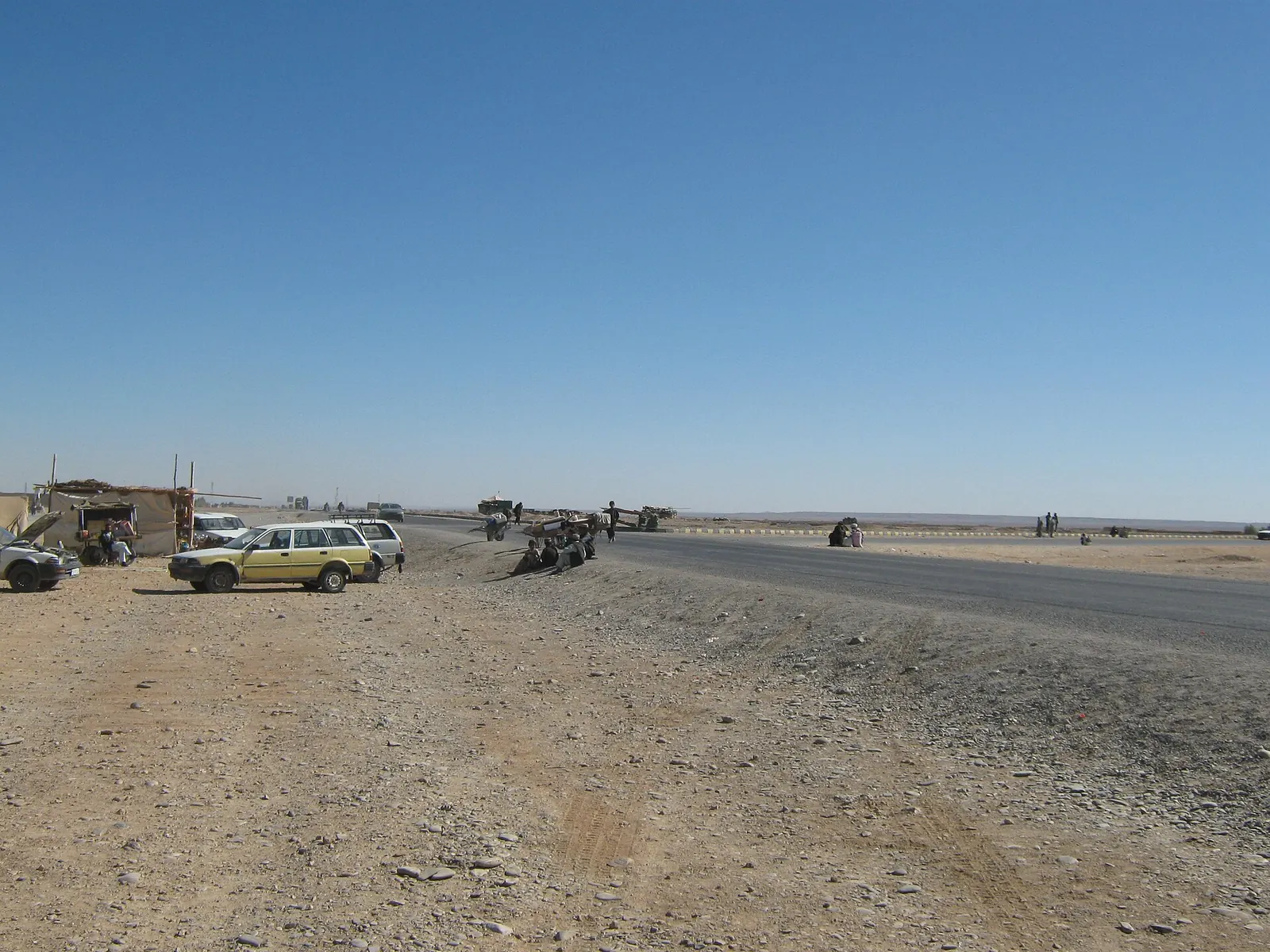
How are BRO's projects organised, and which ones matter to riders?
BRO works through named projects, each responsible for a region, and riders meet them by name on signboards. The project is the unit that builds, maintains and, in winter, clears the road. The table below lists the ones a touring rider is most likely to cross, with the dates I could confirm.
| Project | Raised | Region | What riders know it for |
|---|---|---|---|
| Beacon | 1960 | Jammu and Kashmir | BRO's first project; later split into Sampark and Himank |
| Vartak (ex-Tusker) | 1960 | Arunachal Pradesh | Tawang road and the Sela tunnel |
| Udayak | May 1960 | Not confirmed | One of the three founding projects |
| Chetak | 1962 | Rajasthan (Bikaner) | Western desert border roads |
| Himank | 4 Dec 1985 | Eastern Ladakh (Leh) | Khardung La, Umling La, Mig La, Sarchu to Leh |
| Setuk | 1990 | Shillong | Bridge construction |
| Swastik | Revived 2008 | Sikkim | Sikkim's border roads |
| Vijayak | 2010 | Ladakh (Kargil) | Zoji La snow clearance; over 1,400 km of roads, 80 bridges |
| Deepak | Not confirmed | Himachal Pradesh | Manali to Sarchu on the Manali-Leh highway |
| Yojak | 2022 | Himachal-Ladakh axis | Tunnels and roads on the Manali-Ladakh axis |
| Dantak | Not confirmed | Bhutan | BRO's road work inside Bhutan |
Why are BRO's road signs famous?
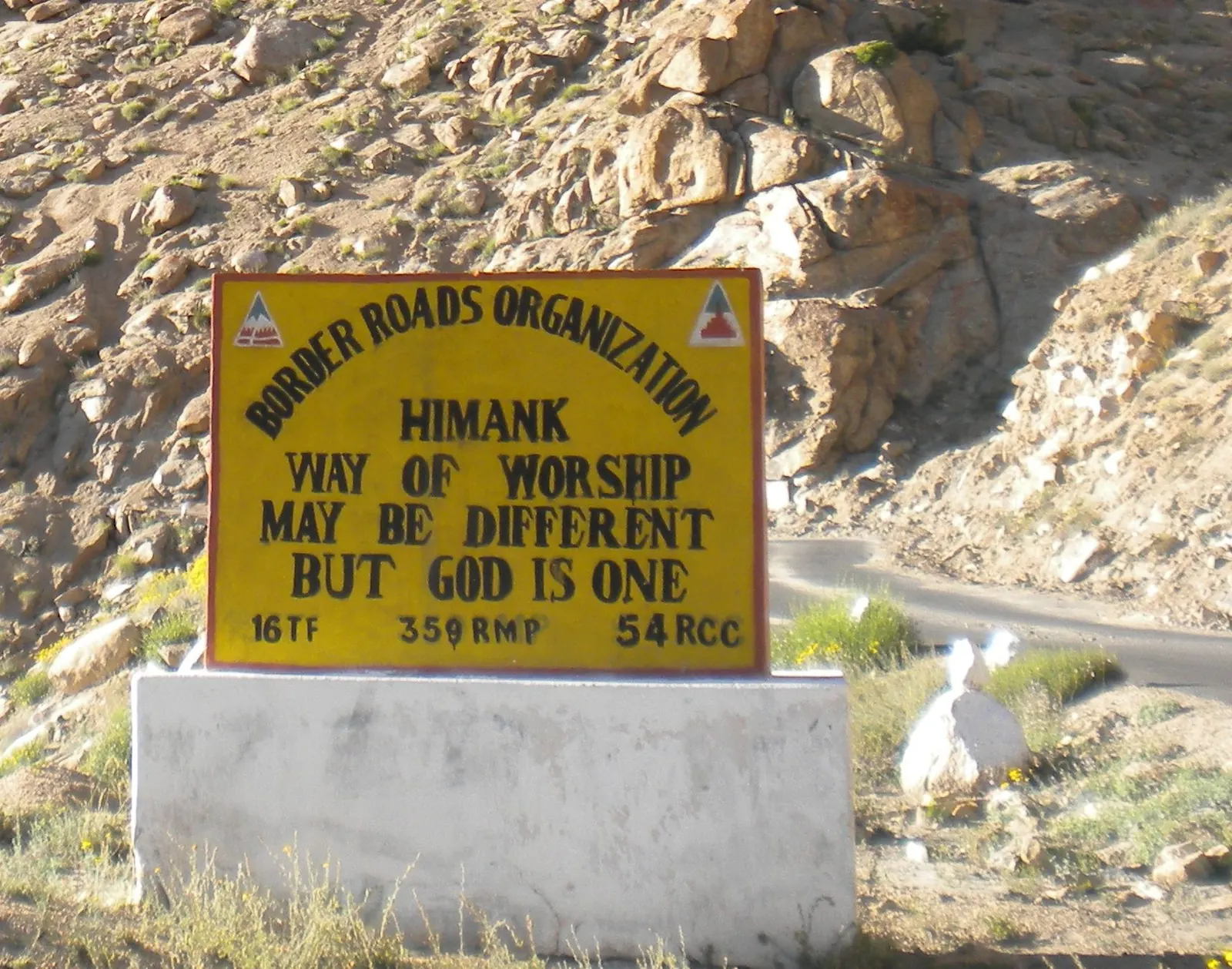
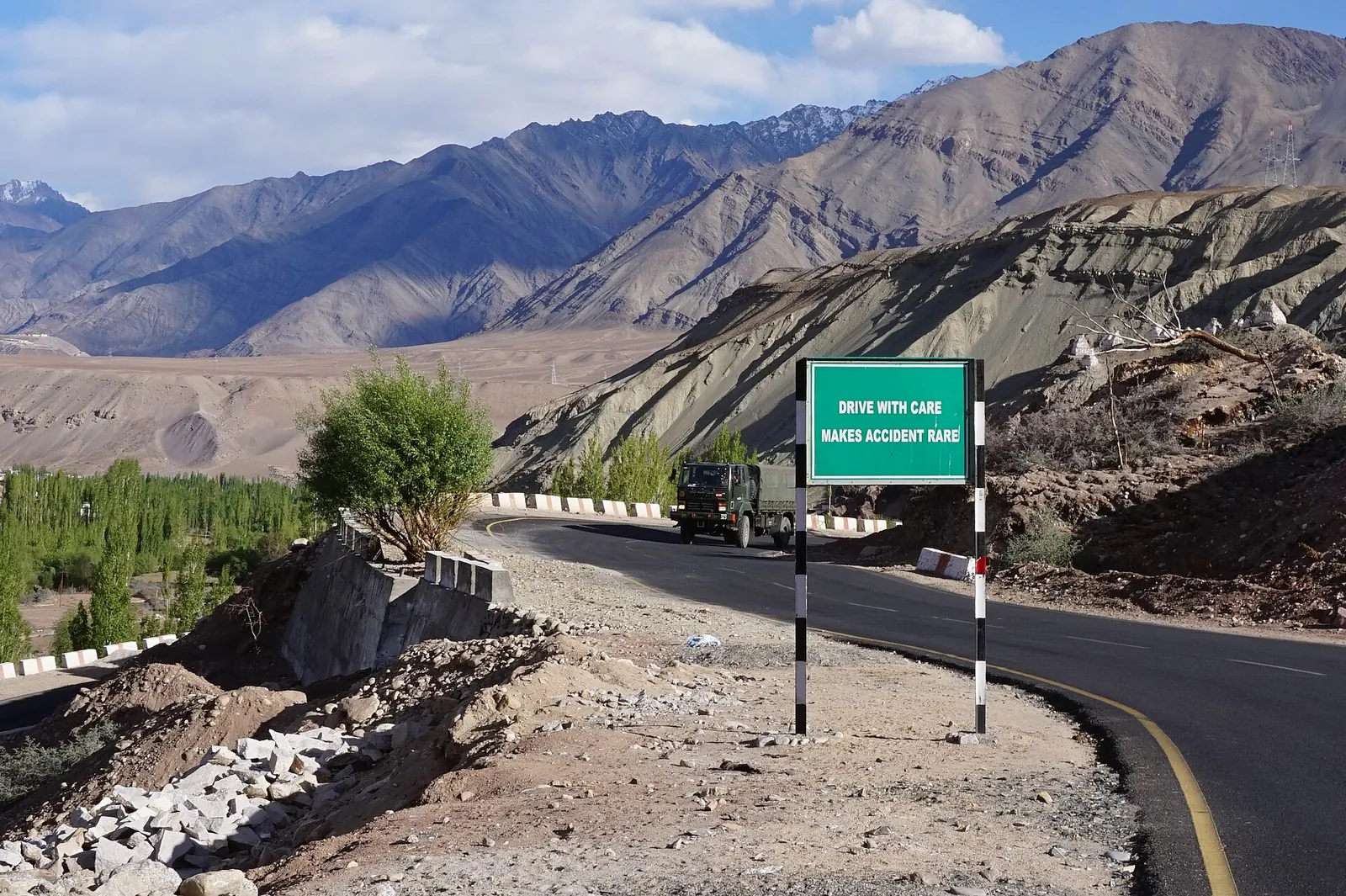
Because they are written to be read. Alongside the usual speed and gradient warnings, BRO projects, Himank in particular, put up boards with quotations, rhymes and road-safety jokes.
One Himank board on the road from Leh to Khardung La simply reads "Way of worship may be different but GOD is One". Others quote writers such as Jules Renard. Riders photograph them, collect them and post them, which is probably the best road-safety campaign India has ever run for free.
A signature on the mountain
The signs also say something about the organisation. BRO's crews live for months in remote camps and its officers rotate through some of the hardest postings in the country.
The boards are a project's way of putting its name and personality on a road that otherwise looks like nobody built it.
How big is BRO today?
By BRO's own count, announced with the Mig La record in October 2025, it has built:
- more than 60,000 km of roads;
- more than 1,000 bridges;
- 19 airfields.
It works in 19 states, three Union Territories and neighbouring countries including Afghanistan, Bhutan, Myanmar, Tajikistan and Sri Lanka. It also says it built 11 of the world's 14 highest motorable passes.
In 2022 the comparable figures were over 55,000 km of roads and more than 450 permanent bridges, so the network grew by at least 5,000 km in three years. The workforce is mostly invisible: BRO employs more than 2 lakh casual paid labourers, who do the digging, the stone-breaking and the snow-clearing that the machines cannot.
See the data as a table
| Capital allocation (₹ crore) | |
|---|---|
| 2022-23 | 3500 |
| 2023-24 | 5000 |
| 2024-25 | 6512 |
| 2025-26 | 7146.5 |
| 2026-27 | 7394 |
Source: Ministry of Defence budget releases, via Swarajya (Feb 2023), Aaj Tak (Feb 2025) and Greater Kashmir (Feb 2026) · 2024-25 is derived from the reported 9.74% rise to ₹7,146.5 crore in 2025-26; the Defence Ministry rounded it to about ₹6,500 crore.
The money has roughly doubled
The capital allocation rose 43% from ₹3,500 crore in 2022-23 to ₹5,000 crore in 2023-24 (Swarajya), then to ₹7,146.5 crore in 2025-26 (Aaj Tak) and ₹7,394 crore in 2026-27 (Greater Kashmir).
On 7 December 2025, Defence Minister Rajnath Singh dedicated 125 BRO projects worth about ₹5,000 crore in one day, the largest single-day inauguration in its history: 28 roads, 93 bridges and 4 other works across Ladakh, Jammu and Kashmir and seven states. Among them was the 920 m Shyok tunnel on the Darbuk-Shyok-Daulat Beg Oldie road.
Has BRO met its deadlines?
Often not, and the official record says so. The most detailed public audit is the Comptroller and Auditor General's 2017 report on the Indo-China Border Roads, and a 2019 parliamentary committee report that followed it up.
Of 73 strategic roads identified along the China border, 61 (3,409 km, estimated at ₹4,644 crore) were given to BRO with a 2012 deadline. By March 2016 only 22 were complete, although ₹4,536 crore, 98% of the estimate, had been spent. In a sample of 24 roads, only 6 were complete. Poor survey work meant ground conditions differed from plans; defective construction led to ₹63.20 crore of wasted spending on corrections and realignment; and six completed roads were unfit for the specialised vehicles they were meant to carry. The limit: the report reflects 2016 conditions, and parts of it were later taken off the CAG website at the Defence Ministry's request.
Read the report page (free)The committee found 28 of the 61 BRO roads complete and the deadline pushed to 2022. It listed why: 593 land compensation cases in court, wildlife clearances taking 3 to 7 years, 29 forest approvals pending with states, and equipment shortfalls in 2016-17 of 40% for stone crushers and 50% for tippers. It noted that field Chief Engineers' financial powers had been raised from ₹10 crore to ₹50 crore to speed decisions. The limit: this is a parliamentary review relying on Ministry data, not an independent field audit.
Read the summary (free)What actually slowed the roads
The pattern is clear from both reports: BRO's problem was rarely the mountain. It was:
- Land: 593 compensation cases in court;
- Clearances: wildlife approvals taking 3 to 7 years, and 29 forest approvals pending;
- Equipment: shortfalls of 40% in stone crushers and 50% in tippers in 2016-17;
- Slow approvals from the top.
Many of the reforms after 2015, including full transfer to the Defence Ministry and more delegated powers, were aimed at exactly those bottlenecks.
What has BRO built since 2017?
The years since 2017 are BRO's record-setting era:
- 2017: it completed the Chisumle-Umling La-Demchok road at 5,799 m, recognised by Guinness World Records in November 2021 as the world's highest motorable road.
- 3 October 2020: the 9.02 km Atal Tunnel under Rohtang opened, taking about 45 km off the Manali-Leh highway after a decade of digging through water-bearing fault rock.
- 9 March 2024: the Sela tunnel, built by Project Vartak at about 3,000 m below the 4,200 m Sela Pass, gave Tawang an all-weather road.
- October 2025: Project Himank opened the Likaru-Mig La-Fukche road over Mig La at 5,913 m, beating its own Umling La record.


| Year | Milestone |
|---|---|
| 7 May 1960 | BRO formed; Projects Beacon, Vartak and Udayak |
| 1962 | Project Chetak raised in Bikaner |
| 1964 | Work begins on the Manali-Leh road from both ends |
| 1976 | Khardung La road built |
| 4 Dec 1985 | Project Himank raised at Leh |
| 1989 | Manali-Leh road serves as Ladakh's second land route |
| 2010 | Project Vijayak raised in Kargil; Atal Tunnel construction begins |
| 2015 | BRO placed entirely under the Ministry of Defence |
| 2017 | Umling La road completed; CAG audit of China border roads tabled |
| 3 Oct 2020 | Atal Tunnel opens |
| Nov 2021 | Guinness record for Umling La |
| 2022 | Project Yojak raised; Zoji La kept open to 4 January for the first time |
| 9 Mar 2024 | Sela tunnel opens |
| Oct 2025 | Mig La, 5,913 m, becomes the highest motorable road |
| 7 Dec 2025 | 125 projects worth about ₹5,000 crore dedicated in one day |
| 12 May 2026 | Manali-Leh highway reconnected at Sarchu after 42 days of clearance |
What does road building cost the mountains?
Roads cut into steep, young slopes make landslides more likely, and BRO works almost entirely on such slopes. That is not a criticism unique to BRO; it is the physics of hill roads. Research from Nepal, where road building has boomed, puts a number on it.
The authors mapped landslides in Sindhupalchok district before and after the 2015 Gorkha earthquake and compared their locations with the road network. Landslides were more than twice as likely to occur near a road as a random distribution would predict, and the authors link rising landslide deaths in Nepal to earthquakes, climate change and a surge in road construction. The limit: it is one district in Nepal, not an Indian BRO corridor, but the geology and building methods are similar across the Himalaya.
Read the paper (free)
A BRO road is never finished. Every monsoon and every thaw reopens it to rockfall and slides.
For riders, the practical upshot is that the same crews who built a road spend most of their year repairing it. My post on why Himalayan roads keep sliding goes into the geology.
What is next for BRO?
Tunnels and altitude.
- Shinku La tunnel: 4.1 km, on the Nimmu-Padum-Darcha road, expected around August 2028.
- Khardung La tunnel: 5.5 km, with a finished project report but still waiting for funding in March 2026.
- Zojila tunnel: on the Srinagar-Leh highway, due in February 2028, is being built by NHIDCL rather than BRO, but BRO still keeps the pass above it open.
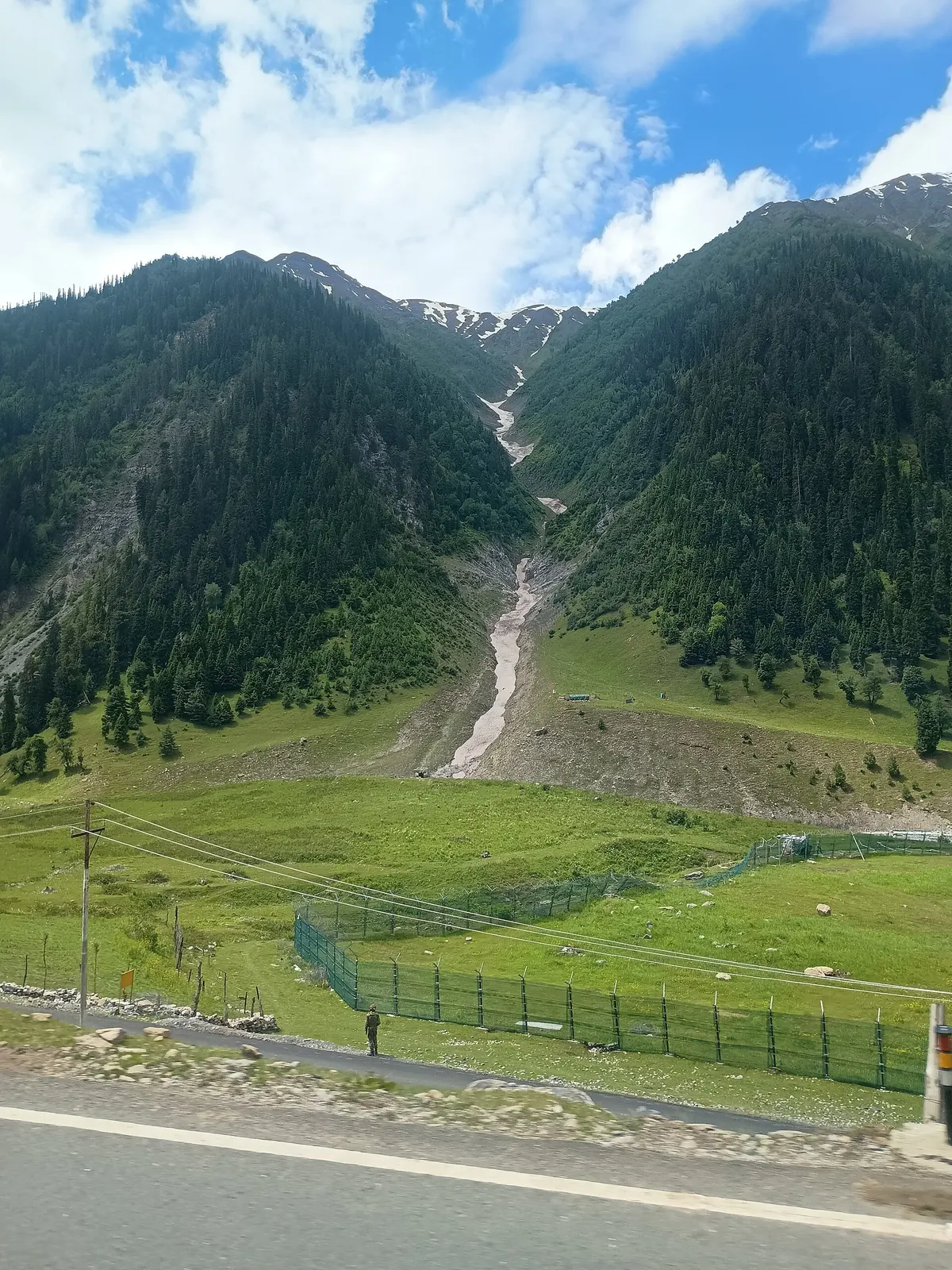
If you want to ride what BRO built, start with the story of Mig La, the Manali-Leh highway history and the list of the highest motorable passes in India.
For the tunnels, see India's longest road tunnels. More of my routes are on the Ride Atlas.
What's new
- BRO capital allocation rises to ₹7,394 crore in the 2026-27 budget Greater Kashmir, Feb 2026
- 125 BRO projects worth about ₹5,000 crore dedicated in a single day Swarajya, Dec 2025
- BRO builds the world's highest motorable road at Mig La The Tribune, Oct 2025
- BRO reopens the Manali-Leh highway after a 42-day clear-up The Tribune, May 2026
Questions people ask
When was the Border Roads Organisation established?
On 7 May 1960. Its first projects were Beacon in Jammu and Kashmir and Vartak (then called Tusker) in the Northeast, with Project Udayak raised the same month.
Is BRO part of the Army?
It is under the Ministry of Defence, fully so since 2015, and is led by an Army lieutenant general, the Director General Border Roads. Its own cadre is the Border Roads Engineering Service and the General Reserve Engineer Force (GREF).
What does GREF stand for?
General Reserve Engineer Force, BRO's parent civilian cadre alongside the Border Roads Engineering Service. GREF personnel staff BRO's projects and camps across the border areas.
How many roads has BRO built?
BRO said in October 2025 that it has built more than 60,000 km of roads, over 1,000 bridges and 19 airfields. In 2022 the figure was over 55,000 km.
Which BRO project maintains the Leh roads?
Project Himank, raised at Leh on 4 December 1985, maintains eastern Ladakh, including Khardung La, Umling La, Mig La and the Sarchu-Leh stretch of the Manali-Leh highway. Project Vijayak in Kargil handles Zoji La and western Ladakh.
Sources
- Wikipedia: Border Roads Organisation (accessed 2026)
- CAG: Report 5 of 2017, Union Government Defence Performance Audit (Indo-China Border Roads) (2017)
- PRS Legislative Research: Standing Committee report on all-weather road connectivity under BRO (2019)
- McAdoo B. G. et al.: Roads and landslides in Nepal, Natural Hazards and Earth System Sciences (2018)
- The Tribune: BRO constructs world's highest motorable road in Ladakh (2025)
- Vajiram and Ravi: Mig La Pass (Project Himank raised 4 December 1985) (2025)
- Swarajya: Capital budget of BRO increased by 43% to ₹5,000 crore (2023)
- Aaj Tak: BRO allocation increased in Budget 2025-26 (2025)
- Greater Kashmir: Defence gets record ₹7.85 lakh crore (2026)
- Swarajya: 125 BRO projects worth ₹5,000 crore dedicated to nation (2025)
- Wikipedia: Sela Tunnel (accessed 2026)
- Wikipedia: Atal Tunnel (construction dates, opening, length) (accessed 2026)
- Wikipedia: Umling La (accessed 2026)
- Wikipedia: Khardung La (accessed 2026)
- The Tribune: BRO reopens Manali-Leh National Highway after 42-day clear-up (2026)
- Wikipedia: Route 606 (Afghanistan), Delaram–Zaranj highway (accessed 2026; 218 km, 135 killed, opened 22 Jan 2009; source for the story)

Sapta (Saptarshi Sarkar) is a mechanical engineer turned marketer in Bengaluru and a solo touring rider. He writes the seven Saptaverse blogs. Work with him or read more of RoadHook Rides.


