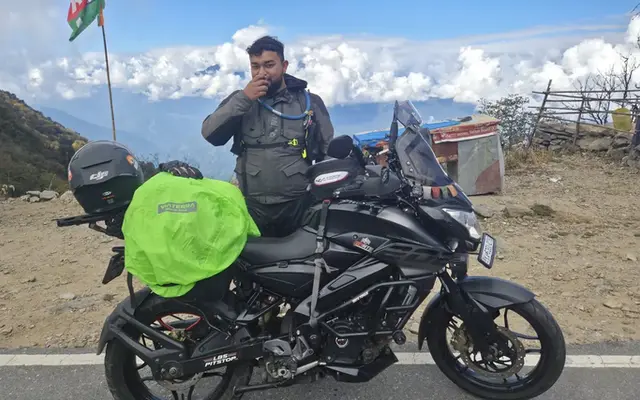
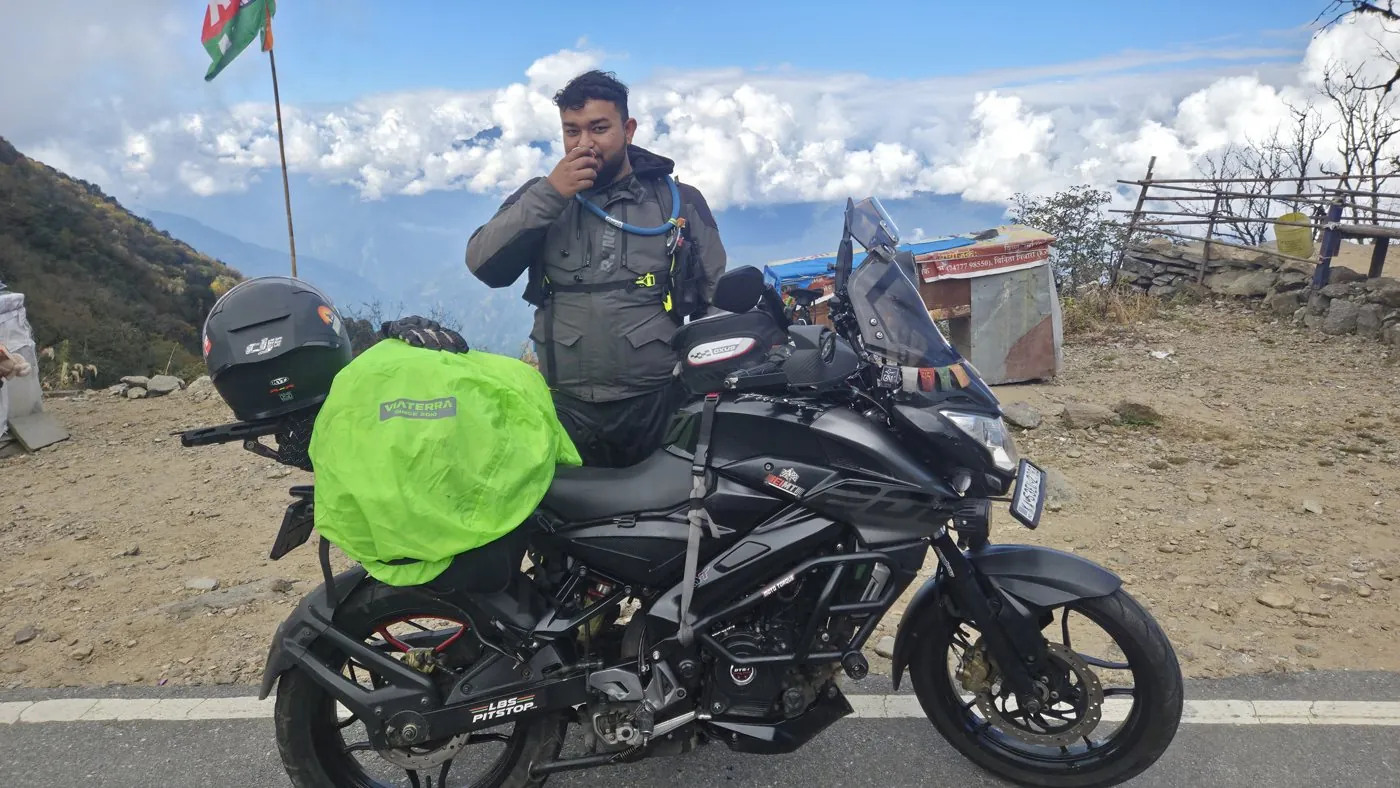
After nine years and around 70,000 km, my 2017 Pulsar NS200 is a capable budget tourer once its riding position, rear suspension and luggage are sorted: it has done several 800–1,000 km days and Bengaluru to Sikkim and back without ever needing a tow. Its real limits are high altitude, where the carburetted engine loses breath, and wear: the cylinder block, piston and rings were replaced at about 62,000 km.
- Around 70,000 km on a bike delivered around 14 November 2017.
- Bengaluru to Kolkata: about 2,000 km in two days, 26 h 42 min of riding.
- Top end (block, piston, rings) replaced at about 61,500–62,500 km; clutch plates replaced too.
- At Gurudongmar the air holds only about 57–59% of sea-level density, and the bike at times managed about 40 km/h.
- Never towed on any tour.
This is an owner's review of one specific bike: a carburetted BS4 NS200 with a 199.5 cc liquid-cooled single. Everything about my use of it comes from my own records. Specs come from Bajaj and the motoring press. Where my records have a gap, I say so rather than guess.
On 10 November 2025 I left Bengaluru on the NS200 for the ride I later filmed as The Sikkim Diaries. Day one ended at a hostel in Visakhapatnam, about 1,100 km by my odometer, via Chittoor, Gowravaram, Guntur and Khammam. Day two ran past Berhampur and Kharagpur to Kolkata. My mission report for the two days says about 2,000 km, 38 h 57 min elapsed and 26 h 42 min of riding, with a stop roughly every 250 km. From there the bike went on to Gangtok, Kupup, Baba Mandir at about 4,120 m and Zuluk, and back home.
Roadhook Touring on YouTube: The Sikkim DiariesWhat exactly is a 2017 Pulsar NS200?
The 2017 NS200 is Bajaj's 199.5 cc, four-valve, liquid-cooled naked, relaunched in February 2017 with BS-IV compliance at Rs 96,453 ex-showroom Delhi. It was carburetted; fuel injection came later, and the 2026 update adds ride-by-wire, traction control and a quickshifter. The table shows how far the model has moved.
| Spec | My 2017 NS200 | NS200 BS VI (manual) | 2026 update |
|---|---|---|---|
| Fuel system | Carburettor | Fuel injection | Fuel injection, ride-by-wire |
| Bore × stroke | 72 × 49 mm | 72 × 49 mm | Carried over |
| Power | 23.2 bhp at 9,500 rpm (launch figure) | 24.5 PS at 9,750 rpm | 25.5 hp |
| Torque | 18.3 Nm at 8,000 rpm (launch figure) | 18.74 Nm at 8,000 rpm | 18.7 Nm |
| Tyres | 110/70 ZR17, 140/70 ZR17 (fitted) | 100/80-17, 130/70-17 | Radial rear |
| Price (ex-showroom) | Rs 96,453 (2017) | n/a | Rs 1.60 lakh |
Bajaj's BS VI manual also gives a 11:1 compression ratio, a 12-litre tank with no reserve, 158 kg kerb weight and 308 kg gross weight. The launch figures are for the 2012 carburetted 200NS, which shares the engine; Bajaj did not publish a separate number for the 2017 BS4 bike that I could find.
Is the Pulsar NS200 good for long-distance touring?
Yes, with work: mine has done several 800–1,000 km days, once it was converted into an upright luggage tourer. The changes that did it are listed in everything I changed on my NS200: a Dominar handlebar, KTM 390 Adventure-style pegs, a tall Carbon Racing screen, a Dominar rear monoshock and a Hyperrider tail rack.
The Bengaluru to Kolkata numbers show what a 200 cc single sustains on Indian highways. Simple arithmetic on my mission report:
- Moving average: 2,000 km ÷ 26.7 h of riding ≈ 75 km/h, including towns, tolls and trucks.
- Overall average: 2,000 km ÷ 38.95 h elapsed ≈ 51 km/h, with stops, food and fuel.
- Stops: about one every 250 km, so roughly seven fuel-and-rest stops over the two days.
The 12-litre tank sets the stop rhythm as much as the rider does. With no reserve, every km/l of economy is worth 12 km of range, so work out your own figure fill-to-fill on the highway before a long trip, and plan fuel stops well inside it.
What does a long day do to the rider?
The limit on these days is the body. Vibration through the seat and bars accumulates over hours, which is why suspension and posture matter more on a small single than peak power does.
The team measured whole-body vibration on 191 delivery riders with a seat-pad accelerometer to ISO 2631-1. The average daily exposure, A(8), was 0.624 m/s², above the EU action value of 0.5 m/s², and three riders crossed the limit value. Riders with musculoskeletal problems were about 2.9 times as likely to be over the action value. The limit: small commuter bikes and city work, not touring, and the suspension-service finding ran the other way to what you'd expect, so it needs more study.
Read the paper (free)That is the reason the comfort changes on my bike come first in the list above: the bar, pegs and screen change how the body is held for those hours, and the rear shock changes what reaches the seat. On a small single, spend on those before you spend on power.
How long does a Pulsar NS200 engine last?
Mine needed a top-end job, the cylinder block, piston and rings, at about 61,500 to 62,500 km, and has carried on to around 70,000 km since. Over its life it has also had new clutch plates, a new front disc and master cylinder, and a chain and sprocket kit at about 39,000 to 40,000 km.
Read that list as a schedule, not a verdict. Bajaj's BS VI service chart runs in 5,000 km steps out to 75,000 km, and names clutch plates, chain, sprockets, brake pads and spark plugs as wear parts. On a carburetted bike, the things that shorten engine life are mostly in the owner's control:
- oil changed on time in the specified SAE 20W-50, JASO MA2 grade (mine runs Motul 7100 20W-50);
- a clean air filter (mine is a K&N high-flow unit);
- coolant topped up (mine runs Motul coolant);
- a correctly set idle mixture (my air-fuel screw sits at about 2.8 turns).
The usual signs that a top end is due are rising oil consumption, blue smoke on the overrun, harder starting, falling compression and a loss of pull; a compression test tells you more than the odometer does.
Why did the NS200 struggle at Gurudongmar?
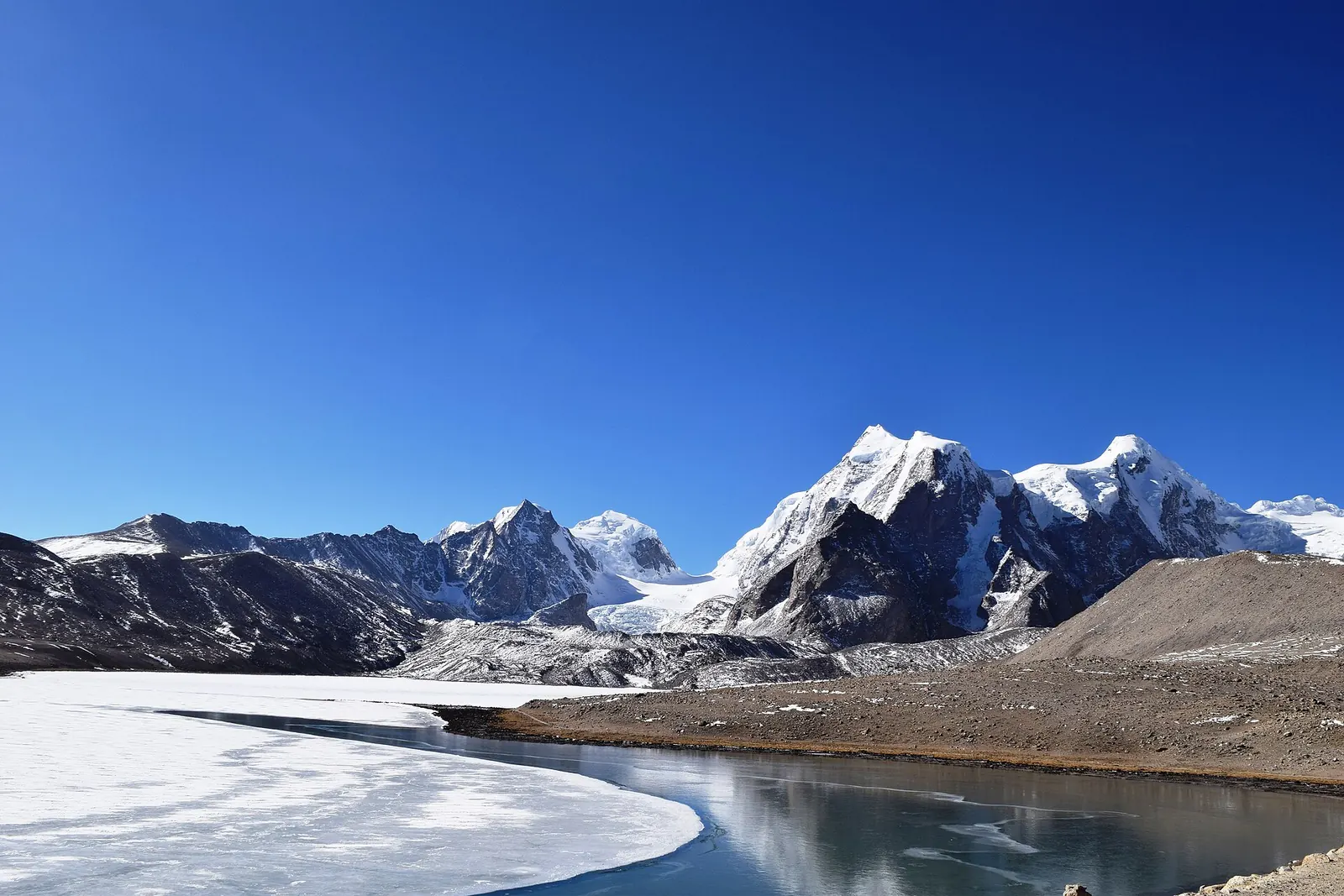
Because a carburettor meters fuel by air velocity, not air mass, so in thin air it runs rich while the engine has less oxygen to burn. On my 2022 ride to Gurudongmar the bike at times could not go faster than about 40 km/h. I put it plainly afterwards: "Main haara nahi tha, bike haari thi" (I didn't lose, the bike did).
How much air is left up there?
NASA's standard atmosphere model gives temperature and pressure by altitude; density follows from the gas law. I ran it for the places on my rides:
For the troposphere, temperature falls about 6.49 °C per 1,000 m from 15.04 °C, and pressure follows a power law in temperature (exponent 5.256), with density from the equation of state. Run at 5,430 m, it gives about 51 kPa, against 101 kPa at sea level. The limit: it is a mean atmosphere; real temperatures on a given day shift the numbers by a few per cent.
Read the model (free)See the data as a table
| Air density (%) | |
|---|---|
| Sea level | 100 |
| Bengaluru 920 m | 91.6 |
| Gangtok 1,650 m | 85.2 |
| Zuluk 2,750 m | 76.3 |
| Baba Mandir 4,120 m | 66.1 |
| Gurudongmar 5,150 m | 59.2 |
| Gurudongmar 5,430 m | 57.5 |
Source: Computed with NASA Glenn Earth Atmosphere Model; elevations from Wikipedia and my ride notes · Two bars for Gurudongmar because published elevations differ.
Why does a carburettor run rich in thin air?
The fuel jet flows according to the pressure drop in the venturi, which scales with air density times velocity squared. Air mass flow scales with density times velocity. Put the two together and, for the same mass of air, the fuel-to-air ratio rises as one over the square root of density:
At Gurudongmar's 57.5% density that is \( 1/\sqrt{0.575} \approx 1.32 \): about 32% richer than the carburettor was set up for. A bike jetted to 13:1 at sea level would be near 10:1 up there, with excess fuel and less oxygen. Power falls twice over: less air per stroke, and a mixture burning off its best point. A fuel-injected engine measures air and trims fuel, which is the core of fuel injection vs carburettor at altitude.
Use this to check what you just read.
What altitude does to a carburetted engine
The textbook fixes for a carburettor that will live at altitude are a smaller main jet or a leaner needle setting. The air screw, which I run at about 2.8 turns, only sets the idle and low-throttle mixture, so it cannot correct a rich mid-range on a climb. If you ride high only a few days a year, it is often simpler to accept the loss and ride within it.
What does nine years of wear look like?
Here is everything replaced or renewed on my NS200, from my records, with the reading where I have it.
| Part | When | Type |
|---|---|---|
| Chain and sprockets (Rolon brass kit, RS200 41T rear) | about 39,000–40,000 km | Wear item, upgraded |
| Cylinder block, piston and rings | about 61,500–62,500 km | Engine rebuild |
| Clutch plates | Not recorded | Wear item |
| Front disc and master cylinder | Not recorded | Brake renewal |
| Front tyre, Apollo Alpha H1 110/70 ZR17 | November 2025 | Wear item |
| Rear tyre, Apollo Alpha H1 140/70 ZR17 | May 2026 | Wear item |
Chain wear and gearing are covered in my Rolon kit and 41T sprocket review, and tyre reading in how to check tyre wear and age.
Should you buy a used Pulsar NS200 in 2026?
Buy one if you want a cheap, repairable 200 cc single for plains touring and you are willing to set it up; skip it if most of your riding is above 4,000 m and you are looking at a carburetted bike. The new 2026 NS200 costs Rs 1.60 lakh ex-showroom, so a well-kept used one is a large saving for a buyer who can check it properly.
- Service book. Look for the 5,000 km rhythm and any top-end or clutch work.
- Fuel system. Carburetted (BS4) or fuel-injected (BS VI); pick FI if you ride high.
- Chain and sprockets. Hooked teeth or a chain at the end of its adjuster mean a kit is due.
- Brakes. Disc thickness, lever feel and fluid colour.
- Mods. Ask for receipts. Swapped shocks or bars need correct parts and fitting.
The full routine is in how to buy a used bike in India. For high passes, read altitude sickness on a motorcycle tour too, because the rider loses breath along with the engine.
A 200 cc single will tour India. It will not climb to 5,000 m like it rides the plains.
Nine years on, mine is still running and has never needed a tow. That is the case for the NS200 in one line: not the fastest or the most refined, but a bike you can keep fixing and keep riding.
What's new
- Updated NS200 launches at Rs 1.60 lakh with ride-by-wire, traction control and a quickshifter DriveSpark, Oct 2026
- First ride of the 2026 NS200 praises the engine and handling but finds the electronic throttle slow to respond DriveSpark, Nov 2026
- ABS likely to become mandatory on all new two-wheelers Autocar India, Jun 2025
Questions people ask
Is the Pulsar NS200 reliable over the long term?
Mine has done around 70,000 km and never needed a tow on tour. It has needed a top-end rebuild at about 62,000 km, clutch plates, a chain kit and brake parts, which is normal wear for a hard-ridden single.
Can the NS200 go to Ladakh or North Sikkim?
Mine reached Gurudongmar, but the carburetted bike at times managed only about 40 km/h near the top. A fuel-injected NS200 compensates for thin air far better.
What is the NS200's fuel tank size and range?
Bajaj lists 12 litres with no reserve. Range is tank size times your real mileage, so measure yours over a full tank before a long ride.
Is a 2017 carburetted NS200 worth buying in 2026?
For plains touring on a budget, yes, if the service record is clean and the chain, brakes and top end are checked. For riding at altitude, a fuel-injected bike is the better choice.
Sources
- Bajaj Auto: Pulsar NS200 BS VI owner's manual (bore, stroke, compression, tank, weights, oil grade, service chart)
- Autocar India: 2017 Bajaj Pulsar range, NS200 returns with BS-IV at Rs 96,453 (2017)
- Wikipedia: Bajaj Pulsar (200NS launch power and torque)
- NASA Glenn Research Center: Earth Atmosphere Model, metric units
- Daud A et al.: Whole-body vibration exposure among food delivery riders, Journal of Public Health Research (2025)
- Wikipedia: Gurudongmar Lake (elevation 5,154 m to 5,430 m)
- Wikipedia: Gangtok (1,650 m)
- Wikipedia: Bengaluru (920 m)
- DriveSpark: Updated Bajaj Pulsar NS200 launched at Rs 1.60 lakh (2026)
- DriveSpark: 2026 Bajaj Pulsar NS200 review (2026)
- Autocar India: ABS likely to be mandatory on all new two-wheelers (2025)
- EUR-Lex: Directive 2002/44/EC on vibration (0.5 m/s² action value, 1.15 m/s² limit) (2002)
- Roadhook Touring: The Sikkim Diaries

Sapta (Saptarshi Sarkar) is a mechanical engineer turned marketer in Bengaluru and a solo touring rider. He writes the seven Saptaverse blogs. Work with him or read more of RoadHook Machines.