
Replace bike tyres when the tread is worn down to the tread-wear indicator bars, when the date code shows the tyre is older than the maker's limit (KTM says 5 years; Michelin and Continental say 10 years at most, with yearly inspection after 5), or at once if you see cracks reaching the cords, bulges or cuts. India's legal floor is 0.8 mm of tread on a two-wheeler, but manufacturers set 1 to 2 mm. Check pressure cold, once a week, against the figure in your manual.
- 0.8 mm is India's legal tread floor for two-wheelers; Hero says 1 mm and KTM 2 mm.
- The last four DOT digits are week and year: 4521 means week 45 of 2021.
- 5 years is KTM's hard age limit; Michelin and Continental stop at 10.
- A bulge, or a cut showing cord, means replace now, whatever the tread.
- Check pressure cold (parked 3+ hours), weekly, and raise the rear 3 to 5 psi for a pillion.
A motorcycle has only two small contact patches, so tyre condition decides grip in a way a car driver never feels. The checks below need three tools:
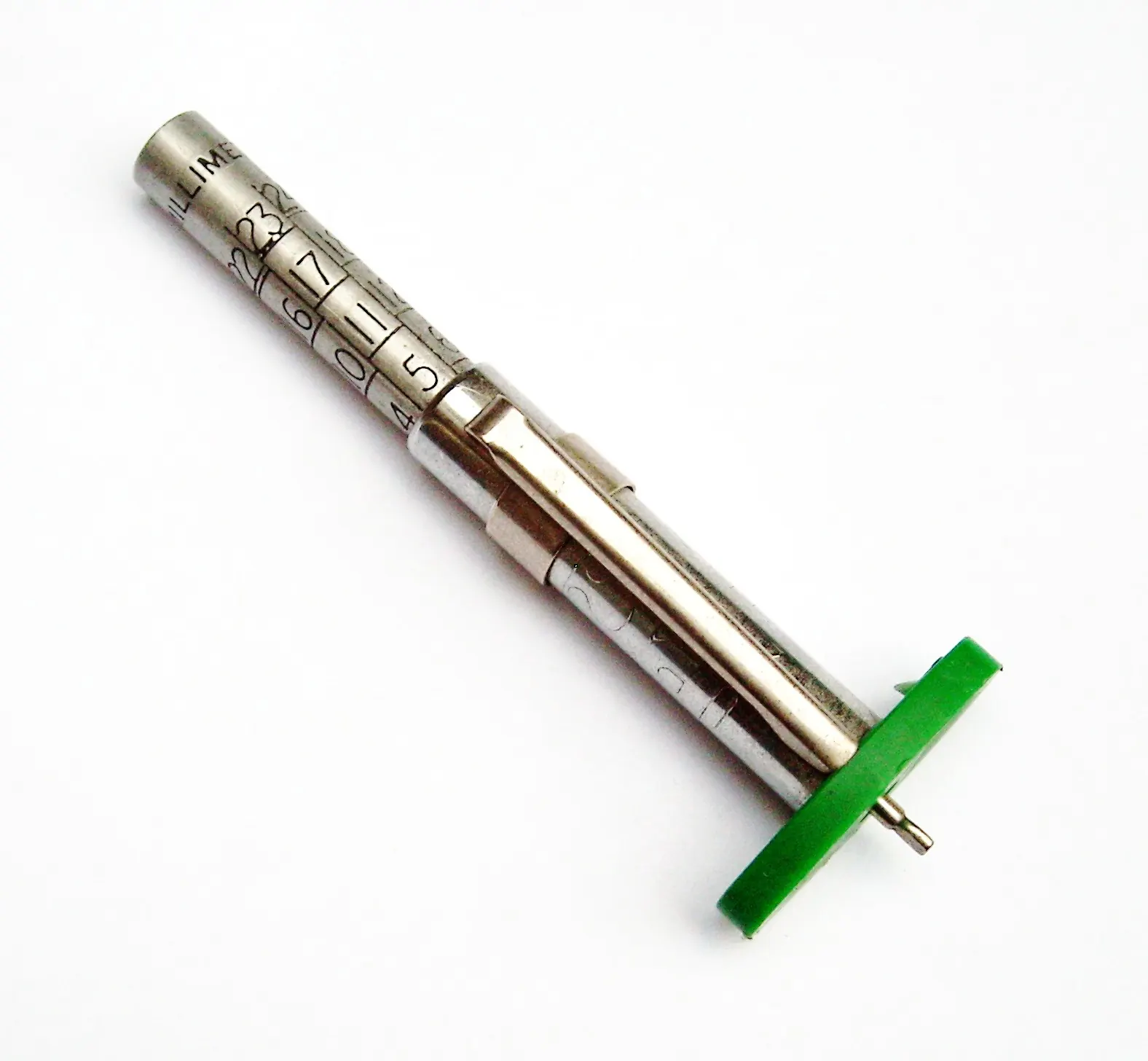
- a tread-depth gauge;
- a torch, for the sidewall and the date code;
- a pressure gauge you keep at home.
The numbers come from the Central Motor Vehicles Rules, six owner's manuals, tyre-maker guidance and two studies on tyre ageing and inflation.
When do you have to replace a motorcycle tyre in India?
Legally, when the tread above the tread-wear indicator is gone. Rule 94(3)(iv) of the Central Motor Vehicles Rules, 1989 says non-skid depth must not be less than 0.8 mm for two- and three-wheelers and 1.6 mm for other vehicles, measured against the tread-wear indicator moulded into the tyre.
The rule was inserted in 2001. A tyre with casing fabric exposed by wear is also not in sound condition under Rule 94.
Manufacturers set higher limits than the law. That is the figure to follow, because wet grip falls away as the grooves that clear water get shallow.
| Source | Minimum tread depth | Age rule |
|---|---|---|
| CMVR Rule 94(3)(iv), India | 0.8 mm (two- and three-wheelers) | None |
| Hero Splendor+ XTEC manual | 1.0 mm front and rear; replace when TWI appears | None stated |
| TVS Apache RTR 160 4V manual | Replace at the TWI level | None stated |
| KTM 390 Adventure manual (2022) | 2 mm, or the national limit if higher | Replace after 5 years at the latest, whatever the wear |
| Michelin | At the wear indicator; change earlier for wet roads | Annual inspection after 5 years; replace at 10 years from manufacture |
| Continental | At the wear indicator | Replace tyres older than 10 years; unused tyres up to 5 years old can be sold as new |
In September 2012 a coach carrying people home from a music festival crashed after a tyre on its front axle blew out. Three people on board died. One of them was Michael Molloy, a teenager. The tyre was 19 years old. His mother, Frances Molloy, set up a campaign called Tyred to change the law, and kept at it for most of a decade. On 15 July 2020 the UK government announced that tyres aged 10 years or more would be banned from the front axles of lorries, buses and coaches and from minibuses with single wheels. The ban took effect on 1 February 2021, and those tyres must now carry a legible date code at the annual test.
GOV.UK: Government bans old coach, bus and lorry tyres from roads (July 2020)India's motor vehicle rules set no age limit for tyres, so the date code is your job. The rest of this guide shows how to read it, alongside the tread and the pressure.
How do you check tread depth and the wear indicators?
Find the small rubber bars moulded across the bottom of the main grooves, usually marked by a triangle or the letters TWI on the sidewall shoulder, and compare the tread surface with them. When the tread is level with any bar, the tyre is finished.
- Find the markers. Look on the sidewall shoulder for small triangles or "TWI". Each points to a wear bar in the groove below. Most tyres have several round the circumference.
- Check several points. Rotate the wheel and check at least three bars. Motorcycle tyres often wear unevenly, with a flat band in the centre from straight-line highway riding.
- Measure the centre. Push a tread-depth gauge into the deepest groove near the centre of the tread. Compare with the 0.8 mm legal floor and your maker's 1 to 2 mm limit.
- Look at the profile. A rear tyre with a visible flat strip in the middle turns in reluctantly and drops into corners suddenly when you lean past the flat. That tyre needs replacing before the bars show.
- Check for cupping or scalloping. Run your hand round the front tyre. Saw-tooth steps between tread blocks point to low pressure or worn fork damping.
How do you read a motorcycle tyre's date code?
Look for the DOT marking on the sidewall and read the last four digits: the first two are the week of manufacture, the last two the year. KTM's manual and Continental use the same reading: a code ending 4521 means week 45 of 2021.
The code may be on one side of the tyre only, so check both sidewalls, and look for the four-digit week-and-year group near the DOT or size marking. Michelin's own example: 1922 means week 19 of 2022.
Use this to check what you just read.
How old is your tyre?
Shelf age counts too
A tyre can age on a shelf. Continental lets unused tyres up to five years old, properly stored, be sold as new, so a tyre fitted today might already be two or three years old.
Why do old tyres fail even with good tread?
Rubber oxidises. Heat and oxygen slowly harden the compound and weaken the bond between rubber and the reinforcing cords, whether the tyre is ridden or parked. The US road-safety regulator NHTSA studied this for car tyres because the damage is invisible from outside.
NHTSA's tyre-ageing project began in 2002 to understand how tyres degrade in service and to build a laboratory test that reproduces it. Its summary states that ageing occurs whether a tyre is driven or not, through thermo-oxidative degradation that speeds up with temperature, and that ageing failures cluster in hot states, in summer and at highway speed. Crash databases for 2005 to 2007 linked about 90 deaths and more than 3,200 injuries in the US to tyre ageing. The agency's oven protocol, five weeks at 65 °C, approximates four years of service in Phoenix, Arizona; aged tyres then showed shoulder cracking, cracking in tread grooves and tread separation. Limit: the work covered passenger-car and light-truck tyres, not motorcycle tyres.
Read the summary (free)Phoenix was chosen because heat is the accelerator, and many Indian cities spend months at similar temperatures. That is the strongest argument for treating the 5-year inspection point seriously on a bike that is parked in the sun.
A tyre ages whether it is ridden or parked, and heat is what speeds it up.

What should you look for on the sidewall?
Hero's Splendor manual gives a clear rule for owners: replace the tyre if you find a bump or bulge, or if a cut, split or crack shows fabric or cord. Everything else is a judgement call that a tyre shop should confirm.
| What you see | What it usually means | Action |
|---|---|---|
| Fine surface crazing on the sidewall | Ozone and UV ageing of the outer rubber | Check the date code; inspect yearly after 5 years |
| Cracks in the tread grooves or at the shoulder | Ageing reaching the structure; NHTSA saw these in aged tyres | Replace |
| Bulge or bump | Internal cord damage, often from a pothole impact | Replace at once |
| Cut showing fabric or cord | Casing exposed | Replace at once |
| Flat band in the centre of the rear | Highway wear | Replace before cornering grip suffers |
| Uneven wear on one side | Camber of roads or wheel alignment | Check chain adjuster marks and wheel alignment |
TVS also recommends balancing the wheels every year or 12,000 km and after every puncture repair or tyre change (Apache RTR 160 4V owner's manual).
What tyre pressure should your motorcycle run?
The pressure in your owner's manual or on the chain-guard or swingarm sticker, measured cold. Manufacturers usually give a higher rear figure for riding with a pillion; the front usually stays the same.
See the data as a table
| Front (psi) | Rear, solo (psi) | Rear, with pillion (psi) | |
|---|---|---|---|
| Hero Splendor+ XTEC | 25 | 28 | 33 |
| Bajaj Pulsar NS200 | 25 | 28 | 32 |
| TVS Apache RTR 160 4V | 25 | 28 | 32 |
| RE Hunter 350 | 29 | 32 | 36 |
| RE Classic 350 | 32 | 32 | 36 |
| KTM 390 Adventure | 29 | 29 | 32 |
Source: Owner's manuals: Hero (2024), Bajaj NS200 BS VI, TVS, Royal Enfield (2025, 2026), KTM (2022) · Front pressures do not change with a pillion on any of these bikes. KTM gives 2.0 and 2.2 bar.
| Bike | Front tyre | Rear tyre | Front psi | Rear psi solo / pillion |
|---|---|---|---|---|
| Hero Splendor+ XTEC | 80/100-18 47P | 80/100-18 54P | 25 | 28 / 33 |
| Bajaj Pulsar NS200 (BS VI) | 100/80-17 52P | 130/70-17 62P | 25 | 28 / 32 |
| TVS Apache RTR 160 4V | 90/90-17 49P | 130/70-17 62P | 25 | 28 / 32 |
| Royal Enfield Hunter 350 | 110/70-17 54P | 140/70-17 66P | 29 | 32 / 36 |
| Royal Enfield Classic 350 | 100/90-19 57P | 120/80-18 62P | 32 | 32 / 36 |
| KTM 390 Adventure (2022) | 100/90-19 57T | 130/80-17 65T | 29 | 29 / 32 |
How the size and load-index codes are built is explained in reading 110/70 R17 54H. The load index matters here: the Splendor's rear 54P carries more than the front 47P, which is why its pillion pressure rises the most.
How do you check tyre pressure correctly?
Measure cold, with your own gauge, before riding. Hero defines cold as parked for at least three hours and warns that tyres ridden even a few kilometres read higher, so you should not let air out to match the cold figure.
- Use a known gauge. Fuel-station gauges vary. A pencil or dial gauge kept at home gives consistent readings; compare it with a second gauge once in a while.
- Check cold. First thing in the morning, before riding, and out of direct sun.
- Set for the load. Use the pillion figure with a passenger or full luggage. KTM gives a single "passenger / full payload" figure for exactly this.
- Check weekly. TVS asks owners to check at least once a week; Hero says at least once a month. Weekly is the safer habit, because tubeless tyres can leak slowly round a nail without going flat.
- Refit the valve cap. It keeps grit out of the valve core, which is a common slow-leak point.
Does a few psi really change how the bike stops?
Less than most riders fear for braking in a straight line, more for handling and wear. A 2023 Italian test on a scooter found that a 0.6 bar (about 9 psi) error in the rear tyre changed rear-brake deceleration by only 0.8 to 3%.
The University of Florence team ran repeated hard stops on a Piaggio Beverly S 300 on a closed road, using only the rear brake with ABS working, and logged deceleration with a smartphone as an inertial sensor. At the nominal 2.4 bar the mean deceleration was 3.69 m/s². At 3.0 bar it was 3.67 m/s² (0.8% less) and at 1.8 bar 3.59 m/s² (3.0% less). Reduced load transfer onto the rear partly offset the loss of grip at low pressure. Limits: one scooter, rear brake only, and a phone-based sensor; the study did not test cornering, wear or the front tyre.
Read the paper (free)Why pressure still matters
So the case for correct pressure is wider than braking distance:
- Low pressure: KTM's manual warns it causes abnormal wear and overheating, and TVS notes that under-inflation makes smooth cornering difficult.
- High pressure: TVS says over-inflation reduces contact with the ground and can lead to skidding.
What nitrogen filling does and does not change is covered in nitrogen in bike tyres; the xBhp thread linked above is a long argument about exactly that.
How often are tyres the problem in real inspections?
Often enough to make the list of top defects. A February 2026 review by CITA, the international vehicle-inspection body, names tyres and brakes as the most critical defects on motorcycles because they decide stability in emergency braking and cornering.
| Country and year | Inspection | Tyre-related finding |
|---|---|---|
| Germany, 2024 | 1.848 million motorcycles inspected | 3.33% had defects in axles, wheels, tyres and suspension |
| Belgium, 2023 | New inspections of second-hand motorcycles | Wheels and tyres were 1.41% of findings |
| India | No periodic inspection for private bikes | The owner is the inspector |
Where to put these checks
- Buying used: put tyre date codes on the list in the used bike checklist; worn tyres on a cheap bike are a real cost to negotiate.
- Before the rains: tread depth matters most, which is why it heads the monsoon maintenance checklist.
- Long trips: packing a gauge and a puncture kit is part of the touring packing list.
What's new
- BKT enters India's on-road two-wheeler tyre market with BIS-certified ranges tested at NATRAX Autocar Professional, Feb 2026
- BIS amends automotive standards including IS 18258 on tyre rolling sound, wet adhesion and rolling resistance TeamLease RegTech, Mar 2026
- CITA review names tyres and brakes as the critical motorcycle defects CITA, Feb 2026
Questions people ask
Is it OK to ride on a 7-year-old motorcycle tyre with good tread?
It depends on whose limit you follow and how it was kept. KTM says replace after 5 years regardless of wear. Michelin allows up to 10 years with a professional inspection every year after 5, and Continental's maximum is also 10. A 7-year-old tyre with any cracking in the grooves or at the shoulder should be replaced.
Should tyre pressure be checked hot or cold?
Cold. Hero defines cold as parked for at least three hours. Warm tyres read higher; do not let air out of a warm tyre to match the cold figure.
Why is the rear pressure higher with a pillion but not the front?
A pillion sits over or behind the rear axle, so most of the added weight goes to the rear tyre. All six manuals above keep the front figure the same and raise the rear by 3 to 5 psi.
Can I replace only one tyre?
Yes. Front and rear wear at different rates, and replacing one at a time is normal. Keep to the size, load index and speed rating in the manual.
What is the minimum tread depth for bikes in India?
0.8 mm below the tread-wear indicator, under CMVR Rule 94(3)(iv). Hero sets 1.0 mm and KTM 2 mm, so replace before you reach the legal floor.
Sources
- Central Motor Vehicles Rules, 1989, Rule 94(3)(iv) (via Indian Kanoon)
- NHTSA: Tire Aging, A Summary of NHTSA's Work
- Failli et al.: Scooter Tire Pressure Influence on a Hard Braking Manoeuvre, IOP Conf. Ser. Mater. Sci. Eng. 1275 (2023)
- GOV.UK: Government bans old coach, bus and lorry tyres from roads (15 Jul 2020)
- DVSA Matters of Testing: Ban on tyres over 10 years old on minibuses, buses and coaches (in force 1 Feb 2021; the 2012 crash) (Dec 2020)
- Motoring Research: Old tyres banned after coach crash (Tyred campaign) (2020)
- Continental: Chronological age of motorcycle and scooter tyres
- Michelin: When should I change my motorcycle tires?
- CITA: Assessing motorcycle crashes in the EU: data, technical failures and safety outcomes (2026)
- KTM: 390 Adventure owner's manual, art. no. 3214576en (2022)
- Hero MotoCorp: Splendor+ XTEC owner's manual (2024)
- TVS Motor: Apache RTR 160 4V owner's manual
- Bajaj Auto: Pulsar NS200 BS VI owner's manual
- Royal Enfield: Classic 350 owner's manual (BS VI) (2025)
- Royal Enfield: Hunter 350 owner's manual (2026)

Sapta (Saptarshi Sarkar) is a mechanical engineer turned marketer in Bengaluru and a solo touring rider. He writes the seven Saptaverse blogs. Work with him or read more of RoadHook Machines.


