Rake is the angle of the steering axis from vertical, and trail is the distance on the ground between where that axis meets the road and where the front tyre touches it. More trail makes a motorcycle steadier and heavier to steer; less trail makes it quicker and more nervous. Trail is calculated as (wheel radius × sin rake − fork offset) ÷ cos rake, and Indian bikes range from about 95 mm on a KTM 390 Duke to about 110-127 mm on adventure bikes.
- Trail = (R sin ε − d) / cos ε: rake, fork offset and wheel radius together make it.
- Indian bikes run about 95 mm (KTM 390 Duke) to 127 mm (Himalayan 450) of trail.
- On a CB350, 1° of rake adds about 7 mm of trail; 1 mm of offset removes about 1.13 mm.
- Raising the rear 10 mm on a 1,440 mm wheelbase steepens rake about 0.4° and cuts trail about 3 mm.
- Trail is not the whole story: a 2011 bicycle with negative trail still balanced itself.
Spec sheets print rake and trail as if they were independent numbers. They are not. Rake, fork offset and front wheel size together produce trail, and trail is what you feel through the bars.
This post works through the geometry with the equation, the real numbers that KTM, Royal Enfield and Honda publish, and the research on what trail does and does not do for stability. The calculator lets you test your own bike, or see what a bigger front wheel or a taller rear shock would change.
What are rake and trail on a motorcycle?
Rake (also called caster angle) is the tilt of the steering head from vertical; trail is how far the front contact patch sits behind the point where the steering axis meets the ground. KTM lists a "steering head angle" measured from horizontal instead, so its 65° figure on the 390 Duke means a rake of 25°.
Three more numbers complete the picture:
- Fork offset: the perpendicular distance from the steering axis to the front axle, built into the triple clamps and sometimes the fork bottoms. Honda's H'ness CB350 uses 45 mm.
- Front wheel radius: rim radius plus tyre sidewall. A 90/90-21 adventure wheel is about 50 mm taller in radius than a 110/70-17 road wheel.
- Wheelbase: axle to axle. It sets how much the bike yaws for a given steering input; longer is calmer.
In 1970 a chemist at ICI in England, David E. H. Jones, set out to find what makes a bicycle stable by building bikes that should not be. His first "unridable bicycle" carried an extra front wheel spun against the real one to cancel its gyroscopic effect. He could still ride it easily.
So he went after trail. He flipped one front wheel round on its steering axis, reversing the geometry, and found the riderless bike ran on for yards and righted itself: too stable to be steered, in his verdict. Then he moved a front wheel four inches ahead of its normal place, into the unstable region. Released at speed, it had almost no self-stability and crashed. Jones concluded that trail's caster effect, which steers the front back under a falling bike, was the key. Later research showed it is one key among several, as this post explains.
Physics Today: From the archives, The stability of the bicycle (David E. H. Jones, 1970)How do you calculate trail from rake and fork offset?
Trail equals the front wheel radius times the sine of the rake angle, minus the fork offset, all divided by the cosine of the rake angle. Written out: t = (R sin ε − d) / cos ε. The perpendicular distance from contact patch to steering axis, called normal or mechanical trail, is t × cos ε; it is the real lever arm the tyre's forces act through.
Worked example: the Honda H'ness CB350
Honda publishes caster 27.5°, offset 45 mm and a 100/90-19 front tyre. Honda does not print the trail; this is the geometry applied to its own numbers.
- Wheel radius. Half of 19 inches (241.3 mm) plus 90% of 100 mm (90 mm) gives 331.3 mm, unloaded.
- Multiply by sin rake. 331.3 × sin 27.5° = 153.0 mm.
- Subtract the offset. 153.0 − 45 = 108.0 mm. This is the normal (mechanical) trail.
- Divide by cos rake. 108.0 ÷ 0.887 gives about 122 mm of trail.
Under load the tyre squashes by a few millimetres, so the running figure is a little lower. Use this to check what you just read, with your own bike's numbers.
Trail calculator: rake, offset and tyre size
Two sensitivities fall out of the equation:
- Rake: differentiate it and each extra degree of rake adds roughly (R − d sin ε) / cos² ε millimetres per radian of trail; for the CB350 that is about 7 mm per degree.
- Offset: each extra millimetre of fork offset removes about 1.13 mm of trail at 27.5°.
A few millimetres of triple-clamp offset changes the steering as much as a degree of rake.
What rake and trail do Indian motorcycles use?
Most Indian road bikes sit between 24° and 27.5° of rake and 95 to 127 mm of trail. Street nakeds sit at the quick end, adventure bikes with 21-inch front wheels at the stable end. Where the maker publishes both numbers I have used them; where it does not, the source column says so.
| Motorcycle | Rake | Trail | Wheelbase | Front wheel | Source |
|---|---|---|---|---|---|
| KTM 390 Duke (2023) | 25.0° | 95 mm | 1,357 mm | 17 in | KTM (steering head angle 65°) |
| Royal Enfield Interceptor 650 | 24.0° | 106 mm | 1,398 mm | 18 in | Royal Enfield |
| KTM 390 Adventure (2024) | 26.5° | 98 mm | Not compared | 19 in | KTM (steering head angle 63.5°) |
| KTM 390 Adventure R (2025) | 27.1° | 110 mm | 1,481 mm | 21 in | KTM (steering head angle 62.9°) |
| Honda H'ness CB350 | 27.5° | About 122 mm (calculated) | 1,440 mm | 19 in | Honda R&D Technical Review; trail from Honda's offset |
| Royal Enfield Himalayan 450 | 26.5° | About 127 mm (5.0 in) | 1,510 mm | 21 in | Cycle World claimed specs; wheelbase from Royal Enfield |
See the data as a table
| Trail (mm) | |
|---|---|
| KTM 390 Duke (2023) | 95 |
| KTM 390 Adventure (2024) | 98 |
| RE Interceptor 650 | 106 |
| KTM 390 Adventure R (2025) | 110 |
| Honda H'ness CB350 (calc.) | 122 |
| RE Himalayan 450 | 127 |
Source: KTM, Royal Enfield, Honda R&D Technical Review, Cycle World · CB350 trail calculated from Honda's caster and offset with an unloaded 100/90-19 tyre; Himalayan 450 trail is Cycle World's claimed figure.
The pattern is clear. The 2023 390 Duke combines the steepest rake with the least trail and the shortest wheelbase, which is why it changes direction like a much smaller bike.
The Himalayan 450 and the 390 Adventure R carry 15-30 mm more trail and 120-150 mm more wheelbase, which buys calm at highway speed and on loose gravel, where a nervous front end is tiring. The two KTM Adventure generations show how a 21-inch wheel and slightly slacker head add 12 mm of trail.

Why does more trail make a bike more stable?
Trail makes the front tyre a caster: any sideways force at the contact patch acts through the normal-trail lever and swings the wheel back into line.
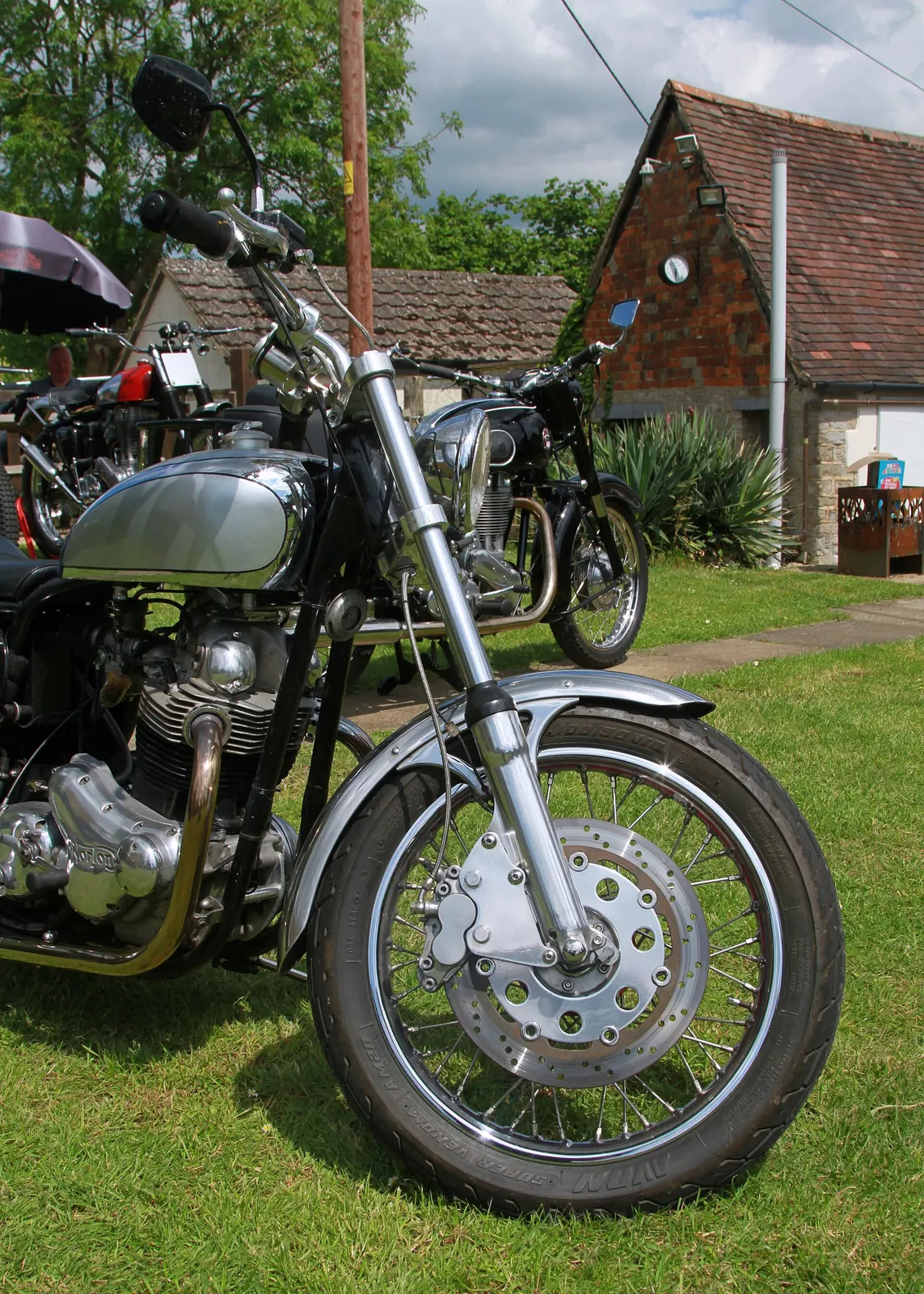
The steering also has a gravity effect: with rake and trail, the front of the bike drops slightly when the bars turn, so the bike's own weight pulls the steering toward centre (or toward the lean, which is what makes a leaned bike steer itself into the turn).
The trade is effort and response. More trail means:
- More self-centring, so small bumps and crosswinds do less to the line.
- Heavier steering at low speed, and more "flop" at walking pace, where the front wants to fall into the turn.
- Slower turn-in, because the tyre force resisting a steering input acts through a longer lever.
- More feel, because changes in front grip show up as changes in bar torque.
Honda's engineers wrote down this trade explicitly for the CB350. Their brief was an upright riding position with "moderate steering response" plus stability for relaxed riding. They set the wheelbase at 1,440 mm, longer than rivals in the class, and chose 27.5° caster and 45 mm offset to allow a large 43° steering lock, so the long bike still turns as tightly as a commuter in town.

Is trail what keeps a motorcycle upright?
Not on its own. The popular explanation says bikes balance because of trail and the gyroscopic effect of the front wheel. In 2011 Kooijman, Meijaard, Papadopoulos, Ruina and Schwab built a riderless bicycle with counter-rotating wheels that cancelled the front wheel's gyroscopic effect and with negative trail, so the contact point was ahead of the steering axis. It still recovered from a sideways push.
The lesson for motorcycles is that stability comes from the whole mass and geometry package: where the front assembly's mass sits, the steering axis angle, trail and gyroscopic effects all interact. Their analysis puts the self-stable speed of a typical bicycle near the square root of g times a characteristic length of about 1 m, a little over 3 m/s. Motorcycles are heavier and faster, but the same coupling between lean and steer is what makes them steer into a lean.
What are wobble and weave, and how does geometry affect them?
Wobble is a fast oscillation of the front assembly about the steering axis; weave is a slower snaking of the whole bike that matters most at high speed. In the Imperial College model below, a leaned bike's weave resonated at 26 rad/s (about 4 Hz) and its wobble at 50 rad/s (about 8 Hz). Both are modes of the same rake-trail-mass system, and geometry alone does not decide them.
Sharp, Evangelou and Limebeer at Imperial College modelled a Suzuki GSX-R1000 with measured parameters and modern tyre data. What they found:
- straight running was stable from about 6 m/s up to 75 m/s;
- halving the rear frame's torsional stiffness compromised high-speed weave and moved the wobble problem from high speed to medium speed;
- rider upper-body damping stabilised wobble, matching the old paddock wisdom that light riders suffer more front-end shakes than heavy ones.
For a road rider the practical reading is that worn steering-head bearings, a loose fork or an overloaded tail rack can turn a stable geometry into an unstable bike.
How do sag, ride height and tyres change rake and trail?
Anything that tilts the bike changes rake and trail. Raise the rear by 10 mm on a 1,440 mm wheelbase and the whole bike pitches forward by about 0.4°, which on the CB350 geometry takes about 3 mm off trail. Sliding the fork tubes 10 mm up through the clamps does the same from the other end.
| Change | Effect on rake | Effect on trail | What you feel |
|---|---|---|---|
| Taller rear shock or more rear preload | Steeper | Less | Quicker turn-in, less calm at speed |
| Heavy pillion and luggage on the tail | Slacker | More | Lazy steering, light front |
| Hard braking (fork dives) | Steeper | Less | Bike turns in more eagerly on the brakes |
| Taller front tyre (bigger radius) | Slightly slacker | More | Heavier steering |
| Triple clamps with more offset | None | Less | Lighter, quicker steering |
A bike set up with too little rear sag rides nose-down and twitchy; one with a sagging rear under touring luggage steers like a barge.This post, on why setup and geometry are one subject
This is why suspension setup and geometry are the same subject. Setting sag correctly, covered in the suspension sag guide, keeps the designed rake and trail when you are on the bike. Tyre profile matters too, which the tyre size guide explains.
Does rake and trail change how a bike countersteers?
Yes. More trail and a slacker rake raise the bar torque needed to start a turn, so a high-trail adventure bike needs a firmer push on the bar than a low-trail naked. The physics of that push, and why you press the left bar to go left, is in countersteering and lean angle explained.
Electronics that read lean angle, such as cornering ABS, are in the traction control explainer, and on hill roads the geometry meets ghat hairpins built to a 14 m radius.
Research behind this post
Honda's engineers describe how they designed the CB350 for Indian riders: a 1,440 mm wheelbase for relaxed stability, a 43° steering lock for town, caster set at 27.5° with a 45 mm fork offset and a 204 mm fork pitch, and reduced front weight bias with a lower centre of gravity for moderate steering response. It is a rare case of a maker publishing the reasoning, not just the numbers. The limit: it does not print the trail, which has to be calculated.
Read the paper (free)An Imperial College multibody model of a Suzuki GSX-R1000 with measured parts, Magic Formula tyre data and a rider model. Straight running was stable from about 6 to 75 m/s; halving or quartering frame torsional stiffness degraded high-speed weave and shifted wobble to medium speed; rider body damping helped stabilise wobble, consistent with light riders being more prone to it. The limit: frame stiffness and damping values were estimates at the time.
Read the paper (free)Using linearised stability equations with 25 geometry and mass parameters, the team designed and built a riderless bicycle with counter-rotating wheels (no net gyroscopic effect) and negative trail. Pushed sideways, it returned to upright running. The result shows trail is one contributor among several, with front-assembly mass placement and steering axis tilt interacting. The limit: it is a bicycle at low speed without a rider, not a motorcycle at road speed.
Read the paper (free)What's new
- KTM launches the updated 390 Adventure X and the long-travel Enduro R in India Autocar Professional, Jul 2025
- KTM's 2025 390 Adventure R specs move to a 62.9° head angle and 110 mm trail KTM, 2025
- Royal Enfield's updated Himalayan 450 technical specifications for India Royal Enfield, 2025
Questions people ask
Does more rake always mean more trail?
Only if offset and wheel size stay the same. Choppers often add fork offset to stop trail growing out of control as rake increases. In the equation t = (R sin ε − d) / cos ε, offset d is subtracted, so designers use it to tune trail independently of rake.
Why do adventure bikes have 21-inch front wheels if that adds trail?
The bigger wheel rolls over ruts and rocks more easily and adds gyroscopic stability on loose surfaces. The extra trail it brings suits gravel, where a stable front end matters more than quick turn-in. KTM's 390 Adventure R pairs its 21-inch wheel with 110 mm trail.
Will raising the rear of my bike make it handle better?
It will turn in faster, because rake and trail fall, but it also loses some straight-line calm. A 10 mm rise on a 1,440 mm wheelbase changes rake by about 0.4°. Change one thing at a time, and set sag first.
What is a normal trail figure for a motorcycle?
Most road motorcycles run roughly 90-130 mm. In this post's data the KTM 390 Duke (2023) has 95 mm and the Himalayan 450 about 127 mm. Very low trail feels nervous; very high trail feels heavy.
Sources
- Honda R&D Technical Review: Development of 2020 H'ness CB350 (2022)
- Sharp, Evangelou, Limebeer: Advances in the modelling of motorcycle dynamics, Multibody System Dynamics (2004)
- Kooijman et al.: A bicycle can be self-stable without gyroscopic or caster effects (Science 2011, open reprint)
- KTM: 2023 390 Duke technical specifications
- KTM: 2025 390 Adventure R technical specifications
- KTM: 2024 390 Adventure technical specifications
- Royal Enfield: Interceptor 650 specifications
- Royal Enfield: Himalayan 450 technical specifications (India)
- Cycle World: 2024 Royal Enfield Himalayan 450 claimed specifications
- Autocar Professional: KTM launches updated 390 Adventure X and Enduro R (2025)
- Physics Today: From the archives, The stability of the bicycle, David E. H. Jones (1970; source for the story and the zero-trail boundary)

Sapta (Saptarshi Sarkar) is a mechanical engineer turned marketer in Bengaluru and a solo touring rider. He writes the seven Saptaverse blogs. Work with him or read more of RoadHook Machines.