
A pressure cooker works by trapping steam until the pressure inside is about 1 kgf/cm² (roughly 1 bar) above the outside air, the limit set by India's standard IS 2347. At that pressure water boils at about 120°C instead of 100°C, so starch and pulses soften several times faster. The whistle is the weight on the vent lifting when the steam force beats its mass, venting a puff of steam, and dropping back.
- 1.0 kgf/cm² gauge (about 0.98 bar) is the nominal cooking pressure in IS 2347.
- About 120°C at sea level and about 118°C in Bengaluru, against 100°C in an open pot.
- A whistle is a valve event, not a unit of time: P × A = m × g.
- Leh, 3,500 m: open pot about 88°C, cooker about 114°C.
- Up to 53% of turmeric's curcumin was lost in 10 minutes of pressure cooking (CFTRI).
Indian recipes measure time in whistles, which confuses anyone who learned to cook with a timer. A whistle is not a unit of time; it is a pressure-release event, and how often it happens depends on your flame, how much water is inside and how full the cooker is. This post works through the physics with steam-table data from the US National Institute of Standards and Technology (NIST), the Bureau of Indian Standards (BIS) rules for domestic cookers, and lab data on cooking time, energy and nutrients.
Why does higher pressure cook food faster?
On 12 April 1682 the diarist John Evelyn went with several Fellows of the Royal Society to a supper in London where every dish, fish and meat, had been cooked in Denis Papin's "digestors", sealed pots with a safety valve that Papin, a French physician, had first described to the Society in 1679.
Evelyn wrote that the hardest beef and mutton bones came out as soft as cheese, using less than eight ounces of coal. The guests ate pike bones and all, and the pigeons tasted as if baked in a pie. The meal ended with a clear jelly made from beef bones, and Evelyn sent a glass of it home to his wife. He called it a philosophical supper that caused much mirth. Every Indian cooker that whistles over a pot of dal runs on Papin's idea.
The Diary of John Evelyn, volume 2, entry for 12 April 1682 (Project Gutenberg); Wikipedia: Denis PapinHigher pressure cooks faster because it raises the temperature at which water boils, and cooking reactions such as starch gelatinisation and the breakdown of cell-wall pectin speed up steeply with temperature. In an open pot, extra flame only makes water boil harder at 100°C; in a sealed cooker, the same flame raises the pressure and with it the temperature.
The steam table
The relationship comes from the saturated steam table. NIST data for pure water give these boiling points:
| Absolute pressure | Water boils at |
|---|---|
| 0.742 bar | 91.5°C |
| 1.013 bar (sea level) | 100°C |
| 1.477 bar | 110.9°C |
| 1.845 bar | 117.7°C |
| 2.213 bar | 123.4°C |
A cooker at sea level adds about 0.98 bar of gauge pressure to the 1.013 bar of the atmosphere, giving about 1.99 bar absolute, which puts the boiling point at about 120°C.
See the data as a table
| Saturation temperature (°C) | |
|---|---|
| 0.74 bar | 91.46 |
| 1.01 bar | 100.0 |
| 1.11 bar | 102.53 |
| 1.48 bar | 110.89 |
| 1.84 bar | 117.67 |
| 2.21 bar | 123.43 |
| 2.58 bar | 128.45 |
| 2.95 bar | 132.93 |
Source: NIST Chemistry WebBook, saturation properties of water · Absolute pressure. A domestic cooker at sea level runs at about 2 bar absolute
How much faster, measured
How much faster is "faster"? It depends on the food, so the honest answer comes from measurements. In a 2017 study of pigeon pea (the whole seed of toor dal) on an LPG stove, Akinoso and Oladeji at the University of Ibadan cooked 150 g batches by eight methods:
- Open pot, unsoaked: 330 minutes and 52,470 kJ of gas energy.
- Pressure pot, unsoaked: 195 minutes and 33,390 kJ.
- Soaked, then pressure cooked: 135 minutes and 28,620 kJ (Akinoso and Oladeji, Table 2).
That is whole, hard pigeon pea; split toor dal in an Indian cooker is far quicker, but the ratios show what pressure and soaking each contribute.
See the data as a table
| Cooking time (min) | |
|---|---|
| Open pot, unsoaked | 330 |
| Open pot, soaked | 245 |
| Pressure pot, unsoaked | 195 |
| Pressure pot, soaked | 135 |
Source: Akinoso and Oladeji, Journal of Biosystems Engineering 42(1), 2017, Table 2 · Normal cooking (continuous heat until done); whole seeds, not split dal
The authors cooked 150 g lots of pigeon pea in aluminium and pressure pots on kerosene, LPG, electric and charcoal stoves, soaked and unsoaked, under "normal" (continuous heat) and "control" (energy matched to need) regimes.
Soaking raised seed moisture from 12% to 30% in 90 minutes. On LPG, energy fell from 52,470 kJ (unsoaked, open pot) to 14,405 kJ (soaked, controlled pressure pot); on an electric stove the soaked, controlled pressure pot cooked in 105 minutes. Limits: whole Nigerian pigeon pea, a single batch size, and stove efficiencies that differ from Indian LPG burners.
Read the paper (free)What is the whistle, physically?
The whistle is the pressure-regulating weight on the vent tube lifting off its seat when the steam pressure times the vent's area exceeds the weight's mass times gravity, letting steam escape with a shriek until the pressure falls and the weight drops back. It is a mechanical relief valve, and it is what holds the cooker at its design pressure.
The force balance
The force balance is simple: P × A = m × g. Take a vent bore of 3 mm (an area of about 7.1 mm²) and a gauge pressure of 1 kgf/cm² (about 98,000 Pa). The force is 98,000 × 0.0000071 ≈ 0.69 N, which a weight of about 70 g balances. Those dimensions are my illustrative numbers, not any brand's specification, but they show why the weight is small and why a blocked vent is dangerous: the pressure has nowhere to go but up.
With these example inputs (a 3 mm vent bore and 1 kgf/cm² gauge pressure), calculated in this post from the nominal cooking pressure of up to 1.0 kgf/cm² in IS 2347:2006, with 1 kgf/cm² taken as about 98,000 Pa. The bore and the weight are illustrations, not any brand's specification.
Why do whistle counts vary so much?
Whistle counts vary because the cooker always vents at about the same pressure, so the number of whistles in a given time depends on how fast your burner makes steam, and the cooking that happens depends on the minutes spent at 120°C, not on the count. A big flame gives frequent whistles and less time at pressure per whistle; a low flame gives slow whistles and more time at pressure per whistle.
Several things change the count for the same dal:
- Flame size. More heat in means more steam per minute, so the weight lifts more often. Cooking per whistle goes down.
- Fill level and water. A fuller cooker takes longer to come up to pressure, and all of that time counts as cooking too.
- Cooker size and weight design. Different brands vent different amounts of steam per lift. The 2026 amendment to IS 2347 (BIS circular, 21 Jan 2026) allows the pressure to drop by up to 50% of the average cooking pressure when the regulator operates, up from 40% before, so two compliant cookers can behave differently per whistle.
- Natural release. Letting pressure fall on its own keeps food above 100°C for several more minutes, which is real cooking time that whistle counts ignore.
That is why a 2011 Food52 Hotline thread, from an American cook baffled by a sundal recipe asking for "2 1/2 whistles", got answers in whistle ranges rather than minutes. A more reliable method is to count minutes after the first whistle on a low flame. Practical timings for common dals and rice are in pressure cooker whistles for dal and rice.

What does altitude do to pressure cooking?
Altitude lowers the outside air pressure, so both an open pot and a cooker boil at lower temperatures, but the cooker loses far less: at about 3,500 m, an open pot boils near 88°C while a cooker still reaches about 114°C. That gap is why pressure cookers are standard kit in Ladakh, Spiti and Sikkim's high passes.
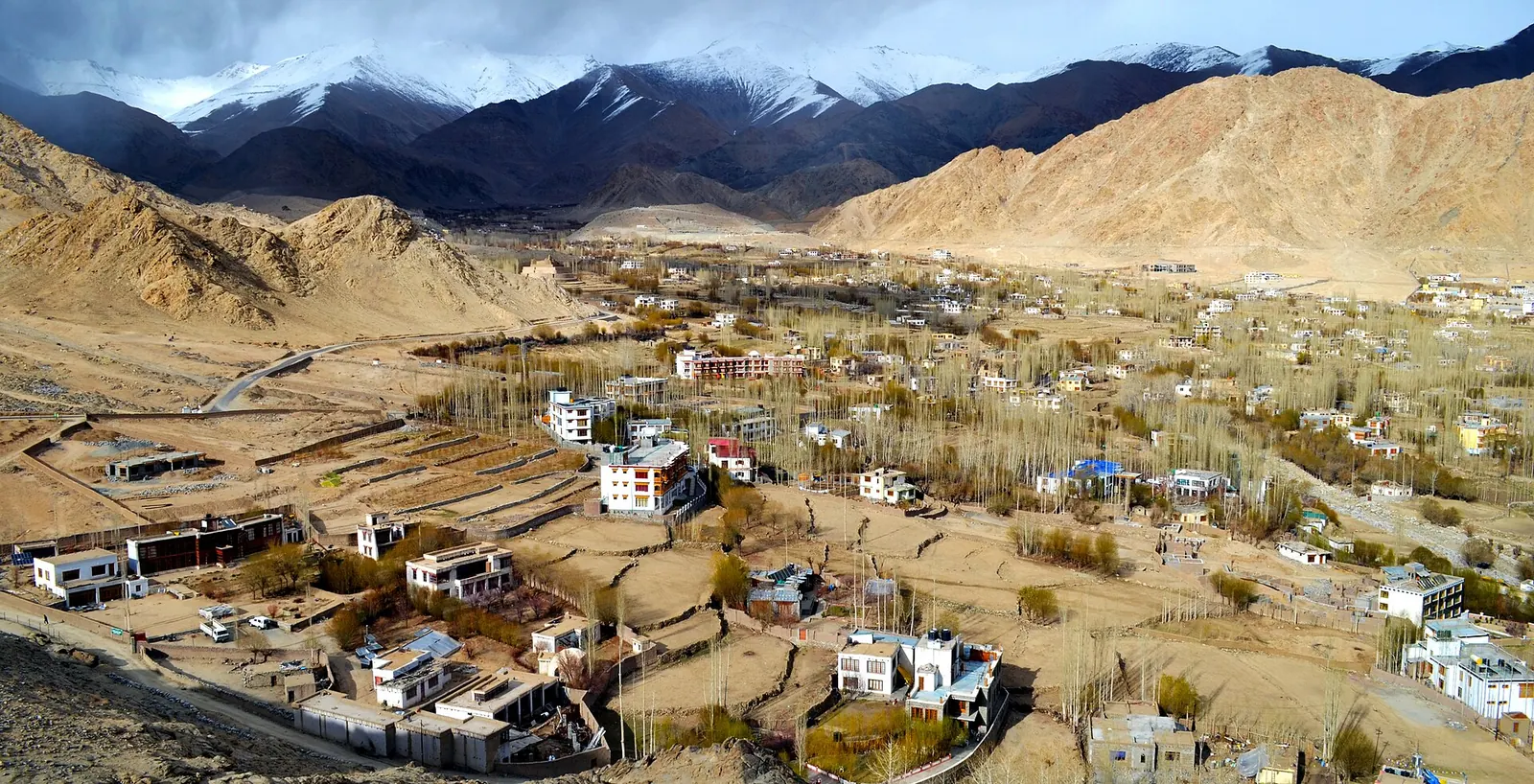
The numbers below use the standard-atmosphere formula for air pressure at height and NIST's saturation curve. Use the calculator for your town, or for the highest pass you plan to cook at.
Boiling point in an open pot and in a cooker at your altitude
| Place (approx. altitude) | Air pressure | Open pot boils at | Cooker at 1 kgf/cm² boils at |
|---|---|---|---|
| Mumbai, Chennai (sea level) | 101.3 kPa | 100.0°C | about 120°C |
| Bengaluru (920 m) | about 90.8 kPa | about 97°C | about 118°C |
| Shimla (2,200 m) | about 78 kPa | about 93°C | about 116°C |
| Leh (3,500 m) | about 65.8 kPa | about 88°C | about 114°C |
| Khardung La (5,360 m) | about 51 kPa | about 82°C | about 111°C |
Values computed from the standard atmosphere and the NIST saturation curve; weather moves air pressure by a few per cent. For riders and trekkers carrying stoves, the ride logistics side is on the Yatri world page.
Does pressure cooking destroy nutrients?
Pressure cooking destroys some heat-sensitive compounds faster per minute, but because it is so much shorter, it often keeps as much or more than long open boiling, and it breaks down anti-nutrients in pulses well. The results depend on the nutrient.
Researchers at Punjab Agricultural University compared steam pressure cooking at 1 kg/cm² with boiling at 100°C, each for three standard times. Both methods significantly reduced phytates, tannins and trypsin inhibitors. Boiling lost more vitamin C and beta-carotene than pressure cooking. In vitro protein digestibility was highest after just 3 minutes of pressure cooking (93.9%), ahead of 15 minutes of boiling (91.0%), and longer cooking in either method lost iron and calcium. Limit: green cowpea pods, not dried pulses, though the anti-nutrient chemistry is similar.
Read the paper (free)Spices lose more under pressure
Spice compounds are a different story. At CSIR-CFTRI in Mysuru, Suresh and colleagues found 10 minutes of pressure cooking caused the largest losses of all methods they tested: up to 53% of the curcumin in turmeric, and the top of the 18 to 36% and 16 to 34% ranges for capsaicin and piperine. That is a good chemical argument for adding part of the turmeric and pepper in a tadka after the cooker has done its job.
Turmeric, red pepper and black pepper were boiled for 10 or 20 minutes or pressure-cooked for 10 minutes, and curcumin, capsaicin and piperine were measured by HPLC. Curcumin losses ran from 27% to 53%, worst in the pressure cooker; tamarind cut the curcumin loss to 12 to 30%. Capsaicin fell 18 to 36% and piperine 16 to 34%, again worst under pressure. Limit: spices cooked in water with or without red gram and tamarind, so real dishes with fat may differ.
Read the paperWhat makes a pressure cooker safe under IS 2347?
A BIS-certified cooker has three layers of protection:
- The weight that regulates pressure.
- A safety relief device, usually a fusible plug that melts before 3 kgf/cm² in wrought-metal cookers.
- A lid that cannot be opened under pressure.
The tests in IS 2347
The 2006 text of IS 2347 defines a domestic cooker as one maintaining up to 1.0 kgf/cm² gauge, and sets the tests:
| Test | Limit |
|---|---|
| Regulator's first operation | Not above 110% of nominal cooking pressure |
| Peak pressure | Within 120% of nominal |
| Body air test | Rising from 0.4 to 1.0 kgf/cm² |
| Cooking capacity | Two-thirds of the vessel at most |
The standard also caps the usable cooking capacity at two-thirds of the vessel's volume. Pulses foam, and foam can carry skins into the vent, so leave plenty of headroom when cooking dal. In January 2026, BIS issued guidelines for Amendment No. 3 to IS 2347:2023, which allows glass-filled nylon for the regulator sleeve and the larger 50% pressure drop on venting.

What's new
- BIS issues guidelines for Amendment No. 3 to IS 2347:2023, changing the regulator pressure-drop rule to 50% Bureau of Indian Standards, Jan 2026
- Pressure cooker explosion during midday meal cooking injures two cooks at a school in Cuttack district OdishaTV, Jan 2026
For what the cooker does to rice grains, read rice science: amylose, basmati and sona masoori; for blood sugar effects of pressure-cooked staples, see the glycaemic index of Indian staples; and for why the cooker never browns food, see the Maillard reaction in Indian cooking. More is on the Rasa world page.
Questions people ask
How many minutes is one whistle?
There is no fixed figure. A whistle marks the cooker venting at its set pressure, so it comes faster on a high flame and slower on a low one. Counting minutes on a low flame after the first whistle is more repeatable.
Why does my cooker leak steam from the lid instead of whistling?
Usually a worn or dirty gasket, or a lid that is not seated properly. Steam escaping at the rim means pressure never builds to the regulator's set point, so food cooks closer to 100°C.
Is it safe to open the cooker immediately after the last whistle?
No. The contents are above 100°C and under pressure. Let it release naturally or lift the weight carefully with a spoon to vent, and open only when no steam hisses out.
Why do recipes say to cook dal on low flame after the first whistle?
Once the cooker is at pressure, you only need enough heat to hold it there. Extra flame just vents steam and water, risks foaming into the vent and wastes gas, without raising the temperature.
Does a pressure cooker work in the hills?
Yes, and it matters more there. At Leh's altitude an open pot boils near 88°C, too cool to cook dal well, while a cooker still reaches about 114°C.
Sources
- NIST Chemistry WebBook: Thermophysical properties of fluid systems, water saturation data (boiling point vs pressure)
- Bureau of Indian Standards: IS 2347:2006 Domestic pressure cookers, specification (1.0 kgf/cm² nominal, fusible plug, tests, two-thirds capacity)
- BIS Central Marks Department-III: Guidelines for implementation of Amendment No. 3 to IS 2347:2023 (21 Jan 2026)
- Akinoso R. and Oladeji O.D., Journal of Biosystems Engineering: Determination of energy and time requirement for cooking pigeon pea (2017)
- Deol J.K. and Bains K., Journal of Food Science and Technology: Effect of household cooking methods on nutritional and anti nutritional factors in green cowpea pods (2010)
- Suresh D., Manjunatha H. and Srinivasan K., Journal of Food Composition and Analysis: Effect of heat processing of spices on their bioactive principles (2007)
- Food52 Hotline: A question about whistles in a sundal recipe (2011)
- OdishaTV: Pressure cooker explosion during midday meal preparation injures two women in Odisha school (2026)
- John Evelyn: The Diary of John Evelyn, volume 2 (Project Gutenberg) (entry for 12 April 1682, the supper cooked in Papin's digesters)
- Wikipedia: Denis Papin (the digester, presented to the Royal Society in 1679)

Sapta (Saptarshi Sarkar) is a mechanical engineer turned marketer in Bengaluru and a solo touring rider. He writes the seven Saptaverse blogs. Work with him or read more of Foodblog.


