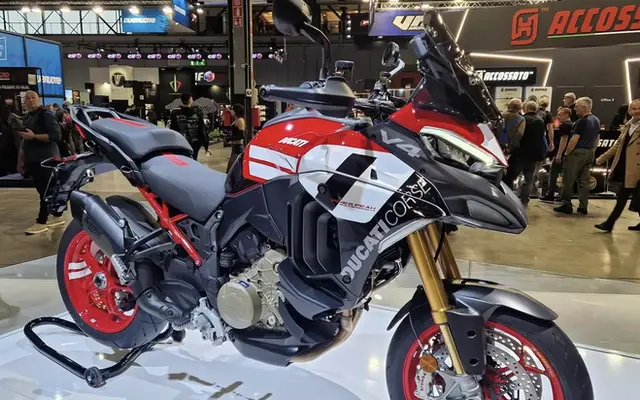
A motorcycle with real AI on board would watch the road with radar and cameras, predict which car is about to pull out, warn you in time, keep your following distance, and add brake pressure the moment you grab the lever too gently. Most of that already exists: front and rear radar went into production on the Ducati Multistrada V4, announced in October 2020 for the 2021 model year, and India's Ultraviolette X47 ships with a 77 GHz rear radar as standard. What does not exist yet is a bike that brakes hard on its own, because a two-wheeler that decelerates unexpectedly can throw its rider.
- 2020: Ducati and Bosch announce front and rear radar for a production bike, the 2021 Multistrada V4.
- 61.5% of 390 real crashes had a moment where at least one assist system could have played a role.
- 0.5 g is about the most automatic braking surprised riders handled in Florence field tests.
- 2.1 seconds: the NTSB's median time from hazard to impact, the window any warning has to beat.
- India's Ultraviolette X47 ships a 77 GHz rear radar as standard: warnings, not auto-braking.
That last point is the heart of this what-if. Cars got automatic emergency braking partly because a car stays upright whatever its brakes do. A motorcycle balances on two contact patches the size of a credit card, steered by a person whose body is part of the suspension.
Any "AI" on a bike has to work with the rider, not instead of the rider. Here is what the hardware does, what the research says it could prevent, and where the physics draws the line.
What would "real AI" on a motorcycle actually mean?
Real AI on a motorcycle means three layers working together:
- Perceive: sensors (IMU, wheel speed, radar, cameras) that see the bike and the road.
- Predict: software that guesses what happens next, such as which car is about to pull out.
- Act: actuators that change the bike (throttle, brake pressure) or alert the rider.
Today's bikes have the first and third layers in partial form. The prediction layer is where the "intelligence" lives, and it is still mostly rule-based rather than learned.
In October 2017, at Thunderhill Raceway's West course in California, Yamaha put its humanoid robot rider Motobot on an unmodified YZF-R1M and asked it to beat a lap set by Valentino Rossi. Rossi had already gone round in 1:25.740. Motobot, with precise track-positioning sensors and fine control of throttle, brake, clutch, steering and gearshift, managed 1:57.504, a little under 32 seconds slower, while touching speeds over 200 km/h.
New Atlas pointed to the gap that mattered: the robot could not move its body on the bike at all, so it could not hang off, shift its weight or brace. Yamaha called the project a test bed for future safety technology. It is the clearest demonstration yet that riding is a whole-body job.
New Atlas: Yamaha's Motobot takes on Valentino Rossi at ThunderhillThe sensors are already familiar. A six-axis inertial measurement unit (IMU) reports lean, pitch and yaw, and is what makes cornering ABS and traction control possible; Bosch and KTM introduced cornering ABS in 2013. Wheel-speed sensors feed ABS. Radar adds distance and closing speed to other vehicles. Cameras add classification: is that a bus, a cow, a pedestrian?
My own KTM 390 Adventure X Plus wears a CHIGEE AIO-6 Max display with front and rear cameras, and they record everything and decide nothing. That gap, between recording and deciding, is the whole subject of this post.
| Function | Sensor | What it does | On sale? |
|---|---|---|---|
| Adaptive cruise control (ACC) | Front radar | Holds a set gap to the vehicle ahead by trimming throttle and braking gently | Yes, since the 2021 Multistrada V4 |
| Forward collision warning | Front radar | Warns by light or sound when closing too fast | Yes |
| Blind-spot detection | Rear radar | Lights a mirror or dash icon when a vehicle sits in the blind spot | Yes, including the Ultraviolette X47 in India |
| Rear collision warning | Rear radar | Flashes hazard lights at a vehicle approaching too fast from behind | Yes (Bosch list; X47) |
| Emergency brake assist | Front radar plus brake hydraulics | Adds pressure when the rider brakes but not hard enough | Listed by Bosch; Honda's version reacts only to rider braking |
| Fully autonomous emergency braking | Radar, camera, IMU | Brakes with no rider input | No; research stage |
| Hazard reasoning (potholes, puddles) | Camera plus vision-language model | Scores each pixel of the road for risk and suggests a path | No; simulation research (Honda Research Institute, 2026) |

Where is motorcycle radar already on sale?
Radar-based rider assistance has been in production since Ducati announced, in October 2020, that the Multistrada V4 would be the first motorcycle with front and rear radar, developed with Bosch. Each unit measured about 70 × 60 × 28 mm and weighed about 190 g, roughly the size of an action camera. The front radar runs adaptive cruise control; the rear one watches the blind spot.
India: the Ultraviolette X47
India has its own entry. Ultraviolette, the Bengaluru electric-motorcycle maker, launched the X47 Crossover on 23 September 2025 at ₹2.74 lakh ex-showroom (₹2.49 lakh for the first 1,000 buyers), with a rear-facing 77 GHz radar it calls Hypersense as standard.
Autocar India reports a 150° horizontal by 68° vertical field of view and tracking out to 200 m, feeding blind-spot alerts in the mirrors, lane-change and overtake warnings, and a rear-collision function that switches on the hazard lamps if something approaches too fast. The bike also records through a dual 1080p dashcam.
Aftermarket radar and Honda Sensing Ride
At EICMA 2025 in Milan, the accessory maker CHIGEE showed an add-on 77 GHz blind-spot radar with matching warning mirrors, which means older bikes can get part of the hardware too.
On 3 November 2026, Honda showed Honda Sensing Ride at EICMA 2026: millimetre-wave radar front and rear, ten functions including adaptive cruise, forward and rear collision warnings, blind-spot alerts and a Group Ride Assist that holds spacing in staggered formation, first on the 2027 Africa Twin Adventure Sports. Its emergency brake assist acts only when the rider is already braking.
How much could rider assistance prevent?
A lot of crashes have a moment where an assist system could have changed the outcome, but "could have played a role" is not the same as "would have prevented". The best open study so far mapped 14 assist systems onto 390 real crashes.
Researchers at Université Gustave Eiffel linked 14 rider assistance systems to the rider errors each could address, then checked 390 in-depth crash cases: 249 from French accident investigations and 141 from the international IGLAD database. At least one system could have influenced 61.5% of the crashes.
ABS led at 34.4%, collision-aversion and surround monitoring 30.8%, emergency and pre-crash braking 27.9%, and adaptive cruise control 17.4%. Weighted to French national data, ABS rose to 39.1% and emergency braking to 30.1%.
The limit you should know: "influence" was judged case by case, without simulating how riders would actually react, so it is an upper bound on potential, not a measured reduction. The underlying crash data are confidential.
Read the paper (free)See the data as a table
| Crashes influenced (%) | |
|---|---|
| ABS | 34.4 |
| Collision aversion (surround monitoring) | 30.8 |
| Emergency and pre-crash braking | 27.9 |
| Adaptive cruise control | 17.4 |
| Smart helmet | 8.2 |
| Dangerous turn warning | 8.2 |
| Combined braking (CBS) | 8.2 |
| Motorcycle stability control | 6.2 |
| Traction control | 2.1 |
| Anti-skid | 2.1 |
| Stoppie control | 0.8 |
Source: Ait-Moula, Riahi and Serre, Heliyon (2024) · Smart helmet, turn warning and CBS (about 32 cases each), traction control and anti-skid (about 8 each) and stoppie control (3) are from case counts out of 390. A crash can count for several systems.
Bosch, which supplies most of the radar hardware, makes a narrower claim. Its current ARAS page says radar-based assistance "could prevent one in six motorcycle accidents", citing Bosch Accident Research from 2022 and German roads; its earlier releases said one in seven. Both are a supplier's estimates, but they sit in the same range as the French study's warning-and-braking categories.
Why can't a motorcycle just brake itself like a car?
Because the rider is not strapped in. A car's automatic emergency braking can brake hard because the seatbelt holds the driver in place. On a motorcycle, a surprise deceleration throws the rider forward onto the bars, which loads the steering, which can make the bike weave or the rider let go. If the bike is leaned, braking also tries to stand it up. Researchers in Florence have spent a decade measuring how much automatic braking an ordinary rider can absorb.
The team derived working parameters from earlier crash studies and injury-risk curves: an intervention lasting at least 0.6 s, a target deceleration of 0.5 g, and a fade-in jerk of 2 g/s.
They then fitted a sport-touring motorcycle with outriggers and a remotely triggered brake, and surprised 31 ordinary riders with it in straight-line riding and in lane changes at 41 to 47 km/h. The system reached a mean 0.48 g for about 1.1 s. No rider lost control and all completed their lane change. Speed reductions of up to 15 km/h could cut serious injuries (MAIS3+) by about 15%.
The limit you should know: the tests were at modest speed, with outriggers, and riders knew they were in an experiment, if not when the brake would fire.
Read the abstractA second Florence study reconstructed 23 real urban crashes and simulated an auto-brake on each motorcycle: it applied in 19 of them, avoided only two outright, but cut mean impact speed by 8.6, 13.8 or 19.1 km/h as the trigger moved from 0.6 to 1.0 s before collision (Piantini et al., 2022). Earlier triggering helps most, and earlier is exactly where false alarms become a problem.
The physics behind that 0.5 g ceiling is simple. A rider of mass m decelerating at a has to resist a forward force of m times a through the arms and knees:
That is like a 37 kg weight suddenly hanging from your shoulders. Braced, a rider holds it easily. Unbraced and surprised, the same force arrives through the handlebars. A rider who starts the stop himself can go well beyond that, because he has braced his body before the brakes bite.
Let the human start the stop, and let the machine supply the missing pressure.The working above
That is why the industry's answer is emergency brake assist: let the human start the stop, and let the machine supply the missing pressure.
How much warning does a radar actually buy you?
Seconds, which is exactly what most riders lack. The US National Transportation Safety Board found a median of 2.1 seconds between the start of a hazard and impact in the 351 crashes of the 2016 Motorcycle Crash Causation Study. A radar that sees 200 m ahead gives far more than that at most closing speeds. The question is whether the warning reaches a rider who then has room to stop:
With these example inputs (80 km/h, which is 22.2 m/s, a 1 s reaction and 0.7 g of braking), the sum is 22.2 + 22.2² / (2 × 6.87) = 22.2 + 35.9 = 58 m. A 200 m radar would give that rider about 9 seconds of warning against a stopped car. The calculator below runs the same sum with your numbers.
Calculated in this post from the stopping-distance formula above, d = vt + v²/2a, with the example inputs named in the paragraph; they are assumptions for illustration, not measured data.
Does the radar warning give you room to stop?
The catch is false alarms. A radar that warns at 200 m about every parked lorry will be switched off within a week, so real systems wait until the time to collision is short. That trims the margin back toward the 2-second window the NTSB measured. The hard problem is not range. It is judging intent: is that autorickshaw stopping, or just slowing to turn?

What would an AI riding coach or hazard reasoner look like?
It would read the road the way an experienced rider does, scoring potholes, puddles and gravel by how dangerous they are, and suggest a line. That is now a research topic, and the first results are in simulation.
Working at Honda Research Institute USA, the authors combined road segmentation with a vision-language model (GPT-4o, zero-shot) that rates each hazard's severity, such as pothole depth or puddle slipperiness, to build a per-pixel risk map. A planner tuned to motorcycle dynamics then suggested throttle and steering.
In the CARLA simulator, over three scenarios of 50 trials each with a Kawasaki Ninja model, success rose from 74/62/52% without the language model to 78/70/68% with it, and clearance from hazards grew.
The limit you should know: it runs on an RTX 4090 laptop, the language model is so slow it is queried once per scene, and lean angle is not modelled in the planner. No real motorcycle was involved.
Read the paper (free)That paper is a fair picture of where on-board AI stands in 2026: it can describe a road usefully, but not yet fast enough, small enough or reliably enough to ride one.
An honest near-term AI coach is more modest. A bike already logs lean angle, throttle, braking pressure and wheel slip through its IMU and ABS unit. Software that turns those logs into feedback after the ride ("you braked late and hard into every left-hander") needs no new hardware and no split-second decisions. Applied well, that is the same pattern I see in other fields where AI helps most when it works beside a skilled person rather than replacing one.
What would it take for Indian bikes to get this?
A price drop of an order of magnitude, and a road the sensors understand. India still sells most of its motorcycles below 125 cc with combined braking rather than ABS; the government's June 2025 draft to make ABS universal from January 2026 had, as of November 2026, no confirmed final notification, as I covered in the ABS mandate story. Radar adds a sensor, a controller and calibration on top of ABS, so it will follow ABS down the price ladder, not jump ahead of it.
The road is the other problem. Radar and camera systems are trained and tested on lane-disciplined traffic. Indian streets add hazards those data sets rarely contain:
- cattle and handcarts;
- wrong-way riders;
- unmarked speed breakers;
- buses that stop anywhere.
The X47's choice of a rear radar for blind spots, rather than a front radar that brakes, is a sensible first step for exactly that reason: warnings fail safe, automatic braking does not.
Perception and warnings are already real: radar sees 150 to 200 m, and blind-spot and collision warnings are on sale, including in India. The part that cannot simply be copied from cars is autonomous braking, because an unbraced rider tolerates only about 0.5 g of surprise deceleration. The workable design is a bike that sees, predicts and warns early, adds brake pressure once the rider starts the stop, and coaches after the ride, with the human still steering.
What's new
- Honda debuts Honda Sensing Ride, front and rear radar with ten functions, on the 2027 Africa Twin Automotive World, Nov 2026
- Ultraviolette X47 Crossover launched with a standard 77 GHz rear radar Autocar India, Sep 2025
- CHIGEE shows an aftermarket 77 GHz blind-spot radar at EICMA 2025 CHIGEE, Nov 2025
- Honda Research Institute tests a vision-language model as a rider hazard advisor arXiv, May 2026
What if next?
- What if you never changed your chain? No radar will save a drivetrain you ignored, and a snapped chain picks its moment badly.
- What if you ran a bike on kerosene, diesel or 100% ethanol? India now sells flex-fuel bikes; the other two fuels are a different story.
- What if your front brake failed at 100 km/h? The case where brake assist has nothing to assist, worked out in metres.
Questions people ask
Which motorcycles have adaptive cruise control?
Radar ACC arrived with the Ducati Multistrada V4 for 2021, and Bosch supplies similar systems to several European and Japanese makers on large touring and adventure bikes. Honda's Sensing Ride adds it to the 2027 Africa Twin Adventure Sports. In India, ACC is limited to imported premium models; the Ultraviolette X47's radar faces rearward and does not run cruise control.
Can a motorcycle brake automatically?
Not on any production bike in 2026. Systems marketed as emergency brake assist only add pressure once the rider has started braking. Research prototypes have tested fully automatic braking at around 0.3 to 0.5 g with ordinary riders, who kept control, but only at moderate speeds and in controlled conditions.
Is blind-spot radar worth it on a motorcycle?
It is the most useful radar feature for traffic like India's, because it warns without taking control, so a false alarm costs nothing. It does not replace a shoulder check, and it cannot see a rider filtering at your elbow until they enter its field of view.
Does radar work in rain?
Radar works in rain, fog and darkness far better than cameras, which is why it was chosen first. Heavy mud or snow over the sensor can block it, and most systems tell the rider when they are unavailable.
Sources
- Ait-Moula, Riahi and Serre: Effect of advanced rider assistance system on powered two wheelers crashes, Heliyon (2024)
- Lucci et al.: Does Motorcycle Autonomous Emergency Braking (MAEB) mitigate rider injuries and fatalities?, Transportation Research Part C (2022)
- Elnoor et al.: VLM-Based Advanced Rider Assistance System for Motorcycle Safety, arXiv (2026)
- NTSB: Select Risk Factors Associated with Causes of Motorcycle Crashes, NTSB/SR-18/01 (2018)
- Bosch Mobility: Advanced rider assistance systems for two-wheelers
- Ducati: Entry into production of the first motorcycle with front and rear radar, the Multistrada V4 (2020)
- Autocar India: Ultraviolette X47 Crossover launched at Rs 2.74 lakh (2025)
- Automotive World: Honda brings car-derived sensing tech to motorcycles (2026)
- CHIGEE: EICMA 2025, new radar safety tech unveiled (2025)
- Piantini et al.: Assessment of the effect of motorcycle autonomous emergency braking (MAEB) based on real-world crashes, Traffic Injury Prevention (2022)
- New Atlas: Yamaha's Motobot takes on Valentino Rossi at Thunderhill (2017) (source for the story: lap times 1:25.740 and 1:57.504)

Sapta (Saptarshi Sarkar) is a mechanical engineer turned marketer in Bengaluru and a solo touring rider. He writes the seven Saptaverse blogs. Work with him or read more of RoadHook Machines.