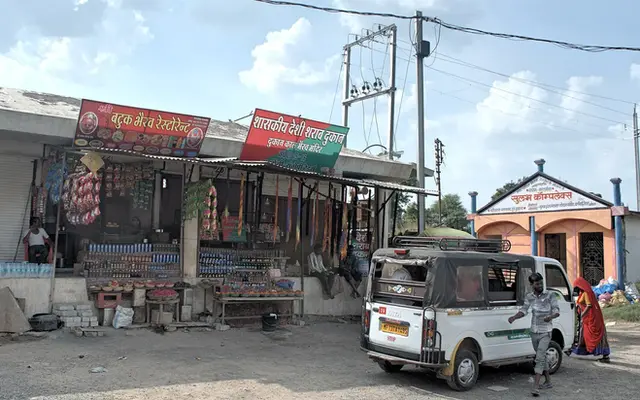
A Bengaluru darshini is a self-service South Indian tiffin restaurant where you pay first, collect your food against a token and usually eat standing at a steel counter. The format began with Cafe Darshini, opened by R. Prabhakar in Jayanagar in 1983, and it grew to an estimated 5,000 outlets in the city, which reported serving 50 to 60 lakh meals a day by around 2000. It was fast food built around idli, dosa and filter coffee, years before McDonald's opened in India in 1996.
- 1983: R. Prabhakar's Cafe Darshini in Jayanagar packaged tiffin as self-service fast food.
- 5,000 outlets and 50–60 lakh meals a day by around 2000, by DNA's estimate.
- Pay first, token, stand: each design choice removes a cost or a delay.
- 13 years ahead of McDonald's first Indian outlet, set to open in Delhi in October 1996.
Calculated in this post from Cafe Darshini in 1983 and McDonald's Delhi opening in 1996.
- About 60% higher wages, and a cylinder that went from ₹1,884 to ₹3,152, squeezed the model in 2026.
The argument of this post is simple. The darshini is not a cheap version of a restaurant; it is a different machine, designed for speed, a narrow menu and very high volume, and that design is why it beat the global chains on their own terms in Bengaluru.
The same design is also why rising wages, gas and milk prices in 2026 hit it harder than most. The account below uses published reporting and official data only.
Where did the Bengaluru darshini come from?
The darshini began in 1983 when R. Prabhakar opened Cafe Darshini in Jayanagar, south Bengaluru, borrowing the speed of foreign fast-food chains for South Indian tiffin.
R. Prabhakar had travelled to Singapore, Malaysia and parts of Europe and watched chains like KFC and McDonald's put food in customers' hands in minutes. South Indian food, he reasoned, could be served just as fast. He tried the idea at his brother-in-law's café in Jayanagar, Cafe Darshini: no waiters, a counter, self-service. People told him it would fail, because Bengaluru diners were used to spending long hours at restaurants. Speaking to Slurrp at 70, he recalled that the place was full in no time. He chose the name for the act of seeing the food and choosing it, the way you read a board at a burger chain.
Slurrp: Why are darshinis in Bengaluru called so? (interview with R. Prabhakar, 2023)From one café to a category
The name stuck to a category. Mint's 2024 long read on the sector notes that copycat outlets used the word "darshini" in their names until it became generic. The Caravan reported in 2015 that Cafe Darshini itself has since closed.
Similar no-frills eateries existed before 1983, and Citizen Matters credits Upahara Darshini in Basavanagudi as another early example, so "first" is best read as first to package the format.
The food was inherited, not invented
Darshini menus are the tiffin repertoire of the older Udupi-style hotels that had spread through South Indian cities: idli, vada, dosa, upma, kesari bath and filter coffee. The full lineage is in the posts on the history of Udupi restaurants and the MTR story. What 1983 changed was the service, not the dosa.

How does the darshini model work?
A darshini works by removing everything that slows a restaurant down: waiters, seating, menus to read at the table and payment at the end. The Quint's 2018 description of the routine is the standard one:
- Choose from the board on the wall.
- Pay at the cash counter.
- Take a token and hand it in at the food counter.
- Eat, usually standing.
- Leave, freeing the counter for the next customer.
The Caravan describes it as pay first and eat standing up. DNA's 2010 profile adds the hardware: steel tables, steel plates, steel tumblers.
Each feature cuts a specific cost or delay:
| Design feature | What it removes | Effect on the business |
|---|---|---|
| Pay first, token system | Bill disputes, waiting for the cheque, unpaid walkouts | Cash in before food out; one cashier handles the whole room |
| Standing counters, few or no chairs | Lingering; large floor area | Far more customers per square metre per hour; works on small, high-rent frontages |
| Short fixed menu (idli, vada, dosa, rice bath, coffee) | Complex inventory; long cooking queues | Batch cooking of batter, chutney and sambar; dosa made to order on one tawa line |
| Steel plates and tumblers | Breakage, disposables | Low replacement cost, fast washing |
| Open kitchen counter | Hidden preparation | Visible freshness builds trust without table service |
Volume is the whole point. A Gandhi Bazaar manager told The Quint in 2018 that his outlet sold around 500 plates of each popular item, such as idli and dosa.
Mint's 2024 analysis makes the finance point: quick turnaround gives darshinis unusually high asset turns, which is why so many survive in an industry where most restaurants fail.
A darshini is not a cheap restaurant. It is a different machine, built for speed, a narrow menu and very high volume.

How big did the darshini business get?
By around 2000 Bengaluru had an estimated 5,000 darshinis serving 50 to 60 lakh meals a day, according to DNA's 2010 report, which said the number had since fallen to about 3,000. The Caravan put the count back at about 5,000 in 2015.
The city gave it a licence
The city formalised it. DNA reported a 2004 order from the municipal corporation requiring darshini staff to wear caps and aprons and to serve UV-treated water, and Slurrp and Mint both note that the BBMP began issuing a separate "darshini type hotel" trade licence from the mid-2000s. A food format that gets its own licence category has stopped being a fad.
Then the chains
The Caravan traced Vasudev Adiga's chain to 1992, building on the Brahmin's Coffee Bar, founded in 1965. In 2012 an affiliate of the private-equity firm New Silk Route bought a controlling stake when the chain had 11 restaurants, with plans backed by ₹165 crore; by 2015 it had 27 outlets and was valued at more than ₹100 crore.
The newest generation, Mint reported in 2024, includes Bengaluru Cafe, Taaza Thindi and South Kitchen, with corporate management, rustic décor and production methods borrowed from factories.
The Rameshwaram Cafe outlet at Brookefield, about 14,000 sq ft, uses digital kiosks, UPI payment and printed tokens (Mint, 2024): the 1983 token, digitised.
What labour and gas cost per plate at a darshini
Use this to check what you just read: play with the volume slider and the logic of the format becomes obvious. Fixed costs such as wages and gas are spread over plates, so with these example inputs (1,500 plates a day, an illustrative figure, not data from any outlet) the per-plate labour cost is a fraction of what the same staff would cost per plate at a few hundred plates a day.
Halve the plates and the per-plate cost doubles. That is why the format depends on footfall, and why it is so exposed when costs jump.
Why did the darshini beat global fast food in Bengaluru?
Darshinis won because they delivered the core promise of fast food (speed, consistency, low price) using food that Bengaluru already ate for breakfast and tiffin, at a price the chains could not match. They also arrived 13 years before McDonald's opened its first Indian outlet, at Basant Lok in Delhi in October 1996 (The Indian Express, 1996).
Calculated in this post from Cafe Darshini opening in 1983 and the 1996 Delhi opening.
There are four structural advantages:
- Fresh, not frozen. Fermented batter, chutneys and sambar are made daily and turned over within hours. The supply chain is a local vegetable market and a wet grinder, not a cold chain.
- Vegetarian by default. One menu works for nearly every customer, with no separate kitchens or certifications.
- Low ticket, high frequency. People eat at a darshini several times a week, for breakfast, coffee and an evening snack. Global chains in India built around lunch, dinner and occasions.
- Coffee as the anchor. Filter coffee is cheap to make in bulk from decoction and milk, and it brings customers back twice a day. The chemistry is in filter coffee decoction and extraction.
The household data shows the market they serve is still growing. In MoSPI's Household Consumption Expenditure Survey 2023-24, "beverages, refreshments and processed food", the group that includes food bought ready to eat, was the single largest item in the food budget of both rural and urban India.
The survey, conducted August 2023 to July 2024, put average monthly per capita consumption expenditure at ₹4,122 in rural and ₹6,996 in urban India. Food was about 47% of rural and about 40% of urban spending. Within food, beverages, refreshments and processed food had the largest share in both sectors: 11.09% of urban and 9.84% of rural MPCE, ahead of milk products (7.19% urban, 8.44% rural) and vegetables (4.12% urban, 6.03% rural). The limit: the category mixes packaged snacks, soft drinks and restaurant meals, so it shows the direction of eating out, not the darshini share.
Read the press note (free)See the data as a table
| Urban (%) | Rural (%) | |
|---|---|---|
| Beverages, refreshments and processed food | 11.09 | 9.84 |
| Milk and milk products | 7.19 | 8.44 |
| Vegetables | 4.12 | 6.03 |
Source: MoSPI, Household Consumption Expenditure Survey 2023-24, press note
Karnataka eats out more than India does
Karnataka is ahead of the national pattern. In the full HCES 2023-24 report (NSS Report No. 592), beverages, refreshments and processed food took a larger share of food spending than the national average:
| Share of food spending | Karnataka | All India |
|---|---|---|
| Urban | 33.23% | 27.95% |
| Rural | 24.75% | 20.93% |
Among the major states in Table 3.9U, only urban Tamil Nadu (34.30%) and urban Telangana (33.63%) were higher than urban Karnataka.
Tea data points the same way. The Tea Board's national study of domestic tea consumption found that Western and Southern states have a higher share of out-of-home drinking than the North, Centre and East. It linked this to urbanisation and industrial work, while noting a stigma about eating outside the home in the North.
A city where people already took coffee and tiffin outside the home was fertile ground for a fast, cheap outlet.

Why are darshini prices rising in 2026?
Darshini prices are rising because the three biggest variable costs, wages, cooking gas and milk, all jumped within a few months in 2026. On 22 May 2026 Karnataka's Labour Department issued a single minimum wage notification for 81 scheduled employments, including hotels and restaurants, and the Karnataka State Hotels Association said it raised wages by about 60% on average.
The notification replaced employment-by-employment rates with a single structure of three zones and four skill grades, after High Court litigation over the 2022-23 revisions. Hotels, lodging hotels, restaurants and dhabas are listed as a scheduled employment. In Zone 1, which covers the Bengaluru area, the general monthly rates run from ₹25,714 for unskilled to ₹34,225 for highly skilled work. The limit: the translation is unofficial, and the Kannada gazette text is authoritative; the association's 60% figure is its own estimate of the average rise.
Read a summary of the notificationThe other costs moved in step:
- Gas. The association said in May 2026 that a 19 kg commercial LPG cylinder had gone from ₹1,884 to ₹3,152 within a few months.
- Milk. In late October 2026 milk rose by ₹8 a litre and curd by ₹14, and the Bengaluru Hotels Association said a rise of ₹2 to ₹3 would have been absorbable. Tea and coffee went up by ₹3 to ₹5 across hotels and darshinis, with some outlets moving coffee from ₹20 to ₹25, according to the Times of India report.
- Menus. The state hotels association warned that idli could move from about ₹50 to ₹80, masala dosa from ₹80-90 to ₹150, and biryani from ₹300-350 to nearly ₹500 (The Pioneer, 2026), phased over months. These were warnings, not announced prices.
Run the calculator with the old and new numbers and the squeeze is clear. Because the darshini runs on thin margins per plate and huge volume, it cannot absorb a 60% wage rise and a two-thirds jump in gas on the same footfall. It has three exits:
- Raise prices, which the hotels association has already warned about;
- Cut staff by automating, the kiosk route;
- Sell more plates per square foot.
Is the darshini still the best fast-food model for India?
As a design, yes: the darshini remains the clearest Indian answer to the question fast food asks, which is how to serve fresh food in two minutes at a price people pay daily. Its weaknesses are the ones the 2026 cost shock exposed, a dependence on cheap labour and cheap fuel.
The next version is already visible. The Mint report describes operators using first-in-first-out stock, just-in-time production and daily reviews modelled on Toyota's methods, and the largest new outlets replace the cashier with a kiosk. If I had to bet, the format survives by doing what it did in 1983: taking the best operating idea from global chains and applying it to local food, rather than copying their menus.
For the drink that holds the whole model together, read why the south drinks coffee and the north drinks tea. For more food stories from the city and beyond, start at the Rasa world page.
What's new
- Bengaluru hotels and darshinis raise tea and coffee by ₹3 to ₹5 after milk goes up ₹8 a litre Times of India via The Dairy News, Nov 2026
- Karnataka hotels warn idli could reach ₹80 and dosa ₹150 after a 60% wage revision The Pioneer, May 2026
- Karnataka overhauls minimum wages into three zones across 81 employments India Briefing, May 2026
Questions people ask
What is a darshini in Bangalore?
A self-service, mostly vegetarian South Indian eatery where you pay at a counter, collect food with a token and usually eat standing. The menu centres on idli, vada, dosa, rice dishes and filter coffee.
Who started the first darshini?
R. Prabhakar is credited with the concept, through Cafe Darshini in Jayanagar in 1983. Some local histories also name Upahara Darshini in Basavanagudi as an early example.
Why do people stand and eat at darshinis?
Standing counters let a small, expensive frontage serve far more customers per hour than a seated restaurant. Quick turnover is how darshinis keep prices low.
How many darshinis are there in Bengaluru?
No official count exists. Published estimates range from about 3,000 (DNA, 2010) to about 5,000 (DNA for around 2000, and The Caravan in 2015).
Sources
- Slurrp: Why are darshinis in Bengaluru called so? (interview with R. Prabhakar) (2023)
- DNA: A bite into reality (darshini numbers and BBMP order) (2010)
- The Caravan: Taking orders, the legal battle over a Bengaluru restaurant chain (2015)
- The Quint: Darshinis of Bengaluru, a food culture by themselves (2018)
- Mint (reposted by Marcellus): Bengaluru's darshini wars (2024)
- Citizen Matters: Basavanagudi, bastion of Kannada and culture (2008)
- The Indian Express (archived): McDonald's to launch first restaurant in Delhi next week (1996)
- MoSPI: Household Consumption Expenditure Survey 2023-24, press note (2025)
- MoSPI: NSS Report No. 592, Survey on Household Consumption Expenditure 2023-24, Tables 3.9R and 3.9U (2025)
- Tea Board of India: Executive summary of study on domestic consumption of tea in India
- India Briefing: Karnataka minimum wage overhaul 2026 (2026)
- The Pioneer: Karnataka hotels warn of food price hike after wage revision (2026)
- The Dairy News (Times of India): Bengaluru eateries raise tea and coffee prices (2026)

Sapta (Saptarshi Sarkar) is a mechanical engineer turned marketer in Bengaluru and a solo touring rider. He writes the seven Saptaverse blogs. Work with him or read more of Foodblog.