
An AI-native motorcycle in 2045 would be a bike whose sensors, software and brakes are designed together around the rider: forward and rear radar plus cameras that track traffic several vehicles ahead, an inertial unit that tracks the bike's lean, a rider-fatigue monitor, and brakes that can start working about 0.2 seconds after a threat appears instead of the second or so a human needs. At 80 km/h that head start shortens the stop by about 18 m. What it should not do is take over steering or lean, because a single-track vehicle with a person balanced on top cannot be driven like a car.
- 61.5% of 390 analysed two-wheeler crashes could have been influenced by at least one rider-assistance system (Ait-Moula, 2024).
- 17.8 m shorter stop from 80 km/h, with these example inputs, if braking starts 0.2 s after a threat instead of 1.0 s.
- 2 m/s² is the most automatic braking ordinary riders have been tested with so far.
- 44.8% of India's 1,72,890 road deaths in 2023 were two-wheeler users.
- Verdict: possible with changes. See, warn and brake gently: yes. Steer and lean for the rider: no.
This is a tier-2 what-if, so the 2045 bike is built up from what exists in 2026, with the physics of stopping worked out step by step. Forecasts about 2045 are labelled as my projections. Every number about today has a source.
In January 2021, KTM revealed the updated 1290 Super Adventure S, which Bennetts described as the first motorcycle in the world with radar-assisted safety equipment as standard. Ducati and BMW already sold the same Bosch-developed radar, but only as a paid option.
KTM's adaptive cruise worked from 30 km/h up to 150 km/h, offered five following-distance settings, stayed active through gear changes and switched off the moment the rider touched either brake. It was a small step: a sensor that measured the gap and a throttle that respected it. Every AI-native motorcycle starts from a sensor like that one.
Bennetts BikeSocial: New KTM 1290 Super Adventure S 2021What does a motorcycle already know in 2026?
Quite a lot about itself, and a little about the road. The building blocks of an AI-native bike are already in showrooms; they just do not yet talk to each other as one system.
- An inertial measurement unit (IMU): a six-axis sensor that measures lean, pitch and yaw rates, used by cornering ABS and traction control. Yamaha's self-balancing prototype uses one to drive its steering actuators.
- Front radar: adaptive cruise and forward collision warning, first offered by Bosch with Ducati and KTM.
- Rear radar: blind-spot detection and rear collision warning. Ultraviolette fitted radar as standard on its X-47 in September 2025.
- Cameras: Hero MotoCorp and Valeo showed a radar-plus-camera system at CES in January 2026, adding pedestrian detection, lane departure and traffic-sign recognition.
- Connected apps: navigation, crash detection and ride logs on the phone.
Bosch's accident researchers estimated in 2018 that radar-based assistance could prevent one in seven motorcycle crashes. The deeper look below comes from French crash data.
The authors matched 14 rider-assistance systems to the rider failures behind 390 real crashes from two in-depth databases, then weighted the results to French national data. At least one system could have influenced 61.5% of the crashes. Nationally, ABS had the largest effect (39.1% of crashes), followed by emergency braking (30.1%), anti-collision warning (29.8%), adaptive cruise (17.3%) and combined braking (11.7%). Just over 35% of national crashes were beyond any system's reach. The limit: "influence" is a judgement from crash reconstructions, not a measured reduction in deaths.
Read the paper (free)See the data as a table
| Crashes influenced, French national weighting (%) | |
|---|---|
| ABS | 39.1 |
| Emergency braking (AEB/PCB) | 30.1 |
| Anti-collision warning | 29.8 |
| Adaptive cruise control | 17.3 |
| Combined braking | 11.7 |
Source: Ait-Moula, Riahi and Serre, Heliyon (2024) · Systems overlap, so the shares do not add up. Based on 390 in-depth crash cases weighted to French national data.
Why does reaction time matter so much?
Because the distance you cover before braking grows with speed, while the braking distance grows with speed squared. A machine cannot brake harder than the tyres allow, but it can start sooner. The stopping distance has two parts:
Here \(t_r\) is the time before the brakes bite and \(a\) is the deceleration. Take 80 km/h, which is 22.2 m/s, and a hard ABS stop on dry tarmac of 7 m/s² (my estimate for a good rider on a modern bike).
- Braking part. \( v^2 / 2a = 493.8 / 14 = 35.3 \) m, the same for human or machine.
- Human, 1.0 s to react. \( 22.2 \times 1.0 = 22.2 \) m before braking. Total: 57.5 m. One second is my mid-range estimate; real reaction times vary with surprise and fatigue.
- Machine, 0.2 s latency. \( 22.2 \times 0.2 = 4.4 \) m. Total: 39.7 m. The 0.2 s for sensing, deciding and building brake pressure is my estimate.
- Gain. 17.8 m, about four car lengths, from starting earlier alone.
Calculated in this post, with these example inputs (80 km/h or 22.2 m/s, braking at 7 m/s², 1.0 s human reaction, 0.2 s machine latency), from the standard stopping-distance sum of reaction distance and braking distance (Wikipedia, Braking distance): 57.5 m for the human, 39.7 m for the machine, a gain of 17.8 m. The 1.0 s, 0.2 s and 7 m/s² are my estimates, not measured values.
Why can't the bike just brake hard by itself?
Because a rider who is not expecting it can be thrown forward, or off. A car occupant is belted in a seat. A rider holds on with hands and knees and balances a leaning machine. That is why motorcycle autonomous emergency braking (MAEB) has been tested so cautiously.
The Florence team reviewed MAEB trials and set out a test protocol after pilot tests on an instrumented motorcycle. Ordinary riders had only been exposed to automatic braking in a straight line, up to 2 m/s².
Professional riders had seen up to 7 m/s², but not as true surprises. The protocol caps the onset jerk at 25 m/s³ to avoid destabilising the bike, and proposes tests in curves (25–40 km/h, 20–30° of lean), lane changes and traffic filtering. The limit: it is a method paper; acceptance at higher decelerations and in corners was still unproven.
Read the paper (free)Worked solution: what a gentle 2 m/s² auto-brake buys
Suppose a car pulls out 45 m ahead at 80 km/h. The bike brakes gently by itself for the first second, until the rider reacts and brakes at 7 m/s². Two constant-acceleration equations from Newton's mechanics do all the work:
- First second, auto-brake. Distance: \( 22.2 - \tfrac12 \times 2 \times 1^2 = 21.2 \) m. Speed: \( 22.2 - 2 = 20.2 \) m/s.
- Rider brakes over the last 23.8 m. \( v^2 = 20.2^2 - 2 \times 7 \times 23.8 = 74.8 \), so impact at 8.7 m/s, or 31 km/h.
- Without the auto-brake. 22.2 m of reaction leaves 22.8 m: \( v^2 = 493.8 - 319.2 = 174.6 \), impact at 13.2 m/s, or 48 km/h.
- Energy at impact. Kinetic energy goes with \(v^2\): \( (8.7/13.2)^2 = 0.43 \), so about 57% less energy hits the car.
Calculated in this post from the constant-acceleration equations (Wikipedia, Equations of motion) and kinetic energy as ½mv² (Wikipedia, Kinetic energy), with these example inputs: 45 m gap, 22.2 m/s, 2 m/s² for the first second, then 7 m/s². The rider brakes over the last 23.8 m (45 − 21.2), with v² = 20.2² − 2 × 7 × 23.8 = 74.8, so an impact at 8.7 m/s or 31 km/h; without the auto-brake, 22.2 m of reaction leaves 22.8 m, v² = 493.8 − 319.2 = 174.6, and the impact is 13.2 m/s or 48 km/h. The energy ratio is (8.7/13.2)² = 0.43, so about 57% less.
A brake gentle enough not to throw the rider still removes more than half the crash energy, because it uses the second the human spends noticing.

How would it see the truck three vehicles ahead?
Not with its own eyes. It would need other vehicles to tell it. Radar and cameras need line of sight, and a bus or truck blocks everything behind it. My projection for 2045 combines three layers:
- Own sensors. Front and rear radar plus cameras, as in the Hero–Valeo concept, covering what the bike can see directly.
- Vehicle-to-vehicle messages. The truck ahead broadcasts "hard braking" the instant its driver brakes, and the bike hears it before the cars in between react.
- Road maps with memory. Known black spots, speed breakers and sharp curves, so the bike warns before the corner, as the dangerous-turn warnings in the Heliyon review already do.
The physics of the gain is the same as above. Every 0.1 s of earlier warning at 80 km/h is 2.2 m of extra space. A warning that arrives one second before the brake lights of the car in front would be worth 22 m.
Calculated in this post: 22.2 m/s × 0.1 s is 2.2 m of reaction distance (Wikipedia, Braking distance), so one second earlier is 22 m.
What would the full 2045 system look like?
Here is my projection, built only from functions that exist in some form today.
| Function | 2026 status | 2045 projection | Who decides |
|---|---|---|---|
| Forward collision warning | On sale (Bosch, KTM, Ducati, Hero–Valeo concept) | Standard, with vehicle-to-vehicle data | Machine warns |
| Blind-spot and rear warning | On sale (Ultraviolette X-47, Ducati, Triumph) | Standard | Machine warns |
| Automatic braking | Tested up to 2 m/s² with riders | Gentle pre-braking, rider-adapted | Shared |
| Cornering ABS and traction control | On sale (IMU-based) | Predictive, reads surface ahead | Machine limits |
| Rider fatigue monitoring | Not on motorcycles | Camera and riding-pattern based | Machine advises |
| Steering and lean | Low-speed prototypes only | Rider only | Rider |
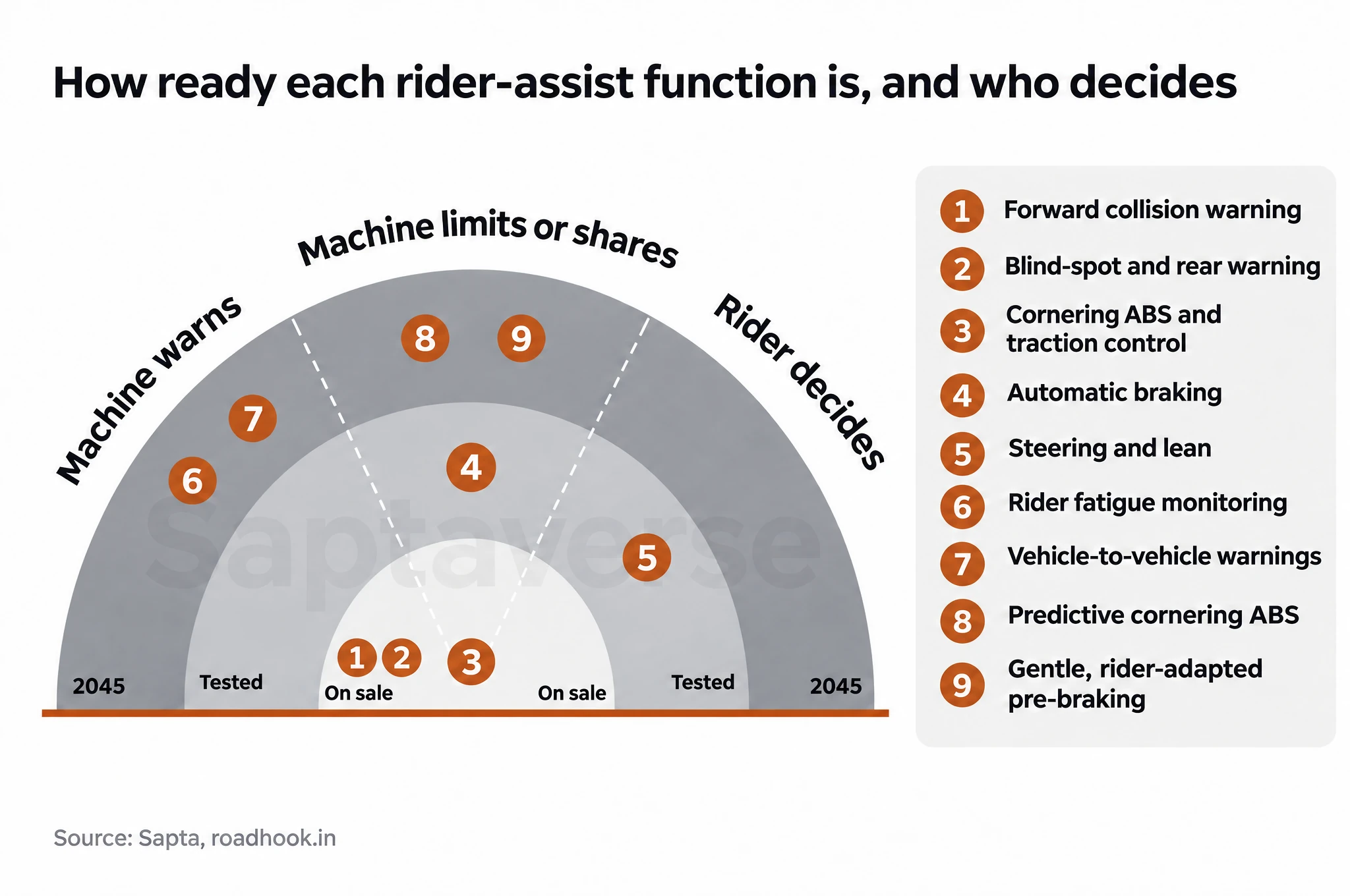
- Forward collision warning: on sale from Bosch with Ducati and KTM
- Blind-spot and rear warning: on sale, standard on the Ultraviolette X-47
- Cornering ABS and traction control: on sale, run by the IMU
- Automatic braking: tested with riders up to 2 m/s²
- Steering and lean: low-speed prototypes only; stays with the rider
- Rider fatigue monitoring: not on motorcycles yet; camera and riding-pattern based
- Vehicle-to-vehicle warnings: collision warning fed by other vehicles
- Predictive cornering ABS: reads the surface ahead
- Gentle, rider-adapted pre-braking: shared between rider and machine
What should never be automated?
Steering and lean at road speed. A motorcycle turns by countersteering: a brief push on the bar the "wrong" way tips the bike into the lean. The rider's body is part of the mass being balanced. A sudden steering input from a machine, at a moment the rider did not expect, could cause the very fall it was meant to prevent.
- Swerving for you: the Lucci team lists swerves as the most relevant pre-crash move and still untested for automatic systems.
- Braking hard in a curve: standing the bike up mid-corner can run it wide, which is why cornering ABS limits braking with lean angle.
- Choosing to ride: fatigue warnings should advise, not lock the rider out of a bike on a lonely highway at night.
Low-speed balance is different. Below walking pace, motors can hold the bike up safely, as Honda and Yamaha prototypes have shown, and as the next what-if explores.

Try it with your own speed
Use this to check what you just read. Change your reaction time, the machine's latency and the grip and compare the two stops.
Human vs machine stopping distance
Why does this matter most in India?
Because two-wheeler riders are the largest group dying on Indian roads. The road ministry's report for 2023 recorded 4,80,583 crashes and 1,72,890 deaths, and two-wheeler users made up 44.8% of those deaths, roughly 77,000 people by my arithmetic. Helmets are still the biggest single lever, as covered in helmets and India's two-wheeler deaths.
The Heliyon authors also note that blind-spot warning matters in India, where wide multi-lane roads create side-swipe crashes. Systems tuned for European traffic will need Indian data: mixed speeds, animals, wrong-side riders and unmarked speed breakers.
The machine's advantage is not stronger brakes. It is the second a human spends noticing.From the stopping-distance working above
So, what does it look like?
- Sees: radar and cameras front and rear, plus messages from vehicles it cannot see.
- Knows itself: lean, grip and load from an IMU, every few milliseconds.
- Acts: warns, limits and gently pre-brakes, worth 18 m at 80 km/h by starting 0.8 s sooner.
- Leaves alone: steering, lean and the decision to ride.
Calculated in this post: starting 0.8 s sooner (1.0 s down to 0.2 s) at 22.2 m/s saves about 18 m, using the reaction-distance term of the stopping-distance sum (Wikipedia, Braking distance).
An AI-native motorcycle is possible by 2045 if "AI-native" means perception, prediction and gentle intervention, not autonomy. With these example inputs, starting the brakes 0.2 s after a threat instead of 1.0 s cuts an 80 km/h stop from 57.5 m to 39.7 m, and even a rider-safe 2 m/s² pre-brake removes about 57% of impact energy in the example above.
Full self-riding with a person aboard is the part to leave out. Balance and countersteering put the rider's body inside the control loop, and automatic steering at lean is untested and risky. The cost should be small: these are mostly sensors and software already being built for mass-market Indian bikes.
For how cornering ABS and traction control use that IMU today, read traction control and cornering ABS explained and how motorcycle ABS works. A shorter near-term take is in what if a motorcycle had real AI on board. For how I think about AI as a tool more broadly, see Applied AI.
What's new
- Hero MotoCorp and Valeo team up on radar-and-camera rider assistance for bikes and scooters Autocar India, Jan 2026
- Ultraviolette X-47 Crossover launches with radar as standard The Machine Maker, Sep 2025
- OMOWAY says its self-balancing OMO X electric motorcycle has entered mass production Electrek, Mar 2026
What if next?
- What if a motorcycle could balance itself forever? The one job a machine can safely take at walking pace.
- What if a bike never needed fuel? All those sensors need power too.
- What if an engine had no friction? The other way to make a bike smarter: waste less.
Questions people ask
Do motorcycles have automatic emergency braking?
Not as a full system on sale. Bikes offer collision warnings and radar cruise, and researchers have tested automatic braking with ordinary riders only up to about 2 m/s² in a straight line, because hard unexpected braking can unsettle a rider.
Which motorcycles have radar?
Bosch-developed radar has been offered by Ducati, BMW and KTM, with KTM's 2021 1290 Super Adventure S the first to make it standard. In India, Ultraviolette's X-47 launched with radar as standard in 2025, and Hero MotoCorp is developing a system with Valeo.
Will motorcycles ever be self-driving?
Robots can ride, as Yamaha's Motobot showed, but carrying a human changes the problem. The rider's body is part of the balance, so the likely future is a bike that sees and warns brilliantly while the rider still steers.
How much can rider assistance reduce crashes?
Bosch estimated in 2018 that radar systems could prevent one in seven motorcycle crashes. A 2024 study of 390 crashes found at least one assistance system could have influenced 61.5% of them, with ABS the most influential.
Sources
- Ait-Moula, A., Riahi, E. and Serre, T.: Effect of advanced rider assistance system on powered two wheelers crashes, Heliyon 10(4) (2024) (source for 390 crashes, 61.5%, 39.1%, 30.1%, 29.8%, 17.3%, 11.7%)
- Lucci, C. et al.: Investigating the feasibility of motorcycle autonomous emergency braking, MethodsX 8 (2021) (source for 2 m/s², 7 m/s² with professionals, 25 m/s³ jerk limit, curve test ranges)
- Bennetts BikeSocial: New KTM 1290 Super Adventure S 2021 (2021) (source for the first standard radar, 30–150 km/h, five gap settings)
- Bosch: Fewer accidents, Bosch is teaching motorcycles how to see and feel (2018) (source for one in seven)
- The Week (PTI): 1.72 lakh people died in 4.80 lakh road accidents in 2023 (2025) (source for 4,80,583 crashes, 1,72,890 deaths, 44.8%)
- Autocar India: Hero partners with Valeo to develop radar-based safety tech (2026)
- The Machine Maker: Ultraviolette unveils X-47 Crossover with standard radar (2025)
- Rushlane: Yamaha R25 self-balancing tech (AMSAS) (2023) (source for the six-axis IMU and steering actuators)
- Electrek: The world's first self-balancing electric motorcycle is entering production (2026)

Sapta (Saptarshi Sarkar) is a mechanical engineer turned marketer in Bengaluru and a solo touring rider. He writes the seven Saptaverse blogs. Work with him or read more of RoadHook Machines.


