
Change motorcycle engine oil at the interval and with the grade your owner's manual gives: Royal Enfield's 350s and 450s get their first change at 500 km and then every 10,000 km or 12 months, Bajaj's Pulsar NS200 after its first service and then every 10,000 km, and KTM's 390 engine at 1,000 km and then every 7,500 km. Every one of these manuals asks for an oil rated JASO MA2, because the same oil lubricates the wet clutch. Fill to the stated quantity, check the sight glass after the engine has run, and stop at the MAX mark.
- JASO MA2 on the label matters more than the brand: it certifies that the oil lets a wet clutch grip.
- In 15W-50, the 50 is the hot viscosity band at 100 °C under SAE J300; the 15W is the cold-start rating.
- 1.7 l refills a KTM 390 engine or an RE Classic 350; the Himalayan 450 takes 2.1 l with the filter.
- Change every 10,000 km or 12 months on current RE and Bajaj bikes, every 7,500 km on KTM's 390 engine.
- Never fill above MAX: a high oil level raised peak clutch drag by about 64% in a TU Munich test rig.
Motorcycle engine oil does a harder job than car oil. In almost every Indian motorcycle the engine, gearbox and wet clutch share one sump, so the oil has to protect a crankshaft, shear between gear teeth and still let the clutch plates grip.
That is why the label matters more than the brand, and why a "better" car oil can make a bike's clutch slip. This guide uses the specifications in current owner's manuals from Royal Enfield, KTM and Bajaj, the SAE J300 viscosity standard and the JASO T903 motorcycle oil standard.
My KTM 390 Adventure X Plus was delivered on 21 August 2026, and its first service came at about 930 km, just ahead of KTM's 1,000 km first-change point. The bike came back with fresh oil, and the level in the sight glass sat above the max mark. I removed about 200 ml to bring it back into range.
It sounds like a small number until you set it against the window it lives in. On Royal Enfield's Himalayan 450, the whole distance from MIN to MAX is about 350 ml, so 200 ml over the top is more than half that window again. Uneven workmanship at service centres, from chain alignment to overfilled oil, is common enough that the sight glass is the one check worth doing yourself after every service, whoever held the bottle.
Sapta's ride log, Yantra: KTM 390 Adventure X Plus ownership notesWhat engine oil does my motorcycle need?
The grade, specification and quantity in your owner's manual. The table collects the figures from current manuals for popular Indian motorcycles, with the page they come from.
| Motorcycle | Oil grade and spec | Refill quantity | First change | Then every | Filter | Source |
|---|---|---|---|---|---|---|
| Royal Enfield Himalayan 450 | 10W-40, API SN, JASO MA2, semi-synthetic | 2.1 L with filter (dry fill 2.4 L) | 500 km | 10,000 km / 12 months | Same as oil | Owner's manual |
| Royal Enfield Classic 350 | 15W-50, API SL, JASO MA2, semi-synthetic | 1.7 L (dry fill 2.2 L) | 500 km | 10,000 km / 12 months | Same as oil | Owner's manual, Jul 2025 |
| Royal Enfield Hunter 350 | 15W-50, API SL, JASO MA2 | 1.7 L (dry fill 2.2 L) | 500 km | 10,000 km / 12 months | Same as oil | Owner's manual, Apr 2025 |
| Bajaj Pulsar NS200 (BSVI) | 20W-50, API SN, JASO MA2 (alt. Bajaj 10W-50 synthetic) | Not stated in manual | 1st service | 10,000 km; top up every 5,000 km | 1st service, then every 10,000 km | Owner's manual, Feb 2023 |
| KTM RC 390 (390 engine) | 15W/50, JASO T903 MA2 | 1.7 l with filter | 1,000 km | 7,500 km / 12 months | Same as oil, plus clean both oil screens | Owner's manual, 2019 |
| Honda H'ness CB350 | 10W-30 (or 5W-30), API SJ+, JASO MA | Not confirmed | Per Honda schedule | Per Honda schedule | Per schedule | Honda schedule via maintenanceschedule.com |
My NS200 has run Motul 7100 in 20W-50, which matches the grade in Bajaj's manual. The quantities are approximate: Royal Enfield notes that actual capacity will vary, which is why the dipstick or sight glass, not the bottle, decides when to stop.
Read the bottle: what each line on the label means
What do 10W-30, 10W-40, 15W-50 and 20W-50 mean?
The number before the W is a cold-weather rating and the number after it is the viscosity band at 100 °C, the engine's running temperature. Both come from SAE J300, the standard that defines oil grades. The second number matters most in India, because it tells you how thick the oil stays when hot.
- The hot number (30, 40, 50). SAE J300 (2021 revision) sets a kinematic viscosity at 100 °C of 9.3 to below 12.5 mm²/s for a 30, 12.5 to below 16.3 for a 40, and 16.3 to below 21.9 for a 50. It also sets a minimum high-temperature high-shear viscosity at 150 °C: 2.9 mPa·s for a 30 and 3.7 for a 50.
- The W number (10W, 15W, 20W). It limits how thick the oil gets when cold, so the engine can crank and the pump can move it. A 10W oil must pass a cranking test at −25 °C, a 15W at −20 °C and a 20W at −15 °C. On the plains of India that hardly matters; it starts to matter on a cold morning in Ladakh or North Sikkim.
See the data as a table
| Minimum (mm²/s) | Upper limit (mm²/s) | |
|---|---|---|
| SAE 20 | 6.9 | 9.3 |
| SAE 30 | 9.3 | 12.5 |
| SAE 40 | 12.5 | 16.3 |
| SAE 50 | 16.3 | 21.9 |
| SAE 60 | 21.9 | 26.1 |
Source: SAE J300 (April 2021 revision), as tabulated by Wikipedia · Kinematic viscosity at 100 °C. A 10W-40 and a 20W-40 are the same hot grade; they differ only when cold.
So the common 10W-40 versus 20W-50 debate is mostly about the hot number. A 50 is thicker at running temperature than a 40, and makers that specify 50-grade oils (Royal Enfield's 350s, KTM's 390, Bajaj's NS200) have chosen that thicker hot film for their engines.
Royal Enfield moved its newer 450 engine to 10W-40. Use the manual's grade; a different grade is not "upgrading" the oil.
| Grade | Cold cranking test (max) | Viscosity at 100 °C | Where you see it |
|---|---|---|---|
| 10W-30 | 7,000 cP at −25 °C | 9.3 to below 12.5 mm²/s | Honda commuters and the CB350 |
| 10W-40 | 7,000 cP at −25 °C | 12.5 to below 16.3 mm²/s | Royal Enfield Himalayan 450 |
| 15W-50 | 7,000 cP at −20 °C | 16.3 to below 21.9 mm²/s | KTM 390, RE Classic and Hunter 350 |
| 20W-50 | 9,500 cP at −15 °C | 16.3 to below 21.9 mm²/s | Bajaj Pulsar NS200 |
Why does JASO MA2 matter for a motorcycle?
JASO MA2 certifies that an oil lets a wet clutch grip. The Japanese JASO T903 standard was created in 1998 for motorcycle four-stroke oils because car oils were being formulated for lower friction to save fuel, and those friction modifiers can make a shared-sump clutch slip. In a 2006 revision, the MA class was split into MA1 and MA2.
How the JASO clutch test works
The test runs the oil in a clutch rig against reference oils and reports three indices: dynamic friction (DFI), static friction (SFI) and stop time (STI). Suzuki's explainer of the standard gives the bands:
- MA2 needs a DFI of 1.85–2.50, SFI 1.70–2.50 and STI 1.85–2.50.
- MA1 sits lower, with a DFI of 1.30–1.85.
- MB, meant only for scooters with automatic transmissions, is lower still (DFI 0.50–1.30). Suzuki warns that MB oil in an engine that needs MA can cause clutch slip.
The 2023 revision introduced a new low-friction reference oil and friction plate, so published index values from different editions are not directly comparable. The MA2 label is what to check.
| JASO class | Dynamic friction index | Static friction index | Stop time index | Use |
|---|---|---|---|---|
| MA2 | 1.85–2.50 | 1.70–2.50 | 1.85–2.50 | Wet-clutch motorcycles; what RE, KTM and Bajaj specify |
| MA1 | 1.30–1.85 | 1.25–1.70 | 1.45–1.85 | Wet-clutch motorcycles, lower friction |
| MB | 0.50–1.30 | 0.50–1.25 | 0.50–1.45 | Scooters with CVT only; never in a geared bike |
Clutch symptoms are a separate topic; how a wet clutch works and why it slips is in how a motorcycle clutch works.

How do you change motorcycle oil at home, step by step?
Drain it warm, clean the screens, change the filter, fill to the manual's quantity, then check the level after the engine has run. These steps follow the procedures in KTM's RC 390 manual and Royal Enfield's Himalayan 450 manual.
- Get the parts. The specified oil quantity plus a little extra, a new filter, new drain-plug O-rings or washers, a drain pan, gloves and a torque wrench.
- Warm the engine. KTM says to drain the oil at operating temperature, and warns that hot engine oil can scald; wear gloves.
- Position the bike as the manual says. KTM drains the RC 390 on its side stand on level ground; Royal Enfield fills the Himalayan with the bike upright on level ground.
- Drain and clean the screens. Remove the drain plug and, where fitted, the oil screens. KTM's 390 engine has two screens to clean at each change; Bajaj's schedule cleans the NS200's oil strainer at every oil change.
- Change the filter. Remove the cover, let the housing drain, clean the sealing faces, fit a new filter and lubricate the cover O-ring. Royal Enfield tightens the Himalayan 450 filter cover to 22 ± 2 Nm; KTM tightens the RC 390's M6 cover screws to 10 Nm.
- Refit the drain plugs to torque. 13 ± 1 Nm on the Himalayan 450; 15 Nm for KTM's M24 drain plug and 12 Nm for the small M17 screen plug. Over-tightening strips aluminium cases, which is an expensive repair.
- Fill. Pour in the specified quantity: 1.7 l for the KTM 390 engine, 2.1 l for the Himalayan 450, 1.7 l for the Classic and Hunter 350.
- Run, wait, check. Royal Enfield's Himalayan procedure: start from cold, run for 1–2 minutes, switch off, wait, then let the oil settle for 2–3 minutes and read the sight glass with the bike upright. The level should be close to MAX, never above it.
- Dispose of the old oil properly. Both makers tell owners to dispose of oil and filters in line with the applicable rules.
What happens if you overfill engine oil?
Too much oil makes the crankshaft and clutch churn through it, and Royal Enfield warns that filling above MAX may affect clutch function. The margin is smaller than most riders think.
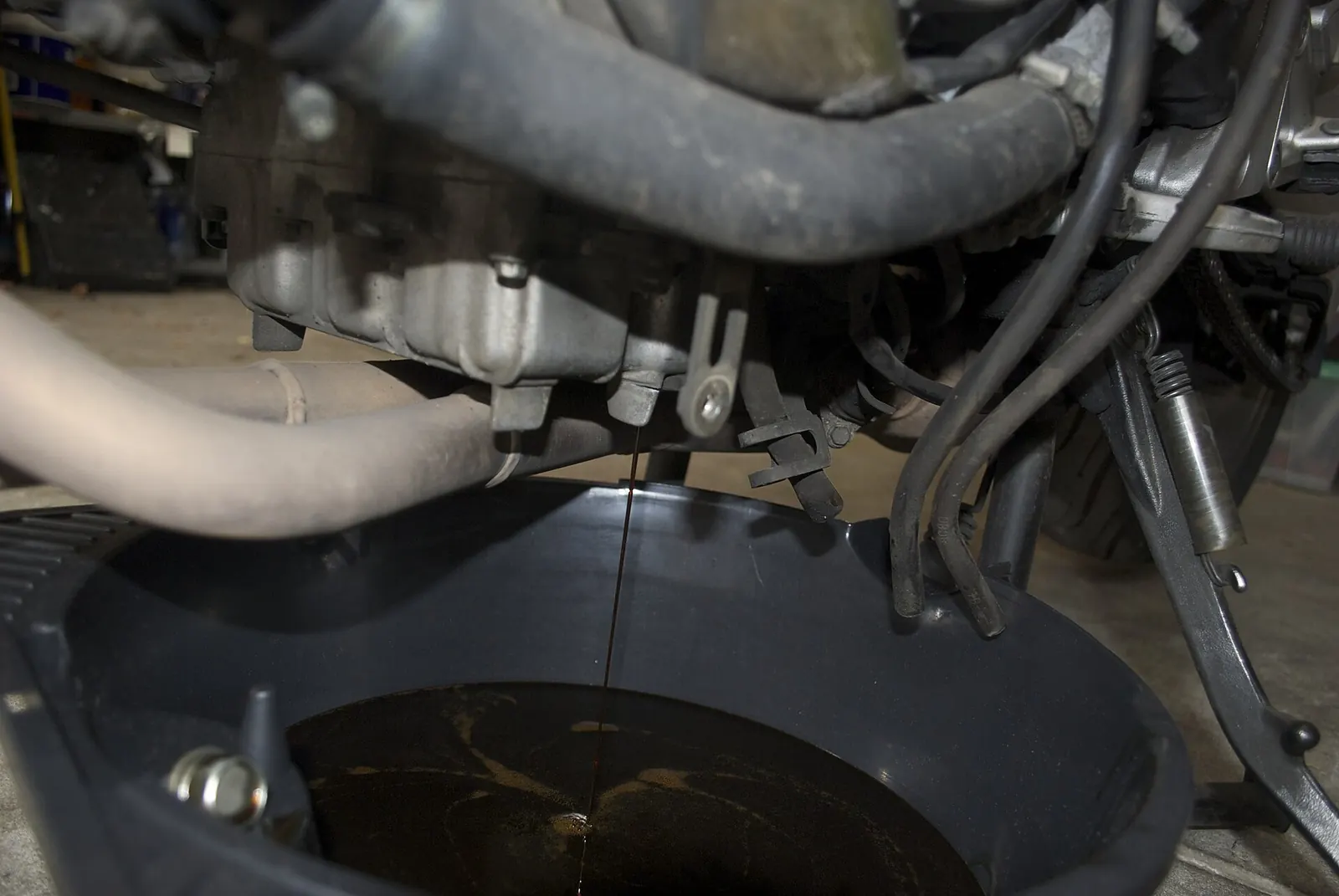
On the Himalayan 450 the whole distance from MIN to MAX on the sight glass is about 350 ml, so a 200 ml overfill uses more than half of it again on top of MAX. That is exactly what happened at my KTM 390 Adventure X Plus's first service, at about 930 km: the oil came back above the max mark and I drained about 200 ml to bring it into range.
Read the sight glass
The research on wet clutches shows the mechanism. In the TU Munich study below, raising the oil level in a dip-lubricated clutch from the reference height to a high level raised the peak drag torque from about 7.7 Nm to 12.6 Nm. More oil means more drag, heat and power lost to churning. Use the calculator to see how far over you are.
More oil is not more protection. Above MAX, the extra oil becomes drag on the clutch and crank.
Oil overfill check
How often should you change motorcycle oil?
At the first service, which comes early in every manual, and then at the manual's interval, whichever of distance or time comes first.
That means 500 km then every 10,000 km or 12 months on current Royal Enfields, the first service then every 10,000 km on the BSVI NS200, and 1,000 km then every 7,500 km or 12 months on KTM's 390 engine. Running-in itself is covered in the running-in rules.
Shorten the interval if your riding is harsh. Royal Enfield says maintenance frequency must be shortened under severe conditions or very dusty use, and Bajaj asks owners to top up oil every 5,000 km between changes. Check the level every 1,000 km, as Royal Enfield's schedule asks, and before any long tour.
What does the research say about oil level and oil life?
Overfilling measurably increases clutch drag, and oil degrades faster when fuel quality is poor. Both findings come from bench studies rather than road tests, so treat them as mechanisms, not exact predictions.
A dip-lubricated wet clutch with transparent parts and a high-speed camera was tested at three oil levels: 18.3 mm, 36.5 mm (reference) and 63.9 mm of plate immersion, using an oil of 14.4 mm²/s at 100 °C. Drag torque rose with speed while the gap stayed full of oil, then fell once centrifugal force emptied it. Peak drag was 7.675 Nm at 225 rpm at the reference level and 12.571 Nm at 450 rpm at the high level, about 64% more. Limit: an industrial clutch rig, not a motorcycle engine, so the numbers show the direction of the effect rather than its size on your bike.
Read the paper (free)A 160 cc Honda single on a test bench ran 40-hour cycles, about 2,000 km equivalent each, on petrol adulterated with ethanol, kerosene or thinner at 5%, 10%, 15% and 20%. Infrared spectroscopy and particle counts on the oil showed changes in sulfation, nitration, oxidation and total base number, a sign the oil was degrading, though engine wear stayed small over the test. Limit: a stationary engine and deliberately adulterated fuel, so it shows why fuel quality and short intervals matter, not how long your oil lasts.
Read the paper (free)What's new
- Castrol pushes 5W-30 and 10W-30 full-synthetic motorcycle oils to commuters Autocar Professional, Jun 2026
- Motul brings the motorcycle-only IPONE oil brand to India Autocar Professional, May 2026
- JASO T903:2023 adds a new low-friction reference oil and friction plate to the MA test Intertek, 2023 standard
Common oil change mistakes
- Using car oil. Many car oils carry energy-conserving friction modifiers; without JASO MA or MA2 on the label they can make the clutch slip.
- Filling to the bottle, not the glass. Quantities in manuals are approximate. Fill a little under, run, wait and top up to the mark.
- Skipping the filter or screens. Fresh oil through a clogged filter is wasted money.
- No torque wrench. Drain plugs of 13–15 Nm are easy to overdo with a long spanner.
- Ignoring the time limit. A bike that does 3,000 km a year still needs oil every 12 months by RE's and KTM's schedules.
The oil change is a good moment to clean and lube the chain too, see how to clean, lube and adjust a chain. Fuel matters for oil life as much as oil does; whether premium petrol is worth it is in XP95 vs normal petrol, and what ethanol blends do to engines is in E20 petrol in motorcycles. My own bikes and what goes into them are on the Gear page.
Questions people ask
10W-40 or 20W-50: which is better for Indian heat?
Neither is "better"; use the manual's grade. A 50 is thicker at 100 °C (16.3 to below 21.9 mm²/s) than a 40 (12.5 to below 16.3). Royal Enfield's Himalayan 450 specifies 10W-40 while its 350s and Bajaj's NS200 specify 50-grade oils.
Can I use car engine oil in my motorcycle?
Not unless it carries JASO MA or MA2. Bikes with a wet clutch share oil between engine and clutch, and low-friction car oils can cause slip.
How much oil does a Royal Enfield Classic 350 take?
1.7 litres at an oil change and 2.2 litres dry, of 15W-50 API SL JASO MA2 semi-synthetic oil, according to the July 2025 owner's manual.
Is it OK if my oil is slightly above MAX?
Royal Enfield says not to fill above MAX because it may affect clutch function. Drain the excess; on the Himalayan 450 the whole MIN–MAX window is only about 350 ml.
Should I switch to fully synthetic oil?
Only if it matches the manual's grade and JASO MA2. Bajaj lists a 10W-50 synthetic as an alternative for the NS200; synthetic does not let you exceed the manual's change interval.
Sources
- Royal Enfield: Himalayan 450 owner's manual (BS VI) (2025)
- Royal Enfield: Classic 350 owner's manual, RAM00347/C (2025)
- Royal Enfield: Hunter 350 owner's manual, RAM01202/A (2025)
- Bajaj Auto: Pulsar NS200 BSVI owner's manual, Doc. 71120193 (2023)
- KTM: RC 390 owner's manual 2019, art. no. 3213934en (2019)
- Maintenanceschedule.com: Honda CB350 H'ness maintenance schedule
- Wikipedia: SAE J300 viscosity grades (2021 revision table)
- Suzuki: JASO T 903 engine oil standard explainer
- Intertek: JASO T903:2023 testing
- Pointner-Gabriel et al., Scientific Reports: Oil flow and drag torque in disengaged wet clutches (2023)
- Gonçalves et al., ACS Omega: Gasoline adulteration and lubricant degradation (2022)
- Autocar Professional: Castrol campaign for full-synthetic motorcycle oil (2026)
- Autocar Professional: Motul India introduces IPONE (2026)

Sapta (Saptarshi Sarkar) is a mechanical engineer turned marketer in Bengaluru and a solo touring rider. He writes the seven Saptaverse blogs. Work with him or read more of RoadHook Machines.


