Clean and lube a motorcycle chain every 500 to 1,000 km, and after every wet or dusty ride: Royal Enfield's manuals say every 500 km for the Himalayan 450 and Hunter 350 and every 1,000 km for the Classic 350, and Bajaj asks NS200 owners to spray chain lube every 500 km. Set slack to your manual's figure and method, which ranges from 5–7 mm on KTM's 390 platform to 35–40 mm on the Himalayan 450, and replace a sealed chain once it has stretched about 1%.
- Clean and lube every 500 km (Himalayan 450, Hunter 350, NS200) to 1,000 km (Classic 350), and after rain.
- Slack specs are not comparable: 5–7 mm on KTM's method, 25–40 mm on Royal Enfield's.
- Replace a sealed chain at 1% stretch (D.I.D); KTM's 304 mm over 20 rollers is about 0.8%.
- Never kerosene on an O-ring chain: D.I.D says it can deform the seals.
- Change chain and both sprockets together; hooked teeth eat a new chain.
A chain is the most neglected wear part on an Indian motorcycle, and the one that most often comes back wrong from a service. It carries all the engine's torque to the rear wheel through a long string of small pin-and-bush bearings, each sealed by rubber O-rings or X-rings that hold grease inside.
Lubricating the outside protects those seals and the roller-to-sprocket contact; setting slack correctly keeps the chain from loading the gearbox output shaft and wheel bearings. This guide uses the actual figures from Royal Enfield, KTM and Bajaj owner's manuals and from chain maker D.I.D.
How often should you lube a motorcycle chain?
Every 500 to 1,000 km for most Indian motorcycles, and sooner after rain, washing or dust. The figures below come straight from the current owner's manuals. D.I.D, which makes chains for many Indian and Japanese bikes, tells riders to wipe the chain with a seal-safe cleaner every 500 km and lube it "every other use".
See the data as a table
| Clean and lube every (km) | |
|---|---|
| RE Himalayan 450 | 500 |
| RE Hunter 350 | 500 |
| Bajaj Pulsar NS200 | 500 |
| RE Classic 350 | 1000 |
| Honda H'ness CB350 | 1000 |
Source: Royal Enfield owner's manuals (2025), Bajaj Pulsar NS200 BSVI owner's manual (2023), Honda schedule via maintenanceschedule.com · All manuals say to do it sooner after wet, dusty or muddy riding.
| Motorcycle | Clean and lube | Check and adjust slack | Slack spec and method | Source |
|---|---|---|---|---|
| Royal Enfield Himalayan 450 | Every 500 km | Every 500 km | 35–40 mm free play (up minus down, at tightest point) | Owner's manual |
| Royal Enfield Hunter 350 | Every 500 km | Every 5,000 km | 25–30 mm free play | Owner's manual, Apr 2025 |
| Royal Enfield Classic 350 | Every 1,000 km | Every 5,000 km | 25–30 mm free play | Owner's manual, Jul 2025 |
| Bajaj Pulsar NS200 (BSVI) | OKS chain spray every 500 km by owner | At each service | Not stated in owner's manual | Owner's manual, Feb 2023 |
| KTM RC 390 (2019 manual) | Not given as a km interval | At 1,000 km, then every 7,500 km | 5–7 mm, pushing chain up behind the sliding guard | Owner's manual, 2019 |
| Honda H'ness CB350 | Inspect and lube every 1,000 km | Every 1,000 km | Not confirmed | Honda schedule, via maintenanceschedule.com |
The chain on your bike was invented by a Swiss engineer in a Manchester suburb. In 1879, Hans Renold, born in Aarau in 1852, borrowed £300 from his future father-in-law and bought James Slater's small business in Salford, Lancashire, a maker of textile chains.
A year later, in 1880, he invented the bush roller chain: a bush round each pin, and a roller turning on each bush. It was a big step on from the plain pin-and-link chains of the day, because the roller rolls onto the sprocket tooth instead of scraping across it. Early demand came from tricycle maker James Starley, who needed chains for his differential, and then exploded after the safety bicycle arrived in 1885. Every 520 chain on an Indian 390 or 350 is still Renold's layout, which is why the lube goes where the bush meets the pin.
Wikipedia: Hans Renold, inventor of the bush roller chainWhat do you need to clean and lube a chain?
You need a way to spin the rear wheel, a seal-safe chain cleaner, a soft brush, rags and a chain lube. A centre stand or paddock stand makes this a ten-minute job; on a side stand you have to roll the bike forward between sections.
- Stand. Centre stand or rear paddock stand. KTM's procedure starts by raising the rear with lifting gear.
- Cleaner. An O-ring or X-ring safe chain cleaner. D.I.D says it does not recommend kerosene on any drive chain, because it can deform the seal rings and strip the grease behind them; it also rules out petrol, thinner, benzene, steam and wire brushes.
- Lube. A chain lube labelled O-ring/X-ring safe. Bajaj's NS200 manual names OKS chain spray for owners; Royal Enfield says to use its recommended chain lubricant.
- Tools for adjustment. A ruler or vernier, the axle-nut spanner, and a torque wrench. Royal Enfield gives 70 Nm for the Himalayan 450 rear spindle; KTM gives 90 Nm for the RC 390's M14 axle nut.

How do you clean and lube a motorcycle chain, step by step?
Clean first, then lube the inside of the chain, then wipe off the excess. Royal Enfield's procedure, which matches what most makers ask for, is the basis of these steps.
- Set up. Park on the stand, engine off, in neutral. Autocar India suggests a flat surface with good drainage and a piece of cardboard behind the chain to catch overspray.
- Spray the cleaner. Spray the seal-safe cleaner along the lower run while turning the rear wheel slowly by hand, until the whole chain is wet. Use a soft brush on hard deposits.
- Let it work. Royal Enfield says to wait a few minutes, then wipe the chain thoroughly clean of dirt and grime.
- Dry it. D.I.D says to dry the chain completely before lubing. Lube on a wet chain traps water against the rollers.
- Lube the inner side. Turn the wheel slowly and apply lube to the chain links, aiming at the gap between the inner and outer plates where the O-rings sit, on the inside of the lower run.
- Wipe off the excess. Royal Enfield says to wipe off excess lube after about five minutes with a clean cloth. Excess lube collects grit and flings onto the rear tyre.
- Check slack while you are there. Rotate the wheel and look for the tightest point. If the slack is outside spec, adjust it as below.
How much slack should a motorcycle chain have?
As much as your owner's manual says, measured exactly the way it says, because makers measure slack differently.
| Method | How you measure | Spec |
|---|---|---|
| Royal Enfield: total free play | Push the chain up and measure to the swingarm, push it down and measure again, take the difference | 35–40 mm Himalayan 450; 25–30 mm Classic 350 and Hunter 350 |
| KTM RC 390: upward travel only | Push up at a point just behind the chain sliding guard, with the top run taut | 5–7 mm |
The two numbers cannot be compared with each other. Two rules apply to every bike:
- Measure at the tightest point, because chains wear unevenly; both Royal Enfield and KTM tell you to rotate the wheel and check several positions.
- Measure with the bike set up as the manual says (KTM on a rear stand, Royal Enfield upright), because the swingarm angle changes the distance between the sprockets.
How do you adjust chain slack and keep the wheel aligned?
Loosen the axle, move both adjusters by the same amount, check slack, then torque the axle and check again. Royal Enfield's Himalayan 450 procedure and KTM's RC 390 procedure follow the same sequence.
- Loosen the rear axle nut. On the KTM, loosen the axle nut and the adjuster lock nuts.
- Turn both adjusters equally. Small turns, the same on each side. Royal Enfield says the wheel position in the slot must always be equal on left and right; KTM says to keep the marks on both adjusters at the same reference position.
- Recheck slack at the tightest point. If it is still out, repeat.
- Torque the axle. 70 Nm on the Himalayan 450 (and 10 Nm on its adjuster bolts), 90 Nm on the KTM RC 390.
- Recheck once more. Tightening the axle can pull the wheel slightly. Royal Enfield's manual says to confirm slack again after torquing.
The adjuster marks are only as good as the factory stamping, so sight along the chain from behind the sprocket as a second check: the chain should run straight onto the rear sprocket, not climb one side of the teeth.
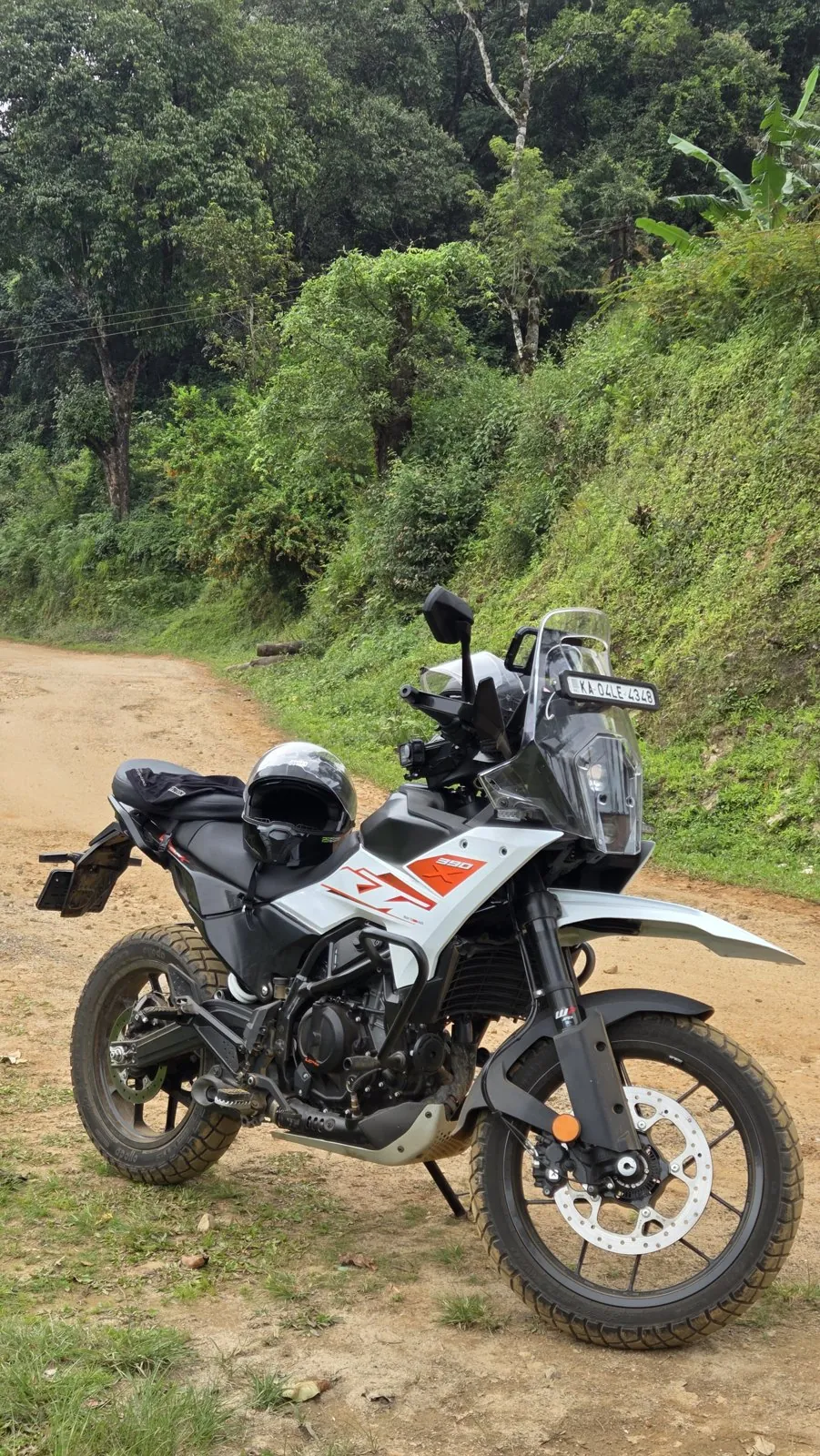
A wrongly aligned or over-tight chain after a service is not rare. My KTM 390 Adventure X Plus came back from a service with the chain too tight or misaligned, which I then investigated. An over-tight chain loads the countershaft, wheel bearings and chain together; KTM's manual warns that some parts may break if overloaded.
How do you know when a chain is worn out?
Measure its length over a set number of links under tension and compare it with the new length. KTM's RC 390 manual gives the cleanest procedure: pull the lower run with 15 kg, measure across 20 rollers, and replace the drivetrain kit if the distance exceeds 304 mm.
On a 520 chain, whose pitch is 5/8 inch (15.875 mm), 20 rollers span 19 pitches, or 301.6 mm new, so KTM's limit is about 0.8% stretch. The other limits:
- D.I.D: 1% for sealed chains and 2% for non-sealed chains.
- iwis, an industrial chain maker: 3% as the general service limit for roller chains.
Motorcycle limits are tighter because a stretched chain no longer seats properly on the sprocket teeth. Use this to check what you just read, with your own ruler measurement.
Chain stretch from a ruler measurement
Read the chain and sprockets: the signs you can see
Stretch needs a ruler, but four other signs need only your eyes:
- tight spots that remain after lubing;
- kinked links that do not straighten;
- pin heads that have started to rotate (D.I.D's sign that replacement is due);
- sprocket teeth that have become hooked or pointed.
KTM and most makers say to replace the chain and both sprockets together, because a new chain wears fast on old sprockets. On my NS200, the chain and sprockets went in as a set, a Rolon brass chain kit with an RS200 41-tooth rear sprocket, at about 39,000–40,000 km.
| Chain | Pitch | New length, 20 rollers (19 pitches) | At 1% (sealed limit) | At 2% (non-sealed limit) |
|---|---|---|---|---|
| 428 (commuters) | 12.7 mm | 241.3 mm | 243.7 mm | 246.1 mm |
| 520, 525, 530 | 15.875 mm | 301.6 mm | 304.6 mm | 307.7 mm |
Does chain lube actually reduce friction, or just wear?
Mostly wear. The best-known lab study of chain efficiency found lubricant type made little difference to how much power the chain lost, while the research on chain life shows wear concentrates in the pin and bush, where lube and seals protect it.
Lube is about keeping grit and water out and the seals alive.The reading of the Johns Hopkins and Noguchi studies below
A computer-controlled chain drive with a motor, magnetic brakes and an infrared camera measured efficiency across power, speed and lubrication conditions. Efficiency ranged from about 81% to 98.6%. Three lubricants (wax, synthetic oil and dry lithium spray) and an unlubricated chain gave no significant difference in the lab; larger sprockets and higher chain tension raised efficiency, and infrared data showed friction heat could not explain the losses. Limit: a clean bicycle chain in a lab, with no dirt, water or O-rings. Outdoors, the authors suggest lube matters for keeping dirt out.
Read the summary (free)The authors built a wear tester that runs only two chain links, measured pin and bush wear with a roundness tester, and used finite-element analysis to explain the pattern. Chain life is set by elongation, and they note the rule of thumb that chains begin to skip teeth at about 3%. Under tensile load the pin bends, so pin and bush do not contact along their centreline and wear happens only at the ends of the pin. Limit: an industrial chain on a test rig, not a sealed motorcycle chain in the field.
Read the paper (free)
What's new
- Royal Enfield's revised Classic 350 manual keeps 25–30 mm slack and 1,000 km lube intervals Royal Enfield, Jul 2025
- Hunter 350 owner's manual sets chain lube at every 500 km Royal Enfield, Apr 2025
- Himalayan 450 manual: clean, lube and adjust every 500 km, 35–40 mm free play Royal Enfield, 2025
What mistakes shorten chain life?
Most chains die early from four habits, all avoidable.
- Too tight. Riders tighten the chain to stop it slapping. Too tight is worse than slightly loose, because the slack disappears when the swingarm moves through its travel, and the chain then pulls directly on the gearbox output shaft.
- Wrong cleaner. Kerosene, petrol and pressure washers attack the seals. Bajaj's own service schedule cleans the NS200 chain with a 50:50 mix of diesel and SAE 90 oil and lubes it with SAE 90, but D.I.D advises against kerosene-type solvents on sealed chains, so for home cleaning stick with a seal-safe cleaner.
- Lubing a dirty chain. Fresh lube on grit makes grinding paste.
- Ignoring sprockets. Fitting a new chain on hooked sprockets halves the job's value.
If you change sprocket sizes, the chain length changes too; how to calculate it is in motorcycle sprocket gearing. Rain is the chain's worst enemy, covered in the monsoon maintenance checklist, and the other job you will do on the same stand is in the oil change guide.
When buying second-hand, chain condition is a quick read on how the bike was kept, see the used bike checklist. My two bikes and their kit are on the Gear page.
Questions people ask
How often should I lube my motorcycle chain in India?
Every 500 km for the Himalayan 450, Hunter 350 and NS200 by their manuals, every 1,000 km for the Classic 350, and after every rain ride or wash whatever the manual says.
Can I use engine oil or gear oil as chain lube?
Bajaj's service schedule uses SAE 90 gear oil on the NS200 chain at services, so it is not harmful. But thin oils fling off quickly; a proper chain spray stays on longer. Avoid used engine oil, which carries abrasive particles.
Is kerosene safe for cleaning an O-ring chain?
D.I.D says no: kerosene can deform the seal rings and remove grease. Use an O-ring or X-ring safe chain cleaner.
How do I know if my chain is too tight?
Measure free play at the tightest point using your manual's method. If it is below the minimum (for example under 25 mm on a Classic 350, or under 5 mm by the method in KTM's RC 390 manual), loosen it.
When should I replace the chain and sprockets?
When the chain exceeds its stretch limit (about 1% for sealed chains per D.I.D, or 304 mm over 20 rollers in KTM's RC 390 manual), or when sprocket teeth are hooked. Replace all three together.
Sources
- Royal Enfield: Himalayan 450 owner's manual (BS VI) (2025)
- Royal Enfield: Classic 350 owner's manual, RAM00347/C (2025)
- Royal Enfield: Hunter 350 owner's manual, RAM01202/A (2025)
- Bajaj Auto: Pulsar NS200 BSVI owner's manual, Doc. 71120193 (2023)
- KTM: RC 390 owner's manual 2019, art. no. 3213934en (2019)
- Maintenanceschedule.com: Honda CB350 H'ness maintenance schedule
- D.I.D: Frequently asked questions on chain care and wear limits
- iwis: Wear resistance testing of roller chains
- ScienceDaily / Johns Hopkins: Bicycle chain efficiency study (1999)
- Noguchi et al., JAMDSM: Evaluation of wear between pin and bush in roller chain (2009)
- Autocar India: How to correctly clean and lube your chain (2018)
- Wikipedia: Hans Renold (bush roller chain, 1880; source for the story)

Sapta (Saptarshi Sarkar) is a mechanical engineer turned marketer in Bengaluru and a solo touring rider. He writes the seven Saptaverse blogs. Work with him or read more of RoadHook Machines.