
Running-in a new bike still matters, but the rule that counts is to vary the load and never go full throttle, not a single magic rpm number. Piston rings and cylinder walls wear fastest in the first hour of running and keep smoothing for about 20 more, so how you ride the first 500-1,000 km sets how well they seal. KTM caps the 390 Duke at 7,500 rpm for 1,000 km, Royal Enfield and Bajaj use gear-by-gear speed limits for 2,000 km, and all of them say the same three things: warm up, vary speed, avoid full throttle.
- ~1 hour: liner wear drops sharply after the first hour of a new engine; friction takes about 20 hours to settle.
- Vary load: too little cylinder pressure risks glazing, full throttle risks scuffing.
- 7,500 rpm for 1,000 km on the KTM 390 Duke; gear-by-gear speed limits for 2,000 km on Royal Enfield and Bajaj.
- Factory honing sets how long running-in lasts, which is why manuals disagree on the number.
- First service flushes the metal shed in running-in; check the oil level yourself afterwards.
Both camps in the old "gentle or hard" argument had a point, and the tribology research explains why. Here is what actually beds in, how fast, and what the manuals of bikes sold in India ask for in 2026.
On 11 March 2009, four days after taking delivery of a new Hero Honda Karizma ZMR, an owner posted on the Indian forum xBhp with the question every new owner asks. His manual said one thing; a popular website said to ride the engine hard from day one. He ran a poll. After 108 votes it had split almost down the middle: 58 against riding hard, 50 for. The replies split the same way. One rider laid out the web method of varied engine speed, short bursts and an early oil change. Another argued for staying under 60 km/h for the first 1,000 km, pointing out that the hard-break-in advice was written for higher-powered bikes, not Indian ones. The owner settled on a middle path. Seventeen years on, that middle path is roughly what the physics supports.
xBhp: Engine break-in process and methods (forum thread, March 2009)What actually wears in during running-in?
The main thing that wears in is the contact between the piston rings and the cylinder wall, followed by gear teeth, cam lobes and bearings.
A new cylinder is honed to a cross-hatched finish of peaks and valleys. The valleys hold oil; the peaks are what the rings first touch. Running-in wears the tallest peaks off, so the rings conform to the bore, contact pressure spreads evenly, and the oil film can carry the load.
- Get it right and the rings seal combustion pressure and scrape oil cleanly.
- Get it wrong and the peaks are polished smooth before the rings have conformed, a condition engineers call glazing, and the engine burns oil and loses compression for life.
How fast it happens
The process is fast. Ma and colleagues measured liner wear and engine friction in a single-cylinder, air-cooled petrol engine during break-in, which is about as close to a commuter motorcycle as tribology papers get.
The wear rate dropped sharply within the first hour. Surface roughness and friction took far longer, about 20 hours, to settle. At typical Indian riding speeds that is roughly the first 500-1,000 km, which is why manuals put the first service there.
Cylinder-liner wear and surface roughness were measured at the top ring reversal point of a single-cylinder, air-cooled spark-ignition engine, while instantaneous friction torque was logged and matched to wear. Friction, roughness and wear were all highest at the start. The wear rate fell sharply in the first hour and then held a lower steady rate; friction changed in three modes, the last of about 20 hours, during which roughness and friction both fell. The limit: one laboratory engine running set conditions, so absolute hours do not transfer directly to road kilometres.
Read the abstract (free)Why does varying rpm matter more than a fixed cap?
Varying rpm and load matters because rings seat under cylinder pressure, and both too little and too much pressure do damage. A piston ring is pushed against the wall mainly by combustion gas getting behind it in its groove.
| How you ride | Pressure behind the ring | Result |
|---|---|---|
| Constant light throttle at one speed | Too little | Polishes the same band of the bore over and over: glazing risk |
| Moderate, varied load | Enough | Wears the peaks and seats the ring |
| Full throttle on a fresh engine | Peak pressure and peak temperature | Surfaces without a protective oil film or worn shape: scuffing risk |
What the manuals tell you to do
Royal Enfield's Classic 350 manual turns this into plain instructions: avoid full-throttle operation, do not ride at constant throttle continuously, and vary your speed by about 10% while riding. Bajaj's Pulsar manuals add: do not race the engine, and idle for a minute after starting so oil reaches the top end.
That is the reasonable core of the "ride it hard" camp too: their method varied load heavily. Where they went wrong was full-throttle runs on a cold or brand-new engine.
Why there is no universal number
Gu and colleagues at MIT showed in 2019 why there is no universal number. Their model of liner wear during break-in found that the duration of break-in depends heavily on the initial surface roughness, which is set at the factory by the honing process.
A manufacturer that hones to a finer, plateau finish needs a shorter, gentler break-in. The number is tuned to the factory finish, not to physics in general, which is why KTM can quote 1,000 km and Royal Enfield 2,000 km for engines of similar size.
The authors built a physics-based model of liner wear during break-in that combines plastic deformation and asperity fatigue, including elastic-plastic asperity contact, crack initiation and crack propagation. Its predicted friction evolution for different liner finishes matched experimental measurements in trend and magnitude. The key result for owners: the wear rate, and so the length of break-in, depends strongly on the liner's initial roughness, which is a manufacturing choice. The limit: it is a model calibrated to engine test data, not a road trial.
Read the paper (free)
What do the owner's manuals actually say?
The manuals agree on the method and disagree on the numbers. KTM uses an rpm cap, Royal Enfield and Bajaj use speed caps for each gear, and Hero asks only for no full throttle over 500 km.
| Bike (manual) | Running-in distance | Limit | Other instructions | First service |
|---|---|---|---|---|
| KTM 390 Duke (2024) | 1,000 km | 7,500 rpm; shift light fixed during running-in | Avoid fully opening the throttle; run in new tyres for 200 km | After 1,000 km |
| Royal Enfield Classic 350 (BS6) | 2,000 km | First 500 km: 20/30/45/60/70 km/h in gears 1-5. Then 25/35/50/65/80 km/h | Warm up; avoid full throttle and constant throttle; vary speed by 10%; break every hour | 500 km or 45 days |
| Bajaj Pulsar 125 and NS160 (BS6) | 2,000 km | First 1,000 km: 10/20/30/35/45 km/h in gears 1-5. Then 15/30/40/45/55 km/h | Do not race the engine; idle one minute after starting | 500-750 km |
| Hero Splendor+ XTEC (2024) | 500 km | No rpm or speed figure | Avoid full throttle and rapid acceleration | See service book |
See the data as a table
| Running-in distance (km) | First service (km) | |
|---|---|---|
| KTM 390 Duke | 1000 | 1000 |
| Royal Enfield Classic 350 | 2000 | 500 |
| Bajaj Pulsar 125 / NS160 | 2000 | 500 |
| Hero Splendor+ XTEC | 500 |
Source: KTM, Royal Enfield, Bajaj Auto and Hero MotoCorp owner's manuals · Bajaj lists the first service at 500-750 km; the lower bound is shown. Hero's service interval is not in the section quoted.
What the KTM cap really allows
Note what the KTM cap really allows. Using the 390 Duke's published ratios, 7,500 rpm in sixth gear is about 130 km/h. KTM is not asking you to ride slowly; it is asking you to stay out of the top of the rev range.
Royal Enfield's long-stroke 349 cc single makes its peak power at 6,100 rpm, and its manual caps road speed in each gear instead of quoting rpm. The two rules look very different and aim at the same thing: moderate cylinder pressure, no peak heat.
Use this to check what you just read: plug in your own bike's ratios and rpm limit.
What an rpm limit means in road speed


Why is the first service so early?
The first service is early because the first few hundred kilometres shed the most metal into the oil. The peaks worn off the bore, gear teeth and cam lobes end up as fine particles; the oil filter catches the larger ones and the rest circulate until the oil is changed.
That is why Royal Enfield's first free service comes at 500 km or 45 days and KTM's at 1,000 km, before any long-interval schedule starts.
Watch the workshop, too
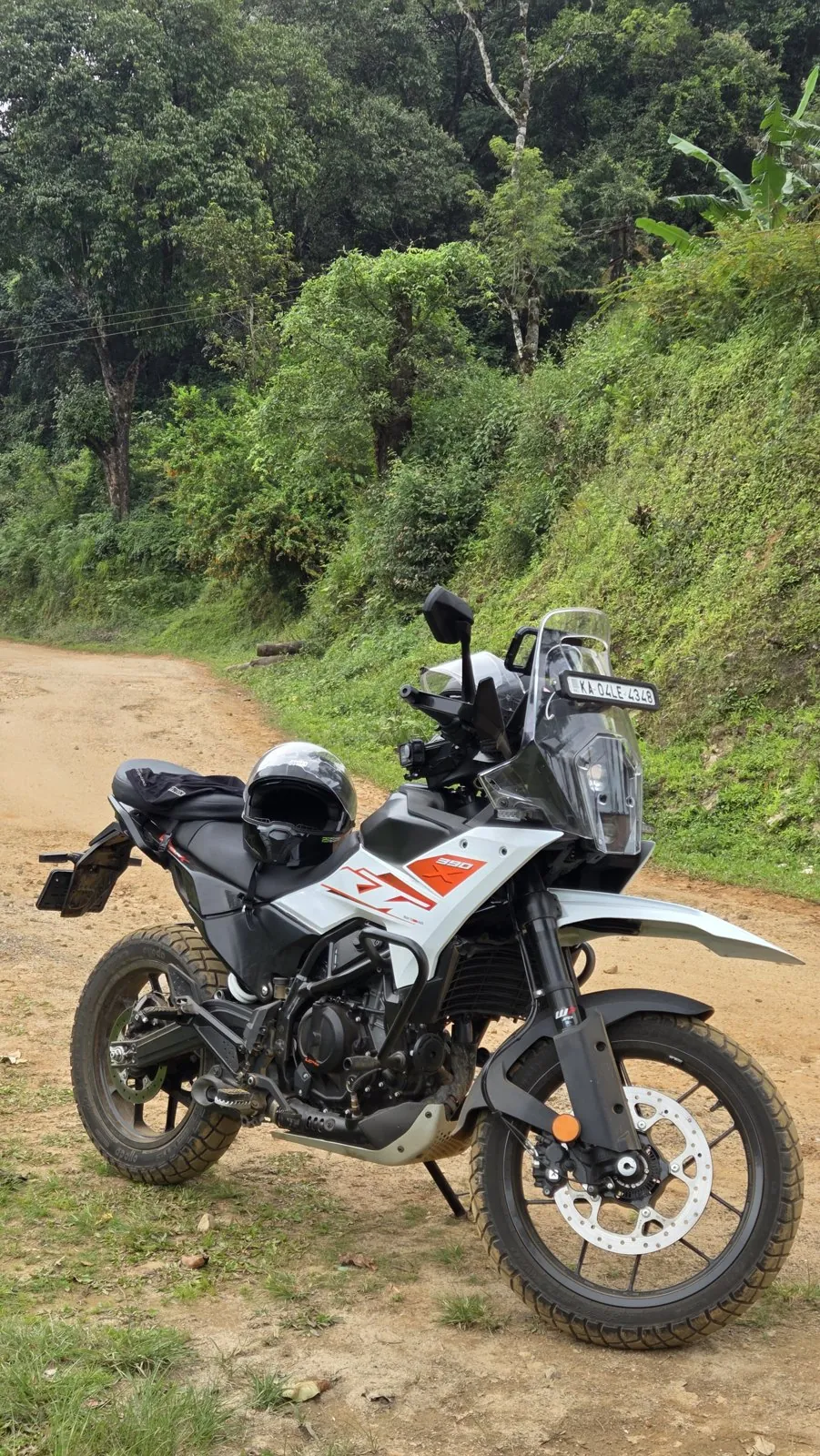
The first service also catches workshop mistakes, and is a good time to watch them. When my KTM 390 Adventure X Plus had its first service at about 930 km, the oil came back above the maximum mark and I drained about 200 ml myself to bring it into range.
Is it all a myth on modern engines?
No, but the stakes are lower than they were. Engines now arrive closer to "run in" than a 1980s two-stroke did, for three reasons:
- modern bores are often coated or plateau-honed;
- rings use harder coatings;
- machining tolerances are tighter.
Gu's work shows the finish decides how much running-in is left to do. But less to do is not nothing to do: the first-hour wear spike in Ma's data is a property of any new sliding pair, and no manufacturer selling bikes in India has dropped running-in from its manual.
Less to do is not nothing to do.On running-in modern engines
What ignoring it can cost
The cost of ignoring it is real but not instant. A Rushlane report from 2018 described a new TVS Apache 160 that needed a piston and cylinder kit after its owner raced it past 120 km/h within the first 100 km, according to the service technician.
One case proves little statistically, and the report itself relied on the owner's account, but it shows the failure mode the manuals are guarding against: peak load on unbedded surfaces.
A running-in routine that respects the physics
- Warm up first. Idle for a minute and ride gently until the engine reaches temperature. KTM's manual notes that high revs on a cold engine shorten engine life.
- Vary everything. Change speed and gear often. Avoid long cruise-control-style stretches at one rpm; Royal Enfield suggests varying speed by about 10%.
- Use moderate throttle, never full. Short pulls to the running-in limit and back off are good. Wide-open throttle and lugging in a tall gear are both bad.
- Respect the manual's number for your bike, whether it is an rpm cap or a speed table, for the full distance.
- Bed in the tyres too. KTM asks for 200 km of moderate riding on new tyres, increasing lean angle gradually, because a fresh tread surface has not yet been roughened.
- Do the first service on time and check the oil level yourself afterwards.
For the oil itself, see the motorcycle oil change guide, and for what rpm and load actually mean, how engine power and torque work. New tyres need their own care, covered in nitrogen vs air in bike tyres, and the habit of killing a new engine with the red switch is examined in kill switch or key. Planning your first long ride on a new bike? My notes on how many kilometres a day are realistic help pace it.
What's new
- A simplified wear model predicts ring and liner wear through break-in and transient speeds Tribology Transactions, 2024
- Teardown of two test engines links double the oil consumption to bore polishing and ring wear, on bores that were not plateau honed SAE Technical Paper, Apr 2025
- KTM's current 390 Duke manual keeps a 7,500 rpm, 1,000 km running-in limit locked into the shift light KTM, 2024 model year
Questions people ask
Can I take a new bike on a highway trip before the first service?
Yes, within the manual's limits and with frequent changes of speed. The risk on a highway is not distance but steady high load. Break the ride every hour, vary speed by 10-15 km/h, and avoid the top of the rev range.
Is "ride it hard" break-in better?
Varied, firm load is good; full throttle on a new engine is not. The useful part of the hard method is that it avoids the low-load glazing risk. The harmful part is peak pressure and heat before surfaces have conformed. The manuals' moderate, varied approach takes the useful part only.
Does running-in affect mileage?
Yes, a little. Ma's data show friction falls over the first tens of hours as surfaces smooth, so fuel economy usually improves somewhat after running-in. Judge a new bike's mileage after the first service, not before.
Should I use synthetic oil during running-in?
Use exactly what the manual specifies for the first fill and first service. The factory fill is chosen to suit the running-in of that engine's surfaces.
Sources
- Ma et al.: Break-in liner wear and piston ring assembly friction in a spark-ignited engine, Tribology Transactions (1998)
- Gu et al.: Modeling the fatigue wear of the cylinder liner during the break-in period, Lubricants (2019)
- KTM: 2024 390 Duke owner's manual (EU) (2023)
- Royal Enfield: Classic 350 BS6 owner's manual
- Royal Enfield: Hunter 350 owner's manual
- Bajaj Auto: Pulsar 125 owner's manual
- Bajaj Auto: Pulsar NS160 owner's manual
- Hero MotoCorp: Splendor+ XTEC owner's manual (2024)
- Rushlane: Brand new TVS Apache needs piston and cylinder kit after improper run-in (2018)
- Liu et al.: Simplified wear model for power cylinder under engine operating conditions, Tribology Transactions (2024)
- Thrush et al.: Three-body abrasive wear surface characterization of piston rings and cylinder bores, SAE Technical Paper (2025)
- xBhp: Engine break-in process and methods (forum thread, source for the story) (March 2009)

Sapta (Saptarshi Sarkar) is a mechanical engineer turned marketer in Bengaluru and a solo touring rider. He writes the seven Saptaverse blogs. Work with him or read more of RoadHook Machines.


