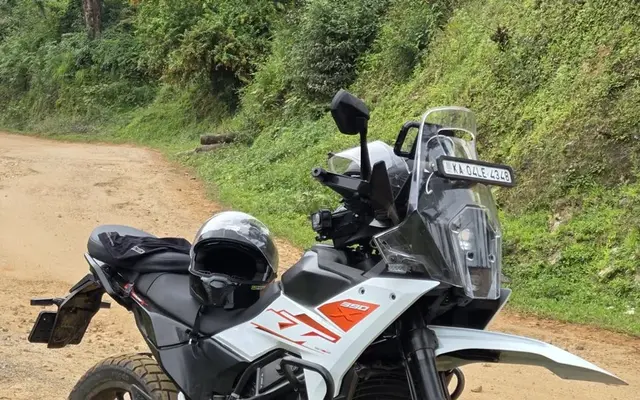
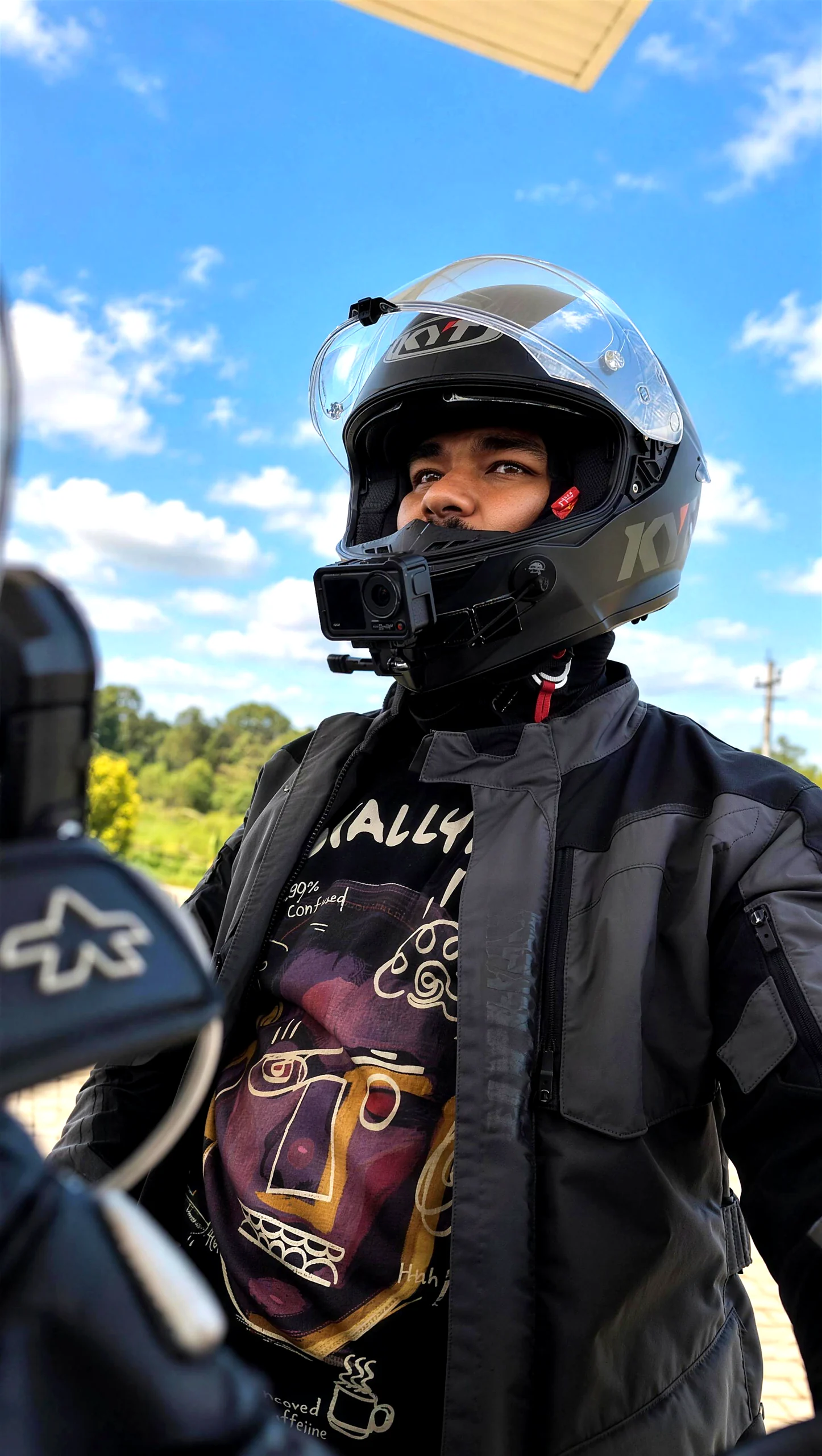
The KYT R2R Pro is KYT's sport-touring full-face helmet, priced at ₹17,500 in Indian reviews from 2024. It is ECE 22.06 and ISI certified, has an ADT thermoplastic shell made in two sizes, a double-D ring, a drop-down sun visor and a Pinlock-ready visor, and KYT quotes about 1,500 g in size M. It is safe and well equipped, but I would not buy it again. Mine, a size L with a Pinlock Max, is very noisy, slightly loose, wobbles at 120–125 km/h and is big: it suits racers who tuck in, not an upright adventure rider.
- ECE 22.06 + ISI: legal in India and tested to Europe's newest standard, which since January 2024 is the only one new designs can be approved to.
- Two shells, six sizes: XS–M share the M shell; L (59–60 cm) is the smallest size in the large shell.
- 1,500 ± 50 g in size M, on KYT's own spec sheet.
- About 105 dB(A) of wind noise at the ear at 125 km/h, by the speed relationship in McCombe's research, which is enough to need earplugs.
- 2.4 times more wind pressure at 125 km/h than at 80 km/h, so small gaps and loose fit show up suddenly.
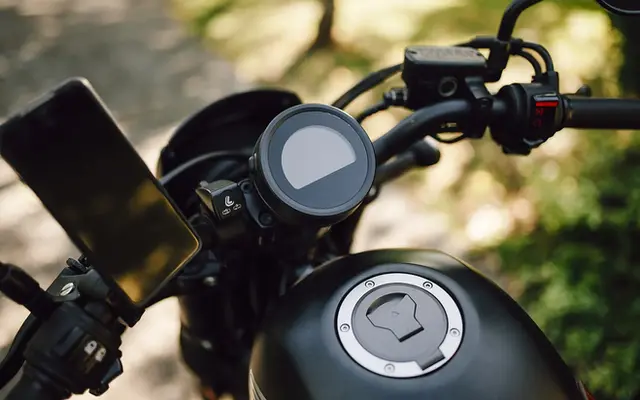
I wear a KYT R2R Pro in size L with a Pinlock Max anti-fog insert, mostly on my 2026 KTM 390 Adventure X Plus. Two things stand out in my use: it feels slightly loose, and at 120–125 km/h it buffets. This post explains the helmet, the certifications, and the physics behind both complaints, so you can size yours right the first time. I paid about ₹15,000 for the helmet and added a Pinlock afterwards, about ₹18,000 in all. For that money I expected better.
Over a series of studies summarised in 2003, an ear, nose and throat surgeon in England, Andrew McCombe, and his colleagues put microphones inside riders' helmets, next to the ear. Wind noise measured about 90 dB(A) at 60 km/h and climbed to about 110 dB(A) at 160 km/h, rising with the logarithm of speed.
They then tested riders' hearing before and after an hour at a steady 128 km/h, and found a temporary threshold shift: their ears were measurably duller after just one ride, with tinnitus to match. In a 2003 commentary in the Journal of the Royal Society of Medicine he asked when employers of police motorcyclists, who knew the risk, could be held responsible. The helmet was not making the noise; the air around it was.
McCombe: Hearing loss in motorcyclists, Journal of the Royal Society of Medicine (2003)What do you get with the KYT R2R Pro?
You get a race-derived sport-touring shell with touring comforts. KYT calls the line R2R, "from race to road", and BikeWale reported the Pro on sale through 65 KYT retailers across India in 2024.
| Item | KYT R2R (Pro in India) | Why it matters |
|---|---|---|
| Shell | ADT thermoplastic, 2 shell sizes (M, L) | Fewer shells means some sizes carry thicker padding |
| EPS liner | 2 sizes, variable density | Absorbs impact energy progressively |
| Weight | 1,500 ± 50 g (size M) | Light for the class; an L is a bigger shell |
| Certification | ECE 22.06, ISI (India), DOT in the US | Legal on Indian roads and tested to the latest EU rules |
| Visor | Polycarbonate, UV380, central lock, tool-free removal | Takes a Pinlock Max Vision 70 insert |
| Sun visor | Internal, drop-down, side control | No need to swap visors for tunnels and dusk |
| Vents | Two brow intakes, chin intake, two rear exhausts | Good airflow above 30–40 km/h, more noise above 80 |
| Retention | Double-D ring | Precise strap tension; the track-day standard |
The interior is removable and washable, the cheek pads have cut-outs for intercom speakers, and the liner is shaped for glasses. Pads and headliners can be swapped within the same shell size to tune fit, which matters a great deal for my "slightly loose" problem.
Is the KYT R2R Pro safe and legal in India?
Yes. It carries the ISI mark required by law and is homologated to ECE 22.06. BikeWale's reviewer noted the ISI mark is lacquered into the paint rather than stuck on as a sticker.
- ISI (IS 4151:2015): mandatory for every two-wheeler helmet sold in India since the helmet Quality Control Order took effect in June 2021. In July 2025 the government said 176 manufacturers held valid BIS helmet licences.
- ECE 22.06: the UN regulation that replaced 22.05. The UK's SHARP scheme says that from January 2024 new helmet designs can only be approved to 22.06, with tests closer to real crashes, including high-speed impacts and low-speed tumbles.
- Read the label: an "E" in a circle with a country number, then "06", a four-digit approval number and "P" for a full-face helmet with a protective chin bar.

Certification is only half of what keeps you safe. The other half is fit, because a helmet that moves on your head behaves differently in a crash and in the wind. The national numbers on helmet use are in my post on helmets and two-wheeler deaths in India.
How do you choose the right KYT R2R Pro size?
Measure your head and pick by centimetres, not by your usual letter. KYT's sizing table runs XS 53–54 cm, S 55–56, M 57–58, L 59–60, XL 61–62 and XXL 63 cm, and Motoring World's reviewer found KYT helmets tend to run a size small.
This matters for my helmet. Size L is the smallest liner in the large shell. A rider near the bottom of the L range wears the biggest outer shell for his head, with more frontal area catching wind. If your head measures close to 59 cm, try an M as well, in the smaller, lighter shell. That is the main reason this helmet felt big to me: an L puts the largest outer shell around a head at the bottom of its range.
- Measure. Tape around the widest part, about 2 cm above the eyebrows and over the back bump. Take the largest of three readings.
- Try it for 15 minutes in the shop. Pressure should be even all round; a hot spot on the forehead means the internal shape is wrong for you, not the size.
- Check the cheeks. With the strap done, the cheek pads should push your cheeks up slightly, and you should not be able to slide a finger in easily.
- Do the roll-off test. Strap fastened, grab the back of the helmet and try to roll it forward off your head. If it comes over your nose, it is too big.
- Shake your head. The skin of your forehead should move with the helmet; if the helmet slides over the skin, it is loose.
The authors built an LS-DYNA finite element model of a motorcycle helmet and simulated the standard shock-absorption test at the crown, rear and side, scoring peak acceleration and Head Injury Criterion. The fit between the headform and the helmet changed the test results dramatically, while the impact site mattered less.
For a real rider, they concluded, fit had a smaller effect on protection than in the lab, which supports a well-fitting helmet with stable fixation. The limit: a 2001 computer model with no quantified gap-versus-injury curve in the abstract, so read it as direction, not a number.
Read the paper (free)Why does a helmet buffet at 120–125 km/h?
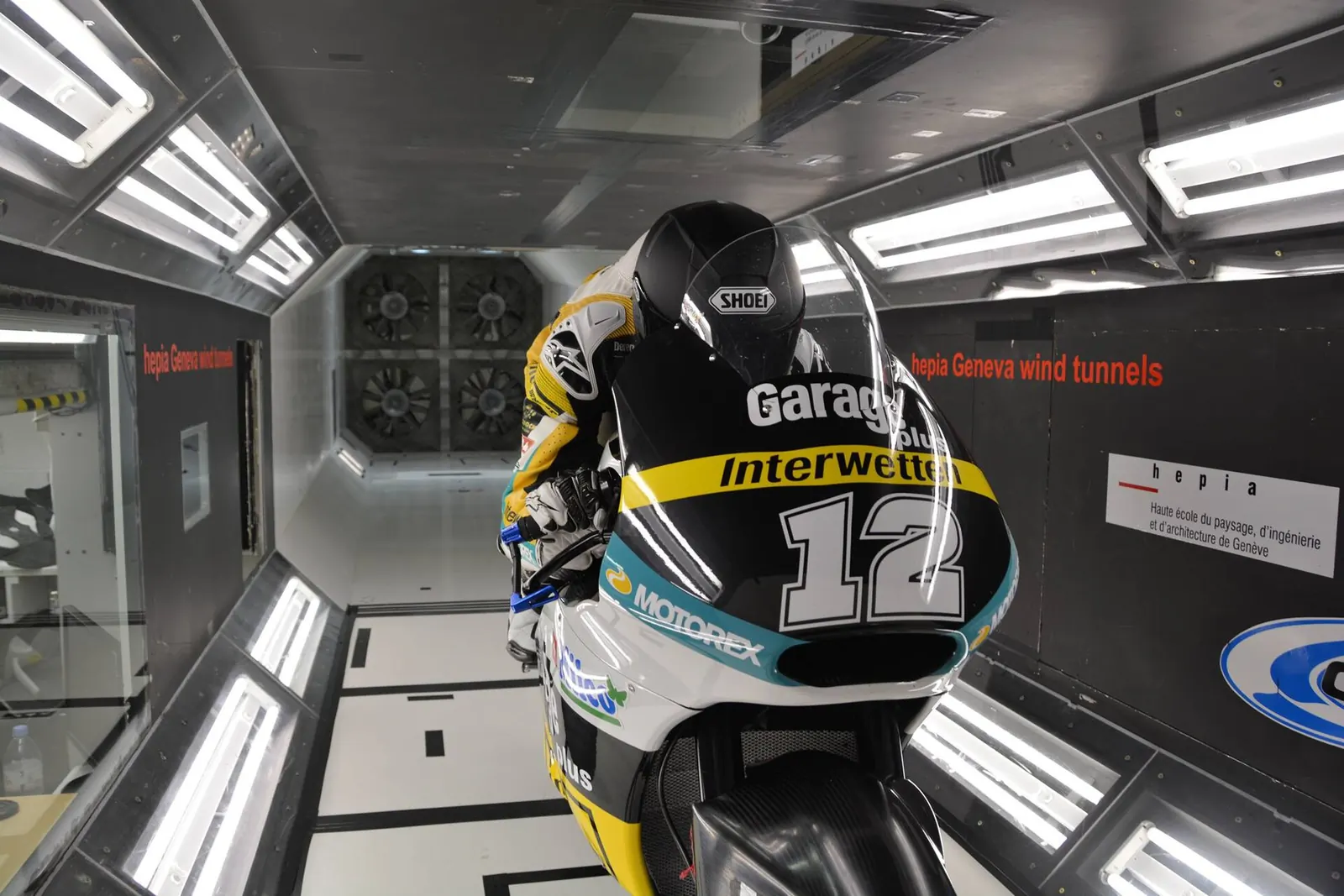
Because wind force grows with the square of speed, and a helmet sitting in turbulent air with any free play starts to shake. Dynamic pressure is ½ρv²: at 80 km/h it is about 296 Pa on the helmet's front, and at 125 km/h about 723 Pa, roughly 2.4 times more.
On an adventure bike, the turbulence usually comes from the windscreen's top edge. Air separates off the edge and forms an unsteady wake. If your helmet sits in that wake, it gets pulsing pressure from several directions; above the wake you get clean, steady wind, and well below it you get calm air.
Three things in my own setup can move my helmet relative to that wake:
- Handlebar risers. I fitted Moto Torque risers of about 1 inch in October 2026. Higher bars sit a rider more upright, which can lift the helmet into a different part of the flow. If you add risers, recheck where buffeting starts afterwards.
- The screen. The screen's height and angle decide where the wake goes. Note the speed where buffeting starts, change the screen or your seating height, and see if that speed moves.
- The helmet's own fit and shape. A slightly loose helmet lets the shell move on the head, which turns pulsing pressure into felt shaking and extra noise. A race-derived shell is shaped to be stable with the rider tucked in; sitting upright, you present it to the wind at an angle it was not designed around.
The Istanbul Technical University team measured a helmet's noise insertion loss on a head-and-torso dummy, first in a sound cabinet and then mounted on a running motorcycle at several engine speeds. On the bike, the helmet actually made noise louder between about 80 and 400 Hz, and more so at higher engine speeds; they put this down to relative motion between the dummy and the helmet. The stationary test overstated high-frequency protection by up to 10 dB.
The limit: one helmet, a dummy rather than people, and engine excitation rather than wind. The lesson for a loose helmet is direct: movement between head and shell adds low-frequency noise.
Read the paper (free)How loud is it inside a helmet at touring speed?
Loud enough to damage hearing on a long day. McCombe's group measured about 90 dB(A) at 60 km/h and 110 dB(A) at 160 km/h, rising linearly with the logarithm of speed; between those points that works out to about 47 dB per tenfold rise in speed, or about 6 dB each time speed rises by a third.
See the data as a table
| At-ear wind noise (dB(A)) | |
|---|---|
| 60 km/h | 90 |
| 80 km/h | 95.9 |
| 100 km/h | 100.4 |
| 120 km/h | 104.1 |
| 140 km/h | 107.3 |
| 160 km/h | 110 |
Source: McCombe, Journal of the Royal Society of Medicine, 2003 (end points); values between are computed from the log-linear relationship he reports · Average across the helmets and bikes in the underlying studies. Your helmet, screen and posture move the line up or down by several decibels.
Set against the US NIOSH limit of 85 dB(A) for eight hours, halving the allowed time for every 3 dB more, the picture is stark. These durations are my calculation from NIOSH's rule:
| Speed | Wind noise at the ear (approx.) | Time to reach NIOSH's daily dose |
|---|---|---|
| 60 km/h | 90 dB(A) | About 2.5 hours |
| 80 km/h | 96 dB(A) | About 40 minutes |
| 100 km/h | 100 dB(A) | About 15 minutes |
| 125 km/h | 105 dB(A) | About 5 minutes |
This short commentary summarises a decade of the author's group's work. At-ear wind noise was 90 dB(A) at 60 km/h and about 110 dB(A) at 160 km/h, with a helmet resonance near 250 Hz from the turbulent boundary layer shaking the shell. An hour at high speed caused temporary hearing loss and tinnitus, and earplugs prevented that shift. Fairing changes gave at most about 6 dB, helmet changes about 5 dB, and earmuffs in the helmet about 10 dB.
The limit: a commentary, not a single study, with the original methods and sample sizes in older papers; and helmets have changed since. The direction of the finding has not.
Read the paper (free)Use this to check what you just read, with your own cruising speed.
Wind pressure and noise at your cruising speed
I am researching reusable riding earplugs for exactly this reason; with a helmet this noisy, they are not optional. Earplugs cut noise, not the wobble itself, so fix fit and airflow as well. Related: wind chill on a motorcycle covers what the same airflow does to your body in cold weather.
How do you fix a loose, buffeting KYT R2R Pro?
Fix fit first, then airflow, then add ear protection. Most riders try the screen first, which is the most expensive step.
- Tighten the double-D properly. Pull until you can fit no more than one finger between strap and chin, every ride.
- Fit the chin curtain. It ships with the helmet and blocks air coming up under the chin bar, a major source of noise and lift.
- Ask the dealer for thicker cheek pads or headliner. KYT lets you mix pads within a shell size; a thicker cheek pad is the cheapest cure for a slightly loose L.
- Close the chin vent at speed. Ventilation and noise trade off directly on this helmet.
- Move the helmet out of the wake. Try the screen at its other setting, sit up or tuck down 5 cm, and note the speed where buffeting starts; if it moves, the screen is the cause.
- Wear earplugs on every highway ride. McCombe found they prevented the temporary hearing loss of a fast hour.
Does the Pinlock Max insert matter?
Yes, for Indian winters, rain and altitude. The R2R's visor takes a Pinlock Max Vision 70 insert, a second inner lens held by two pins that keeps the visor clear when your breath meets cold glass; BikeWale reported the R2R Pro ships with a Pinlock insert in the box.
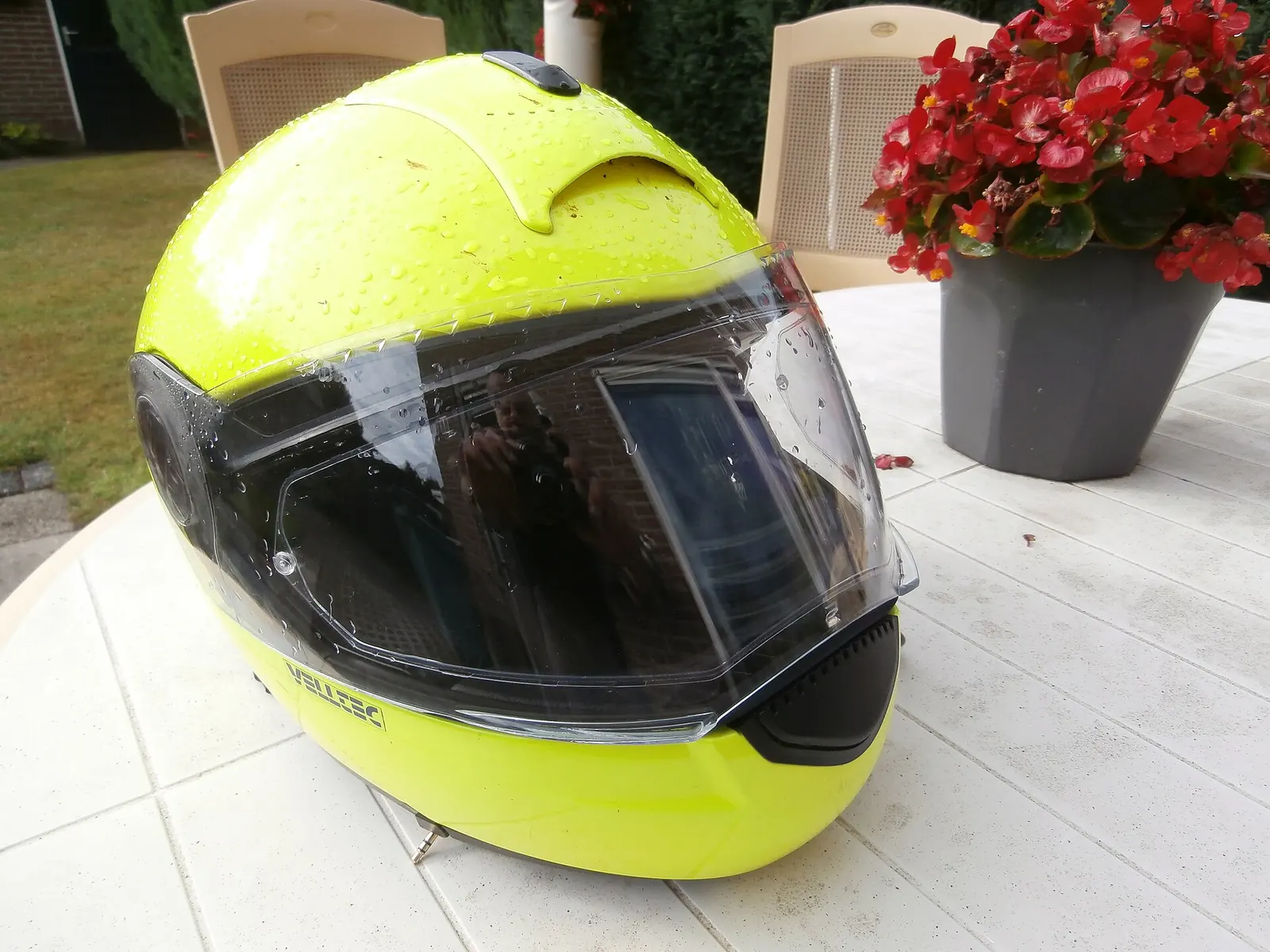
- Keep the seal clean. Grit under the silicone edge breaks the seal and fog appears between the lenses.
- Clean it gently. Follow the insert maker's cleaning instructions; a scratched insert scatters oncoming headlights at night.
- Check it after visor removal. The central lock and tool-free removal make it easy to knock the insert out of line.
Is the KYT R2R Pro worth buying?
Not for an adventure or touring rider, in my view. I would not buy it again, and I won't buy KYT again. It is very noisy, it wobbles at speed and it is big. It is made for racers who tuck in, not for someone sitting upright on an adventure bike, and I think people buy it because premium feels better and because it is tested for conditions that aren't Indian. For about ₹18,000 with the Pinlock, I expected better. Next time I would buy an SMK.
To be fair to it: it is ECE 22.06 and ISI certified, with a sun visor, Pinlock-ready visor and double-D that cheaper helmets lack. Indian reviewers praise its field of view, ventilation and build, and both BikeWale and Motoring World also flag wind noise above about 80 km/h.
| Buy it if | Look elsewhere if |
|---|---|
| You ride a sports bike, mostly tucked in | You ride upright on an adventure or touring bike |
| You want a sun visor and Pinlock-ready visor in one helmet | You want a quiet, stable helmet for long highway days |
| Your head fits KYT's internal shape in a shop trial | You can only buy online without trying the size |
| You will wear earplugs anyway | You need a modular (flip-up) helmet |
If you ride a sports bike and spend your time tucked in, the R2R Pro makes more sense; try it in a shop first, in both neighbouring sizes. The rest of what I ride in is on the gear page, and the electronics on my KTM are in the CHIGEE AIO-6 Max review and the phone mount review.
What's new
- KYT launches the R1R in India at ₹39,000, a step above the NZ Race, with ECE 22.06 and ISI Autocar India, Apr 2026
- Government urges buyers to use only BIS-certified helmets; 176 makers hold licences All India Radio, Jul 2025
- Draft rule would make makers supply two BIS helmets with every new two-wheeler Autocar Professional, Jun 2025
Questions people ask
Is the KYT R2R Pro ISI certified?
Yes. Indian reviews confirm both ISI and ECE 22.06 approval, so it is legal to wear on Indian roads.
How much does the KYT R2R Pro weigh?
KYT quotes 1,500 g ± 50 g for the R2R in size M. Sizes L to XXL use the larger shell, so expect a little more; check the weight printed on the label, which IS 4151 requires.
Does KYT run small?
Motoring World's reviewer found KYT helmets run about a size small, while BikeWale's reviewer found a size S fitted better than his usual M. Measure your head and try both neighbouring sizes.
Why is my helmet so noisy above 100 km/h?
Wind noise rises about 6 dB with each one-third rise in speed, vents add more, and a loose helmet adds low-frequency noise. Fit the chin curtain, close the chin vent, check the fit and wear earplugs.
When should I replace my helmet?
After any crash or hard drop on a hard surface, and otherwise after about five years, which SHARP describes as the industry consensus.
Sources
- KYT Americas: R2R specifications and sizing table (shell, EPS, weight, visor, sizes)
- BikeWale: KYT R2R Pro first impressions (Aug 2024; shells, Pinlock, vents, price)
- BikeWale: KYT R2R Pro review (Oct 2024; noise above 80 km/h, ISI mark)
- Motoring World: KYT R2R Pro, put a lid on it (Nov 2024; sizing runs small, wind noise)
- SHARP (UK Department for Transport): ECE R22-06, what you need to know (2024)
- All India Radio: Govt urges consumers to use only BIS-certified helmets (Jul 2025)
- McCombe: Hearing loss in motorcyclists, Journal of the Royal Society of Medicine (2003)
- Özer, Terzioğlu and Öztürk: Noise reduction performance of a motorcycle helmet, IJAET (2019)
- Chang, Chang and Chang: Fit effect of motorcycle helmet, a finite element modeling, JSME International Journal (2001)
- TRL: The potential for motorcycle helmet loss revisited (2018)
- CDC NIOSH: Noise and hearing loss, the 85 dBA REL and 3 dB exchange rate
- Autocar India: KYT R1R helmet launched at Rs 39,000 (Apr 2026)
- Autocar Professional: draft notification on ABS and two helmets (Jun 2025)

Sapta (Saptarshi Sarkar) is a mechanical engineer turned marketer in Bengaluru and a solo touring rider. He writes the seven Saptaverse blogs. Work with him or read more of RoadHook Machines.