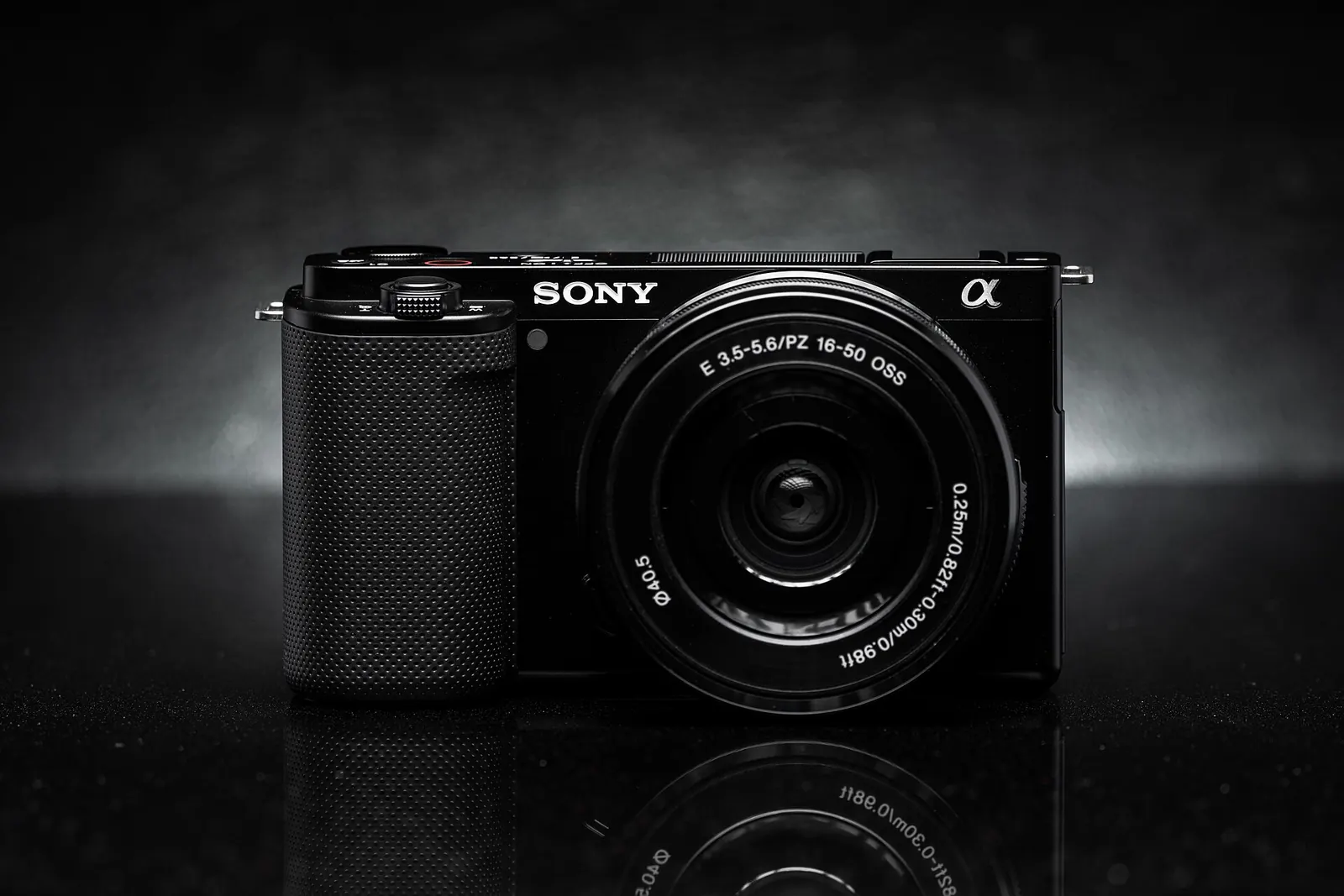
The Sony ZV-E10 is a very good camera for the deliberate shots in a motorcycle travel film: the roadside establishing frame, the slow pan across a valley, the bike riding past a locked-off tripod. It is a poor camera for riding POV, because its sensor takes about 33 ms to read a 4K/24p frame, so fast motion and engine vibration bend the picture. Plan on about 20 minutes of continuous 4K before heat stops it on default settings, and use an action camera for everything shot while moving.
- 24.2 MP APS-C sensor (23.5 × 15.6 mm), about 13 times the area of a 1/2.3-inch action-camera chip.
- 33 ms readout in 4K/24p, 27 ms in 4K/30p and 13 ms in 1080/24p, measured by DPReview.
- About 20 minutes of continuous 4K at 25°C on default heat settings; about 30 with Auto Power OFF Temp set to High.
- No in-body stabilisation: Active mode crops the frame by 1.44×.
- Best job on a bike trip: planned hero shots, interviews and B-roll, not handlebar or helmet footage.
I own a ZV-E10, and it has one job in my kit: the deliberate, cinematic shots. The DJI Osmo Action 4 handles POV and anything dynamic, and my Samsung Galaxy S25+ adds extra coverage. That split is the honest answer to most "should I buy a ZV-E10 for moto vlogging?" questions, and the rest of this review is the engineering behind it.
It has been in my kit since at least January 2025, when it shot the photos and clips of a weekend ride on my NS200 from Bengaluru to Gandikota, the gorge on the Pennar river in Andhra Pradesh.
Sony launched the ZV-E10 in July 2021 as an interchangeable-lens follow-up to the ZV-1 compact: in effect a reworked a6100 with a flip-out screen, no viewfinder, a three-capsule microphone and a dedicated stills/video button. Five months later, on 3 December 2021, Sony Japan announced that it had suspended orders and stopped producing the camera because of the global chip shortage.
The a6100, a6400 and the 2014-era a7 II were paused at the same time. Sony said orders would restart depending on "the status of parts supply". The camera came back, and its low price and simple controls made it one of the most common first cameras for creators. That popularity is why its quirks are so well measured today.
Engadget: Sony suspends orders for the ZV-E10 because of chip shortages (Dec 2021)What do you actually get in a Sony ZV-E10?
The ZV-E10 is a 24.2-megapixel APS-C E-mount body that records 4K in 8-bit 4:2:0 XAVC S at up to 100 Mbps. Every figure below is from Sony's own specification sheet, except the launch price, which DPReview reported in its July 2021 review.
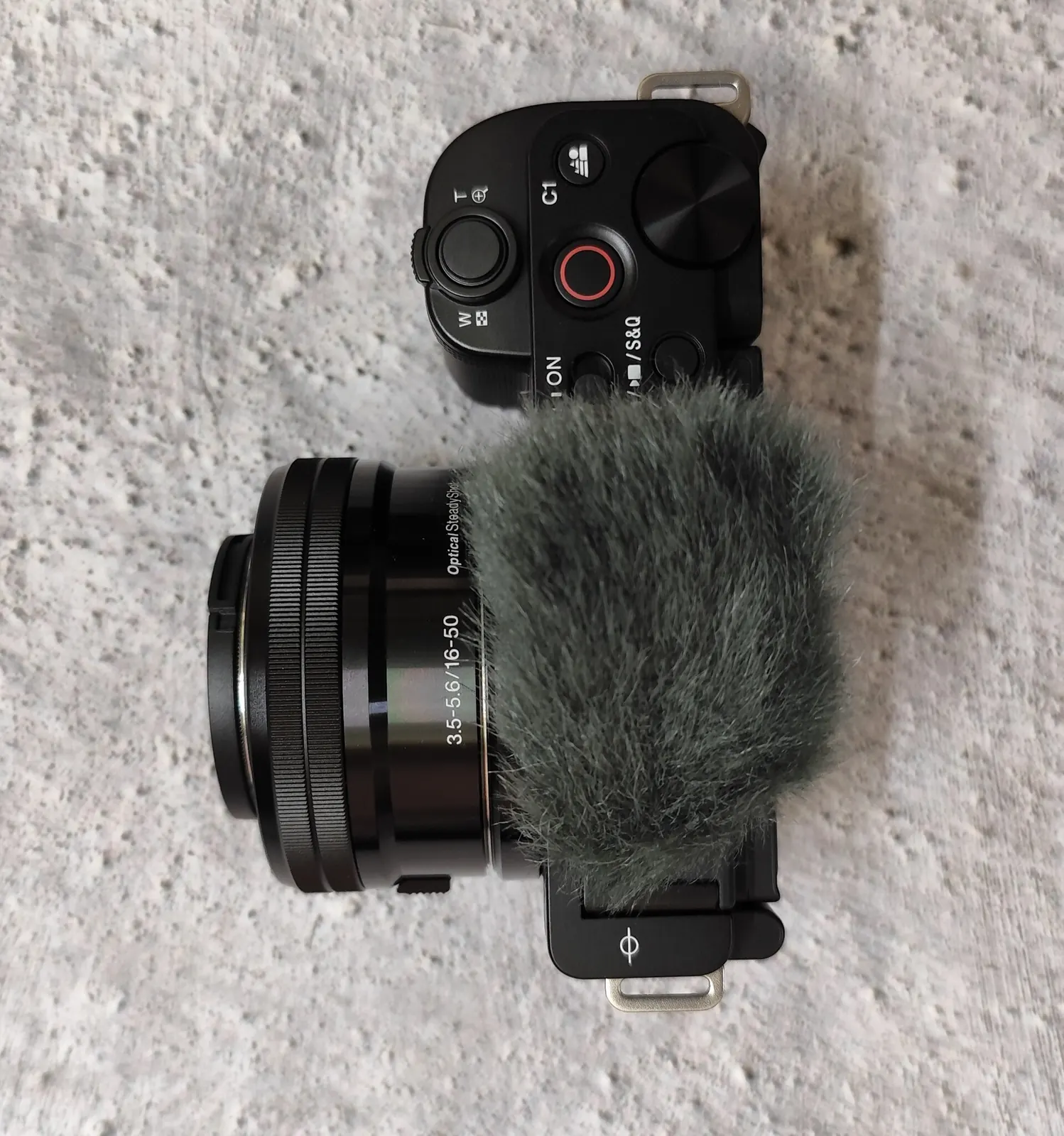
| Spec | Sony ZV-E10 | What it means on a ride |
|---|---|---|
| Sensor | APS-C Exmor CMOS, 23.5 × 15.6 mm, 24.2 MP | Real background blur and clean dusk footage |
| 4K video | 30p and 24p at 100 or 60 Mbps, 8-bit 4:2:0 | Fine for a 1440p or 1080p timeline; less grading room than 10-bit |
| Full HD | Up to 120p at 100 Mbps | 4× slow motion of a bike passing |
| Picture profiles | S-Log2, S-Log3, HLG | Log works, but 8-bit Log bands if pushed hard |
| Autofocus | 425 phase-detect points | Reliable face and subject tracking |
| Stabilisation | Lens OSS plus electronic Active mode | No sensor-shift IBIS |
| Battery | NP-FW50: about 440 shots, 80 min of real recording | Carry two or three spares, or power it over USB |
| Weight | About 343 g with battery and card | Light enough for a tank bag |
| Audio | 3-capsule mic, 3.5 mm mic and headphone jacks | Plug in a wireless mic |
| Launch price | US$700 body, US$800 with 16-50mm | Still one of the cheapest ways into E-mount |
The sensor size is the reason to buy it over a phone or action camera. An APS-C sensor has about 367 mm² of area, roughly five times a 1/1.3-inch action-camera sensor like the Action 4's. That much more light-gathering area means cleaner shadows at dusk and genuine shallow depth of field, which I explain in what really controls depth of field.
How bad is the ZV-E10's rolling shutter on a motorcycle?
Bad enough to rule out mounted riding footage in 4K. DPReview measured the ZV-E10's sensor readout at 33 ms in 4K/24p, 27 ms in the cropped 4K/30p mode and 13 ms in 1080/24p, and called the 4K wobble "fairly noticeable and distracting" in fast pans.
Why readout time matters
A CMOS sensor like this one does not capture a frame at one instant. It reads row by row from top to bottom, so the bottom of a 4K/24p frame is recorded about a thirtieth of a second after the top. If the camera or subject moves during that window, straight lines lean and vibration turns into a rubbery jello ripple.
Why a motorcycle makes it worse
Vibration is the bigger problem than panning. A 2022 study of an underbone single-cylinder motorcycle found handlebar modes at 41.6 Hz, 82.2 Hz and 183 Hz. A 41.6 Hz shake completes one full cycle in 24 ms, so a 33 ms readout captures more than a complete wobble inside a single frame. That is the textbook recipe for jello, and no amount of lens stabilisation removes it.
See the data as a table
| Readout time (ms) | |
|---|---|
| ZV-E10 4K/24p | 33 |
| ZV-E10 4K/30p (1.23× crop) | 27 |
| ZV-E10 1080/24p | 13 |
| ZV-E10 II 4K/24p | 17 |
| ZV-E10 II 4K/60p | 16 |
| ZV-E10 II 1080/24p | 7 |
Source: DPReview reviews of the Sony ZV-E10 (2021) and ZV-E10 II (2024) · The ZV-E10 II figures are from DPReview’s ZV-E10 II review, page 2.
Most rolling-shutter fixes had been trained on synthetic distortion, so the authors built a rig that fed one scene through a 50/50 beam splitter to a rolling-shutter CMOS camera and a global-shutter CCD camera at once, both at 25 fps with 1 ms exposures. The result, BS-RSC, is 80 real video pairs of 50 frames each at 1024 × 768.
Their network corrected real distortion to 28.23 dB PSNR, against 24.86 dB for the best earlier method. Limit: it is trained on one camera pair and street motion, and the authors note artefacts when the time between frames differs from training. Software can reduce jello; it cannot fully undo it.
Read the paper (free)Use this to check what you just read. It estimates how far a vertical line shifts between the top and bottom of the frame during a pan or a sway.
Rolling shutter skew during a pan
At the defaults (16 mm, 30°/s, 4K/24p) the shift is about 52 pixels, a lean of about 1.4°. Switch to 1080p with its 13 ms readout and the lean falls to about 0.55°, which most viewers never notice. If the ZV-E10 must shoot while moving, shoot 1080p, not 4K.
Will the ZV-E10 overheat on a long riding day?
It can, and the limit is written in Sony's own help guide. With Auto Power OFF Temp on Standard, Sony quotes about 20 minutes of continuous 4K (24p, 60 Mbps) and about 30 minutes of Full HD at 25°C. On High, those become about 30 and 60 minutes.
| Setting | Ambient | XAVC S 4K | XAVC S HD (60p, 50 Mbps) |
|---|---|---|---|
| Standard | 25°C | About 20 min | About 30 min |
| Standard | 40°C | About 20 min | About 30 min |
| High | 25°C | About 30 min | About 60 min |
| High | 40°C | About 30 min | About 60 min |
Sony's figures assume the camera has been switched off for a while and is not on Wi-Fi. Sony adds that the time varies with temperature, recording settings, Wi-Fi and the camera's condition before recording, so real days with repeated takes run shorter. A camera sitting in a tank bag on a sunny Deccan afternoon starts warm.
- Set Auto Power OFF Temp to High before the trip if you need longer takes, and expect a warmer body.
- Flip the screen out and keep it out of direct sun between takes.
- Shoot in short takes. Hero shots rarely need more than 2 minutes.
- Turn off Wi-Fi and proxy recording, both of which add heat.
Which settings work best for a motorcycle travel film?
For planned shots, 4K/24p with no crop is the best image this camera makes; for anything moving, 1080p. I edit on a 2K/1440p timeline and use 4K only when it helps, and on this camera 4K helps a lot: a 3840-pixel frame on a 2560-pixel timeline gives a 1.5× reframe with no loss of sharpness.
| Mode | Crop | Readout | Use it for |
|---|---|---|---|
| 4K/24p, 100 Mbps | None | 33 ms | Tripod hero shots, landscapes, slow pans |
| 4K/30p, 100 Mbps | 1.23× | 27 ms | When the 30p cadence matters; less wide |
| 1080/120p, 100 Mbps | None listed | Not measured | Slow-motion pass-bys |
| 1080/24p | None | 13 ms | Hand-held moving shots, gimbal walks |
Shutter, ND and Log
- Shutter at about double the frame rate (1/50 s for 24p) keeps motion blur natural. In daylight that needs an ND filter; I carry ND16–64 and CPL filters. The shutter speed chart for moving subjects has the numbers.
- S-Log3 in 8-bit spreads few code values over a wide range, so skies can band when graded. HLG or a standard profile with a careful exposure is often safer. My notes on exposing to the right apply here too.
- Background Defocus (the C1 button) opens the aperture fully. DPReview warns that in bright light this can force a fast shutter and choppy motion, another reason for an ND.
My general view on log, which I apply to my action camera as well: it only pays off for cinema-grade work that you will grade shot by shot. If you want punchy colour and a quick turnaround, a standard profile exposed carefully is the faster route, and on an 8-bit camera it is also the safer one.
How should you mount the ZV-E10 on a motorcycle, if at all?
Don't hard-mount it to the handlebar. A handlebar is a vibrating beam: the 2022 underbone-motorcycle study measured a hand-arm vibration total of 8.28 m/s² at the grip on the road. Even phone makers now warn about this. In November 2023 Apple advised against mounting iPhones on high-power motorcycles, because high-amplitude vibration can degrade optical image stabilisation and autofocus.
The same physics applies to an OSS lens, whose floating stabiliser group sits on tiny suspension. For a camera with no in-body stabilisation and a slow readout, the right use is off the bike: on a mini tripod, in hand, or on a gimbal while walking.
Researchers at Universiti Sains Malaysia measured an underbone single-cylinder motorcycle on a flat asphalt road and found a grip vibration total of 8.28 m/s², mostly vertical and mostly from tyre-road input rather than the engine. Using modal analysis over 0–200 Hz, they designed rubber-mounted handlebars.
The best design cut on-road vibration to 4.08 m/s², a 51% reduction. Limit: one small commuter motorcycle and rider-hand exposure, not camera mounts. The lesson carries over: rubber isolation between a vibrating bar and a payload halves what reaches it.
Read the paper (free)How does the ZV-E10 fit next to an action camera and a phone?
The ZV-E10 earns its place only if it shoots what the others can't. In my kit, that division is fixed: ZV-E10 for deliberate cinematic shots, the Osmo Action 4 for POV, and the Galaxy S25+ for extra coverage.
ZV-E10 or ZV-E10 II?
If you are buying new in 2026, compare it with the 2024 ZV-E10 II, which fixes most of the original's video weaknesses at a higher price.
| Item | ZV-E10 (2021) | ZV-E10 II (2024) |
|---|---|---|
| Sensor | 24 MP APS-C | 26 MP BSI APS-C |
| Best 4K | 4K/30p (1.23× crop), 4K/24p | 4K/60p (1.1× crop) |
| Bit depth | 8-bit | 10-bit |
| 4K/24p readout | 33 ms | 17 ms |
| Battery (CIPA) | NP-FW50, 440 shots, 80 min video | NP-FZ100, 610 shots, 130 min video |
| US launch price with kit lens | US$800 | US$1,099 |
For a rider who already owns an action camera, the original is the better-value body: the jobs it does well are the still ones. If the ZV-E10 will be your only camera and you shoot while walking, the II's halved readout and 10-bit colour are worth the extra money.
What sound and power setup does the ZV-E10 need on a trip?
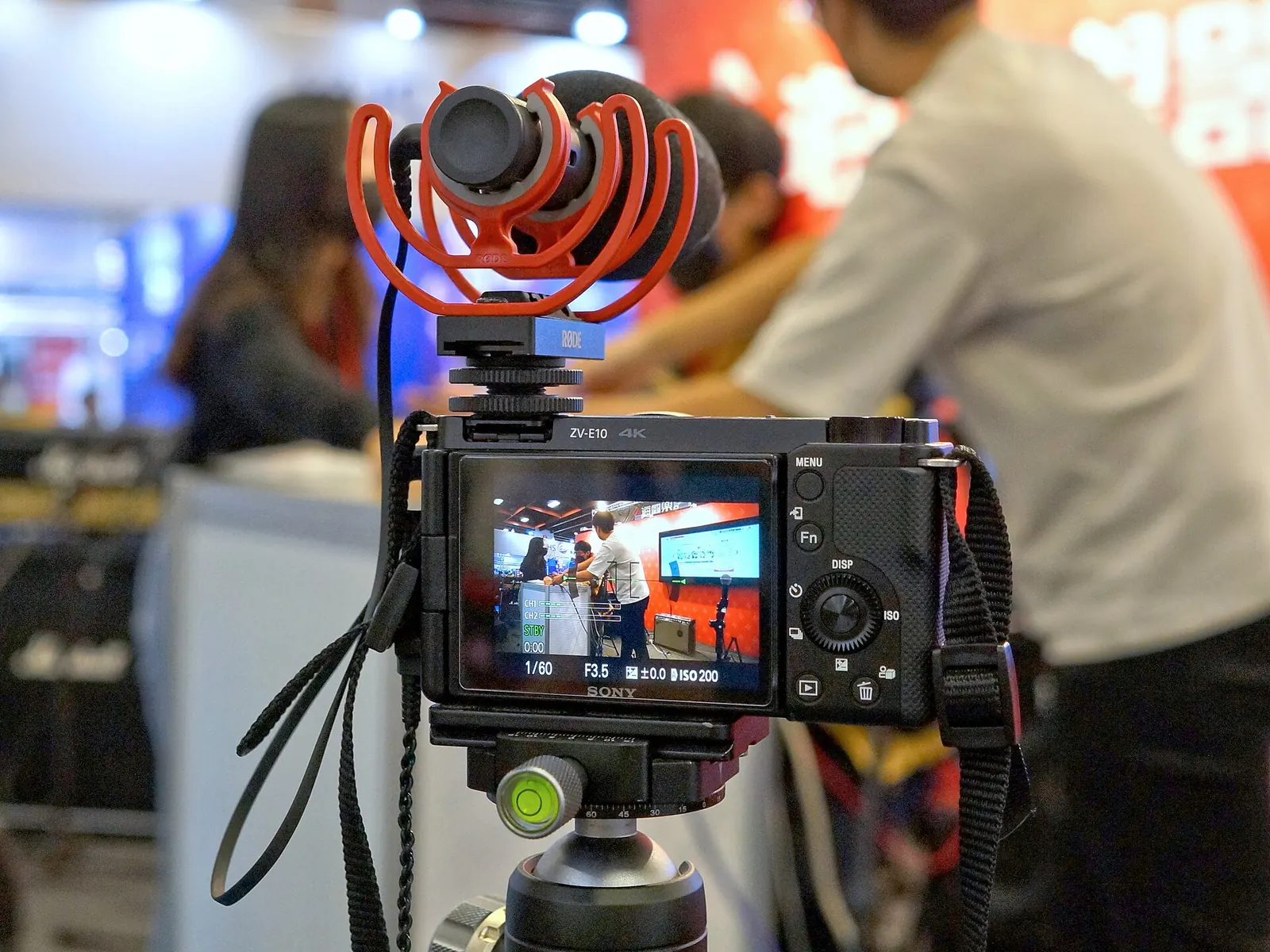
The built-in three-capsule mic is decent for talking to camera, and Sony ships a clip-on windscreen, but it is no use beside a running engine or on a windy pass. I use a DJI Mic Mini with two transmitters, which plugs into the 3.5 mm input, so narration and a second voice get their own clean tracks.
- Batteries: Sony rates the NP-FW50 at about 80 minutes of real recording. DPReview found real-world use ran about 1.5× the CIPA figure, but cold mornings cut it.
- USB power: the camera accepts USB power, so a power bank in the tank bag can keep a long timelapse alive.
- Cards: a 64 GB card holds about 1 h 15 min of 4K at 100 Mbps, or 2 h at 60 Mbps.
So is the ZV-E10 worth buying for motorcycle filmmaking?
Yes, if you pair it with an action camera and use it as the "slow" camera. It gives an APS-C look and interchangeable lenses for the shots viewers remember, the wide establishing frames and the bike passing through them. My motorcycle travel photography guide covers how to plan those frames, and the rest of my riding kit is on the gear page.
No, if you want one camera to strap to the bike. Its slow readout, lack of IBIS and 20-minute heat limit are the wrong traits for that job.
The ZV-E10 is a tripod camera that happens to be small, not an action camera that happens to have a big sensor.
What's new
- Readout speed in milliseconds, not burst fps, predicts rolling shutter Fstoppers, Jan 2026
- Readout comparison puts the Sony FX3 at 8.8 ms and the FX2 at 27.7 ms in 4K/24p YMCinema, Sep 2025
- Sony raises the US price of the ZV-E10 II from $999.99 to $1,099.99 Photo Rumors, Jun 2025
Questions people ask
Is the Sony ZV-E10 good for motorcycle vlogging?
For talking to camera at a stop and for planned scenic shots, yes. For footage shot while riding, no: its 33 ms 4K readout and lack of IBIS turn engine vibration into jello. Pair it with an action camera for riding footage.
Does the Sony ZV-E10 overheat?
Sony's help guide quotes about 20 minutes of continuous 4K at 25°C on the Standard heat setting and about 30 minutes on High. In sun or after repeated takes it can warn sooner.
Does the ZV-E10 have image stabilisation?
It has no sensor-shift IBIS. It relies on optical stabilisation in OSS lenses plus an electronic Active mode that crops the frame by 1.44×.
Can the ZV-E10 shoot 4K at 60 fps?
No. It tops out at 4K/30p (with a 1.23× crop) and 4K/24p. For 4K/60p, the ZV-E10 II offers it with a 1.1× crop.
Is 8-bit S-Log3 on the ZV-E10 usable?
Yes, if exposed carefully, but 8-bit gives only 256 levels per channel, so heavy grades can band in skies. Many owners use HLG or a standard profile instead.
Sources
- Sony: ZV-E10 specifications (sensor, video modes, battery, weight)
- Sony Help Guide: ZV-E10 recordable movie times (continuous recording and card times)
- Sony Help Guide: ZV-E10 battery life and number of recordable images
- DPReview: Sony ZV-E10 review (2021; readout times, crops, launch price)
- DPReview: Sony ZV-E10 II in-depth review, page 2 (2024; readout, battery and price comparison)
- Engadget: Sony suspends orders for the ZV-E10 (2021)
- Cao et al.: Learning Adaptive Warping for Real-World Rolling Shutter Correction (CVPR 2022)
- Usamah, Mazlan and Ripin: Motorcycle handle vibration attenuation (International Journal of Acoustics and Vibration, 2022)
- Apple Support: Vibrations from motorcycle engines might impact iPhone cameras (2023)
- Fstoppers: The most underrated camera spec in 2026 (2026)
- YMCinema: readout speed comparison (2025)
- Photo Rumors: Sony US price increase, 30 June 2025 (2025)

Sapta (Saptarshi Sarkar) is a mechanical engineer turned marketer in Bengaluru and a solo touring rider. He writes the seven Saptaverse blogs. Work with him or read more of Artblog.