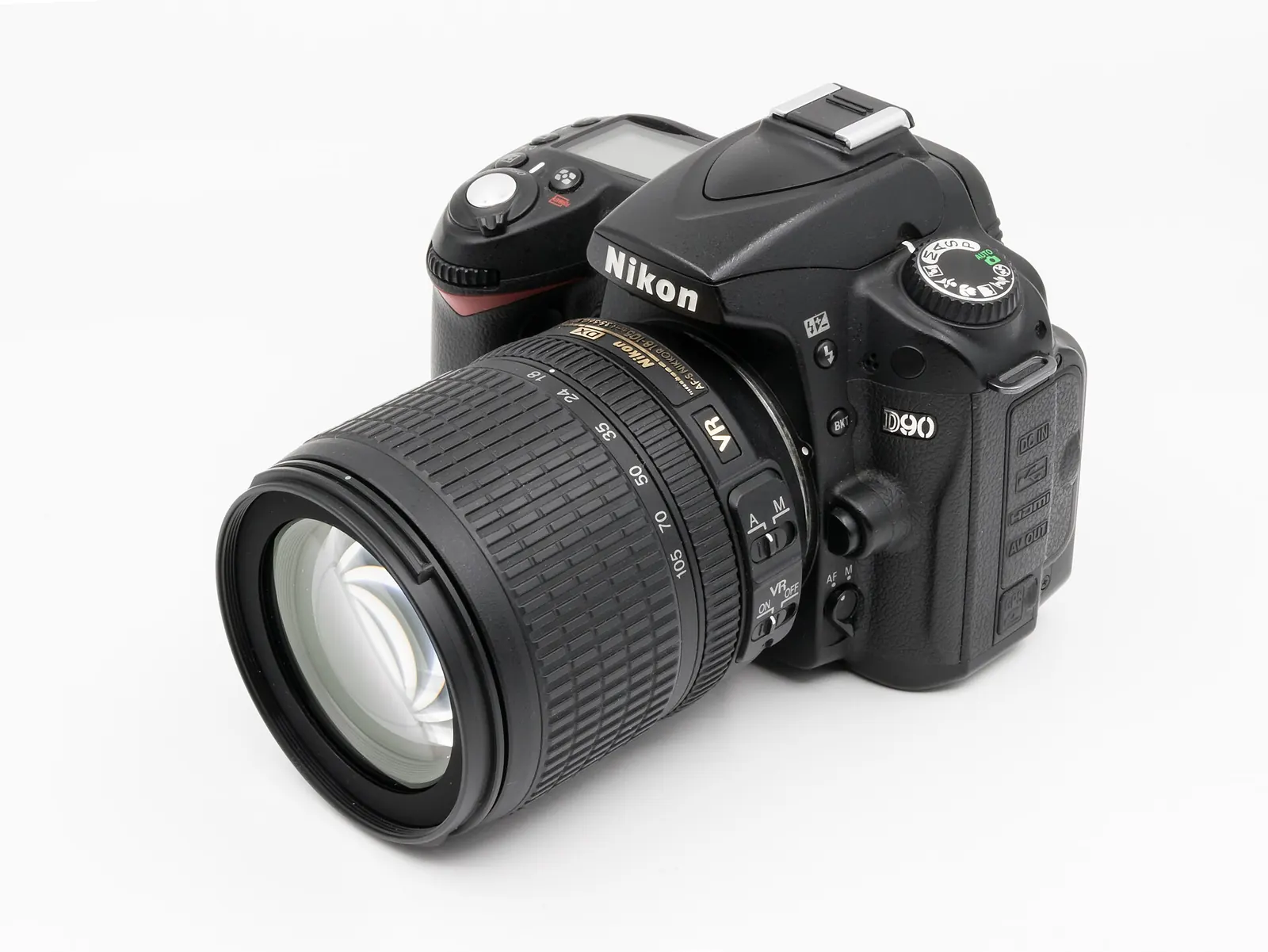
A Nikon D90 in 2026 is still a capable stills camera if you shoot in good light at ISO 200 to 800: its 12.3 MP CMOS sensor, bright pentaprism viewfinder and built-in autofocus motor still make sharp, printable photos with cheap older F-mount lenses. It is not worth buying for video, low light or fast action, because it records only 720p at 24 fps in clips of about 5 minutes, with mono sound and no autofocus while recording. Buy one only cheaply, and test it for hot pixels first.
- 27 August 2008: Nikon announced the D90 as the world's first DSLR with a movie function.
- 12.3 MP DX CMOS, 23.6 × 15.8 mm, ISO 200 to 3200 native; about 8.3 stops of usable dynamic range at ISO 200 (DPReview).
- 720p/24 Motion JPEG video, about 5 minutes per clip, 11 kHz mono sound.
- About 850 shots per EN-EL3e charge (CIPA), against 440 for a Sony ZV-E10.
- Hot pixels grow with age: a published model predicts roughly 40 at ISO 200 and 160 at ISO 3200 after 18 years.
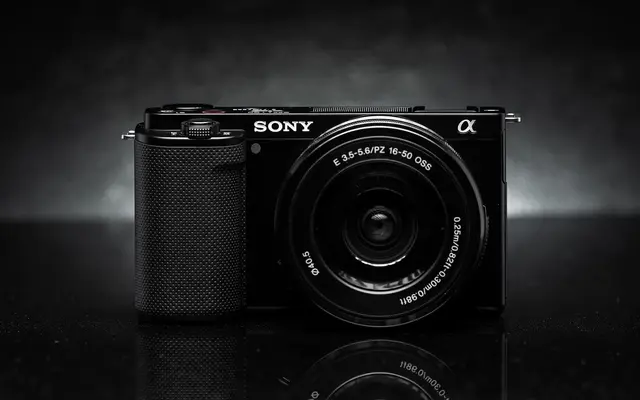
I still own a Nikon D90. It sits beside a Sony ZV-E10, a DJI Osmo Action 4 and a Samsung Galaxy S25+ in my kit, which makes it the oldest camera I have by more than a decade. This post answers the question people keep asking on forums: does a 2008 DSLR still earn a place in a bag, and what should a buyer check?
My short answer: for photos, the D90 is still exceptionally good. For video, it's very bad, and I don't use it for that. Today I reach for it sometimes for long-lens shots with a 70-200 mm zoom.
On 27 August 2008, in a press release from Melville, New York, Nikon announced the D90 and called it "the world's first digital SLR camera with a movie shooting function", with a footnote limiting the claim to Nikon's own research as of that day. The new D-Movie mode recorded 1280 × 720 at 24 fps as Motion JPEG inside AVI files.
Nikon put the headline on video, but the bigger change for most buyers was the sensor. The D90 replaced the D80, whose 10.2 MP sensor was a CCD. The D90 used a 12.3 MP CMOS chip, with Live View, face detection and ISO up to 3200. A sensor change made video possible, and video changed what every camera after it was expected to do.
Nikon: Nikon introduces the D90 digital SLR camera (27 Aug 2008)What were the Nikon D90's specs, and how do they compare today?
The D90 is a 12.3-megapixel DX-format DSLR with an 11-point autofocus module, 4.5 fps bursts and a 3-inch 920k-dot screen. Against a modern entry body like the 2021 Sony ZV-E10, it loses on resolution, ISO and video, and wins on battery life and the optical viewfinder.
| Spec | Nikon D90 (2008) | Sony ZV-E10 (2021) |
|---|---|---|
| Sensor | CMOS, 23.6 × 15.8 mm, 12.3 MP | CMOS, 23.5 × 15.6 mm, 24.2 MP |
| Native ISO | 200 to 3200 (Lo 100, Hi 6400) | 100 to 32000 |
| Autofocus | 11 points, 1 cross-type | 425 phase-detect points |
| Burst | 4.5 fps | 11 fps |
| Viewfinder | Pentaprism, 96% coverage, 0.94× | None |
| Video | 720p/24, Motion JPEG, mono | 4K/30p, XAVC S, stereo |
| Battery (CIPA) | About 850 shots, EN-EL3e | About 440 shots, NP-FW50 |
| Weight with battery | About 703 g body | About 343 g |
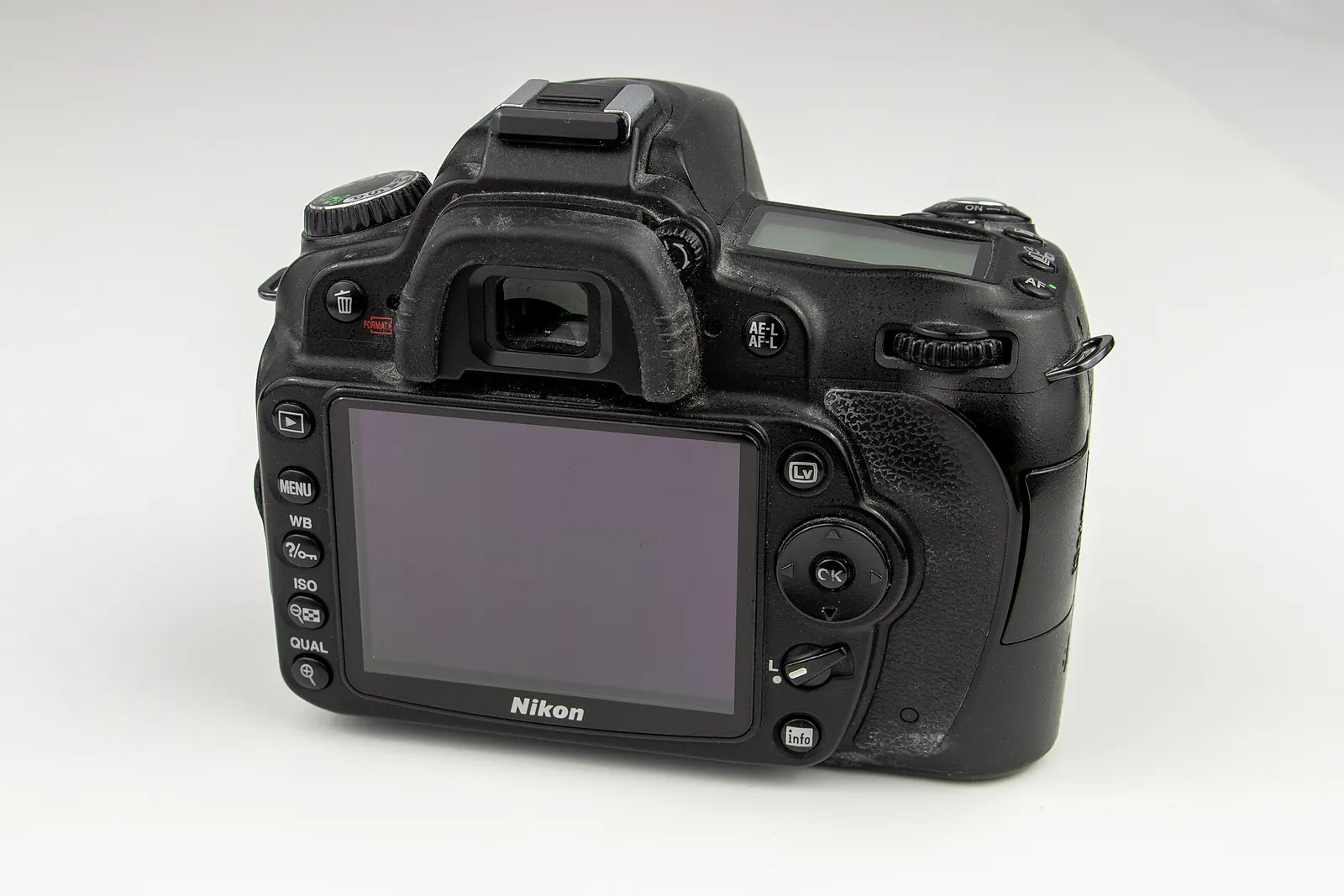
Two of these numbers still matter in the field. 850 shots per charge is a full day's shooting, because an optical viewfinder uses no power. And the viewfinder itself, which DPReview called one of the best on any APS-C camera of its time, shows the scene with zero lag.
Is the D90's sensor CMOS or CCD, and does it matter?
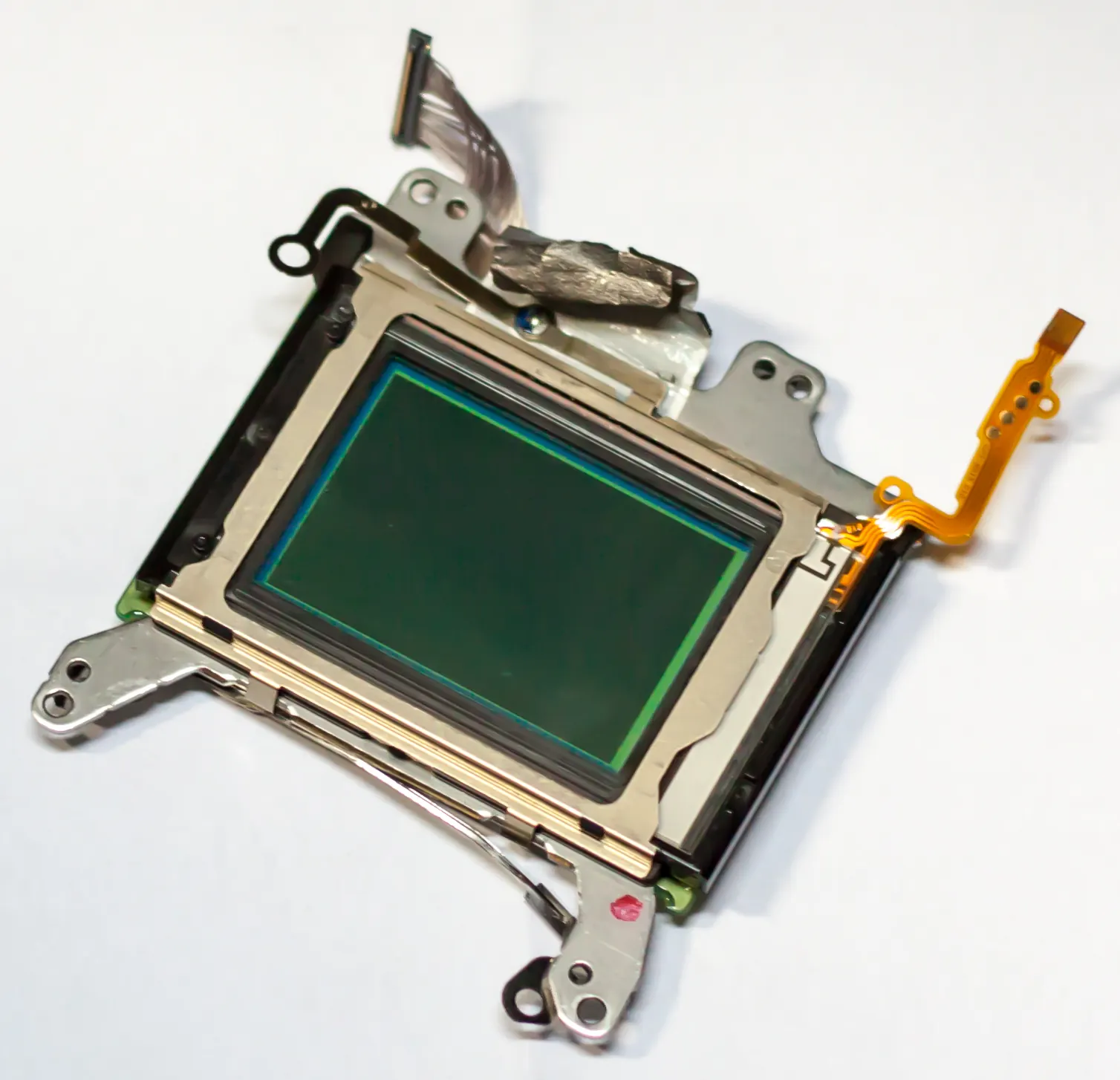
The D90's sensor is CMOS; its predecessor, the D80, used a CCD. The switch matters because it explains both what the D90 could do (Live View and video) and its main video flaw, the rolling shutter.
How the two sensors read out
- Interline CCD: every pixel's charge moves at once into a shielded storage column, then shifts out through one output. The whole frame is captured at one instant: a global shutter.
- CMOS: each pixel has its own amplifier, so the chip can read itself quickly with little power, which is what made continuous Live View and video practical. But most CMOS pixels cannot hold their charge, so rows are read one after another: a rolling shutter.
Written as low-power, low-cost CMOS sensors were spreading, this paper explains the root cause in one line: unlike interline-transfer CCDs, individual CMOS pixels typically cannot store their intensities, so scanlines are exposed at different times. The authors derive projection equations for a rolling-shutter camera and show that, for sideways motion, it behaves like a "crossed-slits" camera rather than a pinhole.
Their simulations of a 30 fps, 40° field-of-view camera viewing a checkerboard 0.5 m away show straight lines curving as the camera rotates. Limit: simulation and a robotics camera, not a DSLR, but the geometry is the same one that skews D90 video.
Read the paper (free)How good is the D90's video in 2026?
As a working video camera, it isn't. DPReview's tests found the D90 records about 5 minutes per 720p clip (20 minutes in the smaller modes), sound at 11 kHz, 16-bit mono from the built-in mic, and no autofocus once recording starts. There is no microphone input.
- Exposure in movie mode is controlled by changing sensor gain, which DPReview found can produce stepped brightness changes.
- Motion JPEG at about 1.7 MB per second is easy to edit but large, and it shows its age next to modern codecs.
- Rolling shutter skews vertical lines into diagonals during fast pans, which DPReview showed in a sample clip.
The honest use for D90 video today is as a look: the soft, slightly crunchy 720p of 2008 can work for a flashback sequence in a travel film. For anything else, a phone shoots better video. I cover what a modern phone pipeline does in how phone cameras compute a photo.
That matches my own experience: the D90's video is very bad to work with, so I don't use it, even though the footage does have a cinematic look to it.
How many hot pixels will an 18-year-old D90 have?
Probably dozens, visible mainly in long or high-ISO exposures. Image sensors keep developing new hot pixels as they age, most likely from cosmic-ray damage, and the rate has been measured across many cameras over 14 years.
The Simon Fraser University group took 5 to 20 dark frames per camera, from 0.001 to 2 s and across every ISO, in RAW, on DSLRs with 7.5 to 4 µm pixels and phones with 1.3 µm pixels. Their fitted formula for CMOS (APS) sensors is D = 10-1.12 × S-3.15 × ISO0.525 defects per mm² per year, with S the pixel size in microns.
In plain terms: halve the pixel size and hot pixels appear about 8 times as fast; double the ISO and about 1.4 times as many show. Limit: averages across tested cameras; any one camera can sit well above or below, and many hot pixels show only in exposures near a second.
Read the paper (free)The D90's pixels are about 5.5 µm across (372.9 mm² of sensor divided among 12.3 million pixels). Plugging that into the formula gives the projection below. The ZV-E10's smaller 3.9 µm pixels age faster, so after only five years it is already close to the old Nikon.
See the data as a table
| Nikon D90, 2008 to 2026 (hot pixels) | Sony ZV-E10, 2021 to 2026 (hot pixels) | |
|---|---|---|
| ISO 200 | 38 | 31 |
| ISO 400 | 55 | 45 |
| ISO 800 | 79 | 64 |
| ISO 1600 | 113 | 93 |
| ISO 3200 | 163 | 133 |
Source: Calculated with the APS formula in Chapman et al., IS&T Electronic Imaging 2018 · Estimate. D90: 5.5 µm pixels, 372.9 mm². ZV-E10: 3.9 µm pixels, 366.6 mm². Real cameras vary widely around these averages.
Use this to check what you just read. Enter a camera's pixel size, sensor area and age to estimate how many hot pixels it has grown at a given ISO.
Hot pixels an old camera has grown
Forty-odd stuck-bright dots out of 12.3 million pixels sounds alarming, but at ISO 200 and normal shutter speeds they rarely show. They matter for night skies and long exposures, where a dark frame subtracted in software, or in-camera long-exposure noise reduction, removes most of them.
What should you check before buying a used Nikon D90?
Test it as a stills camera, because that is all you are really buying. Ask to shoot these five checks before paying.
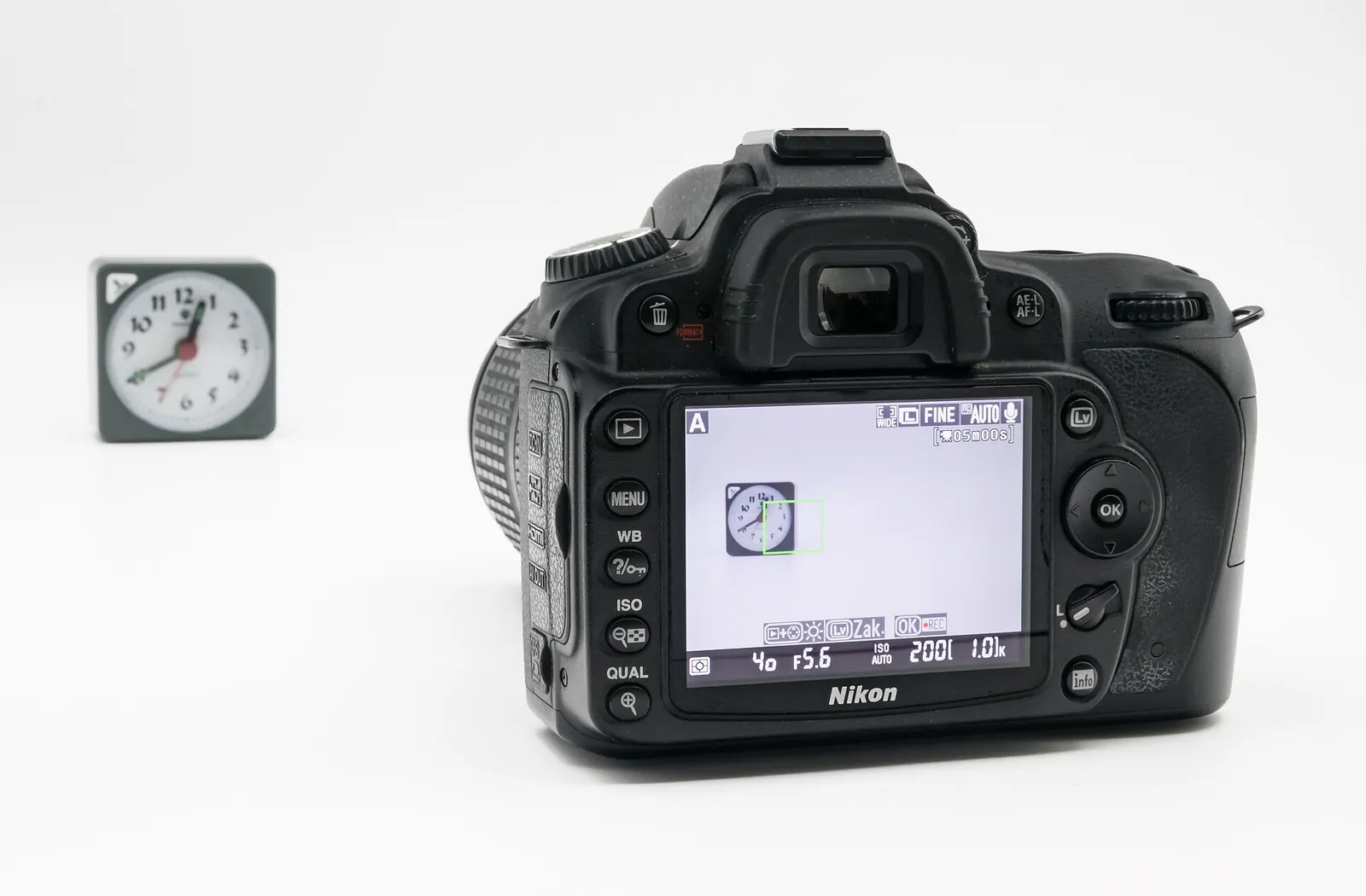
- Dark-frame test. Fit the body cap, set ISO 800 and 1 s, shoot one frame and zoom in on the screen. Count bright dots; dozens are normal at 18 years, clusters or lines are not.
- Shutter and mirror. Fire a 4.5 fps burst of 20 frames. Listen for an even rhythm, and check the last frames for dark bands.
- Autofocus motor. Mount an older AF or AF-D lens; the D90's in-body motor should drive it smoothly. Then check focus on all 11 points, not only the centre.
- Sensor dust. Shoot a plain sky at f/16 and look for grey spots.
- Battery and ports. Make sure the EN-EL3e holds charge and the SD slot and HDMI port work.
Which lenses make a D90 worth using?
The D90's built-in autofocus motor is its best feature in 2026. It autofocuses older screw-drive AF and AF-D Nikkor lenses, which entry-level Nikon bodies without a motor cannot, and those lenses are some of the cheapest good glass on the used market.
- A 50 mm f/1.8 prime becomes a 75 mm-equivalent portrait lens on DX. I explain the history in why 50 mm is the standard lens.
- The 18-105 mm VR kit zoom the D90 launched with covers most travel scenes.
- F-mount lenses are still sold new: in December 2025, Nikon and B&H each listed about 60 F-mount lenses.
On mine, two lenses do the work:
| Lens | Full-frame equivalent on DX (×1.5) | Good for |
|---|---|---|
| 70-200 mm zoom | About 105-300 mm | Long-lens shots: distant subjects, compressed backgrounds |
| 18-55 mm-type kit zoom | About 27-82 mm | Everyday wide-to-normal framing |
The 70-200 is the lens I pair it with for long-lens shots. At 300 mm-equivalent framing, the D90's 4.5 fps and 11 AF points matter less than steady hands and good light, and in good light this sensor delivers. Focal length and perspective compression explains why long lenses flatten a scene.
Who should still buy a Nikon D90 in 2026?
Buy one if you want a cheap, tough stills camera to learn the exposure triangle on real dials, or a body for old F-mount lenses. Its physical controls make it a good teacher; pair it with the exposure triangle explained in stops.
Skip it if you need video, low-light speed or tracking autofocus. A used mirrorless body or a recent phone will do those jobs better.
| You want | D90? | Why |
|---|---|---|
| Landscapes in daylight | Yes | 8.3 stops of usable range at ISO 200, sharp 12 MP files |
| Learning manual exposure | Yes | Two command dials and an optical viewfinder |
| Night and astro | Only with care | Aged sensors grow hot pixels; subtract a dark frame |
| Travel video | No | 720p, 5-minute clips, mono sound, no AF in video |
| Sports or wildlife | No | 11 AF points, 4.5 fps |
The D90 is now what it always was underneath the video headline: a very good 2008 stills camera.
For how I use my current cameras on the road, see the Sony ZV-E10 owner review and the gear page.
What I like most is harder to put in a table: the feel and vibe of the camera. It shows its age, and I love that about it.
What's new
- Nikon's D6 flagship goes out of regular production, leaving the D850, D780 and D7500 DSLRBodies, Apr 2025
- Nikon made about 70,000 DSLRs in 2024; parts and service for the last models may end around 2032 DSLRBodies, Dec 2025
- Retro digital cameras sell to teenagers and young adults as demand for old tech climbs 1News, May 2026
Questions people ask
Is the Nikon D90 still good in 2026?
For stills in good light, yes: 12.3 MP is enough for an A4 print, and its usable dynamic range at ISO 200 measured about 8.3 stops. For video, low light and fast subjects, newer cameras are far better.
Was the Nikon D90 the first DSLR to shoot video?
Nikon announced it on 27 August 2008 as the world's first DSLR with a movie function, based on its own research as of that date. It recorded 720p at 24 fps.
Does the Nikon D90 have a CCD or a CMOS sensor?
CMOS. Its predecessor, the 2006 Nikon D80, used a 10.2 MP CCD.
Can the D90 autofocus while recording video?
No. Focus is set by contrast-detect AF before recording starts, then must be adjusted manually.
How long does a D90 battery last?
Nikon rated the EN-EL3e at about 850 shots per charge under CIPA conditions, which is more than many modern mirrorless cameras.
Sources
- Nikon: D90 announcement and specifications (2008; sensor, ISO, AF, battery, video, first-DSLR-video claim)
- DPReview: Nikon D90 review (2008; clip length, audio, dynamic range, viewfinder, weight)
- Wikipedia: Nikon D90 (production dates, built-in AF motor)
- Wikipedia: Nikon D80 (10.2 MP CCD sensor)
- Sony: ZV-E10 specifications (comparison figures)
- Chapman et al.: Exploring Hot Pixel Characteristics for 7 to 1.3 micron Pixels (IS&T Electronic Imaging, 2018; source for the hot pixel formula)
- Meingast, Geyer and Sastry: Geometric Models of Rolling-Shutter Cameras (arXiv, 2005)
- DSLRBodies: The End is Near (Apr 2025)
- DSLRBodies: Just a reminder about extinction (Dec 2025; production and F-mount lens counts)
- 1News: Why your dusty old gadgets could be worth more than you think (May 2026)

Sapta (Saptarshi Sarkar) is a mechanical engineer turned marketer in Bengaluru and a solo touring rider. He writes the seven Saptaverse blogs. Work with him or read more of Artblog.