
Coasting in neutral or with the clutch held in is not safe on a long descent, and on a fuel-injected bike it does not even save fuel. In gear with the throttle closed, the ECU cuts fuel on overrun, so the engine uses almost nothing; in neutral it must burn idle fuel to keep running. Meanwhile every joule of height you lose has to go somewhere: in gear, the engine absorbs part of it, while in neutral it all goes into the brakes, which is how brake fluid boils on ghat roads. KTM's and Bajaj's manuals both say the same thing: stay in gear and let engine braking work.
- In gear with the throttle shut, a fuel-injected bike's ECU cuts fuel; in neutral it burns idle fuel, about 0.028 g/s.
- A 200 kg bike and rider release 1.96 MJ on a 1,000 m descent, and it must all go somewhere.
- In neutral, everything that air drag doesn't take goes into the brakes.
- Wet DOT 4 brake fluid can boil at 155 °C, 75 °C below fresh fluid (FMVSS 116).
- Slope matters most: going from 3° to 9° raised peak disc temperature by 41.6% in a validated model.
- Descend in the gear you would climb in, and brake in short, firm bursts.
In January 2011 a new rider asked on xBhp whether holding the clutch in while going downhill was fine, since friends had warned it was bad for the clutch. The replies were nearly unanimous: keep the bike in gear.
One member suggested it might save fuel, and another answered that no fuel is saved when there is no throttle. Both were partly right, depending on whether the bike is carburetted or fuel-injected. This post puts numbers on it.
Does coasting in neutral save fuel?
On a fuel-injected bike, coasting in neutral uses more fuel than rolling downhill in gear. The reason is deceleration fuel cut-off (DFCO), also called overrun fuel cut-off.
When the throttle is closed and engine speed is above a threshold, the ECU stops firing the injectors because the wheels are turning the engine; it restores fuel only as rpm falls towards idle or the throttle opens. SAE researchers studying neutral coasting in cars describe DFCO as standard in all current powertrain controllers, and note that neutral coasting only beats it when the coast lasts long enough on a flat or gentle road.
In neutral, the engine is disconnected from the wheels and must keep itself alive at idle. Nguyen and colleagues measured 15 motorcycles idling at 0.028 g of fuel per second in the first five seconds, a little less after that. On a 15-minute descent that is up to about 25 g of petrol spent for nothing, against close to zero in gear with the injectors shut.
Calculated in this post from the idle rate attributed to Nguyen et al. (2025) and an assumed 15-minute descent, with these example inputs: 0.028 g/s x 900 s = 25 g.
On a carburetted bike the picture differs. A carburettor has no fuel cut: its idle circuit keeps feeding fuel whenever the throttle is shut, in gear or in neutral. So on an older carburetted Pulsar or Splendor, coasting in neutral saves little or nothing either way. The xBhp member who said no fuel is saved without throttle was close to right for that bike, and wrong for the fuel-injected ones that now dominate showrooms.
| On a long descent | In gear, throttle closed | Neutral or clutch held in |
|---|---|---|
| Fuel, fuel-injected bike | Near zero above the DFCO threshold | Idle fuel, about 0.028 g/s |
| Fuel, carburetted bike | Idle circuit flow | Idle circuit flow |
| Where the descent's energy goes | Engine pumping and friction, air drag, brakes | Air drag and brakes only |
| Brake temperature | Lower | Higher, and rising with slope and length |
| Ability to accelerate out of trouble | Immediate | Delayed: select gear, match revs, release clutch |
| Clutch wear | None | Some if the lever is half-held; none if fully in |
Engineers developed a control algorithm that decides when a car should coast in neutral, using radar and camera data on the traffic ahead, and tested it on the road. The paper's starting point is the useful part for riders: deceleration fuel cut-off exists in all current powertrain controllers, so neutral coasting only saves fuel when it lasts long enough to beat it, and shifting back into gear creates drivability and safety problems that need automation to manage. The limit: a car study on mild roads with an automatic system, not a rider on a mountain descent.
Read the abstract (free)Where does the energy go on a descent?
In 1931, Clessie Cummins set out to prove that a diesel truck could cross America. With two companions he drove a truck fitted with bunks, storage and a stove 3,214 miles from New York to California, on fuel that cost $11.22. Then came the Cajon Pass on old Route 66, the long drop towards San Bernardino.
On the way down the brakes faded. Cummins saw a train crossing the road below, and as the story is told at Jacobs Vehicle Systems, he barely missed hitting its caboose as the truck crossed the tracks. He kept that descent in mind for decades. After he retired, in the 1950s, he worked on making the engine itself do the braking: a compression-release brake that turns the engine into an air compressor and sends the energy out of the exhaust as hot air, so the wheel brakes stay cool for emergencies. Jacobs began making it in 1961. Truckers call it the Jake Brake.
FleetOwner: Jake Brake turns 60, but conceived 90 years ago (2021)A descent turns height into energy that something must absorb, and the amount is simply mass times gravity times height. A 200 kg bike and rider dropping 1,000 m releases 200 x 9.81 x 1,000 = 1.96 MJ.
Calculated in this post from standard gravity (9.80665 m/s², rounded to 9.81), with these example inputs (a 200 kg bike and rider, a 1,000 m drop).
Part goes into air drag and tyre rolling resistance. In gear, a large part goes into the engine: closed-throttle pumping losses and internal friction act as a brake that never gets hot at the wheel. In neutral, everything that drag does not take goes into the brake discs and pads.
How much your brakes must absorb on a descent
See the data as a table
| Energy (MJ) | |
|---|---|
| Generic 1,000 m ghat | 1.96 |
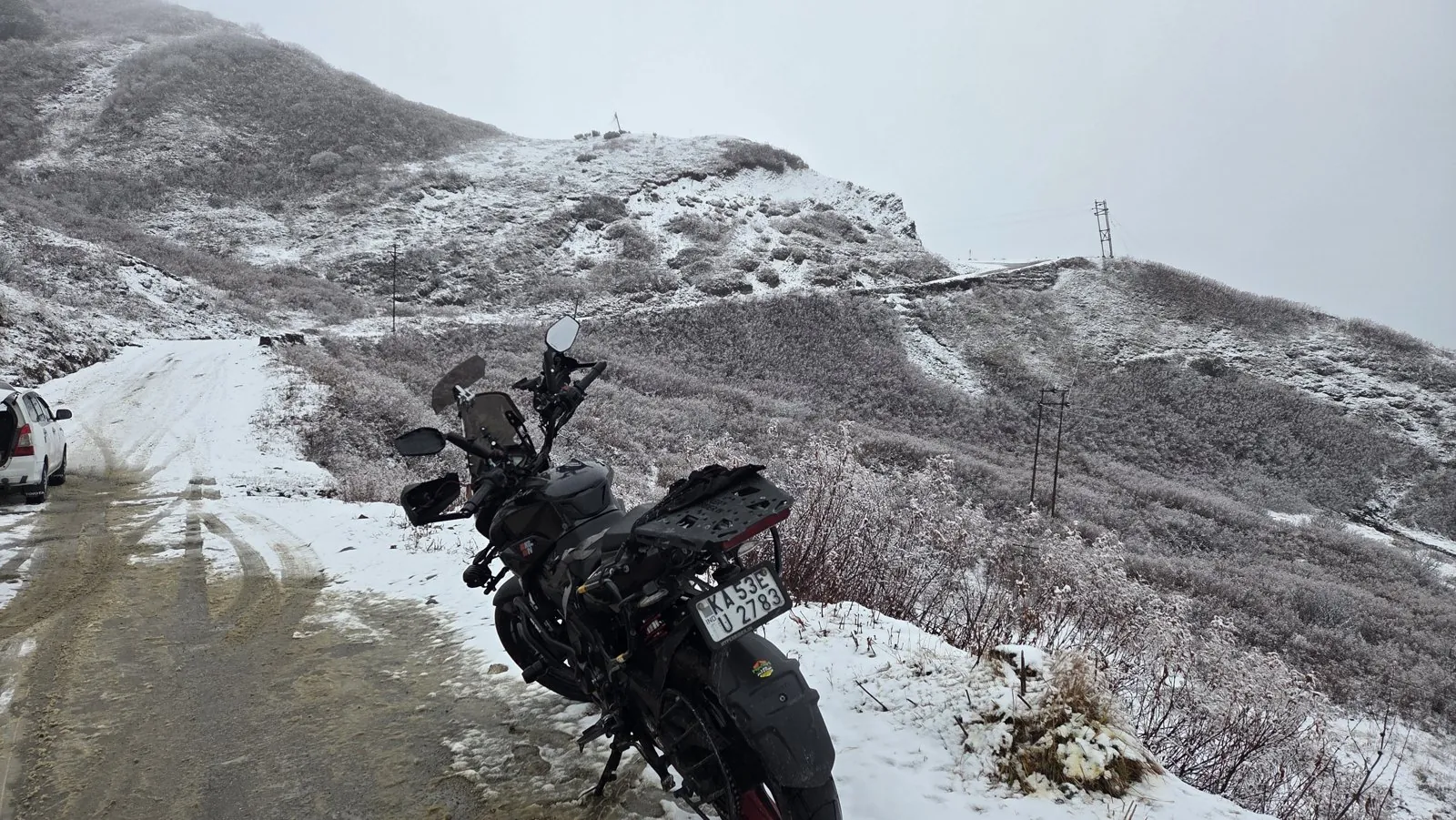
| Baba Mandir (4,120 m) to Zuluk (2,750 m) | 2.69 |
| Zuluk (2,750 m) to Cooch Behar (46 m) | 5.31 |
Source: Calculated as m x g x h with g = 9.81 m/s²; altitudes are approximate · Altitudes as recorded for the Sikkim Diaries ride; treat them as approximate.
Why do brakes fail on long descents?
Brakes fail on long descents because heat arrives faster than the discs can shed it, and two things then go wrong: the pad's friction coefficient falls, and the brake fluid can boil. Both studies below were on heavier vehicles, but the physics is the same for a motorcycle, whose discs are smaller and carry far less thermal mass.

Fluid boiling is the more dangerous failure, because the lever goes soft without warning. The US federal standard FMVSS 116 sets the minimum boiling point of fresh DOT 4 fluid at 230 °C, and of wet DOT 4, after it has absorbed moisture, at just 155 °C. DOT 3 is lower still, at 205 °C dry and 140 °C wet.
Brake fluid absorbs water from the air over time, which is why manufacturers set replacement intervals; Hero's Splendor+ XTEC manual calls for new fluid every two years or 30,000 km. A two-year-old reservoir on a long descent in neutral is the worst combination.
The team modelled a 4-7 tonne vehicle braking on long descents with a finite-element model of disc and pad, then validated it with a real vehicle test. Raising the slope from 3° to 9° increased peak disc temperature by 41.6%, while raising vehicle weight from 4 to 7 tonnes added only 16.7%. Using lighter brake force and a lower speed threshold for braking kept temperatures down. Measured averages were 9.2-11.8% below the simulation. The limit: a commercial vehicle, not a motorcycle, but the ranking of factors carries over: slope matters most.
Read the abstract (free)The authors split a truck's descent into a speed-control phase on the grade and an emergency stop at the bottom, and built a brake-temperature model from energy conservation using initial drum temperature, grade, length, weight and speed. Temperature rose with weight, grade percentage and grade length, and changed little with speed during the controlled descent; the emergency stop at the end added a further rise that grew with speed. The limit: drum brakes on heavy trucks, used to place escape ramps, but the energy accounting is the same one a rider can do.
Read the paper (free)On a controlled descent, the heat comes from the height you lose, not the speed you hold.
The truck study's finding on speed matters for riders: on a controlled descent, the heat comes from the height lost, not the speed you hold. Going slower in neutral does not reduce the energy; only putting part of it into the engine, air drag and time does. That is exactly what a lower gear achieves.
Why is coasting in neutral worse for control?
Coasting in neutral is worse for control because it takes away three things at once:
- Engine braking, so the brakes carry the whole descent.
- Instant drive, so you cannot accelerate out of trouble.
- A safe re-engagement: the moment you select a gear and let the clutch out is itself a risk.
A member on the 2011 xBhp thread named the last one precisely: if you let the clutch out in a gear too low for your speed, the sudden engine braking can upset the bike and cause a fall. On a wet hairpin that is a crash.
Why drive matters in a corner
Steady throttle in gear settles a motorcycle through a corner; a bike freewheeling in neutral cannot be balanced with the throttle and cannot accelerate away from a vehicle drifting into its lane on a blind bend.
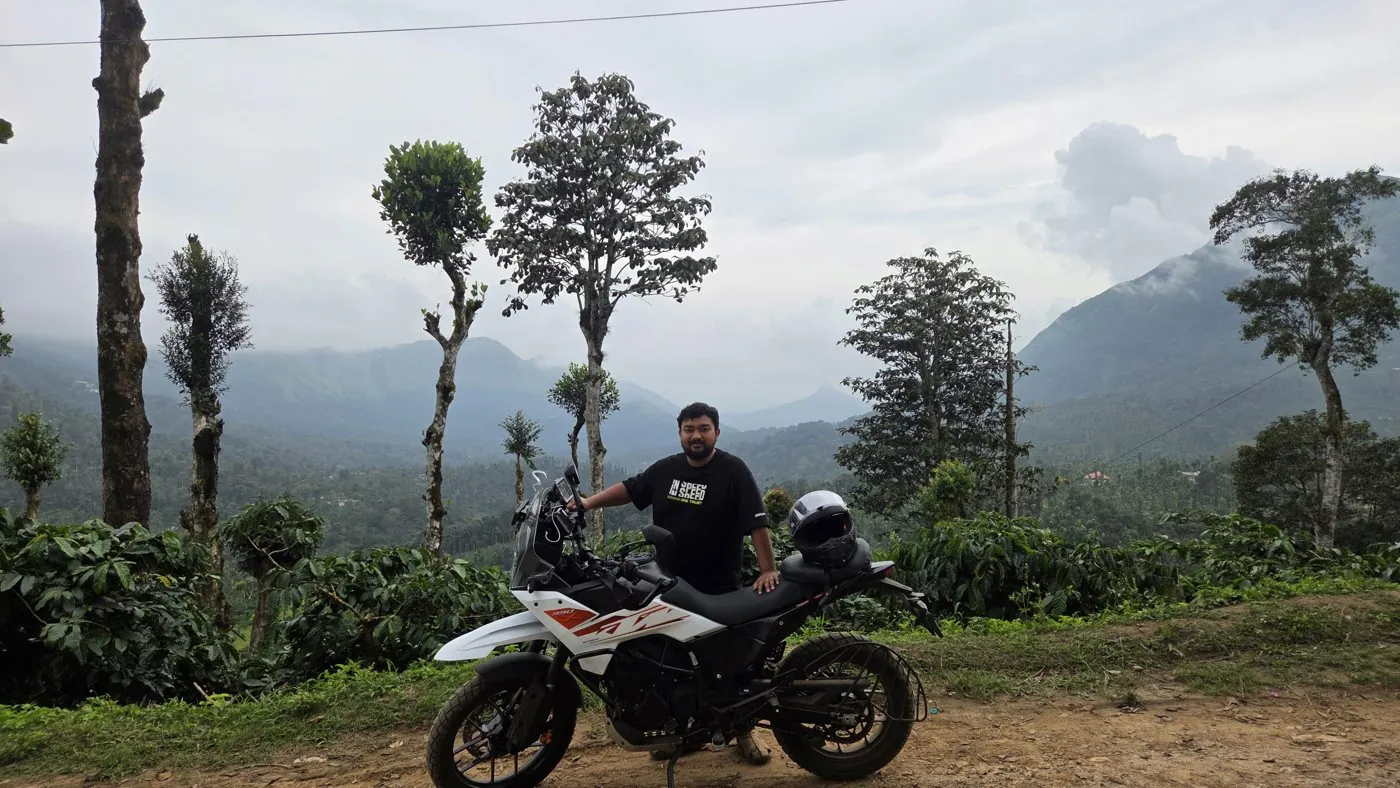
Bajaj's Pulsar 125 manual tells riders to close the throttle completely while leaving the clutch engaged so engine braking helps, and to shift down one gear at a time. KTM's 390 Duke manual goes further for descents: use engine braking on long downhill stretches, shift back one or two gears without over-revving, and the brakes will not overheat.
How should I ride a long descent?
- Choose the gear before the slope. As a rule of thumb, descend in the gear you would climb the same slope in. The engine should hold speed with only occasional braking.
- Brake firmly, then release. Short, firm applications before each bend let the discs cool between them. Dragging the brakes lightly all the way down keeps them hot.
- Use both brakes. Sharing heat between front and rear keeps either from reaching its limit. The rear disc is small, so do not lean on it alone.
- Keep revs below the limit. KTM's warning is not to over-rev while shifting down. Change down one gear at a time and match revs.
- Stop if the lever goes soft. A lever that travels further than usual means hot fluid. Pull over, let the brakes cool, and do not pour water on hot discs.
- Change old brake fluid before a mountain trip. Wet DOT 4 boils 75 °C lower than fresh fluid.
Engine braking itself does not harm the engine; that question is answered in is engine braking bad for your bike. What a held clutch does to the plates is in how a motorcycle clutch works, and fluid and pad intervals are in the brake pads and fluid guide. For why ghat roads have the gradients and hairpins they do, see how ghat roads are designed, and for the full Zuluk-to-plains descent, the altitude drop from Zuluk to the plains.
What's new
- Draft rule proposes ABS on every new two-wheeler sold in India from January 2026 Autocar India, Jun 2025
- Only 23% of 12.25 million motorcycles sold in FY25 had ABS; makers of sub-125 cc bikes push back on the mandate Business Today, Jul 2025
- New motorcycle study measures idle fuel at 0.028 g/s and a restart at 0.069 g Journal of the Chinese Institute of Engineers, Jul 2025
Questions people ask
Does holding the clutch in damage the clutch?
Holding the lever fully in causes little wear, because the plates are separated. Half-holding it, so the plates slip, wears them and heats the oil. On a descent the bigger problem is not the clutch but the loss of engine braking.
Is engine braking bad for the engine?
No, within the rev limit. The engine is designed to be driven by the wheels on a closed throttle; on fuel-injected bikes the injectors simply shut. Over-revving through a careless downshift is the only real risk, which is why KTM says not to.
Which gear should I use going down a ghat?
Usually the same gear you would use to climb it, often second or third on steep hairpins. If you are braking hard on every straight, go down one more gear.
Does coasting in neutral save fuel on a scooter?
A scooter's CVT has no neutral the rider can select; with the throttle closed the centrifugal clutch disengages as revs fall and the engine idles. Fuel-injected engines generally cut fuel on a closed throttle above idle speed, so the same logic applies: closed throttle, not engine off.
Sources
- KTM: 2024 390 Duke owner's manual (EU), braking on long downhill stretches (2023)
- Bajaj Auto: Pulsar 125 owner's manual, braking
- Hero MotoCorp: Splendor+ XTEC owner's manual, maintenance schedule (2024)
- Lee et al.: Utilization of ADAS for improving performance of coasting in neutral, SAE Technical Paper (2018)
- Nguyen et al.: Fuel consumption of idle and re-start options for motorcycles, Journal of the Chinese Institute of Engineers (2025)
- Wu Gang et al.: Influence of running parameters on the temperature field of disc brakes on long downhill roads, Proc. IMechE Part D (2023)
- Yan et al.: Prediction model for brake-drum temperature of large trucks on mountain downgrades, Mathematical Problems in Engineering (2018)
- US FMVSS No. 116: Motor vehicle brake fluids (49 CFR 571.116)
- Business Today: Domestic two-wheeler makers up in arms over ABS implementation (2025)
- Autocar India: ABS likely to be mandatory on all new bikes and scooters (2025)
- xBhp: Holding clutch while riding downhill (forum thread) (2011)
- xBhp: To clutch or not to (forum thread) (2009)
- FleetOwner: Jake Brake turns 60, but conceived 90 years ago (2021) (source for the story: Cummins on Cajon Pass, 1931, and the compression-release brake)
- HDT Trucking Info: Jake Brake celebrates 40th birthday (brake fade on Cajon Pass)
- Sapta: Zuluk to Cooch Behar by bike, snow, then 2,700 m down (2025) (altitudes used in the chart)

Sapta (Saptarshi Sarkar) is a mechanical engineer turned marketer in Bengaluru and a solo touring rider. He writes the seven Saptaverse blogs. Work with him or read more of RoadHook Machines.


