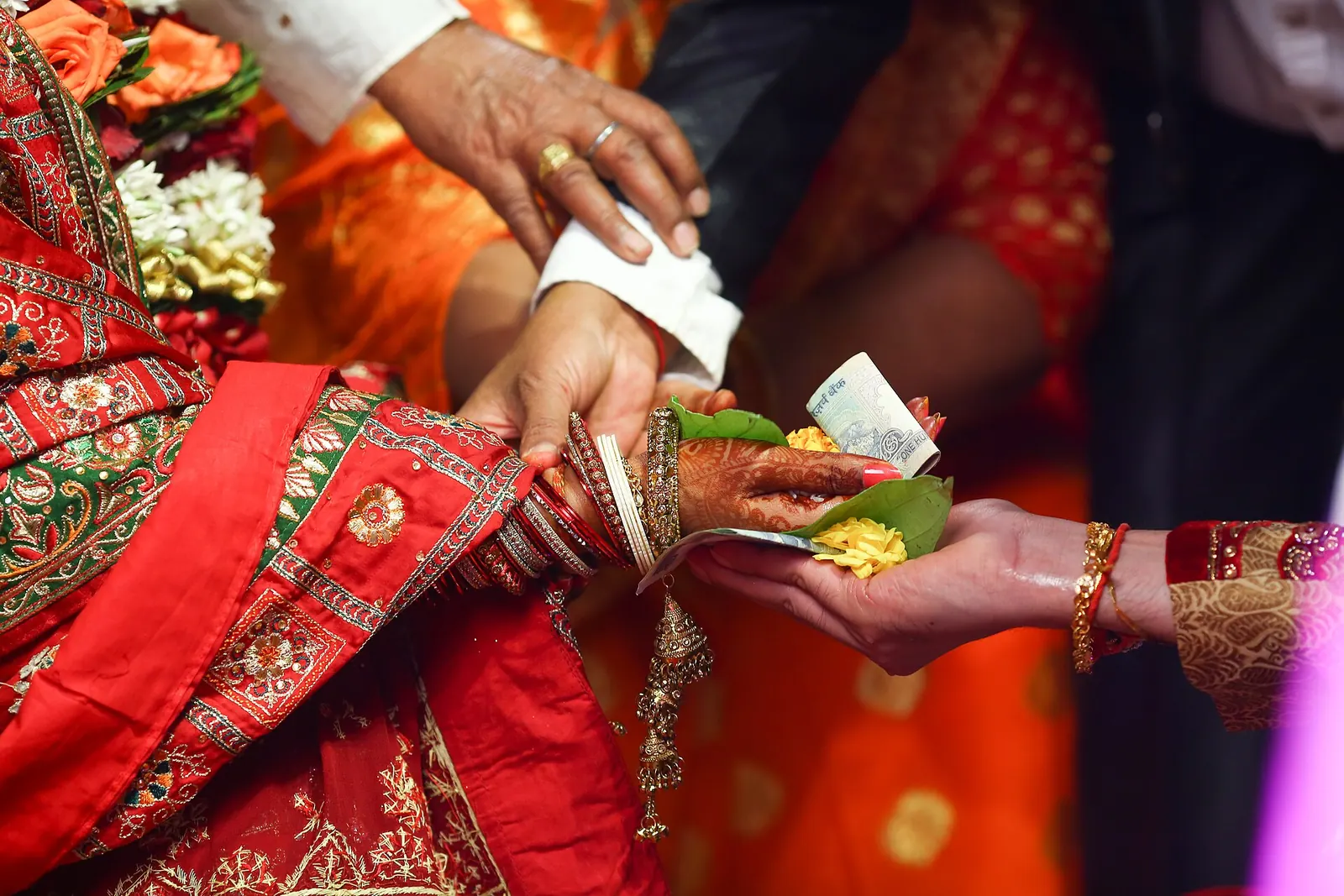
Dowry is still close to universal in rural India. A World Bank analysis of about 40,000 rural marriages from 1960 to 2008, using the Rural Economic and Demographic Survey (REDS 2006), found that dowry was paid in 95% of them, even though giving or taking dowry has been a crime since 1961. The custom survives because it is woven into how families save, how they rank sons-in-law and how daughters inherit, and because almost nobody involved has a reason to report it.
- 95% of rural marriages from 1960 to 2008 involved a dowry (REDS 2006, World Bank analysis, 2021).
- The average net dowry was about ₹27,000 in 2005 prices and stayed roughly flat for 50 years, so it shrank as a share of rising incomes.
- It is not a Hindu-only custom: Christian and Sikh dowries rose sharply and ended above Hindu and Muslim averages.
- NCRB recorded 6,156 dowry deaths in 2023, about 17 a day, with Uttar Pradesh and Bihar together accounting for over half.
- Families expecting bigger dowries save more, mostly because fathers work more days (Anukriti, Kwon and Prakash).
Ask most Indians whether dowry still exists and you will hear two answers at once: "of course not, it is illegal" and "well, there are gifts". The data side with the second answer.
How common is dowry in India today?
In rural India it is the norm, not the exception. The REDS 2006 survey, run by the National Council of Applied Economic Research, covered 17 major states holding about 96% of India's population, and asked households about every marriage in the family going back to 1960. Most interviews actually took place in 2008.
Economists S Anukriti, Sungoh Kwon and Nishith Prakash used it to build a 50-year series on net dowry: the value of gifts from the bride's family to the groom's family, minus gifts flowing the other way. Their headline was blunt. Dowry was paid in 95% of the roughly 40,000 marriages, and marriages where the groom's side paid more were rare.
Two limits matter. REDS is rural, so it says nothing direct about city weddings. And because dowry is illegal, every number is self-reported, which, if anything, should push reported amounts down.
Why did dowry not disappear after the 1961 ban?
Because the ban attacked the symptom and left the incentives untouched. The Dowry Prohibition Act, 1961 came into force on 1 July 1961 and made giving, taking and abetting dowry an offence. As later amended, it carries at least five years in prison and a fine of at least ₹15,000 or the value of the dowry, whichever is more.
Yet a penalty only works if someone reports the crime. In a dowry transaction both families are technically offenders, both usually want the wedding to happen, and the bride's family fears that a complaint will end the marriage before it begins. The result is a law that is used mostly after something goes wrong, typically cruelty or a death, rather than at the moment of the payment.
In May 1978 a 20-year-old woman in Delhi married into a family that, according to court records, had asked for a scooter, a refrigerator and a television. Her mother, Satya Rani Chadha, could not afford them all. The scooter demand was repeated after the young woman became pregnant, the last time on 15 March 1979. Two days later she died of burns at her marital home, about six months pregnant. The husband was convicted of abetting her suicide only in May 2000, 21 years later, and the Delhi High Court upheld the seven-year sentence in March 2013. In the meantime Chadha had become one of the faces of India's anti-dowry movement and co-founded the women's shelter Shakti Shalini.
Delhi High Court, Subhash Chandra v. State, Crl. A. 327/2000 (7 March 2013), via Indian Kanoon
Is dowry getting bigger or smaller?
In real terms, the average stayed almost flat for half a century. The World Bank analysis deflated every payment to 2005 prices and found average net dowry was stable from 1960 to 2008, with bursts of inflation before 1975 and after 2000. Gross payments by the bride's family followed the same line.
- Bride's family to groom's family: about ₹32,000 on average (2005 prices).
- Groom's family to bride's family: about ₹5,000.
- Net dowry: about ₹27,000.
Since household incomes rose over the same decades, dowry has slowly fallen as a share of income. That is real progress, but it is a fall in the burden, not in the practice. The share of marriages with a dowry did not fall the same way.
The national average also hides sharp regional shifts. Kerala shows steady dowry inflation since the 1970s and had the highest recent average of any state in the sample. Haryana, Punjab and Gujarat also inflated. Average dowry fell in Odisha, West Bengal, Tamil Nadu and Maharashtra.
| Group (REDS 2006) | What happened to real net dowry, 1960-2008 |
|---|---|
| Hindus (89% of sample) | Flat, tracking the national average |
| Muslims | Slightly lower than Hindus, stable |
| Christians | Rose sharply, ended above Hindus and Muslims |
| Sikhs | Rose sharply, ended above Hindus and Muslims |
| Upper castes | Highest, ahead of OBCs, then SCs, then STs; ranking unchanged over time |
| Kerala | Persistent inflation since the 1970s; highest recent average |
| Odisha, West Bengal, Tamil Nadu, Maharashtra | Average dowry fell |
Source: Anukriti, Kwon and Prakash, World Bank Development Talk blog, June 2021.
Why do families keep paying it? The economics
Economists offer four overlapping explanations, and the Indian data fit all of them in part.
1. A price in a marriage market
When families compete for grooms with good jobs or higher status, dowry behaves like a price. Siwan Anderson's review of the economics of dowry notes that marriage payments in parts of the developing world have been estimated at four to six times annual household income per marriage, which is why they shape household finances for years.
2. A pre-mortem inheritance
In rural India, daughters almost never live with their parents after marriage, and more than 80% of elderly parents live with sons, who work the family land. A lump-sum transfer at marriage lets parents give daughters a share without splitting the farm. Anukriti and co-authors cite evidence that equal inheritance rights for daughters led to higher dowries and strategic gifting of property to sons, rather than ending the custom.
3. Caste and status
Dowry is highest among upper castes and lowest among Scheduled Tribes, and the ranking held for 50 years. Paying a "respectable" dowry signals status to the community, in the same way that the wedding itself does. I have written about that signalling in why Indian weddings are so expensive.
4. Savings behaviour
The most striking evidence is about saving. Families whose firstborn is a girl tend to have more daughters, so they face larger total dowry bills. Comparing these families with firstborn-boy families, the IZA study found that as expected dowry rose, savings per person rose too, held in banks rather than in jewellery. The money came from fathers working more days a year, not from cutting consumption.
Dowry is not a one-day expense. For many families it is a savings plan that starts the day a daughter is born.Sapta, reading Anukriti, Kwon and Prakash (2018)
Using REDS 2006, the authors compare households whose firstborn was a girl with those whose firstborn was a boy, and define expected dowry from marriages in the same caste and state around the child's birth. As expected dowry rises, firstborn-girl families significantly increase annual savings per person, mainly in financial institutions rather than jewellery, and fathers work more days. Average per-capita saving in the sample was ₹1,132 a year, about 19% of per-capita spending in 2007. They found no effect on son-preferring fertility or on spending on girls. The limit: dowry is self-reported because it is illegal, and the data stop in 2008.
Read the paper (free)A review of how marriage payments vary with economic conditions, social structure, institutions and family characteristics, across history and the developing world. Anderson notes estimates that payments can reach four to six times annual household income per marriage, documents how they can rise sharply or flip direction between brides' and grooms' families, and summarises the theories that explain those shifts, including competition for grooms and dowry as inheritance. The limit: it is a review, not new Indian data, and its India evidence predates REDS 2006.
Read the paper (free)
What happens when dowry turns violent?
A minority of dowry disputes end in cruelty or death, and those are what the crime data capture. The National Crime Records Bureau (NCRB) counts dowry deaths: a woman's death by burns, injury or in unnatural circumstances within seven years of marriage, where she was harassed for dowry soon before. That offence was Section 304B of the IPC and is now Section 80 of the Bharatiya Nyaya Sanhita (BNS). Cruelty by a husband or his relatives was IPC 498A and is now BNS 85.
See the data as a table
| Dowry deaths (cases) | Dowry Prohibition Act cases (cases) | |
|---|---|---|
| 2020 | 6843 | 10046 |
| 2021 | 6589 | 13534 |
| 2023 | 6156 |
Source: NCRB Crime in India via The News Minute (Aug 2022) and LiveLaw (Jun 2026) · Registered cases only. 2022 not shown; 2023 Dowry Act count not in the sources I could open.
- 2021: 13,534 cases under the Dowry Prohibition Act and 6,589 dowry deaths. Uttar Pradesh had the most of both (4,594 and 2,222).
- 2023: 6,156 dowry deaths nationally, including 2,122 in Uttar Pradesh and 1,143 in Bihar, plus 833 murders where dowry was recorded as the motive.
- Case outcomes, 2021: the charge-sheeting rate was 41.3% for dowry deaths and 35% for Dowry Act cases, per the same NCRB release.
Is the anti-dowry law misused?
Both sides of this debate have numbers, and the Supreme Court has heard both. In Arnesh Kumar v. State of Bihar (2 July 2014), the Court quoted NCRB data for 2012: 1,97,762 people were arrested under 498A, nearly a quarter of them women, yet the conviction rate was just 15% and about 3.7 lakh cases were pending. It ruled that police must not arrest automatically and that magistrates must check the reasons first.
A low conviction rate is not the same as false complaints, though. Witnesses are family members, cases drag for years and many end in settlements. In Janshruti (People's Voice) v. Union of India (2025), the Court refused to strike down 498A (now BNS 85), accepting that misuse happens but holding that genuine cases far outnumber it.
In 2026 the Court also closed a trap that kept women silent. In Rahul Gupta v. SHO, it held that a woman's complaint about dowry demands cannot, on its own, be used to prosecute her family for giving dowry under Section 7(3) of the Act.
| Offence | Old law | Law now (from 1 July 2024) |
|---|---|---|
| Giving, taking or demanding dowry | Dowry Prohibition Act 1961 (s. 4 covers demands) | Same Act |
| Dowry death | IPC 304B | BNS 80 |
| Cruelty by husband or relatives | IPC 498A | BNS 85 |
| Domestic violence (civil remedies) | Protection of Women from Domestic Violence Act 2005 | Same Act |
This is general information, not legal advice. For a specific case, talk to a lawyer or your state's Dowry Prohibition Officer.
What should you do if dowry is demanded?
Act early and in writing. The law gives a demanding family no protection, and the Supreme Court's 2025 and 2026 orders in State of U.P. v. Ajmal Beg told every state to make its Dowry Prohibition Officers visible and to prioritise BNS 80 and 85 trials.
- Keep the evidence. Save messages, call logs and lists of what was asked for and given, with dates.
- Call for help. 181 is the women's helpline and 112 is the emergency number. Both work across states.
- File a complaint. Any police station must register an FIR for a cognizable offence; if it is outside its area it can file a Zero FIR and transfer it.
- Use the civil route too. A protection officer under the Domestic Violence Act 2005 can help with residence, protection and maintenance orders.
- Look after your mind. If dowry pressure leaves you or someone you know feeling hopeless, Tele-MANAS (14416, telemanas.mohfw.gov.in) offers free, confidential counselling.
What would actually reduce dowry?
The evidence points to incentives more than to penalties. If dowry is partly a price for grooms and partly a substitute for inheritance, then it shrinks when daughters hold assets in their own name, earn their own income and marry by choice rather than through a market of families. The flat real dowry and its falling share of income suggest that growth has already eased the burden.
Enforcement still matters at the extreme end. The Supreme Court's 2026 push for charges within 60 to 90 days of the charge-sheet and day-to-day evidence in dowry death trials targets the delay that turned the 1979 Delhi case into a 34-year fight. Related reading on this blog: son preference and the sex ratio, arranged marriage in data and why India's divorce rate is so low. More from the Kyun world is on the Kyun page.
What's new
- Supreme Court sets timelines and reporting rules for dowry trials in State of U.P. v. Ajmal Beg LiveLaw, Aug 2026
- How the Supreme Court has kept flagging dowry deaths, with NCRB 2023 figures LiveLaw, Jun 2026
- Madhya Pradesh High Court: no prior dowry agreement needed to prosecute a later demand LiveLaw, Oct 2026
Questions people ask
Is dowry still common in India?
Yes, in rural India it is near-universal: REDS data show dowry in 95% of marriages from 1960 to 2008. There is no equally large urban survey, but NCRB still records about 6,000 dowry deaths a year (6,156 in 2023).
Do Muslims and Christians in India give dowry?
Yes. In the REDS sample, Muslim dowries were only slightly lower than Hindu ones, and Christian and Sikh dowries rose sharply over the decades to end higher than both.
Can the bride's family be prosecuted for giving dowry?
In theory, giving dowry is also an offence. But in Rahul Gupta v. SHO (2026) the Supreme Court held that a woman's or her family's complaint about dowry demands cannot by itself be the basis for prosecuting them for giving it; independent evidence is needed. That removes a common reason families stayed silent.
What is the punishment for taking dowry in India?
Under the 1961 Act as amended, at least five years in prison and a fine of at least ₹15,000 or the value of the dowry, whichever is more. If harassment ends in a woman's death, the case becomes a dowry death under BNS 80 (formerly IPC 304B), where courts presume the harassers' role once dowry harassment soon before death is shown.
Sources
- World Bank Development Talk: The evolution of dowry in rural India, 1960-2008 (Anukriti, Kwon, Prakash) (2021) (95% figure, net dowry, religion, caste and state trends)
- IZA DP 11464: Household Savings and Marriage Payments: Evidence from Dowry in India (2018) (savings, labour supply, penalty in the 1961 Act)
- Journal of Economic Perspectives: The Economics of Dowry and Brideprice (Siwan Anderson) (2007)
- Delhi High Court: Subhash Chandra v. State, Crl. A. 327/2000, via Indian Kanoon (2013)
- Wikipedia: Satya Rani Chadha (activism and Shakti Shalini)
- Supreme Court: Arnesh Kumar v. State of Bihar, via Indian Kanoon (2014)
- The News Minute: NCRB data on dowry cases, 2020 and 2021 (2022)
- LiveLaw: How the Supreme Court has repeatedly raised concerns over dowry deaths (NCRB 2023 figures; Janshruti, Rahul Gupta, Ajmal Beg) (2026)
- LiveLaw: Supreme Court directions in State of U.P. v. Ajmal Beg (2026)
- Wikipedia: Dowry system in India (1961 Act commencement date, 1983 amendment)

Sapta (Saptarshi Sarkar) is a mechanical engineer turned marketer in Bengaluru and a solo touring rider. He writes the seven Saptaverse blogs. Work with him or read more of Whyblog.