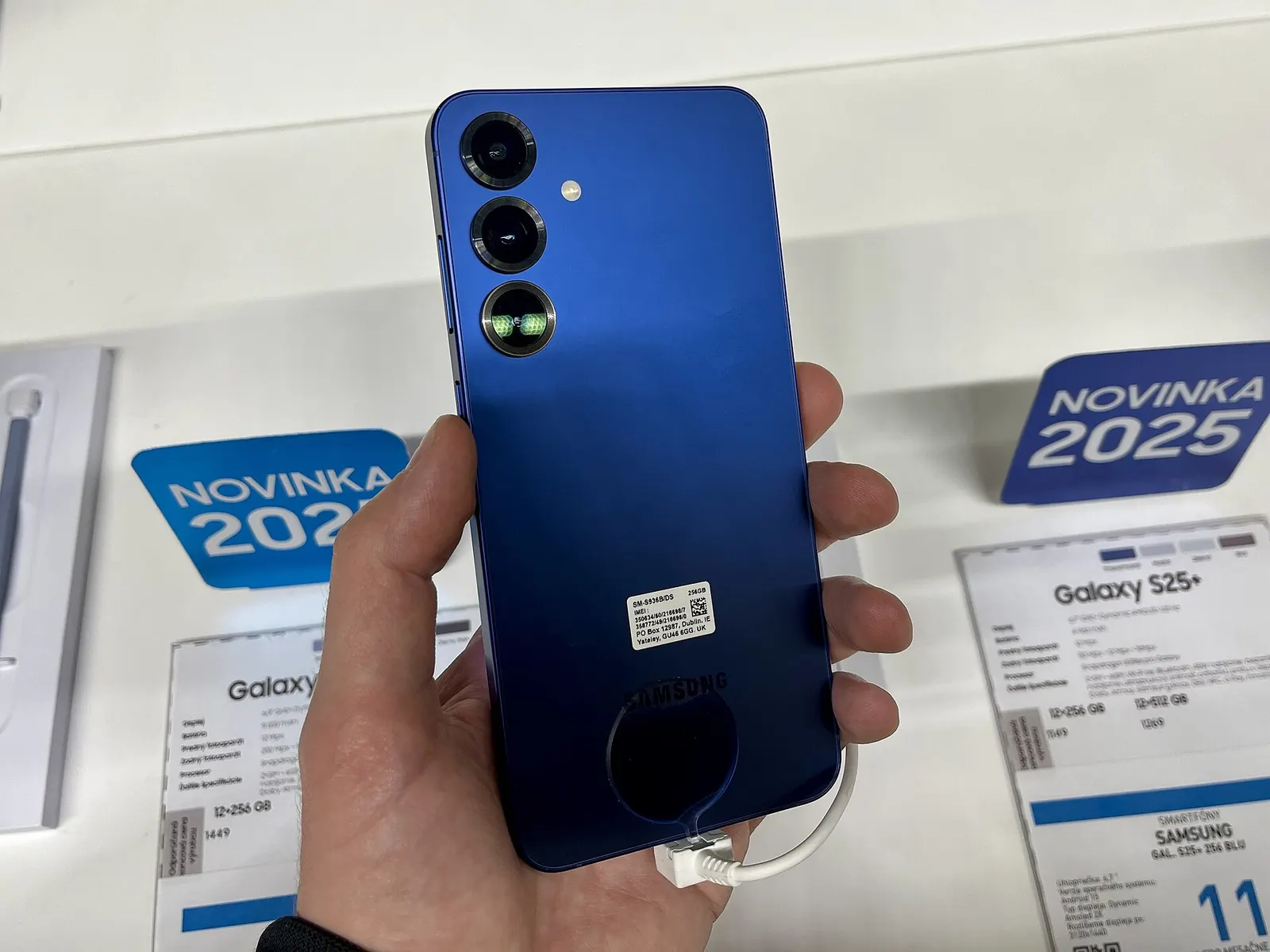
The Samsung Galaxy S25+ is a capable second travel camera: a 50 MP main camera with optical stabilisation, a 12 MP 120° ultra-wide, a 10 MP 3x telephoto, 8K at 30 fps, 10-bit HDR video by default and Samsung's Galaxy Log profile. It does not replace a dedicated camera for low light or shallow depth of field, and it should not live on a motorcycle handlebar without a vibration damper, because engine and road vibration can wear out the stabiliser and autofocus that make its main camera good.
- Three rear lenses cover roughly 12.5 mm, 23.6 mm and 66.6 mm full-frame equivalents, worked out from Samsung's field-of-view figures.
- 10-bit HDR recording is on by default, and Galaxy Log adds a flat profile for grading.
- OIS is listed only on the 50 MP main camera in Samsung's spec table.
- 8.28 m/s² was the measured hand-arm vibration on a single-cylinder motorcycle; a rubber-mounted bar cut it by 51%.
- ₹99,999 was the India launch price of the 12 GB + 256 GB model in January 2025.
I own a Galaxy S25+, and in my kit it has one job: extra coverage. The Sony ZV-E10 handles the deliberate, cinematic shots, the DJI Osmo Action 4 handles POV and fast footage, and the phone catches everything in between. That is the lens this review uses. It is not a spec-sheet race against the Ultra; it is about whether the S25+ earns a pocket on a long ride.
I bought it in a hurry, in the middle of a ride. On 19 November 2025, on the way from Kalyani to Siliguri during my Sikkim trip, my old phone gave up near Habibpur. In Siliguri I needed a replacement that day, and my brief was short: detailed photos and video, reliable, a big battery and premium photo processing. Raw performance didn't matter.
The last three were the Galaxy S25, S25 Ultra and Pixel 10, and the Ultra and the Pixel were too expensive for that trip. The S25+ won over the S25 on what the spec sheets show: a bigger, sharper screen, a bigger battery and faster charging, with the same chip and cameras. It cost me about ₹80,000, plus ₹10,000 for insurance.
Below are Samsung's own numbers, two research papers on vibration and stabilisation, and what the phone actually recorded on the rest of that ride.
What camera hardware does the Galaxy S25+ have?
The Galaxy S25+ has a 50 MP f/1.8 main camera with OIS, a 12 MP f/2.2 ultra-wide (120° field of view), a 10 MP f/2.4 3x telephoto (36°) and a 12 MP f/2.2 front camera (80°). These are Samsung's launch figures, and they are the same camera set as the smaller Galaxy S25.
| Camera | Resolution | Aperture | Field of view | Full-frame equivalent* |
|---|---|---|---|---|
| Ultra-wide | 12 MP | f/2.2 | 120° | about 12.5 mm |
| Wide (main), OIS | 50 MP | f/1.8 | 85° | about 23.6 mm |
| Telephoto 3x | 10 MP | f/2.4 | 36° | about 66.6 mm |
| Front | 12 MP | f/2.2 | 80° | about 25.8 mm |
*My conversion, assuming Samsung's field of view is diagonal: equivalent focal length = 21.63 mm ÷ tan(FOV ÷ 2), where 21.63 mm is half the diagonal of a 36 × 24 mm frame. The ratio of tele to main comes out at 2.8x, which matches Samsung's "3x" label closely enough.
What video modes matter for travel?
- UHD 8K (7680 × 4320) at 30 fps, Samsung's top resolution.
- Slow motion at 120 fps in UHD, and 120 or 240 fps in Full HD.
- 10-bit HDR recording on by default, which Samsung says carries four times the colour steps of 8-bit (1,024 levels per channel instead of 256).
- Galaxy Log, a flat gamma for colour grading, introduced with the S25 series.
- USB 3.2 Gen 1 over Type-C, which matters when you offload a day of 4K to a laptop.

Can a motorcycle phone mount damage the Galaxy S25+ camera?
Yes, it can, and the risk sits in the parts that move. Optical image stabilisation floats the main lens on tiny actuators and a gyroscope steers it; long exposure to strong vibration in the wrong frequency band can wear that system out. Samsung has not published a motorcycle advisory, but Apple has, and the physics is the same for any phone with a floating lens.
In September 2021, Apple quietly posted a support note with an unusual title: vibration from high-powered motorcycle engines might damage iPhone cameras. The note said long-term, direct exposure to high-amplitude vibration in certain frequency ranges could degrade two systems, optical image stabilisation and closed-loop autofocus, and with them photo and video quality.
Apple's advice was blunt. Don't mount an iPhone on a high-power or high-volume motorcycle. For mopeds and scooters, which shake less, use a vibration-dampening mount and avoid regular use over long periods. The note covered every iPhone from the 6 Plus onwards, which is to say almost every phone with a stabilised lens.
Apple Support: Exposure to vibrations might impact iPhone cameras (2021)The same question comes up for Samsung owners. In an Electric Bike Review forum thread, a rider reported that the telephoto cameras on three Galaxy Note20 phones lost sharp focus after years on a handlebar mount. That is one person's account, not a test, but it matches Apple's mechanism.
How much vibration reaches a handlebar?
A 2022 study from Universiti Sains Malaysia measured 8.28 m/s² of hand-arm vibration on an underbone single-cylinder motorcycle on the road. A handlebar suspended on rubber mounts cut that to 4.08 m/s², a 51% drop. The numbers describe what reaches the rider's hands, not a phone, but they show two useful things: the road contributes more than the engine, and a soft mount halves the energy.
The team built a hand-gripped modal model of a motorcycle handlebar by experimental modal analysis, compared rubber-mount designs by their frequency response over 0–200 Hz (the band used for hand-arm vibration under ISO 5349), then road-tested the best one. Stock, the rider saw 8.28 m/s²; with the suspended bar, 4.08 m/s², which stretches the time to reach the EU action value from 44 minutes to about 3 hours. Vertical vibration was higher than horizontal, and tyre-road input outweighed engine input. Limit: one underbone motorcycle and one rider, and it measures hands, not phone mounts.
Read the paper (free)On my KTM 390 Adventure X Plus, the phone mount is a BOBO BM11H Pro Plus, which retailers sell with BOBO's vibration damper, next to a ViaTerra GPS mount. I've reviewed that setup on the RoadHook Machines. Whatever mount you use, the rule above stands: a damper, and short stretches on the bar.
Where does the S25+ fit next to a mirrorless camera and an action cam?
The S25+ is the camera that is always in your hand. In my kit, the Sony ZV-E10 takes the deliberate shots, the DJI Osmo Action 4 takes POV, and the phone fills gaps: a quick wide of a ghat road, a 3x shot of a monastery roof, a talking clip at a chai stop. The table shows how the three files differ when they reach the editor.
| Camera | Role in my kit | Top 4K mode | Codec and bit depth | Log profile |
|---|---|---|---|---|
| Sony ZV-E10 | Cinematic, deliberate | 4K 30p, up to 100 Mbps | XAVC S (H.264), 8-bit 4:2:0 | S-Log2, S-Log3 |
| DJI Osmo Action 4 | POV, dynamic | 4K 120 fps, up to 130 Mbps | H.264 or H.265; 10-bit only in HEVC with D-Log M | D-Log M |
| Galaxy S25+ | Extra coverage | 8K 30 fps; 4K 120 fps slow motion | 10-bit HDR by default | Galaxy Log |
Specs from Sony's ZV-E10 spec sheet, DJI's Osmo Action 4 spec page and store notes, and Samsung's spec tables. Samsung does not publish its video bitrates.
Should you shoot Galaxy Log or 10-bit HDR on the S25+?
Shoot Galaxy Log only if you will grade the footage; otherwise standard 10-bit HDR gives a finished look straight out of the phone. Log records a deliberately flat, low-contrast image that keeps more highlight and shadow information for the edit, and it looks washed out until you apply a conversion.
- At launch (January 2025): Log worked on the rear cameras only, as SamMobile reported.
- With One UI 8 (2025): Samsung extended Log to the front camera on the S25 series.
- With One UI 8.5 (May 2026): the S25 series got real-time Log colour previews with a LUT, so you can see the graded result while recording.
Two practical costs come with Log. It needs exposure discipline, because a flat image hides clipping on the phone screen, and it needs an editor that handles 10-bit H.265 smoothly. On a Windows laptop that is where the paid version of DaVinci Resolve earns part of its price; I've written up whether Resolve Studio is worth buying separately.
On my Sikkim ride, the S25+ clips are 4K 10-bit HDR, mostly at 30 or 60 fps, with a handful in 8K; none are in Galaxy Log. That fits how I work: I want punchy colour and a quick turnaround, not a grade on every clip, and I don't shoot log on my action camera either.
How does phone stabilisation actually work on a moving bike?
Phones stabilise video in two layers: OIS moves the lens to cancel small, fast shake, and electronic stabilisation uses the gyroscope to warp and crop each frame. The second layer is the one that handles big bumps, and its limits explain why phone footage from a bike can still look wobbly.
The authors used an iPhone 4's MEMS gyroscope, sampled at up to 100 Hz alongside 720p 30 fps video, to model camera rotation and the rolling-shutter skew of a CMOS sensor together, then warped each frame to remove both in real time on the phone's GPU. Compared with feature-tracking stabilisers of the time, it was faster and more robust on scenes with big moving objects, parallax and low light. Limits they state: it corrects rotation only, not translation, and warping leaves empty edges that must be cropped.
Read the paper (free)For riding footage this means two things. Up-and-down movement over a broken road is translation, which gyro warping doesn't remove, so a chest or helmet mount often looks steadier than a bar mount. And the stronger the stabilisation mode, the bigger the crop, so the ultra-wide is the lens to use when you want a steady, wide view.
Which S25+ lens should you use for which travel shot?
Use the ultra-wide for scale, the main camera for anything in low light or anything you'll crop, and the 3x telephoto to compress distant subjects such as a ridge behind a road. The main camera is the only one with OIS in Samsung's table, and it has the brightest aperture, so it is the default after sunset.
See the data as a table
| Field of view (°) | |
|---|---|
| Ultra-wide 12 MP | 120 |
| Wide 50 MP | 85 |
| Telephoto 10 MP | 36 |
| Front 12 MP | 80 |
Source: Samsung Newsroom: Galaxy S25 series specification table (Jan 2025) · Wider angle means more of the scene in frame.
Use this to check what you just read. Enter a lens's field of view and how far you are from the subject, and it gives the full-frame equivalent and how much of the scene the frame spans.
Phone lens field of view to focal length
For more on why a 66 mm view flattens a mountain behind a rider, see focal length and perspective compression; for how the phone builds each frame from a burst, see how phone cameras compute a photo.

What is it like to own the S25+ as a travel camera?
My use is narrow and deliberate: the S25+ is coverage, not the hero camera. I edit at 2K/1440p and only use 4K when it helps, so 8K is rarely worth it; the few 8K clips I shot on the ride are wide landscapes, cloud and snow. That editing habit also means the 50 MP main camera's extra resolution is mostly headroom for cropping and stabilising.
What it actually covered, from the files of the rest of that trip:
- Off-bike moments: meals, lodging courtyards, a bike wash in Kolkata and people at roadside stops, mostly in 4K 10-bit HDR.
- Weather the action camera wasn't pointed at: snowfall outside the lodging in Nathang Valley on 22 November, and clouds over the valley.
- Night and dawn highway: clips on the ride home, where the main camera's f/1.8 aperture and OIS matter most.
- In the edit: its 4:2:0 10-bit HEVC files are on the list my laptop's GTX 1650 decodes in hardware, which I cover in my laptop editing review.
Who should buy the Galaxy S25+ for travel video, and who shouldn't?
Buy it if you want one pocketable device that shoots clean 10-bit daylight video across three focal lengths and gets seven years of OS and security updates, which Samsung promised for the S25 series. Skip it as your main travel camera if you shoot mostly at night, need real background blur, or want a camera that can be bolted to a motorcycle all day without worry.
- Decide its role. As a second camera, the S25+ is strong. As the only camera on a motorcycle trip, pair it with an action camera for the mount.
- Set the format once. Pick 25 or 30 fps, decide Log or standard HDR, and keep it for the whole trip.
- Protect the lens system. Damper mount, short sessions on the bar, pocket for highway hours.
- Plan storage. 8K and 4K 10-bit fill a 256 GB phone fast; offload every night over USB 3.2.
- Check your editor. Test a 10-bit HEVC clip on your laptop before the trip, not after.
If you're building the rest of the kit, my motorcycle travel photography guide covers mounts and shot lists, and the phone photography guide covers settings. The full list of what I carry is on the gear page.
What's new
- One UI 8.5 reaches the Galaxy S25 series with real-time Log colour previews and dual recording Android Authority, May 2026
- One UI 8 brings Log video to the S25's selfie camera SamMobile, May 2025
- Samsung India opens Galaxy S25 series pre-orders; S25+ from ₹99,999 Samsung Newsroom India, Jan 2025
Questions people ask
Is the Galaxy S25+ camera different from the Galaxy S25?
No. Samsung's specification table lists the same four cameras for both: 50 MP f/1.8 main with OIS, 12 MP ultra-wide, 10 MP 3x telephoto and 12 MP front. The S25+ differs in its 6.7-inch QHD+ screen, 4,900 mAh battery and 45 W wired charging.
Does the Galaxy S25+ shoot Log video?
Yes. Galaxy Log arrived with the S25 series on the rear cameras, One UI 8 added it to the front camera, and One UI 8.5 (May 2026) added a live LUT preview while recording.
Will a motorcycle mount damage my Samsung phone camera?
It can. Samsung hasn't issued guidance, but Apple warns that long exposure to strong vibration can degrade optical stabilisation and closed-loop autofocus, the same kinds of parts in Samsung phones. Use a damper mount and limit hours on the handlebar.
Is 8K worth using on the S25+?
For most travel edits, no. 8K is capped at 30 fps and creates very large files; 4K gives smoother frame-rate options and is easier to edit. 8K helps only if you plan heavy crops or still frame grabs.
Sources
- Samsung Newsroom: Galaxy S25 series launch and specification table (2025), source for cameras, field of view, battery, weight, 10-bit HDR and Galaxy Log
- Samsung: Galaxy S25+ SM-S936B product specifications (2025), source for video modes, zoom and USB 3.2 Gen 1
- Samsung Newsroom India: Galaxy S25 series launch and prices (2025)
- Apple Support: Exposure to vibrations might impact iPhone cameras (2021)
- Usamah, Mazlan and Ripin: Motorcycle handle vibration attenuation using a suspended handlebar, IJAV 27(3) (2022)
- Karpenko et al.: Digital Video Stabilization and Rolling Shutter Correction using Gyroscopes, Stanford CSTR 2011-03 (2011)
- Electric Bike Review forum: Camera damage in handlebar-mounted phones? (2025)
- Sony: ZV-E10 specifications, source for XAVC S 8-bit 4:2:0 modes
- DJI: Osmo Action 4 specs and DJI Store: Osmo Action 4, source for 10-bit HEVC and D-Log M
- SamMobile: One UI 8 adds selfie Log video (2025)
- Android Authority: One UI 8.5 stable rollout for Galaxy S25 (2026)
- GTR Pitstop: BOBO BM11H Pro Plus listing with vibration damper

Sapta (Saptarshi Sarkar) is a mechanical engineer turned marketer in Bengaluru and a solo touring rider. He writes the seven Saptaverse blogs. Work with him or read more of Artblog.