
Indian Railways uses 1,676 mm (5 ft 6 in) broad gauge because colonial planners in 1850–51 wanted one wide, stable gauge for the whole country: Governor-General Dalhousie argued for 6 ft, the East India Company's directors leaned to Britain's 4 ft 8.5 in, and 5 ft 6 in was the compromise. A cheaper metre gauge was added from 1871 and narrow gauges for feeders, but since 1992 Project Unigauge has converted almost everything back, so by March 2025 about 97% of India's 69,439 route km was broad gauge. Metros, by contrast, mostly use 1,435 mm standard gauge because that is what the world's metro trains are built for.
- 1,676 mm (5 ft 6 in) was a compromise between Dalhousie's 6 ft and Britain's 4 ft 8.5 in.
- Broad gauge tolerates about 17% more sideways acceleration before tipping than standard gauge, in a simple rigid-body model.
- Metre gauge from 1871 saved money (about £10,000 a mile against £17,000) but created costly breaks of gauge.
- Project Unigauge took broad gauge from 56.2% of route km in 1992 to 97.0% in 2025.
- Most metros use 1,435 mm because world metro trains and parts are built for it.
The choice has outlived everyone who made it. Every new line, every Vande Bharat and every freight corridor still sits on rails 1,676 mm apart, while Mumbai's bullet train and most city metros use the narrower world standard. This post covers:
- why the gauge was chosen;
- what a wider gauge does physically;
- how India ended up with four gauges, and then undid it;
- why the metros broke ranks.
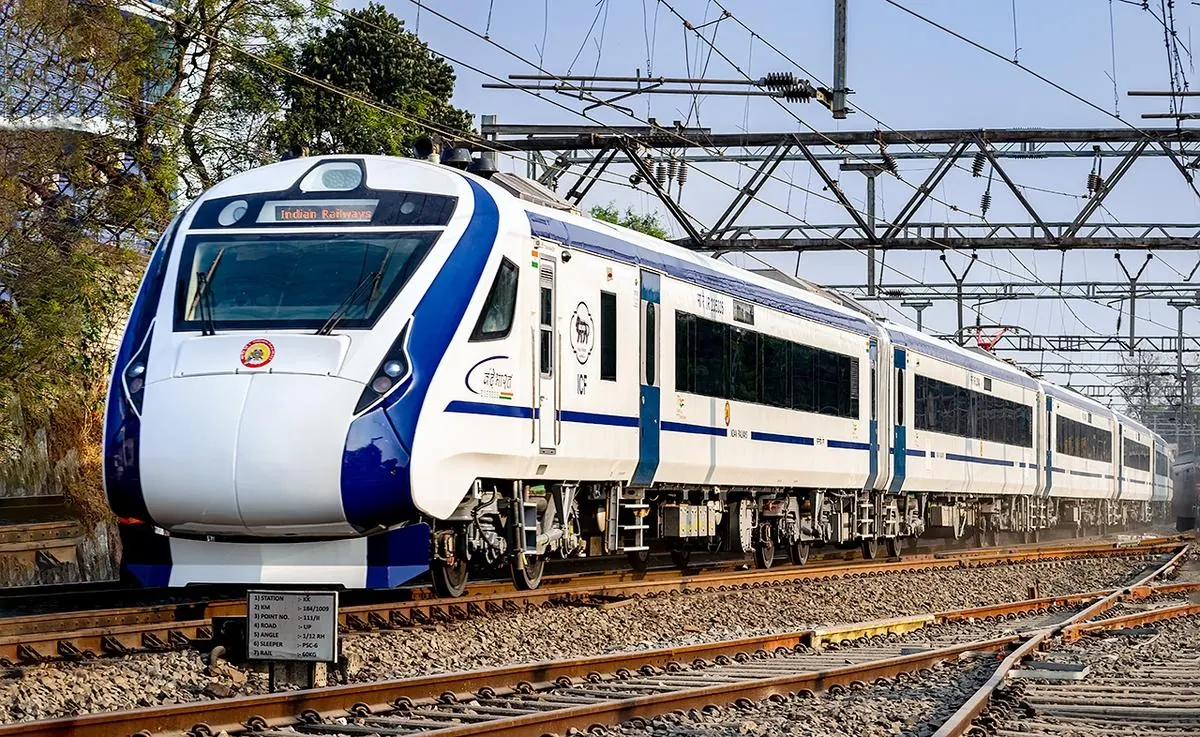
Why did India pick 5 ft 6 in instead of standard gauge?
India picked 5 ft 6 in as a compromise between Lord Dalhousie's preferred 6 ft and the East India Company directors' preference for Britain's 4 ft 8.5 in, on the reasoning that a wider gauge gives a steadier ride and more room for big locomotives and loads.
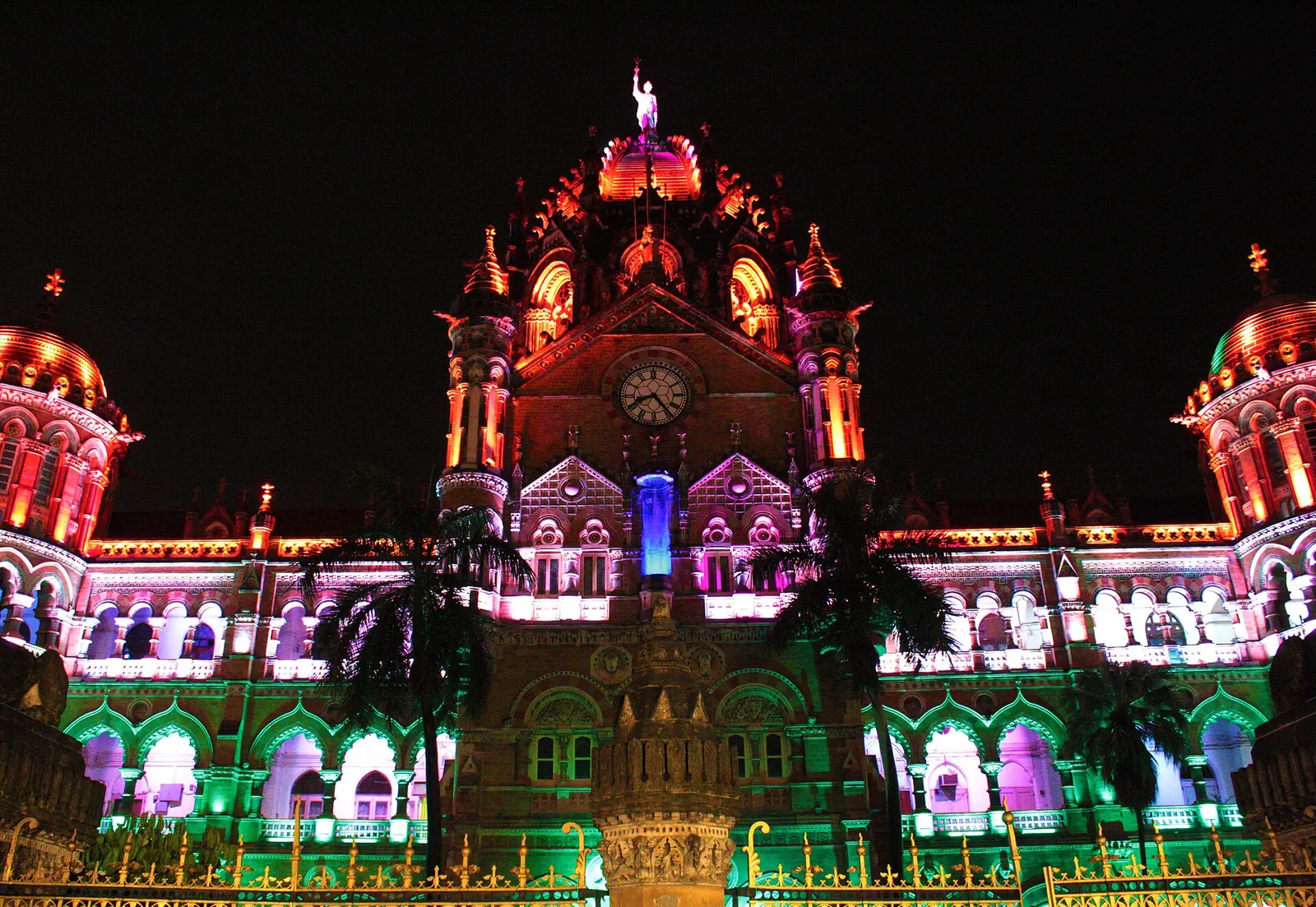
Dalhousie's Railway Minute of 4 July 1850 called for one uniform gauge for the whole of India, and Live History India's account describes him countering the directors with 5 ft 6 in, which was accepted for the first trunk lines. His case rested on two points:
- One gauge for trade: mixed gauges would block through traffic and the movement of goods.
- Sturdiness: a broad track was believed to cope better with monsoons, storms and heat.
The Great Indian Peninsula Railway opened India's first passenger line, Bori Bunder to Thane, on that gauge in April 1853.
A gauge decision can outlive everyone who made it. Silchar, in southern Assam, was joined to the rail network by metre gauge in 1899, and Mahatma Gandhi arrived there by metre gauge train from Kolkata in 1921. Between 28 and 30 September 2014, the Northeast Frontier Railway withdrew 27 metre gauge trains in three phases, and thousands of people came to the stations between Lumding and Agartala to see the last ones off.
Sukumar Das, an academician in Silchar, spoke of the line's "glorious past" and asked for a museum to keep its heritage. Then the tracks were pulled up. Converting the 437 km Lumding–Agartala line to broad gauge was planned as an 18-month job running to March 2016, so that the Northeast's trains could run onto the same 5 ft 6 in track as the rest of India. More than a century after Silchar's line opened, the region was still paying to undo a gauge choice.
Oneindia (IANS): Northeast's 115-year-old metre-gauge rail track becomes history (1 October 2014)The choice was not unique. Douglas Puffert's history of track gauges notes that 5 ft 6 in had been proposed in Britain in the 1820s by George Stephenson's rivals for the Liverpool and Manchester Railway, and that in the 1830s and 1840s many engineers believed broader gauges would allow better locomotives and higher speeds.
By the time India decided, British practice had settled on Stephenson's narrower gauge, but India was a new network with no existing lines to connect to, so it could choose freely. That freedom is exactly what produced so much diversity worldwide.
Puffert traces how regional gauge standards emerged in Britain, Europe, North America and Australia, then models gauge choice as a network of 256 local lines whose builders weigh their own technical preference against the benefit of matching neighbours, solved by simulation with Monte Carlo experiments. He shows that early contingent choices, reinforced by network externalities, decide which gauge wins and how far it spreads, and that diversity is later resolved only when someone internalises the cost, as in conversions. He names India among countries using two gauges extensively and notes its recent progress in reducing them. Limit: India is not modelled directly; the paper explains the general mechanism.
Read the paper (free)What does a wider gauge actually do?
A wider gauge puts the wheels further apart, so a vehicle of the same height resists tipping better and can carry a wider body. In the simplest rigid-body model, a rail vehicle on a flat curve starts to overturn when the lateral acceleration reaches the point where the resultant force passes over the outer rail:
Here \( G \) is the distance between the rail centres (close to the gauge) and \( h \) is the height of the centre of gravity above the rail. Take an illustrative \( h = 1.8 \) m, my assumption for a loaded coach:
- Broad gauge: \( 0.838/1.8 = 0.47g \).
- Standard gauge: \( 0.718/1.8 = 0.40g \).
The broad gauge vehicle tolerates about 17% more lateral acceleration before tipping, or equivalently it can carry its centre of gravity about 17% higher, which is what lets Indian coaches be built wide and tall.
Tipping threshold by gauge (simplified rigid-body model)
Where did metre gauge and narrow gauge come from?
Metre gauge was a cost-cutting decision. By the late 1860s the Government of India wanted to build lines faster and more cheaply than broad gauge allowed.
Viceroy Lord Mayo's minute of 30 December 1870 backed a metre gauge (3 ft 3⅜ in), partly because he favoured the metric system, and the government ordered it for new construction in January 1871, according to the FIBIS wiki's history.
| Gauge | Building cost per mile (1870s-80s) |
|---|---|
| Broad gauge | about £17,000 |
| Metre gauge | about £10,000 |
Source: Live History India. Narrow gauges of 2 ft 6 in (762 mm) and 2 ft (610 mm) followed for feeder and hill lines, such as the Darjeeling Himalayan Railway, opened in 1881 from the plains to Darjeeling.
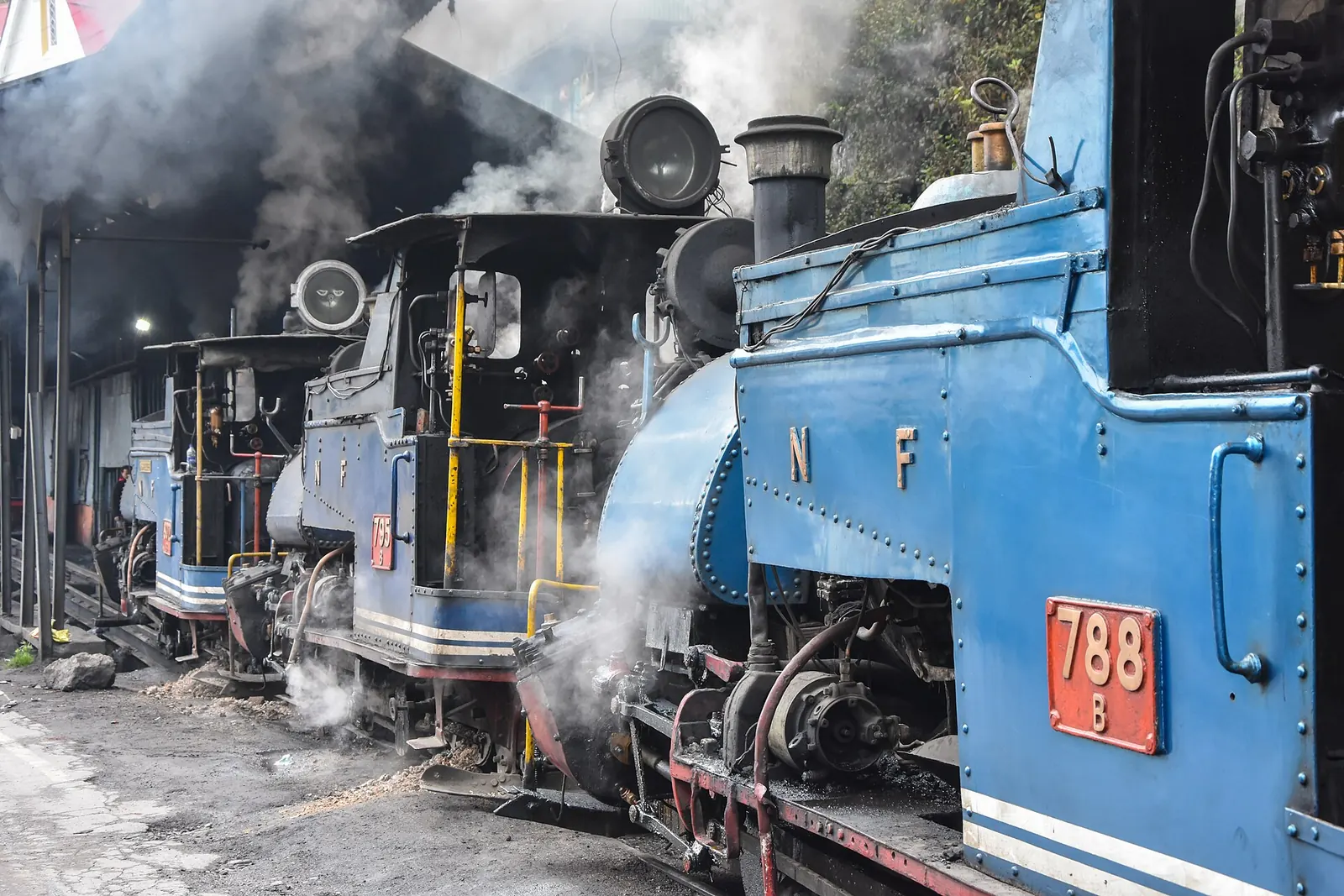
The saving came with a hidden bill: breaks of gauge. Every junction between gauges meant unloading and reloading goods and passengers, which the Army objected to for troop movements from the 1870s, the FIBIS history records.
By 1889 India had about 8,000 miles of broad gauge, 5,000 of metre gauge and roughly 250 of narrow gauge. At Independence, Indian Railways was formed by combining 42 railway systems, including those of former princely states, many with their own gauge choices, as the PIB's 2026 history notes. The full story of the network's birth is in how Indian Railways began in 1853.

What is Project Unigauge, and how far has it got?
Project Unigauge, launched on 1 April 1992, converts metre and narrow gauge lines to broad gauge so that the whole network can run through trains without transhipment. When it started, broad gauge was 35,109 route km, or 56.2% of the network; by March 2025 it was 67,372 km, or 97.0%, while metre gauge had shrunk from 23,283 km to 894 km and narrow gauge from 4,066 km to 1,173 km, according to the Wikipedia summary of PIB and Indian Railways Year Book data.
See the data as a table
| Broad gauge (1,676 mm) (km) | Metre gauge (1,000 mm) (km) | Narrow gauge (762/610 mm) (km) | |
|---|---|---|---|
| 1992 | 35109 | 23283 | 4066 |
| 2020 | 63949 | 2402 | 1604 |
| 2025 | 67372 | 894 | 1173 |
Source: PIB and Indian Railways Year Book 2024-25 via Wikipedia (1992, 2025); Indian Railways profile on IRCEP (31 March 2020) · Figures as at 1 April 1992, 31 March 2020 and 31 March 2025.
| Gauge | Width | Route km, 1992 | Route km, 2025 | Where you find it now |
|---|---|---|---|---|
| Broad | 1,676 mm (5 ft 6 in) | 35,109 | 67,372 | Almost the entire Indian Railways network |
| Metre | 1,000 mm | 23,283 | 894 | Nilgiri Mountain Railway, Mailani–Nanpara, Patalpani–Kalakund, a few lines awaiting conversion |
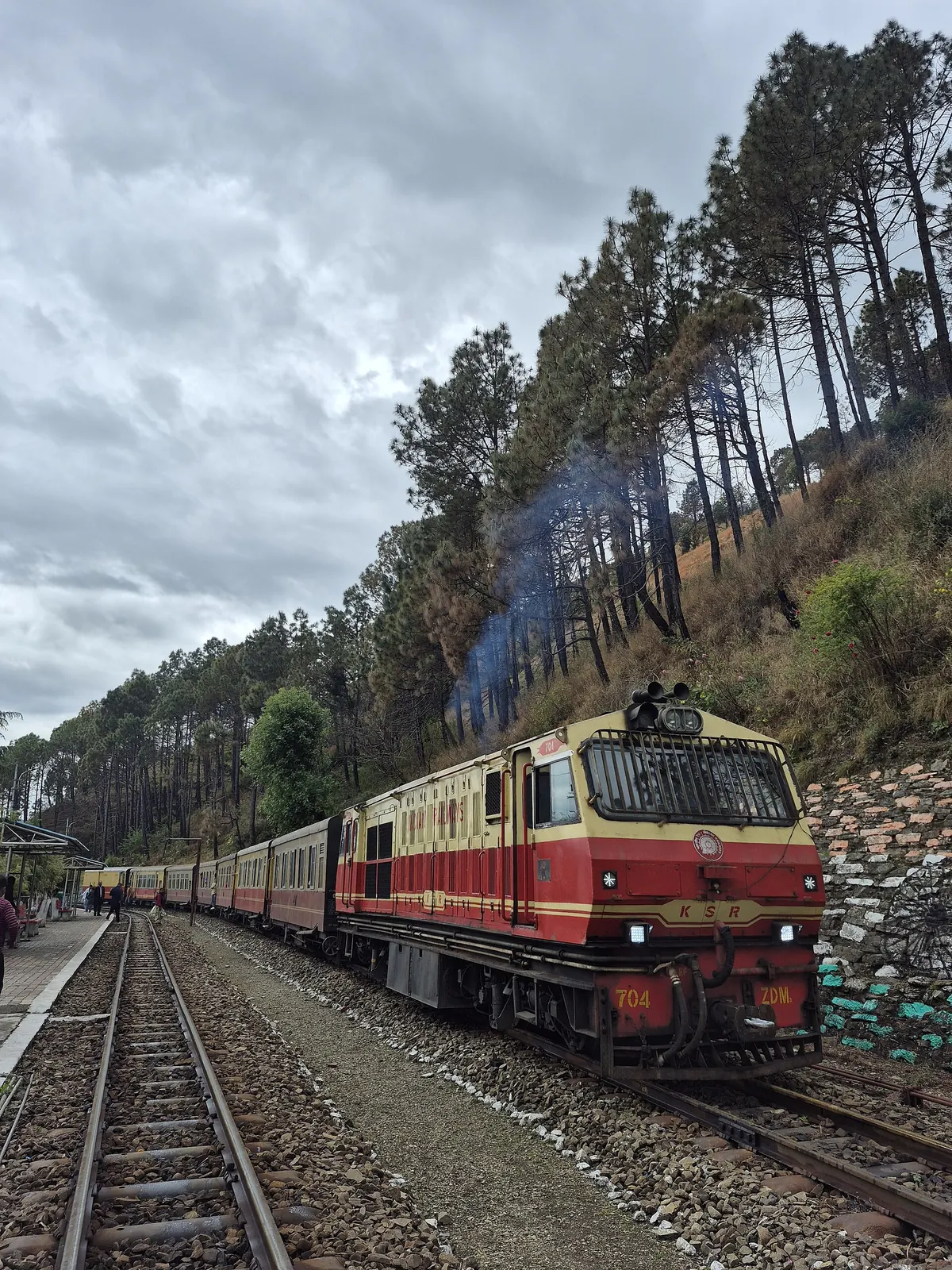
| Narrow (both widths) | 762 mm (2 ft 6 in) and 610 mm (2 ft) | 4,066 | 1,173 | 762 mm: Kalka–Shimla, Kangra Valley, Bilimora–Waghai; 610 mm: Darjeeling Himalayan, Matheran Hill |
| Standard | 1,435 mm (4 ft 8.5 in) | 0 | Outside IR's route km | Most metros, Delhi–Meerut RRTS, Mumbai–Ahmedabad high-speed line |
The eight heritage lines
Eight lines are kept on their original gauge as heritage:
- Metre gauge: the Nilgiri Mountain Railway (46 km), Patalpani–Kalakund (15 km) and Mailani–Nanpara (171 km).
- 762 mm: Kalka–Shimla (96.6 km), the Kangra Valley Railway (164 km) and Bilimora–Waghai (63 km).
- 610 mm: the Darjeeling Himalayan Railway (88 km) and Matheran Hill Railway (21 km).
The Darjeeling, Nilgiri and Kalka–Shimla lines together form the UNESCO World Heritage Site Mountain Railways of India. The total is about 665 km, so most of the 2,067 km of non-broad gauge left in 2025 is due for conversion or closure.
Calculated in this post from the eight line lengths above (Wikipedia: Project Unigauge): 46 + 15 + 171 + 96.6 + 164 + 63 + 88 + 21 = 664.6 km. The 2,067 km is the 894 km of metre gauge plus 1,173 km of narrow gauge in March 2025, from the same page.
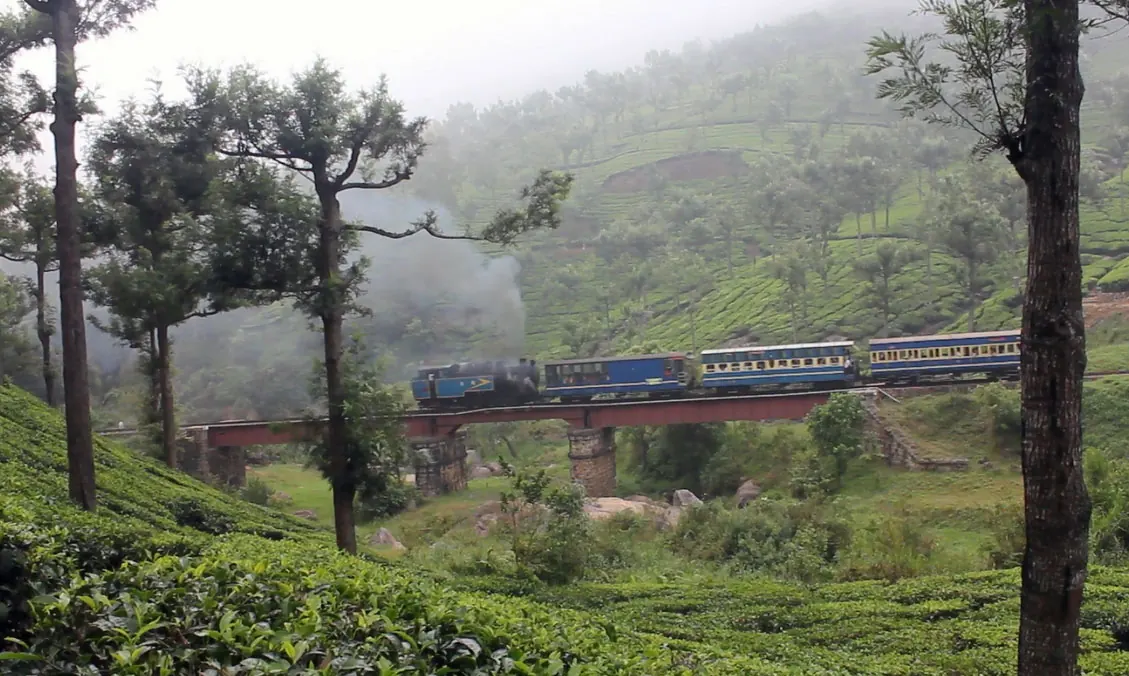

The government's 2026 backgrounder sets out the gauge history and the current network: broad gauge as the first gauge from 1853, metre gauge officially adopted as the second standard in 1871, narrower gauges for poorer and feeder regions, and four gauges in use today. It reports that 69,873 route km of a 70,142 route km broad gauge network, or 99.6%, was electrified by March 2026, up from 21,801 route km in 2014, and that Indian Railways was formed after 1947 by combining 42 railway systems. Limit: a promotional summary, without the gauge-wise breakdown of the Year Book.
Read the report (free)Why do Indian metros use standard gauge?
Metros use standard gauge mainly because the global market for metro trains, signalling and track components is built around 1,435 mm, so standard gauge stock can be bought off the shelf and metros do not need to share track with Indian Railways.
The Delhi Metro argument
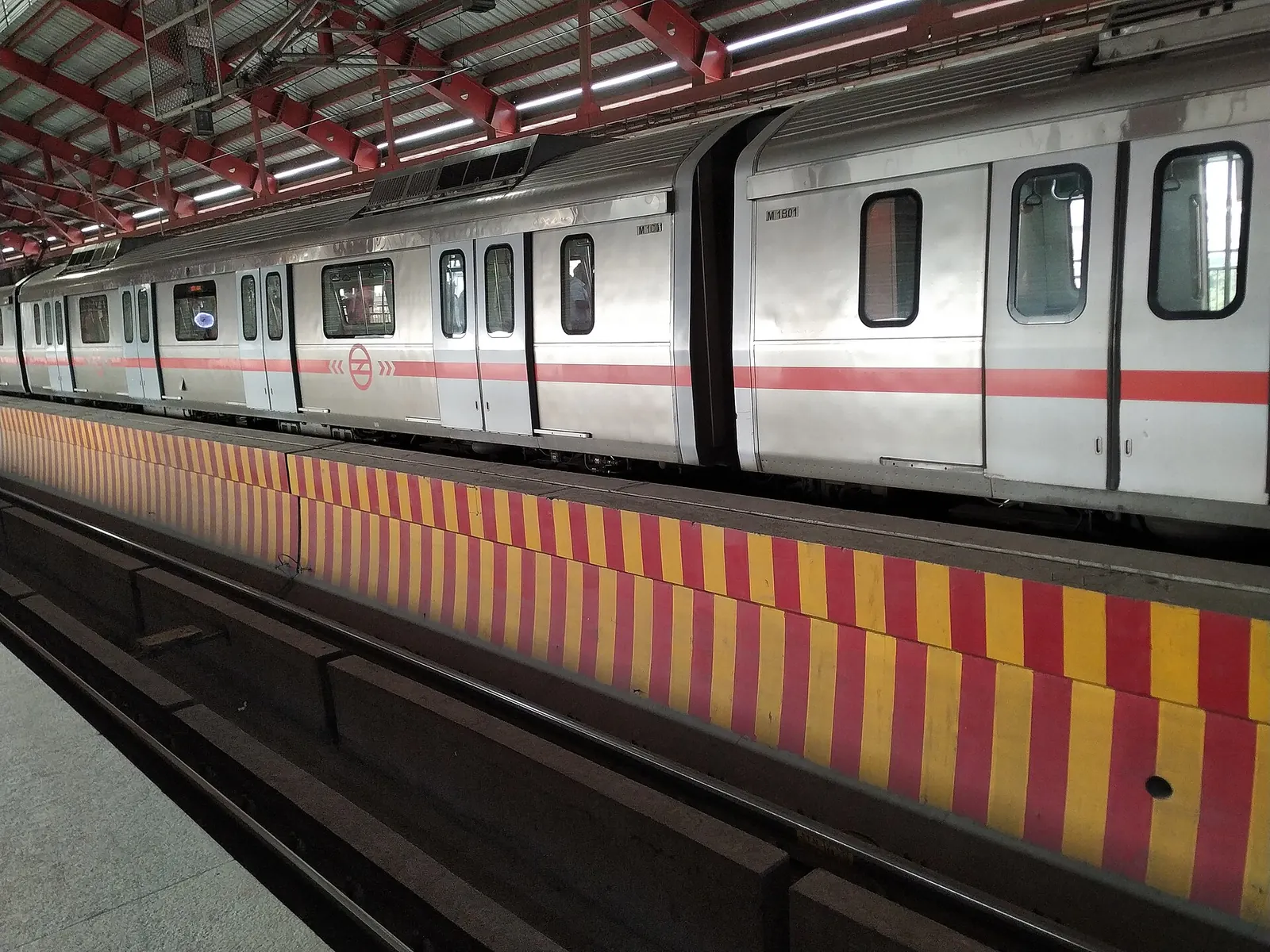
When the Delhi Metro was being planned around 2000, Indian Railways argued for broad gauge under its single-gauge policy and on capacity grounds, while DMRC's managing director E. Sreedharan argued for standard gauge because most metro networks worldwide use it and, in his view, gauge has no bearing on capacity.
Delhi's first line, opened on 24 December 2002, was built to broad gauge; a later decision left the gauge of future lines to the states, and most chose standard gauge. Kochi Post's account of the decision covers the sequence.
Inside a closed city system, the old argument for one national gauge simply does not apply.
The result is a split network. Delhi's early lines and the Kolkata Metro use broad gauge, while Delhi's newer lines and the Mumbai and Bengaluru metros are mostly standard gauge, and so are the Delhi–Meerut RRTS and the Mumbai–Ahmedabad high-speed line. None of them needs through-running with mainline trains, so the old argument for one national gauge, which drove Unigauge, does not apply inside a city. Coach widths, a related constraint, are covered in what ICF and LHB coach colours mean, and one of the great broad gauge builds of the 1990s in the Konkan Railway story.
| Argument | For broad gauge (1,676 mm) | For standard gauge (1,435 mm) |
|---|---|---|
| Compatibility | Matches the national network and its maintenance base | Matches world metro and high-speed suppliers |
| Stability and size | Wider wheelbase allows wider, taller coaches | Metros are light and low; the extra margin is not needed |
| Cost | Indian factories already build broad gauge coaches | Off-the-shelf rolling stock, signalling and track parts |
| Through running | Needed for mainline trains | Not needed in a closed urban system |
What's new
If you have ever sent a motorcycle by train, it travelled on this broad gauge network; my touring blog has the process in how to send a bike by train in India.
Questions people ask
Why does India use broad gauge instead of standard gauge?
Because the gauge was fixed in 1850–51, before India's network connected to anyone else's, and planners wanted a wider, steadier track; 5 ft 6 in was the compromise between 6 ft and 4 ft 8.5 in. Once thousands of kilometres were built, switching would have cost far more than any benefit, so the choice stuck.
Why do Indian metros use standard gauge?
Because metro trains, signalling and components are made worldwide for 1,435 mm, and a city metro does not need to share track with Indian Railways. The Kolkata Metro and Delhi's first lines use broad gauge; most newer metros are standard gauge.
How much of Indian Railways is still metre or narrow gauge?
About 3% in March 2025: 894 route km of metre gauge and 1,173 km of narrow gauge out of 69,439 km. About 665 km of that is protected heritage.
What is the width of broad gauge in India?
1,676 mm, or 5 ft 6 in, between the inner faces of the rails. Standard gauge is 1,435 mm and metre gauge 1,000 mm.
Which other countries use 5 ft 6 in gauge?
Pakistan, Bangladesh (west of the Jamuna), Sri Lanka and Nepal's short lines, plus most of Argentina, much of Chile and the BART system in the San Francisco Bay Area.
Sources
- Wikipedia: Great Indian Peninsula Railway (accessed 2026; first train of 16 April 1853)
- Puffert, D. J.: Path Dependence in Spatial Networks, the Standardization of Railway Track Gauge (working paper, published in Explorations in Economic History 2002) (2001)
- PIB: From Steam to Speed, the ever-evolving journey of railways (2026)
- Wikipedia: Project Unigauge (citing PIB and Indian Railways Year Book 2024-25) (accessed 2026)
- Indian Railways profile, IRCEP: route km by gauge as on 31 March 2020 (accessed 2026)
- Live History India: Indian Railways, battle of the gauges (accessed 2026)
- FIBIS wiki: Rail gauge in India (accessed 2026)
- Wikipedia: 5 ft 6 in gauge railway (accessed 2026)
- Wikipedia: Rail transport in India (accessed 2026)
- Kochi Post: Why the Delhi Metro has two gauges (accessed 2026)
- UNESCO: Mountain Railways of India
- Swarajya: Indian Railways nears complete broad gauge electrification (2026)
- Oneindia (IANS): Northeast's 115-year-old metre-gauge rail track becomes history (2014) (last metre gauge trains, Lumding-Agartala conversion)

Sapta (Saptarshi Sarkar) is a mechanical engineer turned marketer in Bengaluru and a solo touring rider. He writes the seven Saptaverse blogs. Work with him or read more of Whyblog.


