
Use the key to stop the bike when you park, and use the engine kill switch freely for quick stops or emergencies: the kill switch does not harm the engine. What it does is open the ignition circuit while leaving the rest of the bike powered, so if you kill the engine with the switch and walk away with the key still on, lamps, the instrument cluster and the ECU keep drawing current. KTM's 390 Duke manual says exactly this: the battery discharges, so switch off with the key and keep the red switch for emergencies.
- The kill switch opens only the ignition circuit; lamps, cluster and ECU stay live on the key.
- It does no harm to the engine at idle; revving hard and then killing it can cause a backfire.
- Key on, engine off: 9 W of lamps take a 4 Ah battery to half charge in about 2.7 hours.
- Switching off saves fuel only for stops longer than about 14 seconds (Nguyen et al., 2025).
- Park with the key, every time, even after using the switch.
The question is one of the oldest on Indian forums, and the best record of it is a single thread from 2009.
On 25 June 2009 an xBhp member asked whether flicking the engine kill switch at every traffic signal would harm his engine. He had read that the switch was meant only for emergencies, and one source had compared it to pulling the plug on a running computer. Within a day, more than a dozen replies came in. One passed on a Yamaha reply to an R15 owner: use it as often as needed. Another relayed a car mechanic's warning that the coil stays powered. A Pulsar 180 owner said he had used it for 2.5 years without trouble. One pointed out that the switch came from racing, for a rider pinned under a fallen bike. Another warned that revving hard and then cutting the engine made it backfire. By the evening of the 26th the asker marked his question "cleared".
xBhp: Is using engine kill switch harmful? (June 2009)They were mostly right, but for reasons nobody spelled out. Here they are.
What does the kill switch actually cut?
The kill switch cuts the ignition circuit, and on most bikes that is all it cuts. KTM's 2024 390 Duke manual puts it plainly: with the emergency OFF switch off, the ignition circuit is interrupted, a running engine stops, and a stopped engine cannot be started.
With it on, the ignition circuit is closed. Nothing in that description touches the headlamp relay, the instrument cluster or the ECU's power supply, all of which hang off the ignition key.
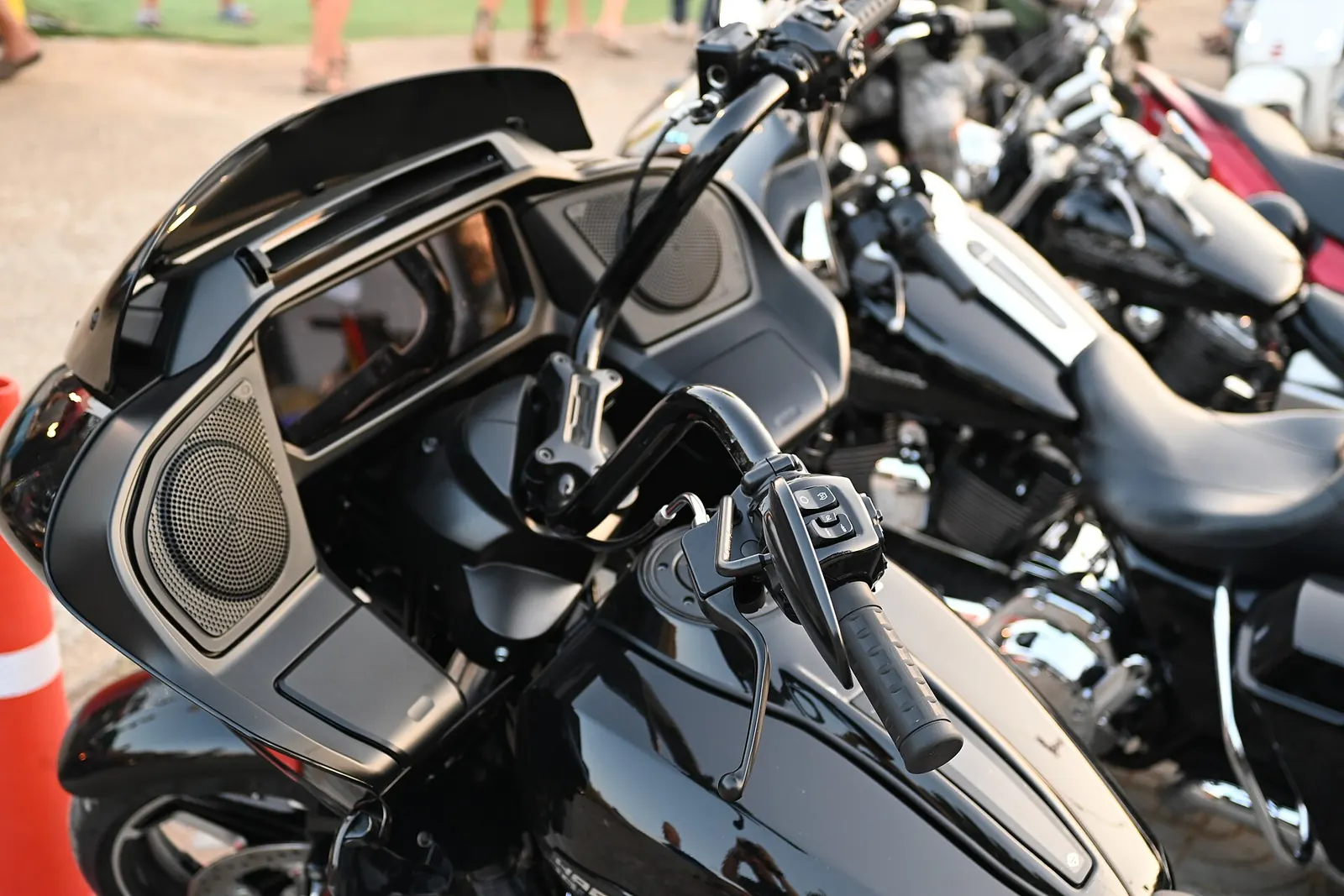
The key is the main switch
The ignition key, by contrast, is the main switch. With the key off, nothing downstream of it gets power:
- the lamps and the instrument cluster;
- the ECU and the fuel pump relay;
- the horn.
That is why Hero's Splendor+ XTEC manual says that with the key off the engine cannot start and no electrical system works.
Can the kill switch damage the engine?
No, not in normal use. Killing the ignition at idle stops the engine exactly as turning the key does, because both remove the spark; the engine coasts to a halt in under a second either way. Bajaj's own Pulsar 125 manual describes its kill switch simply as the control for switching the engine on and off, with no warning attached. Royal Enfield's Classic 350 combines the two into one ignition and engine kill switch on the right bar and tells you to switch both off when you stop.
The one habit to avoid: rev, then kill
There is one technique worth avoiding, and an xBhp member named it in 2009: revving hard and then hitting the switch. On a carburetted engine, fuel keeps being drawn through the carburettor for the last few revolutions with no spark to burn it, and that unburnt mixture can ignite in a hot exhaust as a bang.
On a fuel-injected engine the ECU meters fuel against crank speed and stops injecting as the engine stops turning, so the risk is smaller. Kill at idle and there is nothing to worry about.
The coil myth
The other old fear is the ignition coil. A member suggested the coil may stay powered with the switch off. On a modern CDI or ECU-driven ignition, the coil only carries current when the ignition system fires it, and with the engine stopped and the switch open it is not being fired, so it does not overheat.
If your bike is old enough to have contact-breaker points, the answer can differ: a coil left energised through closed points does get warm. That is a museum-piece problem on Indian roads now.
| Control | What it cuts | What stays live | Source |
|---|---|---|---|
| Ignition key OFF | Everything downstream: ignition, ECU, cluster, lamps | Nothing, except an aftermarket tracker wired direct to the battery | Hero Splendor+ XTEC manual |
| Kill switch OFF, key ON | Ignition circuit | Most electrical consumers, so the battery discharges | KTM 390 Duke manual |
| Side-stand switch | Cranking when the stand is down and the bike is in gear | Everything else | Bajaj NS160 and RS200 manuals |
| Bank-angle sensor (tip-over) | Engine and fuel pump after a fall; key must be cycled to restart | Lamps and cluster | Honda CBR1000RR owner's manual |
| Idle stop-start (Hero i3s) | Engine after 5 s at idle in neutral, once warm | Everything; restart by pulling the clutch | Hero Splendor+ XTEC manual |

How fast does the battery drain if I leave the key on?
A small motorcycle battery can lose half its charge in two or three hours with the key left on. The arithmetic is simple, using Bajaj's Pulsar NS160 manual:
- The battery. A 12 V, 4 Ah VRLA battery.
- The load. Two 3 W position lamps and a 3 W number-plate lamp: 9 W, or 0.75 A.
- The budget. A 4 Ah battery taken to 50% has 2 Ah to give.
Calculated in this post from the 4 Ah battery in Bajaj's Pulsar NS160 owner's manual: 4 Ah × 50% is 2 Ah. The 50% discharge limit is this post's own premise, not a figure from the manual.
- The result. 2 Ah at 0.75 A lasts about 2.7 hours, before counting the cluster and ECU.
Calculated in this post from the 2 Ah above and the 0.75 A load (9 W from the three 3 W lamps listed in Bajaj's Pulsar NS160 owner's manual, divided by 12 V): 2 Ah ÷ 0.75 A is about 2.7 hours.
The NS160 does at least switch its 35 W headlamp on only when the engine runs; bikes that keep a headlamp lit with the key on drain several times faster.
Honda's CBR1000RR manual, for one, says its headlight is always on when the ignition is on, and warns that using the engine stop switch without then turning the key off drains the battery. Use this to check the sum with your own battery and load.
How long until a key-on bike flattens its battery
Depth of discharge matters for battery life as well as for starting. Argonne National Laboratory's 2015 review of stop-start wear found that starter-battery life depends more on keeping the battery fully charged between starts than on the number of starts. A deep discharge on a small VRLA battery followed by a short ride home is exactly the pattern that shortens its life. Accessories make it worse: phone chargers, auxiliary lights and GPS units wired to switched power all keep drawing while the key is on.

Should I switch off at traffic signals?
Switching off at a long signal saves fuel; switching off at a short one wastes it. The break-even is about 14 seconds. Nguyen and colleagues measured 15 motorcycles in Vietnam, carburetted and fuel-injected, aged 0-15 years. Idling used 0.141 g of fuel in 5 seconds and 0.703 g in 30 seconds, while a restart cost a nearly constant 0.069 g. The break-even was 14 seconds: stop for longer and switching off wins.
See the data as a table
| Fuel (g) | |
|---|---|
| Idle 5 s | 0.141 |
| Idle 14 s (break-even) | |
| Idle 30 s | 0.703 |
| One restart | 0.069 |
Source: Nguyen et al., Journal of the Chinese Institute of Engineers, 2025 (15 motorcycles) · The study gives the 14 s break-even point but not the gram figure at 14 s, so that bar is left blank.
Fifteen motorcycles from new to 15 years old, both carburetted and fuel-injected, were tested under controlled conditions to compare idling with switching off and restarting. Restart fuel stayed almost constant at 0.069 ± 0.0007 g per start; idling used 0.028 g/s in the first five seconds, then a little less. A 30-second idle burned about ten times the fuel of a restart. The authors recommend switching off for stops longer than 14 seconds and estimate at least a 38% cut in fuel used at intersections. The limit: small Vietnamese commuter bikes, with fuel only, not battery or starter wear, in the model.
Read the abstract (free)Argonne built a life-cycle cost model for cars that weighed extra starter and battery wear against fuel saved by switching off instead of idling, using the number of daily starts, time between starts, starting-system design life and fuel per restart. For a typical motorist, the extra wear from more daily starts was negligible, and switching off paid whenever idling would last more than about a minute. Starter life tracked the total number of starts; battery life tracked whether the battery was recharged fully between them. The limit: car starting systems, not a 4 Ah motorcycle battery on short city trips.
Read the report (free)A 30-second idle burned about ten times the fuel of a restart. Nguyen et al., 2025
The car study's one-minute threshold is longer than the motorcycle study's 14 seconds because the economics include starter and battery wear, not just fuel. A sensible rule for a bike is to switch off when you can see the stop will last more than half a minute: a railway crossing, a long red at a big junction, a police checkpost. Manufacturers have reached the same conclusion: Hero's i3s cuts a warm engine after 5 seconds at idle in neutral and restarts it when you pull the clutch, and Honda's 2025 SP125 ships with an idling stop system.
Using OBD-II logging on one car over the same route, the authors compared idling stop against continuous idling. Idling stop saved 20.5% of fuel on a simple route and over 15% in weekday traffic, but only 3.67% at peak hours, and stops shorter than 10 seconds increased fuel use. The limit: a single car and route, but the short-stop penalty matches the motorcycle data.
Read the paper (free)What is the right routine, then?
Use the kill switch for long stops and falls, and the key whenever you walk away. The chart puts the whole routine on one page.
- Short stop, engine running: stay in neutral or hold the clutch; under about 15 seconds, do not switch off.
- Long signal or level crossing: use the kill switch. It is quicker than the key, keeps your hands on the bars and keeps indicators and horn working. Restart with the switch back on.
- Parking: turn the key off and take it with you, even if you already killed the engine with the switch. That is KTM's instruction and the only way to stop the drain.
- Before starting next time: check the kill switch is back on. Honda's own troubleshooting page lists it as the first thing to check when a bike will not start.
- After a fall: hit the kill switch first. That is what it was designed for. On bikes with a bank-angle sensor, cycle the key before restarting.
For keeping a small battery healthy between rides, read the motorcycle battery care guide. The other is-this-habit-harmful questions get the same treatment in is engine braking bad for your bike and coasting downhill in neutral, and the first weeks of a new bike's life are covered in running-in a new bike. Where I ride and what I ride is on the Yantra page.
What's new
- Hero's Super Splendor XTEC 2.0 pairs idle stop-start with a silent starter-generator for restarts Autocar Professional, May 2026
- Vietnamese study pins the motorcycle idle-vs-restart break-even at 14 seconds Journal of the Chinese Institute of Engineers, Jul 2025
- Honda's OBD2B-compliant 2025 SP125 ships with an idling stop system Autocar Professional, Dec 2024
Questions people ask
Why won't my bike start even though the battery is fine?
Check the kill switch first. It is the commonest cause, and Honda's own troubleshooting guide lists it before anything else. Then check the side-stand switch: on many bikes the starter is locked out with the stand down and a gear engaged.
Does using the kill switch skip the self-check?
On many fuel-injected bikes, the cluster sweep and fuel-pump prime happen when the key goes on. Restarting with the kill switch while the key stays on skips that wait, which is why some xBhp members preferred it at signals. It does no harm.
Is it bad to turn the key off while riding?
Yes, avoid it. Turning the key off at speed kills the lights, horn, indicators and the ABS control unit along with the engine. Honda's manuals warn against even the stop switch while riding because the engine cuts suddenly; if you must stop the engine on the move, the kill switch at least leaves the electrics alive.
My bike has a GPS tracker. Will it drain the battery?
Trackers wired directly to the battery draw a little current even with the key off, by design. Riders who park for weeks should check the tracker's standby draw or fit a battery maintainer.
Sources
- KTM: 2024 390 Duke owner's manual (EU), emergency OFF switch and parking (2023)
- Bajaj Auto: Pulsar NS160 owner's manual
- Bajaj Auto: Pulsar 125 owner's manual
- Bajaj Auto: Pulsar RS200 owner's manual
- Royal Enfield: Classic 350 BS6 owner's manual
- Hero MotoCorp: Splendor+ XTEC owner's manual, i3s and ignition switch (2024)
- Honda: CBR1000RR owner's manual, ignition switch, engine stop switch and ignition cut-off system
- Honda: Motorcycle won't start? Simple check items (2024)
- Nguyen et al.: Fuel consumption of idle and re-start options for motorcycles, Journal of the Chinese Institute of Engineers (2025)
- Windover et al.: Stop and restart effects on modern vehicle starting system components, Argonne National Laboratory (2015)
- Tseng and Mai: Fuel consumption for idling stop systems in different traffic conditions, EJASET (2025)
- Autocar Professional: Hero launches Super Splendor XTEC 2.0 (2026)
- Autocar Professional: Honda launches 2025 SP125 (2024)
- xBhp: Is using engine kill switch harmful? (forum thread) (2009)

Sapta (Saptarshi Sarkar) is a mechanical engineer turned marketer in Bengaluru and a solo touring rider. He writes the seven Saptaverse blogs. Work with him or read more of RoadHook Machines.


