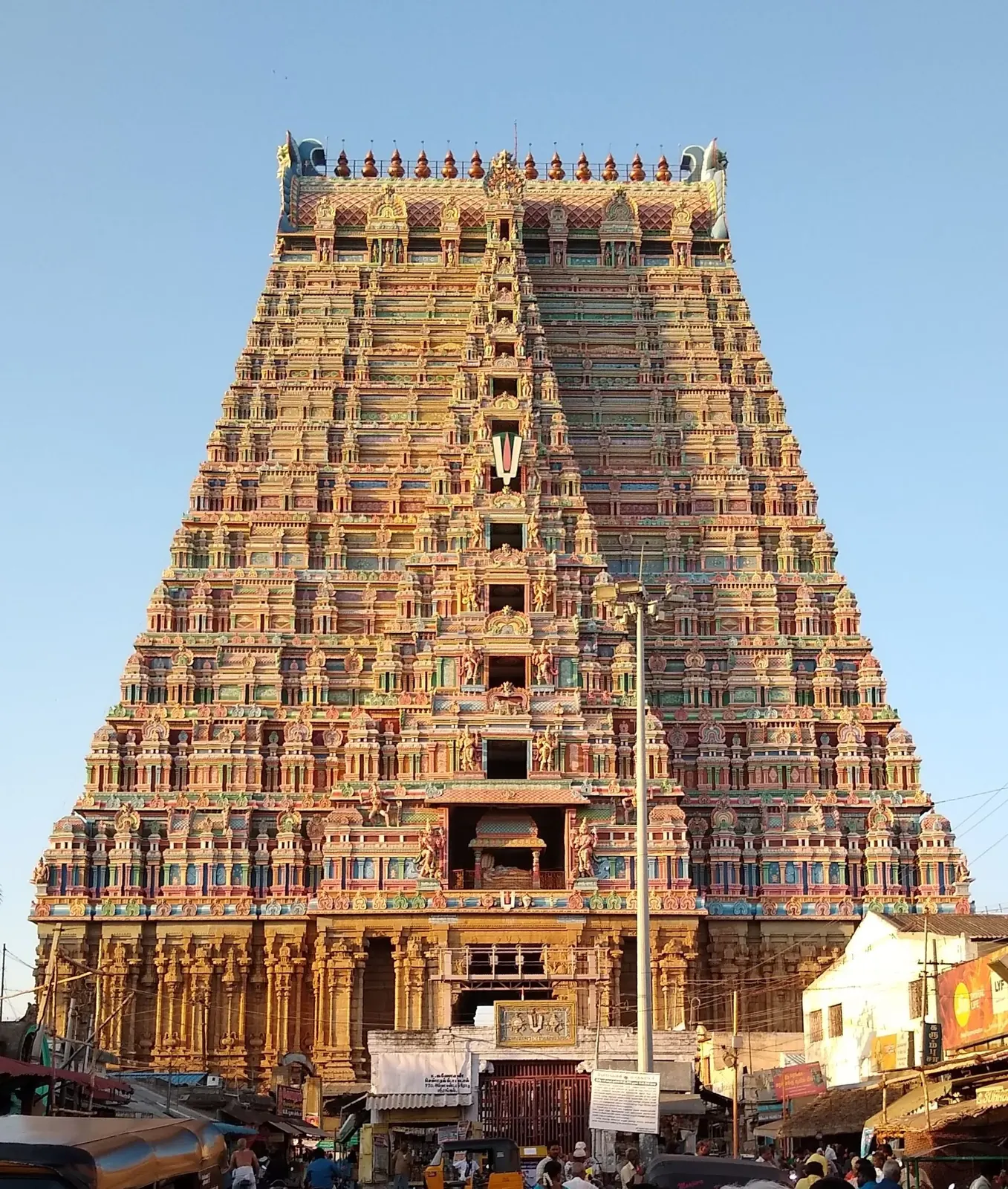
A temple gopuram and a good slide deck are built the same way because they solve the same problem: one object must make sense to viewers at very different distances. Both lead with a shape that reads from far away (the tower's silhouette, the slide's one-line claim), then add layers of detail sized so that each layer becomes legible only as you come closer. The governing rule is the visual angle: the eye resolves about 1 arcminute, so every layer of detail has a distance at which it switches on.
- 1 arcminute is the finest gap 6/6 (20/20) vision resolves: 2.9 cm at 100 m, 0.35 mm on a slide 1.2 m away.
- 73 m and 13 tiers: the Srirangam Rajagopuram, finished in 1987, repeats the same storey on a shrinking scale.
- 30 ms vs 150 ms: at a flash, people categorise scenes by coarse shape; given longer, by fine detail.
- d = 0.81: assertion-evidence slides beat default bullet slides on comprehension in a 110-student study.
- About 3% of screen height is a sensible minimum text size for the back row at six screen-heights (my calculation from the AV standard).
This is a tier-4 "collision": pair two things that don't belong together and test whether the link is real. Here the claim is structural. A Dravidian temple gateway and a 20-slide deck both use hierarchy that reads from a distance, then detail that rewards coming closer. If that is true, the same equation should size both. It does.
What problem do a gopuram and a slide deck share?
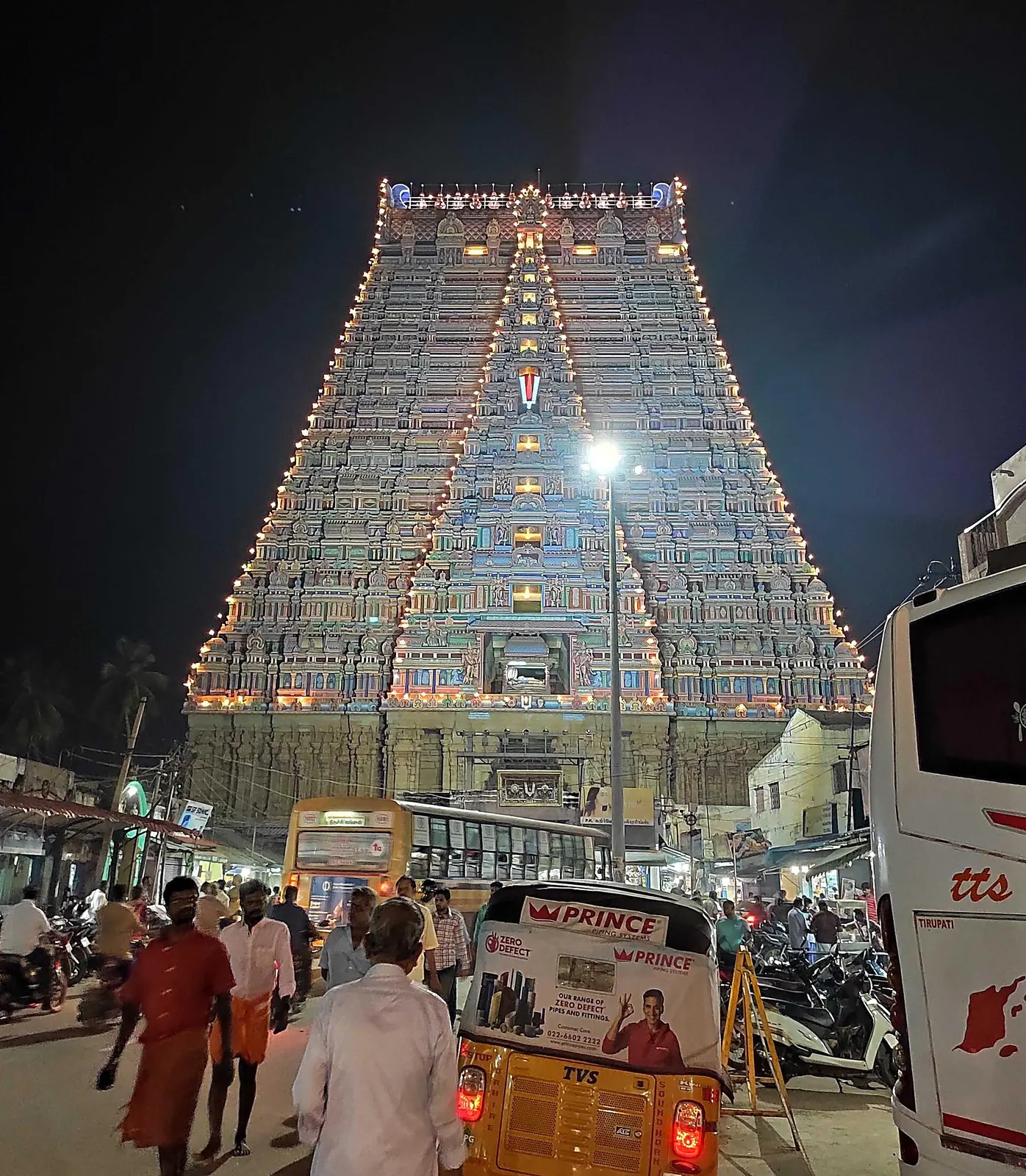
Both are seen by many people at once, from distances that differ by a factor of ten or more. The design has to work at every one of those distances, without the viewer doing anything except walking closer or squinting.
A gopuram is the monumental gateway tower of a South Indian temple. It is often the tallest structure in the complex, taller than the vimana over the shrine. Its outline is meant to be seen across a town; its painted stucco figures are meant to be read at the gate.
The southern gateway of the Ranganathaswamy temple at Srirangam stood unfinished for centuries. In the late twentieth century the 44th pontiff of the Ahobila Mutt took on the job of completing it, gathering money from the mutt, other religious bodies, two state governments, the composer Ilaiyaraaja and ordinary devotees. At least 200 workers were on site every day for nearly eight years. The finished Rajagopuram stands about 236 feet from the ground, with 13 tiers on a base 166 feet long and 97 feet wide, tapering to 98 by 32 feet at the top. Its consecration was set for 25 March 1987.
Ramanuja.org: Ahobila Mutt Jeer and the Rajagopuram
How far away can the eye read a detail?
Normal 6/6 vision resolves two points separated by 1 arcminute, and a standard Snellen letter is 5 arcminutes tall. Everything else in this post follows from turning those angles into sizes.
The worked derivation
My assumptions, stated up front:
- the viewer has 6/6 (20/20) vision in good light;
- "resolvable" means a 1 arcminute gap; "comfortably legible" uses the AVIXA DISCAS acuity factor of 200 for basic decision making, which works out to about 17 arcminutes;
- the detail is face-on (for tall towers, the slant makes things worse, see the sensitivity check).
- Visual angle. An object of height \( h \) at distance \( d \) subtends
\[ \theta = 2\arctan\!\left(\frac{h}{2d}\right) \approx \frac{h}{d}\ \text{(radians, small angles)} \]
- Smallest resolvable detail. With \( \theta = 1' = 2.91\times10^{-4} \) rad,
\[ h_{\min} = d\,\tan(1') = 0.29\ \text{mm per metre} \]At 100 m that is 2.9 cm; at 1.2 m from a laptop, 0.35 mm.
Calculated in this post from the 1 arcminute resolution of 6/6 vision and two distances: 100 m, and 1.2 m for a laptop (my assumed reading distance).
- Comfortable legibility. DISCAS uses an acuity factor of 200 for basic decisions, so an element should be at least
\[ h_{\text{legible}} = \frac{d}{200} \quad\Rightarrow\quad \theta = \frac{1}{200}\ \text{rad} = 17.2' \]For analytical viewing it uses 3,438, which is exactly \( 1/\tan(1') \): one arcminute per pixel.
Calculated in this post from the AVIXA DISCAS acuity factors of 200 and 3,438: 1/200 rad is 3,438 arcminutes per radian divided by 200, or 17.2 arcminutes.
- Switch-on distance. Flip it round: a detail of size \( h \) becomes legible at
\[ d_{\text{on}} = 200\,h \]A 73 m tower reads as a shape from 14.6 km; a 5 cm ornament only from 10 m.
Calculated in this post from the DISCAS acuity factor of 200, the tower height of 73 m (Wikipedia lists 239.5 ft; Ramanuja.org gives about 236 ft, or 72 m) and a 5 cm ornament (my estimate).
That last step is the whole design idea. Each layer of a gopuram, and each layer of a slide, has its own switch-on distance. Good design spaces those distances out so that something new appears at every step closer.
How does a gopuram layer its detail?
By repetition at shrinking scale. Each upper tier repeats the features of the one below on a smaller scale, the whole tapers (it is "battered"), and the top carries a barrel-vaulted roof with metal or stone finials called kalasams.
That structure gives the viewer four readable levels:
- Silhouette. A tapering trapezoid with a vaulted crown. It says "temple, entrance here" from across the town.
- Tiers. The 13 horizontal storeys of the Srirangam tower average about 5.6 m each (73 m ÷ 13, my arithmetic). They give rhythm and scale from a kilometre.
- Figures. Painted stucco deities and attendants, usually tied to the temple's presiding deity, become individual stories from a few hundred metres.
- Ornament. Faces, jewellery and weapons in the figures reward the person standing at the gate.
The authors ran box-counting fractal analysis (ten grid iterations scaled by √2, 40 grid comparisons, over 26,000 data points) and gliding-box lacunarity on the site plans of the IIM Bangalore campus, Fatehpur Sikri, the Meenakshi temple complex at Madurai and the Ranganathaswamy complex at Srirangam. The fractal dimension of Doshi's campus was close to both temple compounds, which they read as measurable evidence of the "detail at every scale" quality Doshi said he took from them. The limit: it measures plans, not towers, so it supports the multi-scale idea rather than proving it for gopurams.
Read the paper (free)
Does the brain really read coarse first and detail later?
Largely, yes. Coarse shape (low spatial frequencies) reaches the visual cortex first through fast pathways, and fine detail (high spatial frequencies) arrives later, so a design that leads with a strong silhouette is matching the order in which the brain works.
This review gathers behavioural and brain-imaging evidence for a default coarse-to-fine order in scene perception: low spatial frequencies carry global structure via fast magnocellular pathways, high frequencies carry edges and detail more slowly. It summarises Schyns and Oliva's hybrid images, where a 30 ms flash was categorised by its coarse layer and a 150 ms view by its fine layer. The limit: about 29% of sequences in that work ran fine-to-coarse, and the authors note the order can flip with the task, so coarse-first is a default, not a law.
Read the paper (free)A gopuram is a slide you can walk into: the headline is the outline, and the speaker notes are carved at the gate.
How does a good slide deck copy the gopuram?
By giving every slide a claim readable from the back, evidence readable from the middle, and detail kept for the handout or the speaker's voice. The assertion-evidence method formalises exactly that, and it has been tested.
| Level | Gopuram | Slide deck | Who it serves |
|---|---|---|---|
| Silhouette | Tapering tower, vaulted crown | Deck structure: one idea per slide | Anyone glancing |
| Tiers | 13 repeating storeys | A full-sentence headline (the assertion) | The back row |
| Figures | Deities and attendants | One chart, photo or diagram as evidence | The middle rows |
| Ornament | Faces, jewellery, weapons | Labels, data values, the spoken story | The front row and the handout |
110 undergraduate engineers (67 men, 43 women) watched the same narrated talk on how MRI works, with slides either in default topic-and-bullets form or as a sentence headline plus visual evidence. The assertion-evidence group wrote essays with higher comprehension scores (t = 3.67, p < 0.001, Cohen's d = 0.81), fewer misconceptions and lower reported mental effort, and recalled more on a surprise test a week later. The limit: one topic, one session and engineering students only.
Read the paper (free)How big should slide text be for the back row?
For a room where the farthest viewer sits six screen-heights away, text should be at least about 3% of the screen height, which on a standard 16:9 slide is roughly 23 pt. The working follows the gopuram maths exactly.
- Room rule. The AV industry's 4/6/8 rule puts the farthest viewer at 4, 6 or 8 times the image height for analytical, basic and passive viewing.
- Element height. With \( h = d/200 \) and \( d = 6H \),
\[ \frac{h}{H} = \frac{6H}{200H} = 0.03 = 3\% \]
- Convert to points. A 16:9 PowerPoint slide is 7.5 inches tall, so 3% is 0.225 in or 16.2 pt of glyph height. Capitals are roughly 0.7 of the font size (my assumption for a typical sans), giving
\[ \text{font size} \approx \frac{16.2}{0.7} \approx 23\ \text{pt} \]
Calculated in this post from the 3% above and the 7.5 inch slide height (Microsoft, Widescreen 13.333 × 7.5 in): 0.03 × 7.5 in × 72 pt per inch = 16.2 pt.
- Back of a long room. At eight screen-heights, the same working gives 4% and about 31 pt.
Calculated in this post from the same steps: 8 ÷ 200 = 4% of 7.5 inches, or 21.6 pt of glyph height, divided by 0.7.
Use this to check your own room. Put in the distance to your farthest seat and your screen's image height.
Minimum text size for your farthest viewer
See the data as a table
| Legible from ( m) | |
|---|---|
| Whole tower (73 m) | 14600 |
| One tier (5.6 m) | 1120 |
| A figure (1.5 m, estimate) | 300 |
| A face (30 cm, estimate) | 60 |
| Jewellery (5 cm, estimate) | 10 |
Source: Tower height and 13 tiers from Wikipedia and Ramanuja.org; acuity factor 200 from AVIXA DISCAS; figure and ornament sizes are my estimates · Atmospheric haze and contrast cut the far distances sharply in practice.
How sensitive is this to the assumptions?
The structure survives every reasonable change; only the exact distances move. Here is what shifts each one.
- Weaker eyes. A viewer with 6/12 vision needs details twice as big, so every switch-on distance halves. The levels still appear in order.
- Looking up. The top tier of a 73 m tower seen from 30 m away is about 80 m off along the line of sight, and foreshortened. Upper figures need to be larger than lower ones to read equally, which is part of why the battered, tapering form works: the eye reads the shrinking tiers as extra height.
Calculated in this post from the 73 m height (Wikipedia list of tallest gopurams) and a 30 m viewing distance chosen as an example: √(73² + 30²) ≈ 79 m.
- Contrast and haze. Acuity numbers assume high contrast. Painted stucco in bright colours helps, just as dark text on a light slide does; a pale grey font halves the useful distance in practice.
- Time. At a 30 ms glance people use the coarse layer. A slide shown for 10 seconds with a speaker talking is closer to a long look, so detail can carry more weight than on a poster.
Where does the comparison break down?
In two places. A gopuram's viewer chooses how close to come and how long to stay; a slide's viewer is fixed in a seat for a fixed time, so the presenter must move the audience through the levels with the voice. And a gopuram's detail is meant to be dense and devotional, while a slide's detail should be sparse. The coherence principle in multimedia learning says extra decoration costs comprehension, which is the opposite of the temple's abundance.
The hierarchy idea transfers; the density does not. For the type side of this, see kerning, tracking and leading, serif vs sans-serif readability and the typographic grid. For contrast, which decides how far any of this carries, see WCAG and APCA contrast. India's great temple sites are ranked in UNESCO's Indian art sites, and the studio's home is Kala.
A gopuram and a good slide deck solve the same visual-angle problem with the same structure: a silhouette legible from about 200 times its size away, then layers of detail each with its own switch-on distance. For a back row at six screen-heights that rule gives text of at least 3% of screen height, about 23 pt. The link breaks only on density: temples reward abundance, slides punish it.
What's new
- Madurai's Meenakshi temple holds its kumbabishekam after 17 years, following 186 restoration works costing ₹32.29 crore GKToday, Sep 2026
- Repairs begin on Srirangam's damaged east gopuram DT Next, May 2024
- Thiruparankundram temple's Rajagopuram restored for its first consecration in 16 years Organiser, Jul 2025
- The 4/6/8 rule for screen size and seating, explained SlashGear, Jul 2026
What if next?
- A kolam is a line you can't lift your hand from, and so is a good logo: Euler's 1736 rule decides which drawings can be one stroke.
- Truck art and app icons solve the same problem: the same visual-angle maths, but now the viewer is moving.
- Your eye and a camera both lie in the same places: the blind spot you never see and the blue shadows you never notice.
Questions people ask
Why are gopurams so tall?
They grew from modest Pallava gateways into landmarks under the Pandya, Vijayanagara and Nayaka rulers between the 12th and 16th centuries, often taller than the shrine itself, so the temple could be found and announced from far away. Srirangam's Rajagopuram, at about 73 m, was completed in 1987.
What is the minimum font size for a presentation?
It depends on the room. A standard derived from visual acuity puts the minimum text height at about 1/200 of the distance to the farthest viewer; for a room where that viewer sits six screen-heights away, that is roughly 23 pt on a 16:9 slide.
What is an assertion-evidence slide?
A slide whose headline is a full-sentence claim, supported by a visual (photo, chart, diagram) instead of bullet points. In Garner and Alley's 2013 study it improved comprehension with a large effect size (d = 0.81).
Why do gopurams have so many sculptures?
The figures illustrate stories linked to the temple's deity and give the visitor something new to read at every step closer, from tiers at a distance to individual faces at the gate.
Sources
- Ramanuja.org: Ahobila Mutt Jeer and the Rajagopuram (1995) (source for the 1987 completion, dimensions, 13 tiers and workforce)
- Wikipedia: Gopuram (source for origins, diminishing tiers, kalasams and the 73 m height)
- Wikipedia: List of tallest gopurams (source for heights including Meenakshi's 51.9 m)
- Wikipedia: Visual acuity (source for 1 arcminute and 5 arcminute letters)
- AVIXA: Learn more about display size (DISCAS) (source for acuity factors 200 and 3,438 and element height)
- SlashGear: What is the 4/6/8 rule for projectors (2026) (source for 4, 6 and 8 screen-heights)
- Garner and Alley: How the design of presentation slides affects audience comprehension, IJEE (2013) (source for the 110-student study and d = 0.81)
- Kauffmann, Ramanoël and Peyrin: The neural bases of spatial frequency processing during scene perception (2014) (source for coarse-to-fine and the 30 ms and 150 ms hybrids)
- Lionar and Ediz: Doshi's IIM Complex compared by fractal dimension and lacunarity, ITU A|Z (2021) (source for the fractal comparison with Meenakshi and Srirangam)
- GKToday: Madurai Meenakshi temple kumbabishekam held after 17 years (2026)

Sapta (Saptarshi Sarkar) is a mechanical engineer turned marketer in Bengaluru and a solo touring rider. He writes the seven Saptaverse blogs. Work with him or read more of Artblog.


