Your eye and a digital camera fail in the same three places and hide the failure the same two ways. Both have holes in the image, and both fill them by interpolating from neighbours. Both face light of the wrong colour and correct it by scaling each colour channel against a guess of what white should be. The one real difference: your brain corrects each part of a scene separately, while most cameras apply one correction to the whole frame, which is why photos show blue shadows your eyes never saw.
- About 7.5° × 5.5°: the size of each eye's blind spot, 12 to 15 degrees out from the centre of gaze.
- 2 of 3 colours at every pixel of a Bayer sensor are interpolated, not measured (Bryce Bayer's 1976 Kodak patent).
- About 2×: how much more short-wave (S-cone) signal a white sheet sends in blue skylight shade than in sunlight at equal brightness (my calculation).
- Von Kries scaling: eye and camera both divide each colour channel by the value of "white".
- One frame, one gain: a camera's single white balance cannot fix sun and shade together; the eye largely can.
This is a tier-4 "collision": pair two things and test the link. The link here is not "the eye is like a camera", which is a cliché. It is narrower and stranger: the specific places where the two systems produce wrong data, and the specific arithmetic each uses to cover it up, turn out to be the same.
Where is the hole in your eye?
About 12 to 15 degrees towards your temple and 1.5 degrees below the line of sight, where the optic nerve leaves the eyeball. There are no photoreceptors on that patch, the optic disc, so a region roughly 7.5 degrees high and 5.5 degrees wide sees nothing at all.
In the 1660s the French physicist Edme Mariotte noticed something that contradicted the textbooks of his day: there was a point in each eye's field where nothing was seen. At the time it was assumed the whole retina detected light. He showed the effect at the court of Louis XIV and to the Royal Society of London by having people fix one eye on a mark while an object to the side vanished. The trick still works the same way today, and you can try it below.
Wikipedia: Blind spot (vision)Find your own blind spot
- Draw the card. On paper, draw a small cross and, to its right, a dot about 1 cm wide.
- Close your left eye. Look only at the cross with your right eye.
- Move slowly. Bring the paper towards you or away until the dot vanishes. The calculator below tells you the distance to expect.
- Notice what replaces it. You will not see a black hole. You will see paper.
The geometry is simple. If the dot must sit at about 15° from where you are looking, at viewing distance \( d \),
At 30 cm that means a dot 8 cm to the right of the cross, inside a blank region nearly 3 cm across.
Blind spot test: where to put the dot
Participants searched two noise patches for a small tilted target and moved their eyes to the side they thought it was on; with one eye covered, the target could fall in the blind spot (placed 14° out and 1.5° down). With 31 people and targets mixed unpredictably, eye movements went to the blind-spot side only at chance (0.50), as if the filled-in patch were real image. When the blind-spot side was predictable, 29 participants learned to look there (0.69). The limit: the blind spot was placed at a standard location rather than mapped for each person.
Read the paper (free)Where is the hole in a camera?
Everywhere, in a sense. A typical sensor puts a red, green or blue filter over each photosite, so every pixel measures one colour and the other two are calculated from its neighbours. That is a far bigger fill-in job than the eye's blind spot.
- The Bayer mosaic. Bryce Bayer at Kodak patented the layout in 1976 (US 3,971,065, Wikipedia: Bayer filter): half the filters green, a quarter red, a quarter blue, with green doubled to match the eye's sensitivity.
- Demosaicing. For every pixel, two of the three colour values are interpolated from neighbours. Errors show up as moiré, false colour and "zipper" edges.
- Hot and dead pixels. A photosite that is stuck bright or dark is mapped out and replaced with an average of its neighbours, the camera's own blind-spot filling.

| The lie | Eye: what fails | Eye: how it hides it | Camera: what fails | Camera: how it hides it |
|---|---|---|---|---|
| Holes | Blind spot, about 7.5° × 5.5° | Filling-in from surroundings and the other eye | Dead pixels; 2 of 3 colours missing per pixel | Pixel mapping and demosaicing from neighbours |
| Wrong-coloured light | Cone signals shift with the illuminant | Colour constancy (von Kries-like scaling) | Raw RGB shifts with the illuminant | Auto white balance gains |
| Shadow colour | Shade is lit by blue skylight | Corrects shade and sun regions separately | Same blue skylight in the raw data | Usually one gain per frame, so shade stays blue |
How do both correct the colour of light?
By the same arithmetic: divide each colour channel by the value that "white" has under the current light. In vision science this is the von Kries model of chromatic adaptation; in photography it is white balance. The only difference is which three channels get divided.
The worked derivation
Assumptions, stated plainly:
- a white surface is seen first in sunlight, then in the shade of a building, lit only by blue skylight;
- I use the sunlight chromaticity \( (x, y) = (0.339, 0.353) \) and the blue skylight \( (0.259, 0.271) \) that Morimoto and colleagues used in their 2025 shadow experiment, both scaled to equal luminance \( Y = 1 \);
- cone responses come from the standard Hunt–Pointer–Estévez matrix (normalised to D65), the matrix traditionally paired with the von Kries method.
- Chromaticity to tristimulus.
\[ X = \frac{x}{y}Y,\qquad Z = \frac{1-x-y}{y}Y \]Sun: \( (X, Y, Z) = (0.960, 1, 0.873) \). Sky: \( (0.956, 1, 1.734) \).
- Tristimulus to cones.
\[ \begin{pmatrix}L\\M\\S\end{pmatrix} = \begin{pmatrix}0.4002 & 0.7076 & -0.0808\\ -0.2263 & 1.1653 & 0.0457\\ 0 & 0 & 0.9182\end{pmatrix}\begin{pmatrix}X\\Y\\Z\end{pmatrix} \]Sun: \( (1.021, 0.988, 0.801) \). Sky: \( (0.950, 1.028, 1.592) \).
Calculated in this post from the Hunt–Pointer–Estévez matrix (Wikipedia: LMS color space) and the sunlight and skylight chromaticities of Morimoto et al., 2025.
- Compare. The white sheet in shade sends \( 0.93\times \) the L signal, \( 1.04\times \) the M signal and \( 1.99\times \) the S signal it sends in sun. Without correction, white in shade would look strongly blue.
- Von Kries correction. Scale each channel by the reciprocal of white's value under the current light:
\[ L' = \frac{L}{L_w},\quad M' = \frac{M}{M_w},\quad S' = \frac{S}{S_w} \]In the shade that means turning the S channel down by about half (gain 0.50). A camera's auto white balance does the same thing in RGB: \( R' = 255\,R/R_w \) and likewise for G and B.
See the data as a table
| Sunlight | Blue skylight shade | |
|---|---|---|
| L (long-wave) | 1.02 | 0.95 |
| M (medium-wave) | 0.99 | 1.03 |
| S (short-wave) | 0.8 | 1.59 |
Source: My calculation from the sunlight and skylight chromaticities in Morimoto et al. (2025), using the Hunt-Pointer-Estevez matrix · S nearly doubles in shade. The eye scales it back; a camera balanced for the sunlit part of the frame does not.
Your eye and your camera do the same division. The eye just does it in patches, and the camera does it once for the whole picture.
Why are shadows blue in photos but not to your eye?
Because a shadow on a clear day is lit only by the sky, which is far bluer than direct sun, and the eye corrects the shadow separately from the sunlit area while a camera usually applies one correction to the whole frame. Wikipedia's colour temperature table puts a clear blue sky at 15,000 to 27,000 K against 6,500 K for overcast daylight.
Projectors simulating sunlight and five colours of skylight lit a scene of coloured hexagons, with a shadow lit by skylight alone. Observers adjusted a patch inside the shadow until it looked white. With 3 observers in Experiment 1 the mean constancy index was 1.16 in the sun-plus-shadow scene against 1.08 under skylight alone, not a significant difference: constancy in shadow matched constancy under one light. Outlining the shadow edge changed nothing for 12 observers in Experiment 2. The limit: very small samples, projected rather than real daylight, and results that depended strongly on instructions.
Read the paper (free)A camera can only match the eye if it treats the two regions separately. Here is what changes the outcome:
- Balance for the sun. Sunlit areas look right, shadows go blue. This is the classic snow-in-shade photo.
- Balance for the shade. Shadows look neutral, sunlit areas turn orange.
- Shoot raw and correct locally. A brush or mask with its own white balance in the shadow is the manual version of what your visual system does automatically.

How sensitive is the comparison?
The structure holds under every change I tried; the numbers move. Here is the check, one assumption at a time.
- A different sky. A hazy or overcast sky is less blue, so the S-signal ratio drops well below 2 and shadows in photos look only slightly cool.
- A different cone matrix. Using another standard matrix (Bradford instead of Hunt–Pointer–Estévez) shifts the gains by a few per cent (my estimate), not the conclusion.
- Imperfect constancy. Human constancy is not perfect. Morimoto's own observers ranged from about 0.68 to 1.26 on the index depending on the task, so the eye also "lies" a little, just less visibly.
- Blind spot vs demosaicing. The eye's hole is one patch per eye, covered by the other eye in normal viewing. The camera's missing data is spread across every pixel, so it relies on interpolation far more, but each guess is local and small.

Where does the analogy break?
In time and in scale. Your eyes keep moving, so the brain stitches many glimpses and can check the blind-spot region with the other eye; a camera captures one frame. And the brain's corrections are tuned to what it expects, which makes them better than a camera's in natural scenes and worse in tricks: famous illusions exist because the eye's guesses are wrong in ways a light meter is not.
For the camera side in depth, see white balance and colour temperature, RAW, dynamic range and ETTR, how phone cameras compute a photo and do megapixels matter. What happens when colour is taken away altogether is in what if the world had only one colour. More from the studio at Kala.
The eye and the camera fail in the same places (missing data, wrong-coloured light, blue shade) and hide it by the same two operations: interpolation from neighbours and von Kries-style division by an estimate of white. In blue skylight a white surface sends about twice the S-cone signal it does in sun; both systems scale that back by roughly half. They part ways on scope: the eye corrects shade and sun separately, a camera usually once per frame, which is the whole reason photos show blue shadows.
What's new
- Gaze treats the filled-in blind spot as real image unless its position is predictable Scientific Reports, Dec 2025
- Colour constancy inside cast shadows works about as well as under one light i-Perception, Jul 2025
- A large consortium protocol tests how space is "warped" across the blind spot to compare theories of consciousness PLOS One, Jan 2026
What if next?
- A sari and a sports bike are both exercises in the same curve: why one unbroken line feels alive, from bending energy to the brain's motion area.
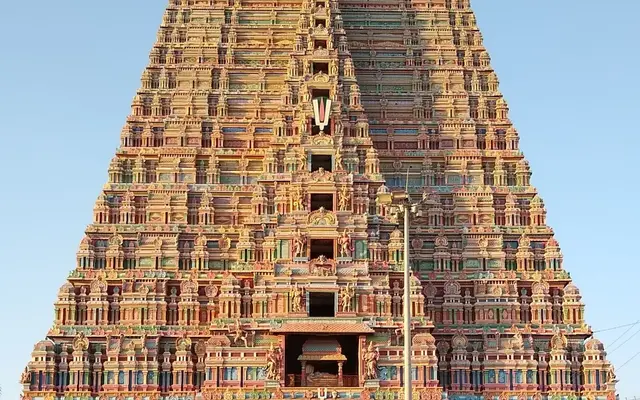
- Why a temple gopuram and a good slide deck are built the same way: the 1-arcminute limit of the eye, used as a design rule.
- A kolam is a line you can't lift your hand from, and so is a good logo: Euler's rule for drawings you never lift your hand from.
Questions people ask
Why don't we see our blind spot?
The brain fills it in from the surrounding pattern and from the other eye, which sees that region with a different part of its retina. A 2025 study found eye movements treat the filled-in region as if it were real image.
Why are shadows blue in photos?
Shade on a clear day is lit by blue skylight rather than direct sun. A camera usually sets one white balance for the whole frame, typically for the sunlit part, so the shade keeps its blue cast; your visual system corrects the shade separately.
What does auto white balance actually do?
It estimates the colour of the light and multiplies the red, green and blue channels by different gains so that a white or grey surface comes out neutral. This is the camera version of the von Kries adaptation the eye performs on its cone signals.
Does a camera have a blind spot?
Not one big one, but every pixel on a Bayer sensor is blind to two of the three colours, which are interpolated from neighbours, and faulty pixels are mapped out and filled in. The camera relies on interpolation more than the eye does.
Sources
- Wikipedia: Blind spot (vision) (source for position, 7.5° × 5.5° size and Mariotte's 1660s discovery)
- Baykan and Schütz: Eye movements do not preferentially test inferences in the blind spot, Scientific Reports (2025) (source for the gaze experiments)
- Morimoto, Sato, Sunaga and Uchikawa: Human color constancy in cast shadows, i-Perception (2025) (source for the sunlight and skylight chromaticities and constancy indices)
- Wikipedia: LMS color space (source for the Hunt–Pointer–Estévez matrix and its link to von Kries)
- Wikipedia: Color balance (source for von Kries diagonal scaling and RGB white balance gains)
- Wikipedia: Color constancy (source for von Kries 1902 and Land's retinex theory)
- Wikipedia: Bayer filter (source for the 1976 patent, the 50/25/25 layout and demosaicing artefacts)
- Wikipedia: Color temperature (source for 15,000–27,000 K clear sky and 6,500 K overcast)
- Abbatecola et al.: Protocol for investigating the warping of spatial experience across the blind spot, PLOS One (2026)

Sapta (Saptarshi Sarkar) is a mechanical engineer turned marketer in Bengaluru and a solo touring rider. He writes the seven Saptaverse blogs. Work with him or read more of Artblog.