
The samosa came to India from the Persian-speaking world. Its name goes back to the Middle Persian sambōsag, an Abbasid poet in Baghdad was already praising the sanbusaj in the ninth century, and Central Asian cooks brought it to the Delhi Sultanate by the thirteenth or fourteenth century. For about 300 years in India it was a court snack of minced meat, ghee, onion and nuts. The spiced potato filling that defines it today could only appear after the potato arrived in the seventeenth century, and became standard much later.
- 9th century: the Abbasid court musician Ishaq al-Mawsili praised the sanbusaj in Baghdad.
- c. 1300: Amir Khusrau records Delhi nobles eating samosas of meat, ghee and onion.
- 4 to 5 per diner: Ibn Battuta's count of nut-filled sambusak at a meal served in the sultan's style, 1330s.
- 10 : 4 sers of meat to flour in Akbar's sanbusa recipe, c. 1590.
- Potato is a 17th-century arrival, so the potato samosa is the young version of a 700-year-old dish.
- 4% vs 17.4% of samosa and jalebi frying oils broke India's trans-fat limit in a 2020 street study.
The samosa is one of the best-documented foods in Indian history, because almost every major court writer from 1300 to 1600 mentioned it. Read in order, those texts show a dish that changed its filling, its fat, its shape and its social class while keeping its name.
This post goes through the record source by source, compares the medieval recipe with today's, and looks at what the street version means for your oil.
Where does the word samosa come from?
The word comes from Persian. Etymologists trace samosa, the Arabic sambusak and the Central Asian samsa to the Middle Persian sambōsag, a triangular pastry.
Arabic cookbooks of the tenth to thirteenth centuries record it as sanbusak, sanbusaq and sanbusaj; the tenth-century Kitab al-Tabikh of Ibn Sayyar al-Warraq in Baghdad lists it. The earliest known praise of the dish is a poem by Ishaq al-Mawsili, the Abbasid court musician who died in 850.
The early Middle Eastern pastry was often baked rather than fried, and its fillings ranged from meat to cheese and even sweet mixtures. The Persian historian Abu'l-Fadl Bayhaqi (995 to 1077) mentions it in his Tarikh-i Bayhaqi.
In Bengal and eastern Nepal the same snack is called singara or shingara, after the water chestnut (water caltrop) whose horned, tetrahedral fruit it resembles.
When did the samosa reach India?
The samosa reached India with cooks from Central Asia and Iran who worked in the kitchens of the Delhi Sultanate, by the thirteenth or fourteenth century. Two court witnesses describe it within about 40 years of each other.
- Amir Khusrau, about 1300. The poet and courtier of the Delhi Sultanate (1253 to 1325) wrote that the nobility enjoyed a samosa made from meat, ghee and onion.
- Ibn Battuta, 1330s. The Moroccan traveller, who served Sultan Muhammad bin Tughluq in Delhi from 1334, described a meal served in the sultan's style in which a samushak or sambusak arrived before the rice: minced meat cooked with almonds, walnuts, pistachios, onions and spices, wrapped in thin bread and fried in ghee.
On the road to Delhi in the early 1330s, officials escorting a royal guest, Khudawandzada, brought about twenty cooks from Multan and served the travellers meals in the sultan's style. Ibn Battuta attended one and wrote down the running order. First came very thin breads, then roast mutton cut so that one sheep made four to six portions, then round breads soaked in ghee and topped with sweets, then meat cooked in ghee with onion and green ginger.
Then the sambusak: minced meat cooked with almonds, walnuts, pistachios, onion and spices, sealed in thin bread and fried in ghee. Every diner got four or five. Rice cooked in ghee and topped with a roast fowl followed. Before anyone ate, the chamberlain bowed towards the absent sultan and everyone copied him; then rose-scented sherbet came round in gold, silver and glass cups.
Ibn Battuta, The Rehla (India, Maldive Islands and Ceylon), trans. Mahdi Husain, Gaekwad's Oriental Series 122Both descriptions put the dish firmly in elite kitchens. Meat, ghee and three kinds of imported nuts were expensive; this was a banquet course, not a snack sold at a railway platform.

What did the Ni'matnama and the A'in-i Akbari say about samosas?
The two great Indian food texts of the period between 1495 and 1600 both give samosa recipes, and both use meat.
The Ni'matnama, Mandu, c. 1495 to 1505
The Ni'matnama, the "Book of Delights" made for Sultan Ghiyath Shah of Malwa (reigned 1469 to 1500) and his son Nasir Shah, survives in a single copy in the British Library with 50 miniature paintings.
It has recipes for several sambusas, with fillings of minced meat such as goat or venison, and paintings that show cooks frying them and arranging them on dishes.
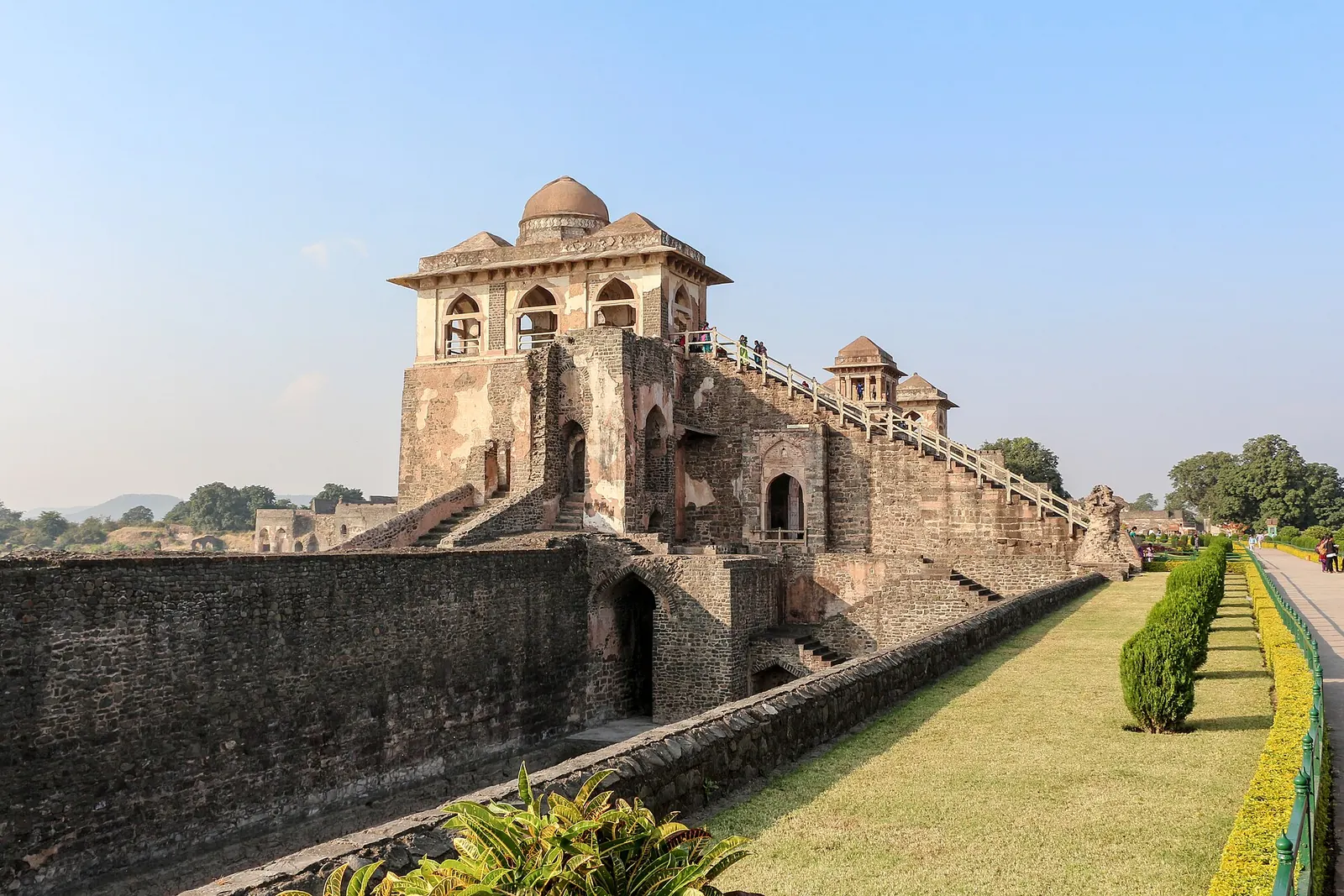
The A'in-i Akbari, Akbar's kitchen, c. 1590
About a century later, Abu'l Fazl's A'in-i Akbari recorded the dishes of Akbar's kitchen. In Book 1, A'in 24, he lists qutab, "which the people of Hind call sanbusa", and gives quantities. I have charted them below from H. Blochmann's translation.
The ratio is the striking part: two and a half times as much meat as flour, plus ghee, onion, ginger and sumac, and spiced with pepper, coriander, cardamom, cumin and cloves. Abu'l Fazl adds that it could be cooked in twenty different ways and that this batch made four full dishes.
See the data as a table
| Quantity (ser) | |
|---|---|
| Meat | 10 |
| Fine flour | 4 |
| Ghee | 2 |
| Onions | 1 |
| Salt | 0.5 |
| Fresh ginger | 0.25 |
| Sumac | 0.25 |
Source: Abu'l Fazl, A'in-i Akbari, Book 1, A'in 24, trans. H. Blochmann · Smaller amounts of pepper, coriander seed, cardamom, cumin and cloves are also listed. No potato and no chilli: neither was in Akbar's kitchen.
No potato and no chilli: the samosa of Akbar's kitchen was two and a half parts meat to one part flour.From the A'in-i Akbari recipe, c. 1590
A primary source rather than a study: the official account of Akbar's administration includes a chapter on the imperial kitchen with three classes of dishes (without meat, meat with rice, meat with spices) and ingredient lists in sers and dams. The sanbusa sits in the meat-and-rice class next to qabuli, qima pulao and shulla. The heat in every recipe comes from pepper and ginger. The limit: it lists quantities but not methods, and it records the emperor's table, not what ordinary people ate.
Read the text (free)| Date | Source | Name used | Filling | Cooked in |
|---|---|---|---|---|
| 9th century | Ishaq al-Mawsili, Baghdad | Sanbusaj | Not specified | Not specified |
| 10th century | Ibn Sayyar al-Warraq, Kitab al-Tabikh | Sanbusak | Various | Often baked |
| c. 1300 | Amir Khusrau, Delhi | Samosa | Meat, onion | Ghee |
| 1330s | Ibn Battuta, Delhi court | Samushak | Minced meat, almonds, walnuts, pistachios, onion, spices | Fried in ghee |
| c. 1495-1505 | Ni'matnama, Mandu | Sambusa | Minced goat or venison | Fried |
| c. 1590 | A'in-i Akbari, Akbar's court | Qutab / sanbusa | Meat, onion, ginger, sumac | Ghee |
| 20th century | Street and railway vendors | Samosa, singara | Potato, peas, chilli | Vegetable oil or vanaspati |
When did potatoes go into samosas?
No document records the first potato samosa, but it cannot be older than the potato in India, and the potato was still a rarity in the early seventeenth century.
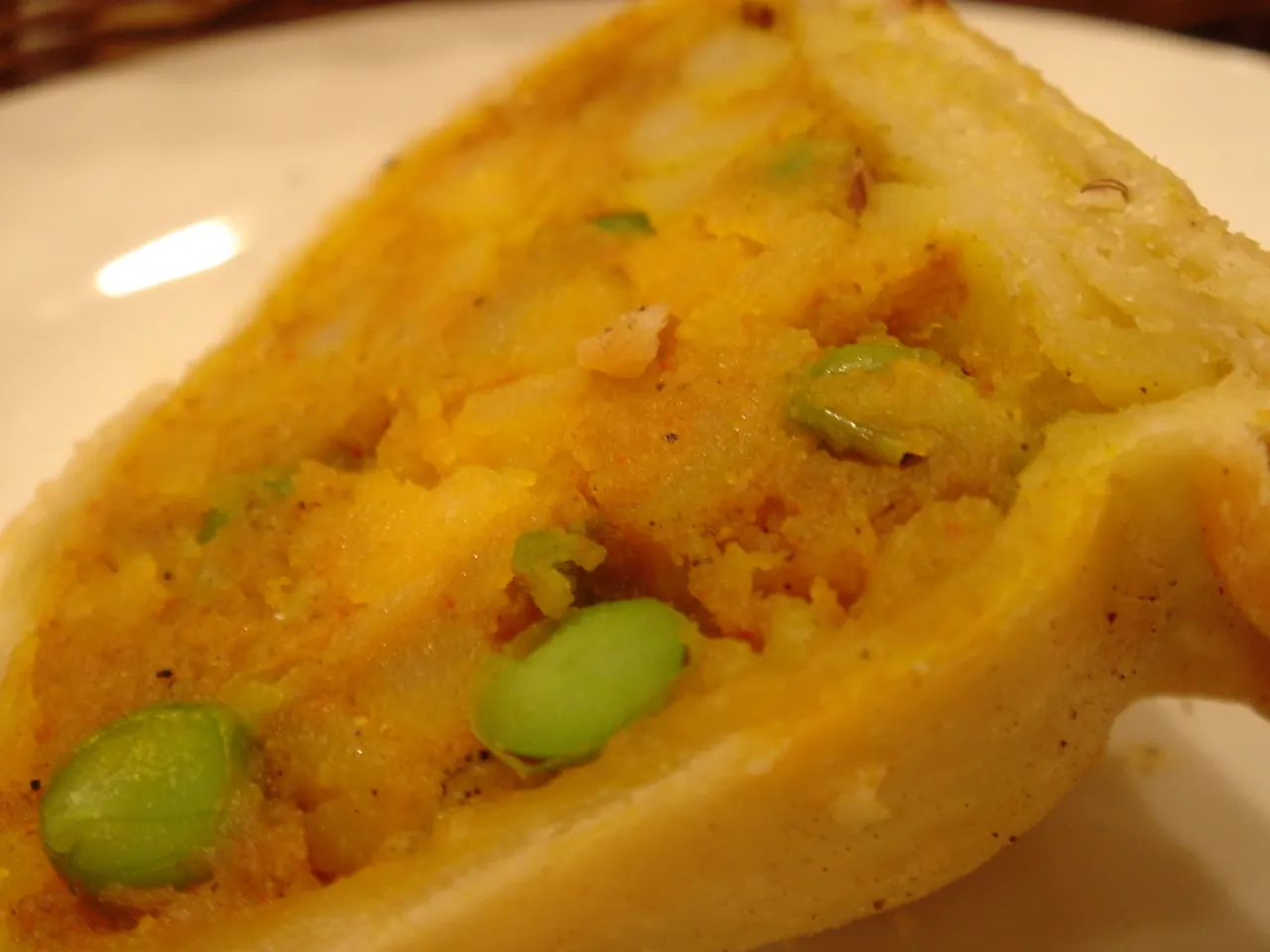
The first potatoes on Indian record
- Edward Terry, 1616 to 1619. The chaplain to the English ambassador Sir Thomas Roe, describing a banquet Asaf Khan gave for Roe at the Mughal court, lists among the dishes "potatoes excellently well dressed".
- John Fryer, 1670s. He saw potatoes in gardens at Surat and in the Karnataka region.
- The caution. Both may in part mean sweet potato, the usual problem with these early accounts.
Why the potato took over the filling
The potato spread as a field crop only in the nineteenth century, pushed by the British for their own tables and by hill-station farming (see how potatoes and tomatoes took over).
The potato samosa makes sense in that world. Potatoes were cheap, kept well, and turned a meat dish for nobles into a vegetarian snack that anyone could sell and anyone could eat, including the large share of Indians who avoid meat. Chillies and peas followed the same path.
The modern Punjabi samosa, with its cone shape and loose potato-pea filling, is therefore a fairly recent creation layered onto a 700-year-old name.
| Feature | Court sanbusa (1330s to 1590) | Street samosa (20th century on) |
|---|---|---|
| Main filling | Minced meat, onion, nuts | Potato, peas |
| Heat from | Pepper, ginger | Green chilli, red chilli |
| Frying fat | Ghee | Vegetable oil or vanaspati |
| Who ate it | Sultans, nobles, their guests | Anyone at a stall, station or canteen |
| Main sources | Ibn Battuta, Ni'matnama, A'in-i Akbari | Vendors; Swiggy order data (2025) |
A document analysis of scriptures, travelogues and histories that traces Indian cooking from the Vedic period through the Sultanate, Mughal, Portuguese and British eras. It notes that the Ni'matnama gives recipes for a variety of sambusas with a refined-flour pastry and a venison filling, lists the sambusa among the dishes that show Central Asian influence, and argues that chillies, tomatoes and potatoes reached Indian kitchens only in the late seventeenth or early eighteenth century. The limit: it is a broad secondary review, and some of its claims, such as mirchi ka salan in Mughal kitchens, sit awkwardly with its own dating of the chilli.
Read the paper (free)
Is the street samosa bad for you?
The main risk is not the samosa but the oil. Deep-frying the same oil for hours breaks down its fats and can create trans fats, which raise heart risk.
A 2020 study by R. Kumar and colleagues sampled frying oil from five Indian street vendors at the start of frying and after two and four hours, 143 samples in all, and measured trans fatty acids by infrared spectroscopy. Trans-fat levels rose with frying time and were significantly higher at four hours.
Three of 74 samosa oil samples (4 per cent) were above India's 5 per cent legal limit, against 12 of 69 jalebi oil samples (17.4 per cent) (Kumar et al., 2020).
See the data as a table
| Share of samples over limit (%) | |
|---|---|
| Samosa oil (n=74) | 4 |
| Jalebi oil (n=69) | 17.4 |
Source: Kumar et al., Journal of Food Quality and Hazards Control 7(2), 2020
143 oil samples were taken from five vendors frying samosas (74) and jalebis (69), at 0, 2 and 4 hours. The trans-fat infrared peak at 966 cm⁻¹ rose with frying time in both oils, peroxide values fell and saturated fats rose. 4 per cent of samosa oils and 17.4 per cent of jalebi oils exceeded the 5 per cent regulatory limit. The limit: five vendors is a very small sample, and infrared screening is less precise than gas chromatography, so the numbers show a direction rather than a national rate.
Read the paper (free)Why is the samosa everywhere in India?
The samosa won because it suits the way India snacks on the move:
- Cheap and filling: potato and flour cost little and keep a worker going until dinner.
- Portable: the pastry is a sealed pouch, so it travels without a plate, and the fried crust protects the filling.
- Keeps for hours at room temperature, which suits railway platforms, tea stalls and office canteens.
Swiggy counted 3.42 million samosa orders in the 3 to 7 pm snack slot between January and November 2025, next to 2.9 million orders of adrak chai (Swiggy, How India Swiggy'd 2025). That counts only app orders, not the samosas bought at street stalls.
It sits beside chai in North India the way vada and bajji do in the South, and it is a staple of the namkeen business that firms like Haldiram's built (see the Haldiram's story). In Bengaluru it competes with the idli and vada of the darshini fast-food model.
The dish also stayed alive outside India: Central Asian samsa and Arab sambusak are its cousins, descended from the same Persian pastry. The Indian potato version is the one that conquered the world's Indian restaurants, which is ironic given how late the potato arrived.
What's new
The samosa's filling depends on two American crops; the full story of how they arrived is in how the chilli reached India and the potato and tomato history. For the biggest snack firm built on fried namkeen, see the Haldiram's story, and for more from this world, the Rasa page.
Questions people ask
Is the samosa Indian?
Not originally. The dish and its name came from the Persian and Arab world through Central Asia, and arrived with Sultanate cooks around the thirteenth or fourteenth century. The potato version is an Indian creation, and India made the samosa a mass street food.
What was in the samosa before potatoes?
Minced meat, mostly. Amir Khusrau mentions meat, ghee and onion; Ibn Battuta adds almonds, walnuts and pistachios; the A'in-i Akbari recipe uses 10 sers of meat to 4 of flour with ginger, onion and sumac.
Who first wrote about the samosa in India?
Amir Khusrau, around 1300, is the earliest Indian reference usually cited, followed by Ibn Battuta's account of a meal served in the Delhi sultan's style in the 1330s.
Why is it called singara in Bengal?
Singara is the Bengali name for the water chestnut (water caltrop), a horned, pyramid-shaped fruit, and the snack is named after its shape.
Are samosas fried or baked originally?
Early Middle Eastern versions were often baked, and Central Asian samsa still is. Indian court versions were fried in ghee by the 1330s, and today's street samosas are fried in vegetable oil.
Sources
- Abu'l Fazl: A'in-i Akbari, Book 1, A'in 24, trans. H. Blochmann (sanbusa recipe) (c. 1590; trans. 1927)
- Ibn Battuta: The Rehla (India, Maldive Islands and Ceylon), trans. Mahdi Husain, Gaekwad's Oriental Series 122 (1953; order of the meal and the sambusak, source for the story)
- Antani, V. and Mahapatra, S.: Evolution of Indian cuisine: a socio-historical review, Journal of Ethnic Foods (2022)
- Kumar, R. et al.: Trans fatty acid analysis of frying oil using ATR-FTIR spectroscopy, Journal of Food Quality and Hazards Control (2020)
- Terry, E.: A Voyage to East-India (1655; 1777 reprint), banquet of Asaf Khan for Sir Thomas Roe
- Watt, G.: The Commercial Products of India, entry on the potato (Terry and Fryer references) (1908)
- Biswas, N.: The Ni'matnama, AramcoWorld (Nov 2025)
- Wikipedia: Samosa (etymology, Ishaq al-Mawsili, al-Warraq, Bayhaqi, Amir Khusrau, Ibn Battuta)
- The Tribune: Warning labels for samosas, jalebis? Health ministry says claim misleading (Jul 2025)
- Swiggy: How India Swiggy'd 2025 (samosa and chai orders, Jan to Nov 2025) (Dec 2025)

Sapta (Saptarshi Sarkar) is a mechanical engineer turned marketer in Bengaluru and a solo touring rider. He writes the seven Saptaverse blogs. Work with him or read more of Foodblog.


