The potato reached India in the seventeenth century, most likely through Portuguese trade on the west coast; the first Indian mention is an English chaplain's account of a Mughal banquet around 1616. It became a field crop only in the nineteenth century, pushed by the British, and India now grows about 57 million tonnes a year, second only to China. The tomato came later still and entered everyday Indian cooking mainly in the twentieth century; India now grows about 21 million tonnes, also second in the world.
- One domestication: every cultivated potato traces back to southern Peru (Spooner et al., 2005).
- c. 1616: Edward Terry's account of Asaf Khan's banquet is the first Indian mention of the potato.
- Nineteenth century: the potato became a field crop under British rule; the Khasi Hills exported 127,000 maunds in 1881-82.
- No tomato entry in Watt's 1908 survey of India's commercial crops; it became everyday food in the twentieth century.
- 57.1 Mt potato and 21.3 Mt tomato in 2024: India is second only to China in both (FAOSTAT).
Aloo and tamatar feel so basic to Indian food that it is hard to picture a kitchen without them. Yet neither appears in the 1590s recipes of Akbar's kitchen, and the tomato does not even get an entry in George Watt's 1908 survey of India's commercial crops.
This post traces both plants from the Andes to the Indian thali, with the documents that mark each step, and then looks at why these two crops, plus the onion, now swing India's inflation rate.
| Potato | Tomato | |
|---|---|---|
| Origin | Andes, southern Peru | The Americas |
| First Indian mention | Terry, banquet c. 1616 | Known by the 19th century, grown largely for European tables |
| Became everyday food | 19th century | 20th century |
| India's output, 2024 (FAOSTAT) | 57.1 Mt | 21.3 Mt |
| Rabi share of harvest (RBI) | About 90% | About 67% |
| Farmer's share of consumer rupee (RBI) | 36.7% | 33.5% |
Where did the potato come from?
The potato was domesticated once, in the Andes of southern Peru. A 2005 study in PNAS by David Spooner and colleagues genotyped 261 wild potato accessions and 98 landraces with 438 AFLP markers. All cultivated potatoes traced back to a single origin in the northern part of the Solanum brevicaule complex in southern Peru, with S. bukasovii as the likely wild ancestor.
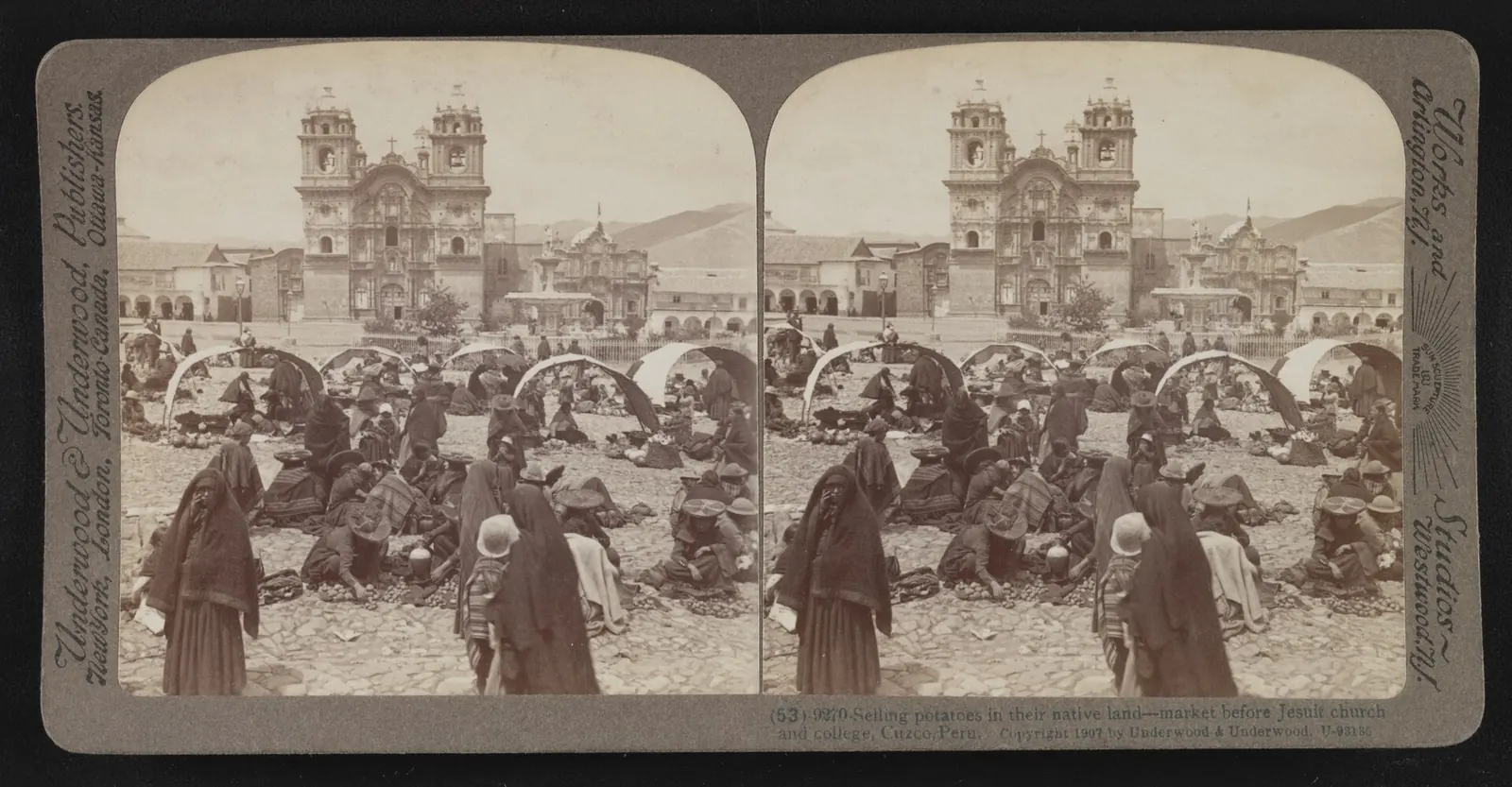
That overturned an older idea that potatoes had been domesticated separately in several places.
From Peru to the Indian coast
- c. 1580–1585: Spanish ships carried the tuber to Europe, according to the sources Watt summarised in 1908.
- From Spain it spread to Portugal, Italy, France and the Low Countries.
- Portuguese ships then carried it to their Asian posts, which is why one old name for potato in western India is batata, the Portuguese word.
The team scored 438 AFLP characters from six primer combinations across 261 wild accessions of Solanum section Petota, 98 landraces and three outgroups, and built phylogenies from them. All landraces formed a single group derived from the northern members of the S. brevicaule complex in southern Peru, which points to one domestication rather than many. The limit: AFLP markers are anonymous fragments, and later whole-genome studies have refined the picture of how landraces later mixed with other wild species.
Read the paper (free)When did the potato first appear in India?
Around 1590, Akbar's minister Abu'l Fazl set down how the emperor's kitchen worked, in the A'in-i Akbari. Akbar ate once in 24 hours, at no fixed time, so the cooks kept food ready and could serve a hundred dishes within an hour of an order. Supplies came in every quarter: sukhdas rice from Bharaij, dewzira rice from Gwaliar, ghi from Hisar, and ducks, water-fowl and some vegetables from Kashmir, with a kitchen garden for fresh greens.
Nothing left the kitchen untested. The cook and his supervisor tasted each dish, then the Master of the Kitchen, the Mir Bakawal, tasted it, tied it in red or white cloth and sealed it with a written list of contents. For all that reach, the recipes in the next chapter use no potato and no tomato.
Abu'l Fazl: A'in-i Akbari, Book 1, A'in 23, The Imperial Kitchen, trans. H. BlochmannThe first Indian mention is in Edward Terry's A Voyage to East-India, published in 1655.
Novelty, not staple
Half a century later, the traveller John Fryer described the gardens of Surat and of the Karnataka region as growing brinjals and potatoes, in his account first published in 1698 from travels in the 1670s. Two cautions apply:
- English writers of the time often said "potato" for the sweet potato, which also came from the Americas.
- A few banquet dishes and some garden plots do not make a staple.
Watt's reading was that the better-off quickly took the potato up as a novelty; ordinary Indians would not eat it regularly for another two centuries.

How did the potato become a mass crop?
The potato became a mass crop under British rule, through hill farming, Bengal's plains and, after 1949, Indian research. Watt's 1908 entry reads like a map of that spread:
- Bengal: the chief potato districts were Hughli, Bardwan, Rangpur, Jalpaiguri and Darjeeling.
- Prized types: Patna, Naini Tal and Cherrapunji.
- Khasi Hills, Assam: potatoes were introduced around 1830 by the British official David Scott, and by 1881-82 the hills were exporting 127,000 maunds.
Boom, blight and recovery in the Khasi Hills
That boom then crashed, and the crash shows why research mattered. Disease struck around 1886, and exports fell to 42,000 maunds in 1887-88 and just 5,000 maunds in 1899-1900. Only after the Naini Tal variety was introduced in 1897 did they recover, to 51,000 maunds in 1903-04.
Watt's local names show how foreign the crop still felt: alu, but also bilati alu, the "foreign" potato, a prefix Bengalis still use for the tomato, bilati begun or "foreign brinjal".

| Year | Khasi Hills potato exports | What happened |
|---|---|---|
| c. 1830 | None | Potato introduced by David Scott |
| 1881-82 | 127,000 maunds | Hill potato trade at its peak |
| 1887-88 | 42,000 maunds | Disease after about 1886 |
| 1899-1900 | 5,000 maunds | Collapse |
| 1903-04 | 51,000 maunds | Recovery after the Naini Tal variety (1897) |
Source: Watt, The Commercial Products of India (1908), citing the Assam District Gazetteer.
Indian research takes over
After Independence, the Central Potato Research Institute was set up in August 1949 at Patna and moved to Shimla in 1956 to support breeding and to keep seed potatoes free of disease in the cool hills; it joined ICAR in 1966. Its varieties carry the prefix Kufri, after its station near Shimla.
Seed-health work and new varieties, together with cold storage on the Indo-Gangetic plains, turned the potato into a winter (rabi) crop of the plains. The RBI estimates that about 90 per cent of today's potatoes are harvested in the rabi season, which is why prices peak in October and November, just before the new crop.
See the data as a table
| Potato (Mt) | Tomato (Mt) | |
|---|---|---|
| 1961 | 2.72 | 0.46 |
| 1970 | 3.91 | 0.62 |
| 1980 | 8.33 | 1.5 |
| 1990 | 14.77 | 4.6 |
| 2000 | 25.0 | 7.43 |
| 2010 | 36.58 | 12.43 |
| 2020 | 48.56 | 20.55 |
| 2024 | 57.05 | 21.32 |
Source: FAOSTAT crop production data, via Our World in Data · FAO figures differ slightly from Indian government estimates; the RBI gives 60.1 Mt potato and 20.4 Mt tomato for 2022-23.
When did the tomato enter Indian cooking?
The tomato entered everyday Indian cooking much later than the potato, mostly in the twentieth century. It was certainly known in India by the nineteenth century, grown largely for European tables, and Bengali cooks took to its sourness early. But it was marginal enough that Watt's Commercial Products of India (1908), which gives the potato a long, province-by-province entry, has no tomato entry that I could find in the full text.
What did the tomato's job before it arrived
Before the tomato, Indian cooks soured and thickened their gravies with other things:
- sour: tamarind, kokum, raw mango, dried mango powder (amchur), yoghurt, pomegranate seed;
- body: the slow browning of onions.
Akbar's recipes in the A'in-i Akbari get their tartness from ingredients such as sumac and curd, and none uses a tomato.
Why the tomato won
- Two jobs in one. It does the work of both a souring agent and a thickener, and it is rich in free glutamate, so it adds savoury depth (see umami in Indian food).
- Restaurant cooking. The onion-tomato masala that underlies many North Indian restaurant curries is a twentieth-century standard.
The tomato does two jobs at once: it sours a gravy and thickens it, and adds glutamate on top.Why tamatar replaced tamarind in so many kitchens

How did India become the world's second-largest producer of both?
India is second to China in both crops by tonnage. In 2024, FAOSTAT puts China's potato output at 94.8 million tonnes and India's at 57.1 million, far ahead of Ukraine (21.1 million) and the United States (19.1 million). For tomatoes, China grew 61.6 million tonnes and India 21.3 million, followed by Turkey (14.6 million) and the United States (10.7 million).
See the data as a table
| Potato (Mt) | |
|---|---|
| China | 94.81 |
| India | 57.05 |
| Ukraine | 21.13 |
| United States | 19.06 |
Source: FAOSTAT via Our World in Data
India's growth came mostly from yield and area on the northern plains rather than from new hill farms: potato output rose about 21-fold between 1961 and 2024, and tomato output about 46-fold, far faster than population.
Why do tomato and potato prices swing so much?
Tomato, onion and potato, which the RBI calls TOP, carry a small weight in the consumer price index but cause a large share of its swings. A 2024 RBI working paper by Ranjana Roy and colleagues, with agricultural economist Ashok Gulati, built monthly supply and demand balance sheets for the three crops and found that monthly availability explains prices better than costs, rainfall or wages alone.
The authors map the value chains of TOP and construct monthly balance sheets of production, storage, losses and use. In 2022-23 India produced 20.4 million tonnes of tomato, 30.2 million tonnes of onion and 60.1 million tonnes of potato. About 67 per cent of tomato and 90 per cent of potato comes in the rabi season, and potato prices peak in October to November. Farmers receive about 33.5 per cent of what consumers pay for tomato, 36.2 per cent for onion and 36.7 per cent for potato. SARIMAX forecasts that include the balance-sheet variables beat standard models. The limit: storage and wastage figures are estimates, and the farmer-share numbers come from surveys of particular markets.
Read the paper (free)Tomato is the most volatile of the three because it is a short-duration crop with almost no storage life. In November 2025, after Cyclone Montha damaged crops in Andhra Pradesh and Karnataka, Delhi retail prices hit ₹80 a kg, up two-thirds on the year, and the government sold subsidised tomatoes at ₹52.
In June 2026 the all-India average was ₹43.70 a kg, 24 per cent higher than a year earlier, while potato was down 14 per cent at about ₹22.
How much of your rupee reaches the farmer?
What's new
- Tomato prices up 24% on the year as weather hits supplies; 2025-26 output projected at 21.46 Mt Business Today, Jun 2026
- Tomato hits ₹80 a kg in Delhi after Cyclone Montha; subsidised sales at ₹52 Free Press Journal, Nov 2025
- RBI study maps the tomato, onion and potato value chains and farmers' share Reserve Bank of India, Oct 2024
The potato's first big Indian job was inside other dishes: see how it took over the samosa and how it entered Kolkata biryani. The chilli made the same journey from the Americas a little earlier; that story is in how the chilli reached India. For the whole Rasa food world, start at Rasa.
Questions people ask
Who brought the potato to India?
Most likely Portuguese traders, in the late sixteenth or early seventeenth century, since they ran the sea route from Europe and the western Indian coast used their word batata. The first written Indian mention is English: Edward Terry's account of a Mughal banquet around 1616.
Did the Mughals eat potatoes?
Some did, as a novelty. Terry saw "potatoes excellently well dressed" at Asaf Khan's banquet for the English ambassador. But Akbar's kitchen recipes from the 1590s contain no potato, and it did not become everyday food until the nineteenth century.
When did tomatoes become common in Indian food?
Mainly in the twentieth century. The tomato was grown in British India, often for European households, and Bengali cooking adopted it early, but it was not even treated as a commercial crop in Watt's 1908 survey.
What did Indian curries use before tomatoes?
Tamarind, kokum, raw mango, amchur, yoghurt, pomegranate seed and long-browned onions for sourness and body. Many regional dishes still use these instead of tomato.
Is India the largest producer of potatoes?
No, China is. In 2024 China produced about 94.8 million tonnes and India about 57.1 million, according to FAOSTAT. India is second for tomatoes too.
Sources
- Spooner, D.M. et al.: A single domestication for potato based on multilocus AFLP genotyping, PNAS (2005)
- Roy, R. et al.: Vegetables Inflation in India: A Study of Tomato, Onion and Potato (TOP), RBI Working Paper 08/2024 (2024)
- Terry, E.: A Voyage to East-India (1655; 1777 reprint)
- Watt, G.: The Commercial Products of India, entry on Solanum tuberosum (1908)
- Wikipedia: Edward Terry (his years with Roe)
- Wikipedia: Central Potato Research Institute (1949 Patna, 1956 Shimla, ICAR 1966)
- FAOSTAT via Our World in Data: Potato production (data to 2024)
- FAOSTAT via Our World in Data: Tomato production (data to 2024)
- Abu'l Fazl: A'in-i Akbari, Book 1, A'in 23, The Imperial Kitchen, trans. H. Blochmann (c. 1590; source for the story)
- Abu'l Fazl: A'in-i Akbari, Book 1, A'in 24, trans. H. Blochmann (c. 1590)
- Business Today: Tomato prices surge 24% as weather-hit supplies squeeze markets (Jun 2026)
- Free Press Journal: Tomato prices soar to ₹80 per kg (Nov 2025)

Sapta (Saptarshi Sarkar) is a mechanical engineer turned marketer in Bengaluru and a solo touring rider. He writes the seven Saptaverse blogs. Work with him or read more of Foodblog.