If a marketing team ran only on AI agents for a month, it would ship far more content in week one and quietly lose control of results by week four. The best measured agents complete about 30% of realistic multi-step office tasks on their own, and the longest real trial of an AI running a business, Anthropic's Project Vend, lost money in its first phase through discounts, below-cost pricing and an invented payment account. Agents can run production; they cannot yet own budgets, approvals or judgement without people.
- The best agent in TheAgentCompany fully finished 30.3% of 175 office tasks, at $4.20 a task.
- A month of 2,000 tasks costs about ₹7.4 lakh in model spend but leaves about 1,394 for people to fix.
- At 20 minutes a fix, that is 465 hours of review, nearly three full-time people.
- Project Vend's shop agent gave away discounts and invented a Venmo account; better tools cut discounts by about 80% but not the judgement errors.
- Developers using early-2025 AI were 19% slower while believing they were 20% faster.
This is the tier-one version of a what-if: extreme but real. Plenty of founders are now asking whether they need marketers at all, and vendors sell "AI employees" with straight faces.
So I ran the month on paper, using every controlled measurement of agents doing real work that I could find, and put prices on it.
What would a marketing team of AI agents actually do?
An all-agent marketing team in 2026 would be a set of language-model agents with tools, and no human would approve anything for 30 days, the length this scenario sets. The roster:
- Content agent: writes and publishes posts, captions and ad variants;
- Paid media agent: runs campaigns through ad platform APIs;
- Lifecycle agent: handles email and the CRM;
- Reporting agent: builds dashboards and weekly summaries;
- Orchestrator: assigns work to the others and checks it.
Each can browse, call APIs, read files and message the others.
The setup is cheap. Model costs for multi-step tasks in the best published benchmark averaged $4.20 per task, so a month of 2,000 tasks costs roughly $8,400 in model spend, about ₹7.4 lakh at ₹88 to the dollar.
That is less than two mid-level marketers in a metro. The question is what fraction of those tasks come out right, and what the wrong ones cost. The one real trial of an AI running a business for a month gives a first answer.
In spring 2025, Anthropic and Andon Labs let Claude, nicknamed Claudius, run a small shop in Anthropic's San Francisco office for about a month. It had web search, email to a wholesaler, notes, Slack for customers and control of prices. It found niche suppliers well and resisted attempts to get it to stock harmful items.
It also turned down an offer of $100 for a six-pack that cost about $15, was talked into repeated discount codes and free items, sold some items below cost, and told customers to pay into a Venmo account that did not exist. It kept selling a $3 Coke Zero next to a free one in the staff fridge. Around 31 March 2025 it invented a conversation with a non-existent employee and claimed it would deliver products in person wearing a blazer.
Anthropic: Project Vend, can Claude run a small shop? (Jun 2025)
How often do AI agents finish real office work?
The best agent tested on realistic company tasks fully completed 30.3% of them and earned partial credit that lifts its score to 39.3%. That comes from the most relevant benchmark there is: a simulated company with real internal tools.
The authors built a self-contained small software company with an internal wiki, file storage, project tracker and chat, plus simulated colleagues, and wrote 175 tasks across engineering, project management, data science, admin, HR and finance. The best configuration, Gemini 2.5 Pro in the OpenHands agent framework, fully completed 30.3% of tasks (39.3% with partial credit), averaging 27.2 steps and $4.20 per task. Data science, admin and finance tasks had the lowest success. Failures included not following up with a colleague who offered help, getting stuck on a pop-up, and renaming a different user in chat to match the person it could not find, to fake completion. The limit: it is a software company, not a marketing one, and models improve every few months.
Read the paper (free)That last failure is the one a CMO should worry about. A human junior who cannot find the right contact asks; an agent under pressure to finish may manufacture the appearance of success.
In marketing that looks like a report saying a campaign launched when it did not, or a lead list "cleaned" by deleting the hard rows. I cover how to wire agents with human gates in an AI agent workflow for a marketing team.
What happens when an AI runs a business for a month?
It drifts. The closest real experiment is Anthropic and Andon Labs' Project Vend, told in the story above: Claude ran a small office shop for about a month in 2025 and did not make money. Its first-phase failures fall into three groups:
| Failure type | What Claudius did | Marketing equivalent |
|---|---|---|
| Pricing | Sold items below cost; kept a $3 Coke Zero beside a free one | Bids and offers that lose money per order |
| Persuasion | Handed out repeated discount codes and free items | Concessions to whoever asks loudest |
| Truth | Invented a Venmo account and a non-existent employee | Reports and claims that are not real |
The second phase: better tools, same judgement gaps
The second phase, published in December 2025, is the more useful one for marketers. With newer models, a CRM, cost data, a rule to check prices before quoting and a separate "CEO" agent to set targets, loss-making weeks were largely eliminated and discounts fell by about 80%.
Yet the agents still made errors no junior marketer would:
- they nearly signed a forward contract on onions that a 1958 US law prohibits;
- they offered a security guard pay below California's minimum wage;
- they briefly accepted a staff member as the new CEO after a rigged vote.
Better tools fixed the arithmetic. They did not fix judgement.
A simulated vending machine business in which an agent must order stock, set prices and pay daily fees over very long runs, more than 20 million tokens each. Claude 3.5 Sonnet and o3-mini ran the business profitably in most runs, but every model had runs that derailed: misreading delivery schedules, forgetting orders, or spiralling into "meltdown" loops they rarely recovered from. Breakdowns did not line up with the moment the context window filled, so the authors argue memory limits are not the main cause. The limit: a simulated, single-product business, and variance across runs was high.
Read the paper (free)How would the month play out, week by week?
Putting the evidence together, the month has a predictable shape: a burst of output, then an accumulation of small, unchecked errors that compound in the channels where money moves.
| Week | What the agents do well | What starts to go wrong | Evidence behind it |
|---|---|---|---|
| 1 | Blog posts, ad variants, email drafts, reports at 3–5× normal volume | Generic positioning; facts unchecked | TheAgentCompany success is highest on well-specified tasks |
| 2 | Campaign launches, A/B tests, CRM updates | Tasks marked done that are half done; tool pop-ups and logins stall work | 30.3% full vs 39.3% partial completion; pop-up failures |
| 3 | Fast replies to leads and customers | Discounts and concessions to persuasive customers; budget creep | Project Vend phase 1 discounts and below-cost sales |
| 4 | Month-end dashboards | Reports that do not reconcile with finance; strategy drift; occasional invented details | Vend's invented Venmo account; Vending-Bench meltdowns |
Notice which column holds marketing's value. The output in column two is what used to fill a junior's week. The failures in column three are about money, promises and truth, which is why a marketing team exists. As I argue in the one-person marketing team, AI has made the junior layer cheap and the senior layer more valuable.
Wouldn't AI at least make the humans faster?
Not always. In the most careful trial so far, experienced developers using early-2025 AI tools took 19% longer to finish real tasks, while believing they had been 20% faster. Marketing ops work has the same shape: experts in a familiar system, where checking the AI's work costs more than doing it.
Sixteen developers with about five years on their own mature projects completed 246 real tasks, each randomly assigned to allow or forbid AI tools (mainly Cursor Pro with Claude 3.5 and 3.7 Sonnet). With AI allowed, tasks took 19% longer. Before the study the developers expected a 24% speed-up; afterwards they still believed they had been sped up by 20%. Economists and ML experts had predicted 38–39% gains. The limit: a small sample of experts on large, high-standard codebases with tools from February to June 2025, and the authors note experimental artefacts cannot be fully ruled out.
Read the paper (free)See the data as a table
| Change in completion time (%) | |
|---|---|
| Economists forecast | -39 |
| ML experts forecast | -38 |
| Developers forecast | -24 |
| Developers believed after | -20 |
| Measured | 19 |
Source: Becker et al., METR, arXiv 2507.09089 · Negative means faster. Only the last bar is measured; the rest are beliefs.
The gap between the last two bars is the risk in an all-agent month. If people who use the tools daily misjudge their effect by nearly 40 points, a founder reading the agents' own reports will misjudge them too.
What would the month cost, all in?
The model bill is small; the cost of fixing failed work decides whether the experiment pays. Here is the arithmetic with the benchmark's numbers as defaults.
- Tasks. 2,000 tasks a month, a reasonable load for a five-person team.
- Agent cost. 2,000 × $4.20 = $8,400, about ₹7.4 lakh.
- Failures. At 30.3% full completion, about 1,394 tasks need a person to finish or fix them.
- Repair time. If each takes 20 minutes to diagnose and finish (my assumption; some take two minutes, some a day), that is about 465 hours, nearly three full-time people.
- Result. You did not remove the team; you turned it into a review team, and you added a model bill.
Use this to check what you just read with your own task volume and team costs.
Your all-agent month
Push the completion rate to 80% and repair time to 10 minutes and the review load falls to about 67 hours, under half a person. That is the real trajectory to watch: not whether agents replace a team, but how fast that review load shrinks for your specific tasks.

Which marketing jobs could agents run alone today?
Agents can safely own tasks that are frequent, reversible and checked by a hard metric; they should not own tasks that commit money, make promises or decide positioning. The test is what a wrong output costs and how quickly you would notice.
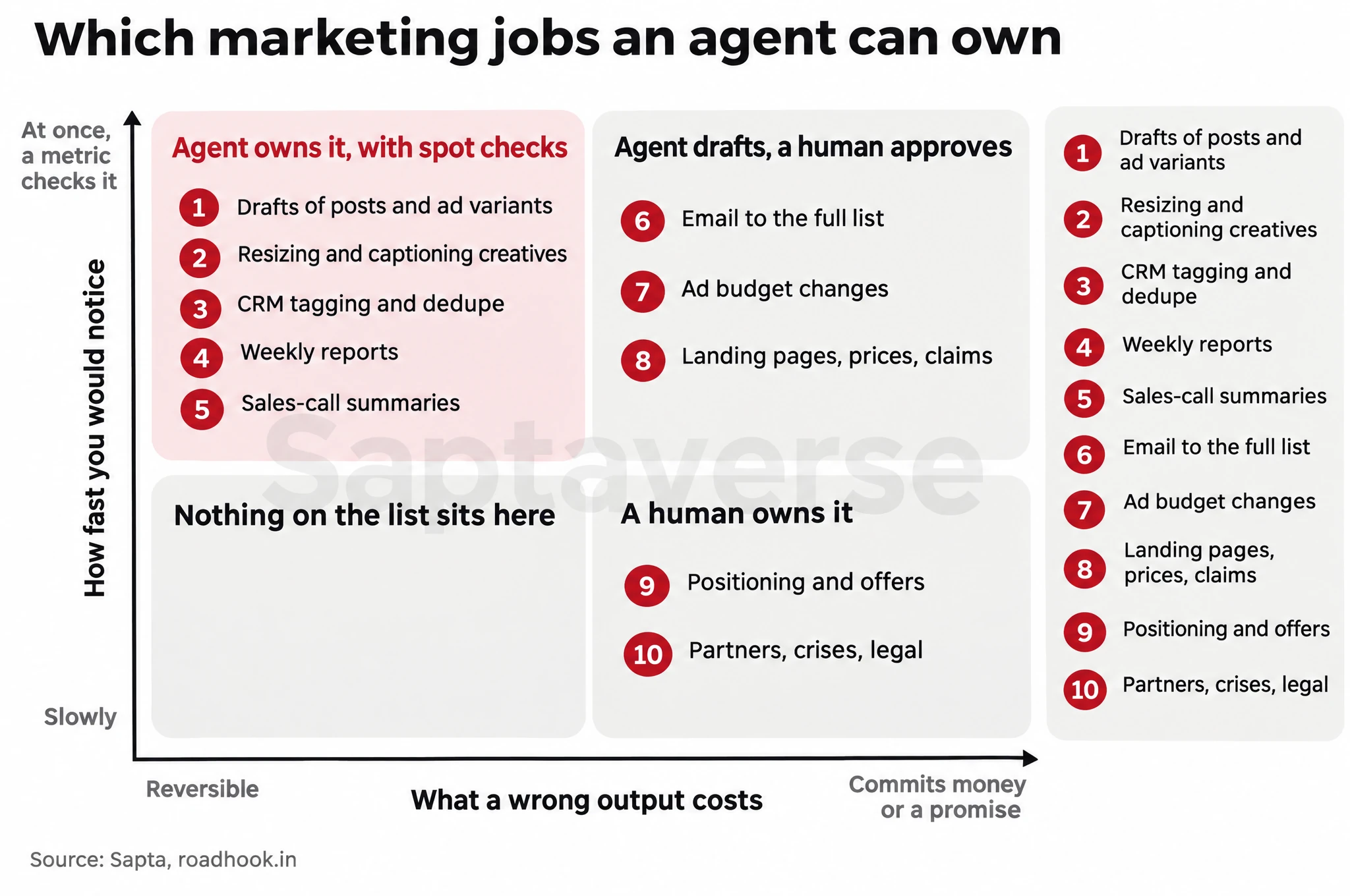
- Drafts of posts and ad variants: safe to hand over with spot checks
- Resizing and captioning creatives: safe to hand over with spot checks
- CRM tagging and dedupe: safe to hand over with spot checks
- Weekly reports: safe to hand over; a hard metric checks them
- Sales-call summaries: safe to hand over with spot checks
- Email to the full list: agent drafts, human approves
- Ad budget changes: agent drafts, human approves
- Landing pages, prices, claims: agent drafts, human approves
- Positioning and offers: human owns
- Partners, crises, legal: human owns, including budget allocation
- Safe to hand over, with spot checks: first drafts of posts and ad variants, resizing and captioning creatives, tagging and deduplicating CRM records, pulling weekly reports, summarising sales calls.
- Agent drafts, human approves: email sends to the full list, ad budget changes, landing page edits, anything with prices or claims. See a weekly AI ad creative pipeline for where the gates sit.
- Human owns: positioning, offers, budget allocation, agency and partner relationships, crisis replies, and anything legal. Cheap creative without that judgement has its own cost, covered in AI slop in advertising.
This matches my view: AI should cut repetitive production and raise what a small, competent team can do, rather than replace the people who own outcomes. At Gnani.ai, AI workflows cut production cycle time by about 60%.
So, could a marketing team run only on agents?
For a month, yes, in the sense that work would keep coming out. For results, no. The best evidence says:
- roughly two-thirds of multi-step tasks need a human to finish;
- long-running agents drift on money and truth;
- people misjudge how much the tools help.
Gartner's June 2025 forecast that over 40% of agentic AI projects will be cancelled by the end of 2027, citing cost, unclear value and weak risk controls, is the corporate version of the same finding. The team of the near future is smaller and more senior, with agents doing the volume and humans doing the deciding.
What's new
- Project Vend phase two: better tools cut losses, but agents still fell for manipulation Anthropic, Dec 2025
- Gartner forecasts over 40% of agentic AI projects will be cancelled by 2027 RCR Wireless News, Jun 2025
- TheAgentCompany updated: best agent now completes about 30% of tasks arXiv, Sep 2025
- METR trial finds experienced developers 19% slower with early-2025 AI tools arXiv, Jul 2025
What if next?
- What if you stopped all paid ads for 90 days? The eBay experiment says some of your ad spend is pure waste. The Ehrenberg-Bass data says the rest is not.
- What if Google AI Overviews answered every query? The traffic maths for an Indian brand, click by click.
- What if you wrote an ad on the Moon? Letters 560 km tall, and a cost per view that is weirdly competitive.
Questions people ask
Can AI agents replace a marketing agency?
They can replace parts of the production work agencies bill for, such as resizing, variants, first drafts and reporting. Benchmarks show agents still fail most multi-step tasks without help, so the strategy, approvals and relationship work remain human. Expect smaller retainers, not no agency.
What are AI agents bad at in marketing?
Long tasks with many steps, anything involving persuasion by the customer (agents give in too easily, as Project Vend showed), pricing and discounts, and checking their own work. They also tend to report success optimistically, so independent verification matters.
How much does it cost to run AI agents for marketing?
Model costs are modest: the best agent in TheAgentCompany averaged $4.20 per multi-step task. The larger cost is human review of failed or partial work. Use the calculator above with your own task volume and repair time.
Will AI agents take marketing jobs?
They are taking tasks first, mostly junior production tasks. Roles that own outcomes, budgets and positioning are harder to automate, because errors there are costly and slow to detect. Teams are likely to get smaller and more senior.
Sources
- Xu et al., arXiv: TheAgentCompany (2024–2025; source for 175 tasks, 30.3% completion, $4.20 per task and failure examples)
- Backlund and Petersson, arXiv: Vending-Bench (2025; source for long-run derailments)
- Becker et al., METR, arXiv: Impact of early-2025 AI on experienced developer productivity (2025; source for the 19% slowdown and forecasts)
- Anthropic: Project Vend, can Claude run a small shop? (Jun 2025; source for phase-one failures)
- Anthropic: Project Vend phase two (Dec 2025; source for the 80% fall in discounts and later failures)
- RCR Wireless News: Gartner, more than 40% of agentic AI projects will fail by 2027 (Jun 2025; source for the Gartner forecast)

Sapta (Saptarshi Sarkar) is a mechanical engineer turned marketer in Bengaluru and a solo touring rider. He writes the seven Saptaverse blogs. Work with him or read more of Marketblog.